SMM News, September 8:
Metals market:
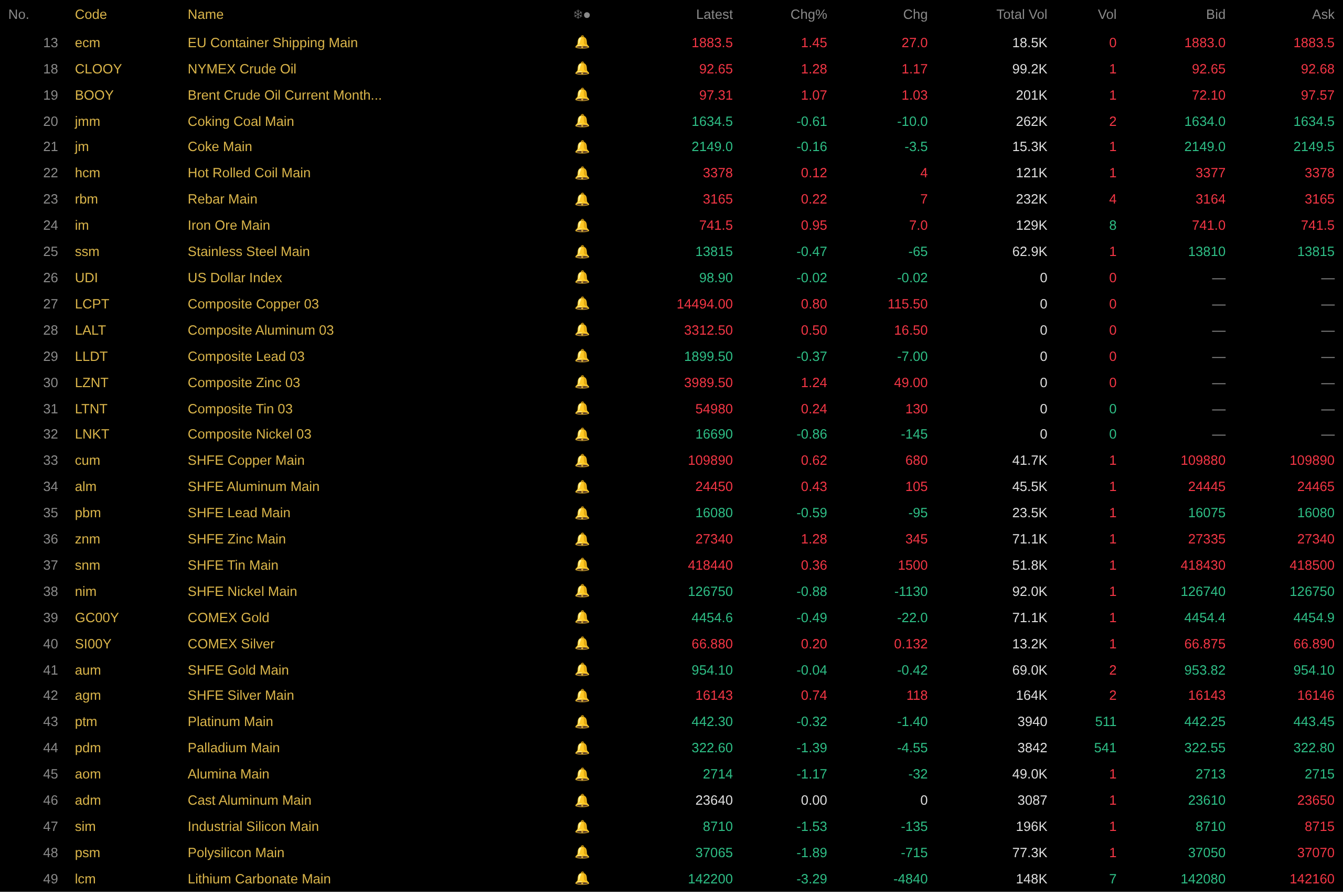
Overnight, base metals in both the overseas market and China showed mixed performance. Both LME zinc and SHFE zinc rose by more than 1%, with LME zinc up 1.24% and SHFE zinc up 1.28%. During the session, LME zinc hit an intraday high of $3,998/mt, setting a new high since May 2022; SHFE zinc reached an intraday high of 27,385 yuan/mt, also a new high since May 2022. LME copper rose 0.8%, and SHFE copper rose 0.62%. LME nickel fell 0.86%, and SHFE nickel fell 0.88%, while % changes in other metals were relatively small. The main alumina contract fell 1.17%, and the main casting aluminum contract was flat at 23,640 yuan/mt.
Ferrous metals showed mixed performance: stainless steel fell 0.47%, iron ore rose 0.95%, and gains in rebar and hot-rolled coil fluctuated slightly. For coking coal and coke, coking coal fell 0.61% and coke fell 0.16%.
Overnight precious metals: COMEX gold fell 0.55% overnight, while COMEX silver rose 0.1%. In China, SHFE gold fell 0.04% and SHFE silver rose 0.74%.
Overnight closing market as of 6:41 on September 8:
Macro front
China:
[Two ministries: Further standardize automakers’ management of supplier payment terms] On September 7, the Ministry of Industry and Information Technology and the State Administration for Market Regulation jointly issued the Notice on Promoting Automakers to Standardize Supplier Payables Payments and Optimize Payment-Term Management. This was the first payment-term management document issued at the national level for an industry sector, and a key measure related to building the industrial ecosystem. The Notice set out requirements in five areas regarding automakers’ payments of supplier payables. These included further standardizing the start date for calculating payment terms, clarifying that payment terms shall be calculated from the date on which suppliers deliver goods, projects, and services and such deliveries pass acceptance; further standardizing acceptance procedures, requiring that after automakers receive goods, projects, and services, production materials such as general parts shall generally be accepted within 3 working days, and functional parts that require vehicle-installation verification shall be accepted within 5 working days; and further standardizing payment methods, encouraging cash payments and prohibiting forcing, or coercing in disguised form, suppliers to accept non-cash payment methods such as bank acceptance drafts, commercial acceptance drafts, and supply-chain notes. (CCTV News)
[SAMR: Deepen quality breakthroughs, overcome technical bottlenecks, and resolve a batch of “chokepoint” quality issues constraining the development of the power battery industry] On the morning of September 4, the special meeting “Strengthening the Quality Chain to Build a New Ecosystem for the Power Battery Industry” of the 2026 World Power Battery Conference was held in Yibin, Sichuan Province. Liu Min, Chief Engineer of the State Administration for Market Regulation, attended the meeting and delivered a speech. The meeting noted that the global competitive landscape of the power battery industry is undergoing profound adjustments, technological innovation and iteration are accelerating, and the restructuring trend of industry and supply chains is evident. It is necessary to deepen quality breakthroughs, overcome technological bottlenecks, and resolve a number of "chokepoint" quality issues constraining the development of the power battery industry. Enterprises should be encouraged to increase R&D investment, apply advanced quality management methods, ensure stable and reliable product performance, and enhance the resilience and security of industry and supply chains. It is necessary to strengthen the leading role of standards, consolidate the foundation of the industry, promote alignment and mutual recognition of domestic and international standards, upgrade from passive compliance with standards to proactively leading standards, enhance the voice and influence of Chinese standards on the international stage, and drive high-quality development with high standards. It is necessary to jointly build an ecosystem and promote coordinated development, with the government, enterprises, industry associations, and research institutions each performing their respective roles and working closely together to build an open, inclusive, mutually beneficial, and win-win new industry ecosystem through multi-party collaboration. (Jin10 Data APP)
[DCE: Notice on Adjusting the Price Limit Range and Trading Margin Levels of Iron Ore Futures Contracts]The DCE issued a notice on adjusting the price limit range and trading margin levels of iron ore futures contracts. According to the Risk Management Measures of the Dalian Commodity Exchange, after study and decision: Starting from the settlement on September 9, 2026 (Wednesday), the price limit range of iron ore futures contracts will be adjusted from 9% to 6%, and the trading margin level will be adjusted from 11% to 8%. For contracts that simultaneously meet the relevant provisions of the Risk Management Measures of the Dalian Commodity Exchange on adjusting the price limit range and trading margin, the price limit range and trading margin shall be implemented according to the larger of the prescribed values. All member units are requested to provide risk warnings to clients, strengthen market risk prevention, and ensure the stable operation of the market. (Jin10 Data APP)
US dollar:
As of the overnight close, the US dollar index fell 0.23% to 98.92. According to the CME "FedWatch": The probability that the US Fed will keep interest rates unchanged by September is 39.6%, and the probability of a cumulative 25 basis point rate hike is 60.4%. The probability that the US Fed will keep interest rates unchanged by October is 29.1%, the probability of a cumulative 25 basis point rate hike is 54.9%, and the probability of a cumulative 50 basis point rate hike is 16.1%. (Jin10 Data APP)
The unexpectedly strong US August non-farm payrolls data is significantly changing market judgment on the US Fed's September policy. UBS believes that the market fluctuations brought about by the repricing of interest rate expectations may instead provide opportunities for investors to adjust asset allocation. August non-farm payrolls increased by 162,000, far above market expectations of 55,000, while the unemployment rate held at 4.1%. This was the strongest monthly jobs gain since March. After the jobs report was released, traders priced in a roughly 60% probability that the FOMC would raise rates by 25 basis points at its September 15-16 meeting. UBS said the key is not just whether the US Fed hikes at its next meeting, but the economic reasons behind the hike. A team of strategists led by Mark Haefele, chief investment officer at UBS Global Wealth Management, noted that there is a fundamental difference in the impact on portfolios between the US Fed hiking because of a strengthening economy and hiking because of inflationary pressures. "There is a fundamental difference between the US Fed acting because the US economy is strengthening and the US Fed acting because of inflation concerns. For portfolios, that distinction matters far more than the next policy meeting," he said. (Jin10 Data)
In other currencies:
Driven by strong corporate earnings and a tight labour market, Japanese workers' nominal wage growth hit its fastest pace in nearly 30 years. Data released by Japan's Ministry of Labour on Tuesday showed nominal wages rose 4.7% YoY in July, up from a revised 4% in June. That was the largest increase since 1997, far exceeding economists' forecast of 3.8%, and marked the sixth consecutive month of gains above 3%, the longest streak in 34 years. Real wages, adjusted for inflation excluding rent, grew 2.4%, the biggest increase in nearly five years. Base pay also rose 4.1%, while real wages for full-time employees, a more stable measure that strips out bonuses, overtime pay and sampling bias, grew 2.7%. The stronger-than-expected economic data further reinforced market expectations that the Bank of Japan will raise rates this month. Markets have largely priced in a rate hike at next week's central bank meeting, with some investors even expecting further monetary tightening after a relatively short interval. (Jin10 Data APP)
Japan's economy grew faster in Q2 than previously estimated, further reinforcing the widely held expectation that the Bank of Japan will raise rates next week. A report released by Japan's Cabinet Office on Tuesday showed Q2 GDP grew at an annualised rate of 1.4%, up from the previous estimate of 1.1%. However, the result was below economists' median forecast of 1.8%. This supports the Bank of Japan's assessment that the economy is developing broadly in line with its expectations, and reinforces the need for the central bank to raise rates at its next policy meeting on September 18. (Jin10 Data APP)
On the macro front:
Today will see the release of China's August trade balance (TBD), China's August imports YoY (TBD), China's August total imports and exports (TBD), the US August NFIB Small Business Optimism Index, the US August New York Fed 1-year inflation expectations, Japan's July trade balance, Germany's July seasonally adjusted trade balance, and France's July trade balance, among other data.
On the crude oil front:
As of the overnight close, oil prices rose across both benchmarks, with WTI up 1.33% and Brent up 1.07%. The market continues to closely watch developments in the geopolitical tensions between the US and Iran.
On the 7th local time, Iranian Foreign Ministry spokesman Baghaei said that negotiations between Iran and Oman on delineating a safe maritime passage through the Strait of Hormuz have made significant substantive progress. Although some third-party forces have attempted to obstruct and interfere, causing the talks to hit hurdles on several occasions, the consultations between the two countries have now entered the final stage. On August 25, Iran and Oman issued a joint statement saying they plan to establish a mutually agreed safe maritime passage in the Strait of Hormuz. (CCTV News)(Jin10 Data APP)
Kerstin Hottner, head of commodities at Swiss bank Vontobel, said that approximately 7 million barrels per day of global refining capacity is currently offline. Of that, 1.5 million barrels per day of refining capacity in Asia has been affected because Asian countries are receiving insufficient crude oil supplies. Russia has 3.5 million barrels per day of refining capacity affected. In the Middle East, about 2 million barrels per day of refining capacity is idled. Hottner estimates that, including supply losses in the Gulf region, about 15% of global diesel exports have disappeared. As a result, inventories are falling rapidly. According to Bloomberg data, US diesel inventories have fallen to their lowest level on record relative to the typical inventory level at the end of August. Consequently, US diesel retail prices rose to a record high last Friday. (Jin10 Data APP)
South Africa's economy is expected to end its longest streak of quarterly growth in nearly a decade, as the Iran conflict dampened domestic demand and key industries accounting for nearly one-fifth of GDP contracted. The median estimate of 14 economists surveyed by institutions shows that Q2 GDP likely contracted 0.1%, compared with a 0.5% expansion in the previous quarter. Unlike Q1, which only reflected the initial impact of the Iran war that began on February 28, Q2 fully incorporated the shock of the conflict. Fighting persisted throughout the quarter, pushing up Brent crude oil and agricultural input prices, while traffic through the Strait of Hormuz—a critical waterway for about one-fifth of global seaborne oil and liquefied natural gas supplies—was restricted. Retail and wholesale trade sales were also under pressure in Q2, with retail sales growing only 0.4% and wholesale trade declining 4.2%. Uncertainty from the war may also dampen gross capital formation levels. Economist John Loos said sentiment indicators are not showing an optimistic trend, with numerous surveys pointing to war-related uncertainty, and investment is likely to remain subdued, driven more by uncertainty and interest rate trends than structural issues, and this situation may persist. (Jin10 Data APP)
![Metals broadly rose, LME copper hit a record high, SHFE zinc gained over 2%, SHFE silver, SHFE copper, and coking coal rose more than 1% [SMM midday comment]](https://imgqn.smm.cn/usercenter/VCNvX20251217171735.jpeg)