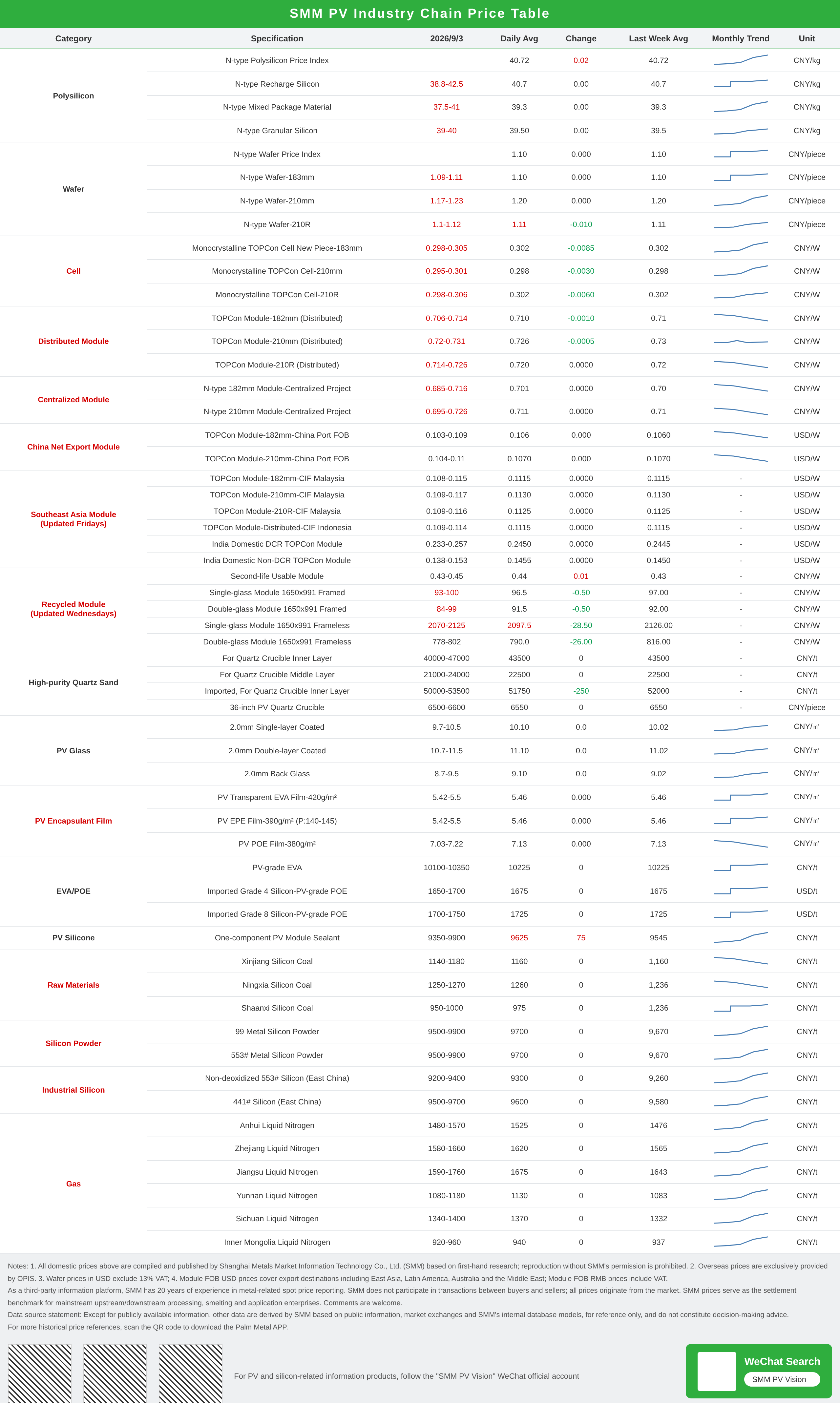
Polysilicon: This week, the polysilicon price index stood at 40.72 yuan/kg, with N-type recharging polysilicon quoted at 38.8-42.5 yuan/kg and granular polysilicon at 39-40 yuan/kg. Market quotations remained broadly stable this week, with no large-volume transactions concluded and relevant meetings still ongoing. This week, inspections entered Inner Mongolia, Xinjiang, and other regions. Another self-organized meeting took place on Saturday, further fueling a wait-and-see sentiment in the market. Currently, top-tier players' quotations remain costly for downstream acceptance, downstream sentiment is subdued, and overall trading activity is sluggish.
Wafer: Wafer prices extended their slight decline this week, with N-type 183 wafers at 1.089-1.114 yuan/piece, 210R wafers at 1.096-1.119 yuan/piece, and 210mm wafers at 1.174-1.232 yuan/piece. On the cost side, upstream polysilicon prices remained relatively firm, providing some floor support for wafer prices but with limited strength. On the supply side, wafer production in September edged up MoM, with output still exceeding downstream demand, keeping supply pressure in place. Some traders were eager to offload previously stockpiled inventory, further intensifying downward price pressure. On the demand side, the Chinese market remained persistently weak. Although stockpiling in India and re-export demand lent some support to the export market, it was insufficient to fully offset the negative impact of weak domestic demand. Wafer prices are expected to continue drifting lower in the short term.
Solar cell: This week, the overall solar cell market remained subdued, with prices across most sizes edging down slightly. Price divergence between upstream and downstream widened, and early signs of inventory buildup emerged in the futures market, pushing the market into a consolidating, tug-of-war phase on a subdued note. This week, TOPCon prices across all sizes moved lower in tandem, with the overall market under pressure. The 210R price range was adjusted to 0.298-0.306 yuan/W, 183 to 0.298-0.305 yuan/W, and 210N was lowered to 0.295-0.301 yuan/W. Mainstream quotations from solar cell plants are currently concentrated at 0.3-0.31 yuan/W, but downstream module makers are aggressively pushing for lower prices, with procurement expectations continuing to drift lower and strong resistance to high-price transactions. At this stage, orders below 0.30 yuan/W generally face cash losses, leaving solar cell plants reluctant to take orders. The tug-of-war between upstream and downstream is pronounced, overall trading is sluggish, and prices are expected to consolidate on a subdued note in the near term. In September, industry-wide production schedules are expected to pull back slightly, with capacity adjustments showing clear divergence among manufacturers. Some specialized solar cell plants have brought new production lines online after line conversions, ramping up production modestly and adding incremental growth. However, large integrated players have cut production more significantly due to weak demand and other factors, resulting in a slight contraction in overall industry supply for September after offsetting effects. This week, the pace of industry shipments slowed noticeably, and early signs of inventory buildup began to emerge. Traders' purchase enthusiasm continued to cool, compounded by strong wait-and-see sentiment and cautious procurement among domestic module makers. Solar cell destocking slowed, inventory pressure became more evident, and fundamental support weakened, further constraining the room for futures price recovery.
China modules: Recently, guidance prices from distributed enterprises have remained largely unchanged. The earlier decline in some transaction prices did occur, but it mainly compressed the lower end of the quotation range and has not yet spread to the overall industry center. On the centralized side, there have been few projects exceeding 1 GW in scale recently, and the market is focused on delivering existing orders. The cost side shows a two-way offset: solar cells remain weak, but auxiliary material prices have begun to rebound, and silver prices have also risen somewhat recently, further increasing costs for integrated enterprises. Regarding the short-term price outlook, SMM believes that barring policy impacts, module prices will likely consolidate in the doldrums, with little chance of a trending move in the near term. As of now, the average price of domestic Topcon modules - 182mm (distributed) is 0.71 yuan/W; Topcon modules - 210mm (distributed) average 0.7255 yuan/W; Topcon modules - 210R (distributed) average 0.72 yuan/W; Topcon modules - 210R high power (distributed) average 0.76 yuan/W; BC modules - 210R (distributed) average 0.764 yuan/W; HJT modules - 210mm (distributed) average 0.7355 yuan/W. On the centralized side, 182mm module prices are 0.7005 yuan/W, 210mm module prices are 0.7105 yuan/W, and 210R module prices are 0.708 yuan/W. In terms of inventory, China module inventory edged down this week. As transaction prices dipped slightly, buyers who had previously been highly resistant began to make purchases.
Module FOB exports:
This week, module FOB prices remained generally stable, with overseas demand yet to show clear improvement. Entering September, the European market has gradually ended its summer break and resumed project advancement and procurement, with demand recovery expected to take another one to two weeks. By product, distributed BC small-format modules saw a slight price increase this week, supported by relatively limited supply; TOPCon product quotations remained mostly stable. If overseas demand gradually recovers, part of the earlier price increases may be transmitted to actual transactions. Currently, extremely low-priced orders in the market have decreased, and enterprise quotations are stabilizing, but a rebound in transaction prices still requires support from end-use demand. As of today, PV module export FOB prices are: TOPCon 182mm modules at $0.103-0.109/W, 210mm modules at $0.104-0.110/W, and 210R modules at $0.104-0.109/W; TOPCon high-power 210R modules at $0.111-0.117/W; BC 210R (66/72-cell) modules at $0.116-0.125/W, and BC 54-cell modules at $0.131-0.142/W.
Module CIF Southeast Asia:
This week, the Southeast Asian module market continued last week's trend, with limited price fluctuations and a slight rebound in inquiry activity, but actual transactions remained limited, with buyers and sellers still in a price negotiation phase.
As of today, the CIF prices for TOPCon modules in Southeast Asian markets are as follows: In Malaysia, the CIF price for 182mm modules is $0.108–0.115/W, for 210mm modules $0.109–0.117/W, and for 210R modules $0.109–0.116/W. In Indonesia, the CIF price for distributed TOPCon modules is $0.109–0.114/W. In Thailand, the CIF price for 182mm modules is $0.107–0.115/W, for 210mm modules $0.108–0.116/W, and for 210R modules $0.108–0.116/W. In Vietnam, the CIF price for 182mm modules is $0.106–0.112/W, for 210mm modules $0.107–0.113/W, and for 210R modules $0.107–0.113/W.
By region, Malaysia completed the LSS 6 project briefing this week and is expected to launch the tender soon, with attention needed on how project progress translates into module procurement demand. Indonesia's specific quotas have not yet been finalized, and project procurement still awaits further clarification. In Thailand, a policy transition gap of about two months is expected between the advancement of TISI certification and the implementation of mandatory requirements. Certification applications and factory audits have already begun, but the statutory effective date for mandatory requirements on imports, production, and sales has not yet been finalized. According to SMM, some small and medium-sized producers have already obtained certification, while enterprises with multiple production sites may face a relatively longer certification cycle due to more audit procedures and coordination work.
India modules: This week, the Indian module market continued its divergent trend. Driven by producers' willingness to raise prices, both DCR and non-DCR module prices edged up slightly, but the actual increase was limited. As of today, the price of India-made DCR TOPCon modules is $0.233–0.257/W, and non-DCR TOPCon modules are $0.138–0.153/W. In terms of production, India's DCR module production in August was about 2 GW, and solar cell production was about 2.11 GW. In terms of shipments, the extension of the exemption period for some projects under ALMM List II continued to divert some DCR module demand, and domestic solar cell demand was also constrained, with sustained inventory digestion pressure. As of today, India's DCR module inventory is about 13.37 GW, and solar cell inventory is about 4.45 GW.
Europe modules: This week, the European market gradually ended its summer break, and project advancement and procurement activities are expected to recover gradually, with market attention shifting to demand release from remaining projects within the year. Some producers raised quotes for the distributed market, driving a slight increase in prices for small-format modules; prices for standard-format and centralized modules remained generally stable as end-use demand has yet to pick up significantly. As of today, DDP EXW TOPCon module prices at the Rotterdam warehouse are as follows: distributed 210R (48-cell) modules at EUR0.1102–0.1189/W, distributed 210R (66/72-cell) modules at EUR0.1012–0.1115/W; centralized 210R (66/72-cell) modules at EUR0.0993–0.1087/W, and centralized 210mm (66/72-cell) modules at EUR0.0997–0.1093/W. Based on average prices by format, warehouse prices in Portugal and Greece are approximately 2.2%–2.4% and 2.0%–2.4% higher than Rotterdam, respectively.
Terminal: This week, PV modules showed stable prices with increasing volumes. According to SMM statistics, from August 24 to August 30, 2026, Chinese enterprises won bids for 38 PV module projects, with a single-week weighted average price of 0.70 yuan/W, unchanged from the previous statistical period; total awarded procurement capacity was 1,216.62 MW, an increase of 895.78 MW from the previous statistical period.
According to SMM analysis, the main awarded capacity in the current statistical period fell within the 500 MW–1,000 MW range, accounting for 59.40% of the total disclosed awarded capacity. The specifics by capacity range are as follows:
The 0 MW–1 MW section had 3 projects, accounting for 0.11% of capacity, with an average price of 0.830 yuan/W;
the 1 MW–6 MW section had 7 projects, accounting for 1.57% of capacity, with an average price of 0.808 yuan/W;
the 6 MW–50 MW section had 6 projects, accounting for 10.73% of capacity, with an average price of 0.708 yuan/W;
the 50 MW–100 MW section had 2 projects, accounting for 13.23% of capacity, with an average price of 0.670 yuan/W;
the 100 MW–200 MW section had 1 project, accounting for 14.96% of capacity, with an average price of 0.689 yuan/W;
the 500 MW–1,000 MW section had 1 project, accounting for 59.40% of capacity, with an average price of 0.698 yuan/W.
According to SMM analysis, the weighted average price in the current statistical period was 0.70 yuan/W, unchanged from last week.
In terms of total awarded procurement capacity, the week recorded 1,216.62 MW, an increase of 895.78 MW from the previous statistical period.
In terms of regional distribution, the region with the highest awarded capacity this week was the Inner Mongolia Autonomous Region, accounting for 59.91% of the total capacity, followed by Hubei Province at 15.09% of the total.
Key awarded information during the statistical period (August 24 to August 30):
In the "Inner Mongolia Jungar Banner Guangzhihyuan 600MW PV Project PV Module Equipment" tender, Hongyuan Green Energy Co., Ltd. won the bid for 722.61 MW of PV modules at an average price of 0.698 yuan/W.
In the "Xinxia Shashi District Guanyindang (Phase I) 140MW Fishery-Solar Hybrid PV Project PV Modules" of CEWUD Energy Construction Investment (Hubei) Co., Ltd., Jinko Solar Co., Ltd. won the bid for 182.03MW of PV modules at an average price of 0.689 yuan/W.
PV glass: This week, PV glass continued its upward trend. As of September 3, the average price of 3.2mm double-layer coating was 17.30 yuan/m2, up 0.15 yuan/m2 from 17.15 yuan/m2 last week; the average price of 2.0mm double-layer coating was 11.10 yuan/m2, up 0.30 yuan/m2 from 10.80 yuan/m2 last week. This increase was driven by the supply side rather than a demand recovery. SMM statistics show that domestic kiln production cuts recently totaled 3,400 mt/day, while another 2,400 mt/day of kiln capacity is planned for cold repair, accounting for nearly 10% of total capacity. Meanwhile, inventory has also declined by 1-2 days recently, supporting the price increase. For the subsequent price outlook, prices still have a basis for further gains, but sustainability will depend on whether module scheduled production can follow through, the pace of kiln production resumptions, and the speed of inventory destocking.
Film: This week, film price range was 26,800-27,200 yuan/mt, with film market prices holding steady. The new round of monthly film pricing for September has been settled, remaining flat with August pricing; on the cost side, upstream EVA resin prices have remained stable recently, providing cost support for film; on the demand side, downstream module operating rates in September are expected to see limited changes, with procurement demand for film continuing a mild trend. Overall, film prices are expected to remain largely stable in the short term.
EVA: This week, spot prices of PV-grade EVA resin were 10,100-10,350 yuan/mt, with resin prices moving sideways. On the cost side, ethylene prices are still rising, providing some cost support for resin; on the supply side, PV-grade production schedules remain relatively high, and pressure from future supply releases persists, but recent conversion at a major plant has reduced PV output compared with the original plan, easing supply pressure to some extent. On the demand side, module scheduled production changes are limited, and just-in-time procurement by film producers is providing a floor for the market. In addition, foaming-grade prices continue to rise due to tight supply and are expected to approach PV-grade levels next week; attention should be paid to whether the narrowing price spread between the two triggers adjustments in enterprise production schedules.
POE: POE delivered prices in China were 12,000-12,500 yuan/mt, edging up slightly. On the cost side, ethylene and olefin raw material price centers have recently risen, driving POE production costs higher, and some producers have made slight upward adjustments to their quotes. On the supply side, new domestic capacity continues to be released, and imported cargoes are arriving normally, but the output pace of PV-grade qualified grades remains differentiated. On the demand side, although there is some just-in-time procurement, downstream acceptance of POE price increases remains limited. Overall, the current price rise lacks momentum, and PV POE resin prices are expected to continue to consolidate.
High-purity quartz sand: This week, quartz sand prices remained generally stable. Current market quotes are as follows: inner-layer sand at 40,000-47,000 yuan/mt, middle-layer sand at 21,000-24,000 yuan/mt, outer-layer sand at 13,000-18,000 yuan/mt, and imported sand spot orders at 50,000-54,000 yuan/mt. For crucibles, 33-inch crucibles are priced at 5,500-5,700 yuan/piece, and 36-inch crucibles at 6,500-6,600 yuan/piece. Quartz sand prices held steady this week. As crucible prices pulled back again, high-durability crucibles have approached the cost line, dampening production enthusiasm. Q4 is expected to see notable production cuts by quartz sand and crucible enterprises, with oversupply pressure easing significantly.
Module recycling: Last week, China's PV module recycling market prices edged lower.
Early small-format framed modules fell by around 0.5 yuan/piece, with first-hand single-glass prices landing in the 95-112 yuan/piece range. Frameless modules dropped by 26-28 yuan/mt, with first-hand single-glass prices in the 2,070-2,125 yuan/piece range. Besides early small-size modules, large-format prices also pulled back, with framed module prices down around 0.5 yuan/piece and frameless modules down around 21-23 yuan/mt.
The price decline was mainly driven by lower spot prices of key recycled metals. Last week, spot silver drifted lower, while aluminum prices continued to consolidate at highs. According to SMM, the #1 silver spot price fell from 16,789 yuan/kg on August 26 to 15,398 yuan/kg on September 2. A00 aluminum prices stayed high and consolidated, rising from 23,870 yuan/mt on August 26 to 24,080 yuan/mt on September 2.


![Social inventory of silicon metal in major regions edged down WoW [SMM silicon inventory]](https://imgqn.smm.cn/usercenter/OGmeJ20251217171722.jpeg)
![[SMM Chromium Flash] South Africa's July Ferrochrome Exports Fall 20.8% MoM as Global Glut Risk Weighs on China Demand](https://imgqn.smm.cn/usercenter/UhBXJ20251217171724.jpeg)
![[SMM Chromium Flash] South Africa's July Chrome Ore Exports Hit 2026 High of 2.65 Mt as Buyer Base Broadens](https://imgqn.smm.cn/usercenter/eThpo20251217171723.jpeg)