SMM, September 1:
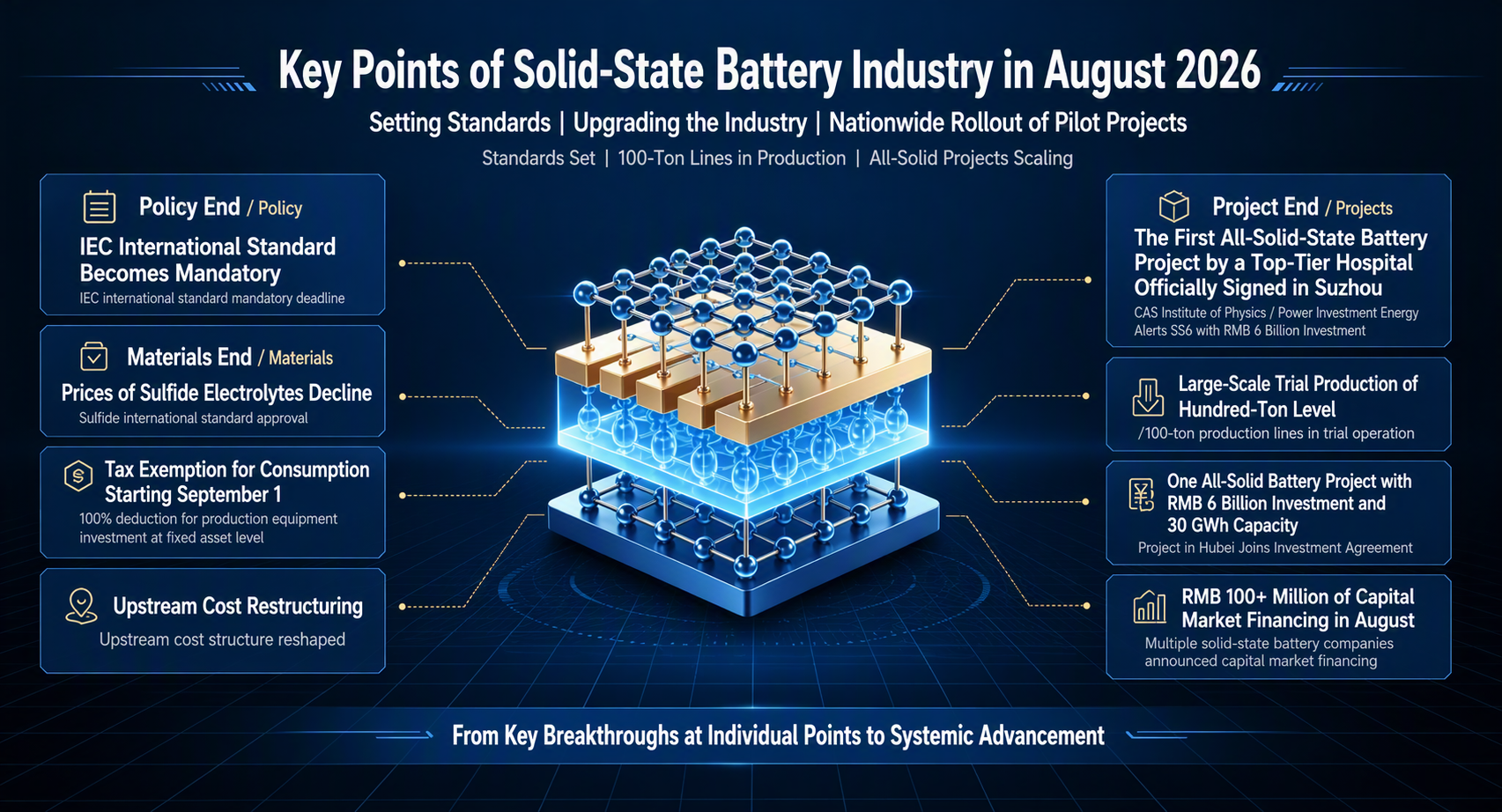
Key points: In August 2026, the solid-state battery industry reached a critical period marked by multiple converging signals. On the policy front, the world's first international standard for solid-state batteries was successfully initiated at the IEC, and with the consumption tax exemption officially taking effect on September 1, the institutional framework has been upgraded from a "national standard" to an "international benchmark." On the materials front, sulphide electrolyte prices continued to decline, and 100-mt-scale production lines entered trial production, with upstream cost restructuring clearing obstacles for industrialisation. On the project front, the Institute of Physics at the Chinese Academy of Sciences signed an agreement for a prismatic all-solid-state battery project in Suzhou, Tuoyi Gune broke ground on a 6 billion yuan, 30 GWh project, and Xinjie Energy secured over $100 million in financing, with capital and capacity resonating in tandem. In August, the solid-state battery sector exhibited three defining characteristics: "standards set the tone, 100-mt-scale production lines came online in concentrated fashion, and all-solid-state projects accelerated their rollout." The industry is shifting from "isolated breakthroughs" to "systematic advancement."
Introduction: Material price analysis
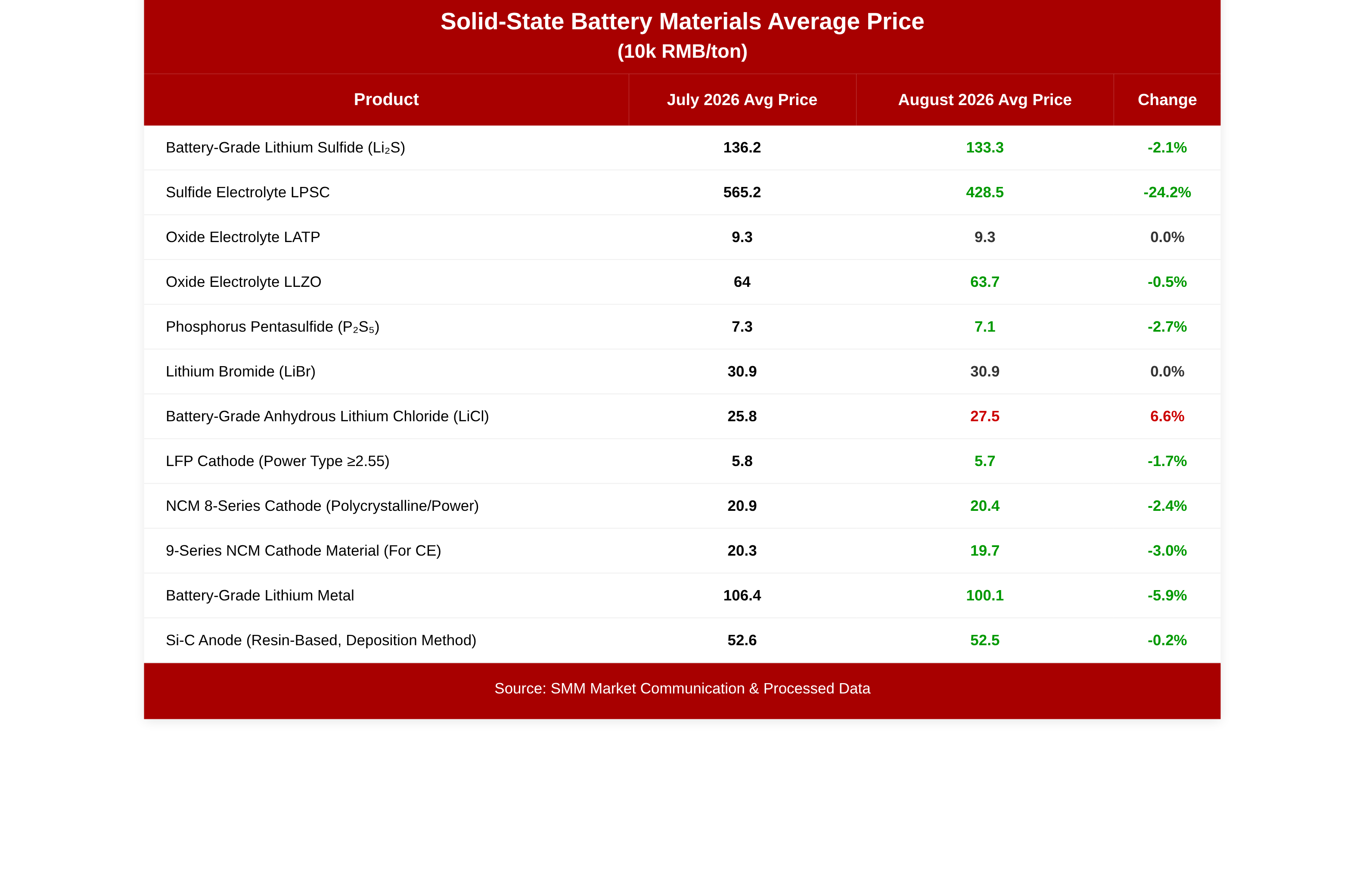
In August 2026, prices of solid-state battery-related materials were generally on a downward trend , with only battery-grade anhydrous lithium chloride (LiCl) bucking the trend with a 6.6% increase, which was related to the phased tightening of upstream lithium concentrates and lithium chloride supply. The largest decline was seen in the sulphide electrolyte LPSC, down 24.2% MoM, mainly affected by expectations of cost reduction in the sulphide technology route and a slowdown in downstream procurement.
The average price of 9-series ternary cathode material (consumer electronics-grade) in August was 197,000 yuan/mt, down 3.0% MoM, a decline slightly greater than that of the 8-series (-2.4%), reflecting that high-nickel consumer electronics-grade cathodes were under more pronounced price pressure amid weak end-use demand. Battery-grade lithium metal fell 5.9%, extending its downward trend. Other products such as LFP and silicon carbon anode saw relatively small fluctuations, with declines within 2% or basically flat.
Overall, the solid-state battery materials market in August was dominated by consolidation on a weak note, with high-nickel cathodes and sulphide electrolytes leading the declines, while lithium chloride became one of the few rising products due to supply-side disruptions.
I. Solid-state battery materials
1.1 Electrolytes
In August, upstream material prices for solid-state batteries continued to show structural divergence. The price of the sulphide electrolyte LPSC (Li₆PS₅Cl) gradually pulled back from 4,400 yuan/kg to 4,300 yuan/kg, with a weekly decline of approximately 2.27%; battery-grade lithium sulphide was quoted at approximately 1,320 yuan/kg, down only 0.8% MoM, with the decline clearly narrowing, suggesting that prices are searching for a phased bottom. The oxide electrolyte LLZO held steady at 638 yuan/kg, and LATP remained at 93 yuan/kg, having been flat for several consecutive weeks.
The core logic behind the price divergence lies in differences in supply pace: the sulphide route is on the eve of concentrated 100-mt-scale capacity release—Tinci's 100-mt-scale production line is expected to enter trial production in Q3, with economies of scale driving the price center lower; the oxide process is more mature and has a more stable competitive landscape, and has already been the first to hit bottom.
Capacity construction: Tinci Materials' 100 mt-class lithium sulphide (50 mt/year) and sulphide solid-state electrolyte (100 mt/year) pilot lines have been fully completed, with trial production starting in Q3. Sinocera has built an automated sulphide solid-state electrolyte production line, initially establishing mass production capability. Tianqi Lithium's 50 mt/year lithium sulphide pilot project is under construction and expected to be completed in H2, and preparation of argyrodite-type sulphide electrolyte has achieved production with most steps outside glove boxes. Ronbay Technology's Xiantao 10 mt/year solid-state electrolyte project has completed EIA public consultation, with an investment of 50 million yuan. Dalian Institute of Chemical Physics' high-performance solid-state battery core materials pilot platform has completed EIA public consultation, with a total investment of 55 million yuan and planned annual production of 5 mt of solid-state electrolyte materials.
Technology breakthroughs: Zhejiang University's Tu Jiangping and Zhong Yu team reported in Nature Communications a kg-scale liquid-phase suspension synthesis platform, with prepared LSPS₀.₄₅ achieving room-temperature ionic conductivity as high as 5.42 mS·cm⁻¹. A Lanzhou University undergraduate team developed oxynitride-halide solid-state electrolyte LZCONx, which can be simultaneously compatible with 4V-class LCO cathodes and low-voltage Li₁₃Si₄ anodes.
1.2 Cathode
Easpring Technology has cumulatively shipped 50 mt of all-solid-state cathode materials, passing tests by multiple top-tier all-solid-state battery players and initiating vehicle validation; dual-phase composite solid-state cathode materials have achieved stable monthly shipments of over 100 mt. Ronbay Technology expects solid-state cathode material market demand to approach 100 mt this year, with small-batch production starting in 2027. GEM has partnered with Professor Sun Xueliang's team, a fellow of the Canadian Academy of Engineering and Royal Society of Canada, to establish a joint laboratory for solid-state battery cathode materials. Canmax's subsidiary Jiangsu Yili has officially launched its solid-state battery cathode material mass production line, with planned annual capacity of 10kt of high-nickel ternary cathode materials.
1.3 Anode
Yibin Intelligent Solid-State Battery Innovation Center (Tsinghua University Professor Zhang Qiang's team) has achieved a leap in composite lithium anode materials from gram-scale lab trials to kg-scale roll-to-roll preparation, capable of boosting energy density to 400-500Wh/kg, primarily targeting low-altitude economy and embodied AI scenarios. PTL's silicon carbon anode and lithium metal anode products can be applied in solid-state/solid-liquid battery fields, and the company has delivered dry-process and solid-state battery electrode equipment to top-tier clients in China and overseas, with cumulative related orders exceeding 200 million yuan. Dowstone Technology's silicon carbon anode has achieved large-scale production capability, with 300 mt capacity gradually reaching full production.
1.4 Other materials
Shenzhen Senior Technology Material has entered a strategic partnership with Reasolid New Material to jointly develop high-performance solid electrolyte membranes, with the "Gurui" series compatible with semi-solid-state, quasi-solid-state, and all-solid-state routes. Crown has completed client sample trials of solid-state battery aluminum laminated film, with significantly improved high-temperature resistance. Chitwing has strategically positioned itself in solid-state battery materials, planning to build a 5,000 mt/year high-purity lithium sulphide production site.
II. Solid-state battery technology
2.1 Technology breakthroughs
In August, the most notable technology developments came from both basic research and applied engineering.
On the basic research front,a joint team from Stanford University and SLAC National Accelerator Laboratory published a study in Nature, showing that applying planar biaxial mechanical compressive stress to garnet-type solid-state electrolytes can force lithium dendrites to shift from vertical penetration to lateral spreading, preventing them from connecting the positive and negative electrodes. The compressed battery remained stable for thousands of cycles even with extensive dendrite formation internally. Using synchrotron X-rays, the team confirmed for the first time that dendrites originate from nanoscale defects at the junctions between internal pores and grain boundaries in the electrolyte, ending years of debate and suggesting that “bulk defect control + cell pre-stressed packaging” could become a second battleground beyond material formulation.
Academician Sun Xueliang’s team published an analytical article in Nature Energy, systematically revealing for the first time that the electronic conductivity of mainstream inorganic solid-state electrolytes is generally in the range of 10⁻⁸–10⁻⁹ S/cm, 6–7 orders of magnitude higher than that of commercial polymer separators (10⁻¹⁵–10⁻¹⁸ S/cm). When the electrolyte thickness is reduced from 1,000μm to 20μm, the capacity loss of a battery after one month of storage soars from 3.9% to 94.5%.
Baima Lake Laboratory adopted a boride electrolyte routeand developed a solid-state battery capable of stable operation across a wide temperature range from -20°C to 120°C, with an energy density of 400Wh/kg and a cycle life exceeding 2,000 cycles.
On the applied engineering front,Topology Advanced Manufacturing successfully passed nail penetration testing with a 20Ah sulphide all-solid-state battery cell produced using its proprietary equipment and processes, using a 4mm steel needle (stricter than the 3mm upper limit in Chinese military standards) to penetrate the cell, with the needle left in place for one hour of observation and zero thermal runaway throughout. Greater Bay Technology completed nail penetration testing of its self-developed all-solid-state battery cell in accordance with the new national standard GB38031-2025, with the 40Ah cell continuing to power an external LED sign after penetration. Zhongke Yuanben completed real-vehicle road testing of its sulphide all-solid-state battery pack, marking the first publicly reported vehicle installation case in China.
2.2 Product progress
Ganfeng Lithium achieved small-batch mass production of the world’s first 500Wh/kg-class 10Ah product, with its 400Wh/kg battery surpassing 1,100 cycles and completing engineering validation. Farasis Energy disclosed for the first time the technical parameters of two generations of sulphide all-solid-state technology: the first generation at 400Wh/kg (high-nickel ternary + high-silicon anode), and the second generation at 500Wh/kg (lithium-rich manganese-based/high-nickel ternary + lithium metal anode). Sunwoda’s 0.2GWh solid-state battery sample line was fully connected, with pilot production to begin within the year, and its 320Wh/kg and 360Wh/kg semi-solid-state batteries have already achieved small-batch mass production. Gotion High-tech’s Jinshi all-solid-state battery successfully passed multiple authoritative safety tests, and the mass production line design has been completed. EVE’s “Longquan No. 3” and “Longquan No. 4” all-solid-state batteries were successfully rolled off the line, with a capacity of 60Ah and a focus on the EV sector. Jinlongyu’s 20Ah all-solid-state pouch battery passed third-party performance testing, with an energy density of 400Wh/kg.
III. Solid-state battery projects
In August, solid-state battery projects were launched intensively, exhibiting three major characteristics: “large projects breaking ground, concentrated delivery of pilot lines, and regional clustering.”
3.1 All-solid-state battery projects
The Institute of Physics of the Chinese Academy of Sciences signed an agreement in Suzhou for an advanced prismatic all-solid-state battery industrialisation project, with the first phase occupying 219 mu of industrial land in Suzhou Industrial Park and Researcher Li Hong serving as project leader. The project adopts a polymer-oxide composite route (oxygen-polymer all-solid-state), focusing on five key processes: dry electrode, solid-state processing, pre-lithiation, interfacial thermal bonding, and central liquid-cooled cells, with target product energy density of 400-600Wh/kg. The first phase includes a 0.2GWh cell pilot line and a 4GWh PACK production line, aiming to achieve mass production within two years. The project adopts a dual-site model of “R&D and pilot production in the industrial park, large-scale manufacturing in Wuzhong.”
Tuoyi GUneng commenced construction of its 30 GWh solid-state battery project in Inner Mongolia on August 13, with a total investment of RMB6 billion. Located in Hohhot, the project covers a total area of 1,000 mu and is being developed in three phases, each with an investment of RMB2 billion and an annual production capacity of 10 GWh of solid-state battery production lines. Phase I occupies approximately 371 mu and is scheduled for construction from June 2026 to June 2028.
Shen'an Lithium Energy's Shaoxing smart manufacturing production site involves an investment of approximately RMB200 million to build a 500 MWh high-standard battery cell production line, with a planned annual output value of RMB1 billion.
3.2 Pilot line and R&D platform
The Sichuan Advanced Battery Innovation Center (a key platform under Yibin's "Jiangyuan Initiative") is scheduled for delivery by month-end August, with a total building area of over 8,600 m² and a total investment of RMB210 million. Phase I will establish two battery cell small-scale test lines, and Phase II will build a 0.2 GWh battery cell pilot line.
Yibin has established six high-level solid-state battery R&D platforms, covering different technology routes including composite lithium anode (Zhang Qiang from Tsinghua University), sulphide electrolyte (Ouyang Minggao workstation), cathode material and battery cell (Chen Jun from Nankai University), electrolyte (Cui Guanglei from the Chinese Academy of Sciences), cathode material (Su Yuefeng from Beijing Institute of Technology), and lithium-rich manganese-based cathode material (Wei Haijun from Beijing University of Technology).
The Dalian Institute of Chemical Physics has published an environmental impact assessment for its high-performance solid-state battery core material pilot platform, with a total investment of RMB55 million. The platform is planned to produce 50 mt of high-energy-density cathode material, 5 mt of solid-state electrolyte material, and 10 mt of high-capacity composite anode material annually.
3.3 Equipment segment
Lyric has completed delivery and achieved phased acceptance of an all-solid-state battery full-line project for a leading automaker client, marking a leap from laboratory technology to pilot-line production. It has also received orders for key solid-state battery equipment and pilot lines from two leading battery clients. UW Laser's all-solid-state battery assembly line has been delivered to a leading client and entered trial production. PTL has delivered dry-process and solid-state battery electrode equipment to leading clients in China and overseas, with cumulative related orders exceeding RMB200 million.
IV. Solid-state battery financing and cooperation
In August, financing activity in the solid-state battery sector continued to heat up, with multiple large financing rounds completed.
Xinjie Energycompleted a Series B round exceeding $100 million (approximately RMB670 million), led by Puhua Capital. The funds will be used for the mass production of lithium metal solid-state batteries and the addition of a 3 GWh solid-state battery production line, which is expected to commence production from the end of 2026 to early 2027. Currently, Phase I of the 10 GWh solid-state lithium metal battery project in Hangzhou, with a capacity of 2 GWh, has already entered production, and construction of a new 3 GWh production site in east China has begun.
SEVC POWERcompleted a Series A round of several hundred million yuan, co-led by SEVC Investment and CICC Capital, with participation from Dingfeng Sci-Tech Innovation, Qihang Investment, and others. The financing will be used for the construction of a solid-state electrolyte material pilot production line and R&D of all-solid-state battery technology.
WELION New Energyis advancing a RMB2 billion Pre-IPO financing round, with a pre-money valuation of RMB20 billion, targeting a listing on the ChiNext board.
Ruizhi New Energycompleted a Pre-A+ round of tens of millions of yuan, exclusively invested by Shanghai Chenyao Yichuang Investment Fund (jointly established by Shanghai Guotou Sci-Tech Innovation and Yixing Jingfa). The funds will be used for capacity expansion at its Yixing base.
Guxin Energycompleted a financing round of RMB100 million, led by Toukong Donghai, with participation from Jianyuan Fund.
In terms of cooperation, GSP Dongchi signed a strategic cooperation framework agreement with CNNC Huineng to jointly promote the deployment of solid-liquid hybrid batteries in wind and solar power supporting energy storage and industrial and commercial ESS scenarios. CESI, JD.com, and Sunwoda signed an agreement to jointly build a robot battery joint laboratory, focusing on robot battery standard development and product development. Tianneng Battery and WELION New Energy jointly produced semi-solid-state 314Ah battery cells, achieving large-scale batch delivery and taking the lead in grid-side ESS deployment.
V. Overseas Progress in Solid-State Batteries
In August, overseas solid-state battery enterprises entered a critical phase of engineering validation. In 2026, the all-solid-state battery industry entered the engineering validation stage, with Toyota, Honda, Nissan, Samsung SDI, and other producers making slightly ahead progress in small-scale trial production, and Japanese automotive-grade products have been verified and confirmed on some performance indicators.
Solid Power reported H1 revenue of $2.805 million, with the continuous electrolyte trial production line construction progressing as planned, and continued to advance cooperation with Samsung SDI, BMW, SK On, and others. The company plans to establish a joint venture in South Korea, planning a sulphide solid-state electrolyte production site with a maximum capacity of 20,000 mt/year, with initial facility scale of approximately 500 mt, targeting the announcement of partnership relationships within 2026.
QuantumScape reported H1 client revenue of $21.8 million, already exceeding the full-year 2025 level; GAAP net loss was $199 million. The company reorganized into three business groups: QSEV (automotive), QSDC (AI data center), and QSAS (advanced solutions). All-solid-state lithium metal batteries have shipped QSE-5 battery cells to major US national defense contractors, and a new cooperation was established with Honda.
Factorial Energy secured its first commercial battery order in Q2 (aerospace sector) and entered into a strategic cooperation with Tulip Tech to advance commercial deployment of solid-state batteries for drones.
LG Energy Solution announced it will establish an all-solid-state battery pilot line using dry electrode processes in H2.
Overseas performance diverged significantly: domestic material suppliers benefited from price rebounds with substantial profit growth (Tinci Materials +over 900%), while overseas startups remained mired in losses (QuantumScape H1 net loss of $199 million).
VI. Industry Voices on Solid-State Batteries
The summit set the tone of "oxide first, sulphide delayed." The 6th Global Solid-State Battery Annual Summit was held in Chicago, US in August, where the industry formed a clear consensus: oxide electrolytes will be prioritized for deployment in the next 2-3 years, while mass production of sulphide all-solid-state batteries will be delayed to 2028-2030.
In terms of enterprise voices, Sunwoda's Liang Rui stated that the industry has entered a stage of "real skill" competition, and the company will not engage in price wars. Gotion High-tech's Zhou Fu said that battery consumption tax adjustments will accelerate industry reshuffle, and the tax exemption window for solid-state batteries will amplify first-mover technological advantages.
VII. Solid-State Battery Policies and Regulations
In August, the policy landscape saw milestone progress.
International standards:The international standard proposal "Secondary lithium-ion batteries for EV propulsion - Application guidelines, test items and conditions for solid-state batteries" proposed by China was successfully approved by IEC, becoming the world's first international standard in the solid-state battery field, with experts from France, South Korea, Japan, and other countries participating in its development. This standard will form a dual-layer system of "national standard + international standard" with the national standard GB/T 43568-2026, which officially took effect on July 1.
Consumption tax policy:Announcement No. 20 of 2026 from the Ministry of Finance, the General Administration of Customs, and the State Taxation Administration shows that lithium-ion batteries will be subject to a 2% consumption tax from September 1, rising to 4% from September 1, 2027; sodium-ion batteries, solid-state batteries, and fuel cells are exempt until December 31, 2028. To enjoy the exemption, products must comply with corresponding national standards, and a testing report issued by a CMA-accredited testing institution confirming compliance with national standards must be obtained before the first declaration. The State Taxation Administration further clarified that semi-solid-state batteries and hybrid battery cell products that do not meet the standards are not eligible for tax exemption. This policy is interpreted by the industry as using tax leverage to provide targeted support for solid-state and other new technology routes, accelerating the exit of tail-end capacity.
Summary: In August 2026, the solid-state battery industry accelerated simultaneously across four dimensions: standards, materials, projects, and capital. The approval of the international standard and the consumption tax exemption cleared institutional obstacles for industrialisation; the concentrated commissioning of hundred-tonne-scale sulphide electrolyte production lines drove upstream cost restructuring; landmark projects such as the Institute of Physics, CAS prismatic all-solid-state project and Tuoyi Gufeng's 30GWh project commenced construction, marking that all-solid-state batteries are moving from the laboratory to large-scale production. The industry has formed a consensus on the technical pace of "oxide first, sulphide delayed," and 2026-2027 will be a critical window for pilot line deployment and vehicle installation validation.
SMM Solid-State Battery Conference Attendee List (Partial)
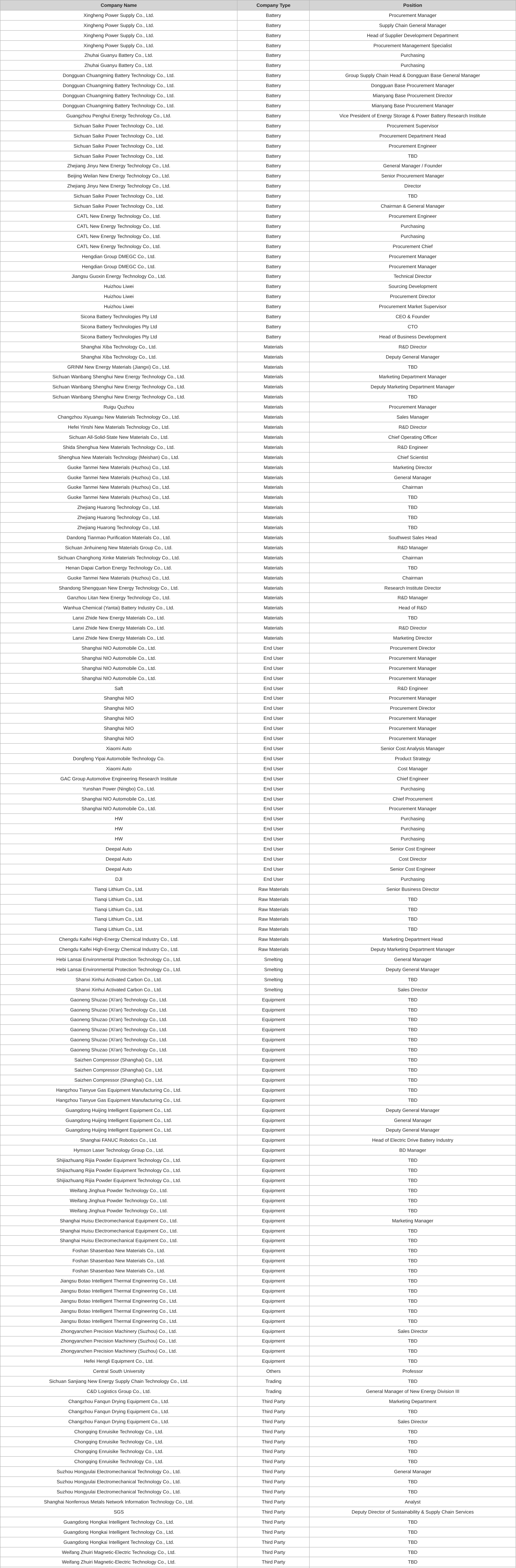
Note: If you have any additional details to share regarding the content mentioned in this article or are interested in following the development of solid-state batteries, please feel free to contact us as follows:
Tel: 021-20707860 (or add WeChat 13585549799) Yang Chaoxing, thank you!

Related Reading
![[SMM Analysis] Domestic Ternary Cathode Production Schedules for September Cut Significantly](https://imgqn.smm.cn/usercenter/JMINH20251217171728.jpg)
![[Solid-State Battery: Tianneng Co., Ltd. Achieves Scaled Delivery of Semi-Solid-State 314Ah Battery Cells, with Tiered Breakthroughs Across Multiple Technology Systems]](https://imgqn.smm.cn/usercenter/JmyWy20251217171729.png)