On August 31, 2026, the Service Survey Center of the National Bureau of Statistics (NBS) and the China Federation of Logistics and Purchasing released China's PMI. In response, Huo Lihui, chief statistician of the Service Survey Center of the National Bureau of Statistics, provided an interpretation. In August, the manufacturing PMI was 49.8%, up 0.6 percentage points from the previous month, with the prosperity level rebounding; the non-manufacturing business activity index was 49.0%, unchanged from the previous month; and the composite PMI output index was 49.5%, up 0.2 percentage points from the previous month, indicating that the overall output prosperity level of China's economy improved somewhat.
China's PMI Performance in August 2026
I. Performance of China's Manufacturing PMI
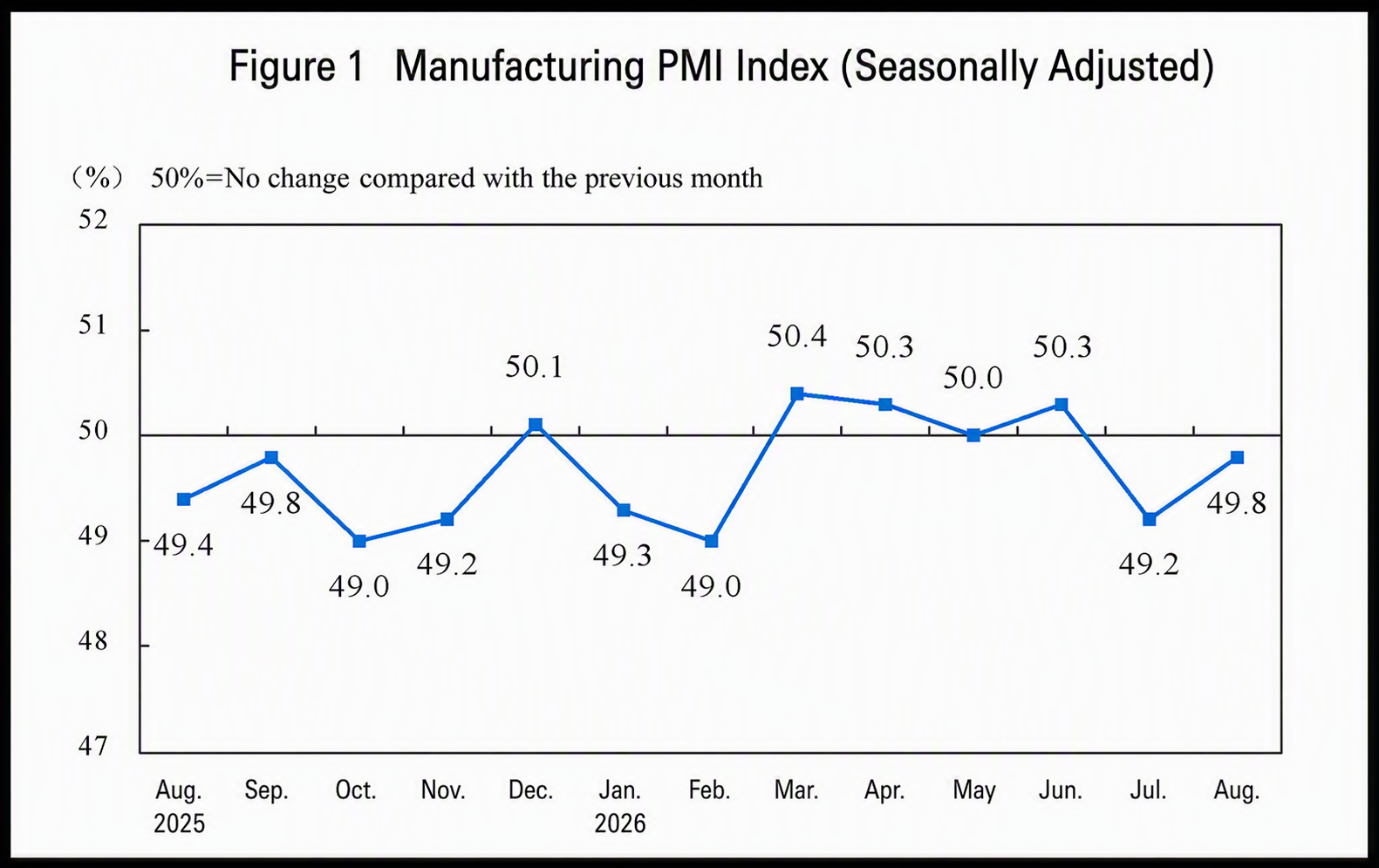
In August, the manufacturing PMI was 49.8%, up 0.6 percentage points from the previous month, with the prosperity level rebounding.
By enterprise size, the PMI for large enterprises was 50.6%, up 1.1 percentage points from the previous month and above the threshold; the PMI for medium-sized enterprises was 49.4%, down 0.3 percentage points from the previous month and below the threshold; and the PMI for small enterprises was 47.9%, up 0.5 percentage points from the previous month and below the threshold.
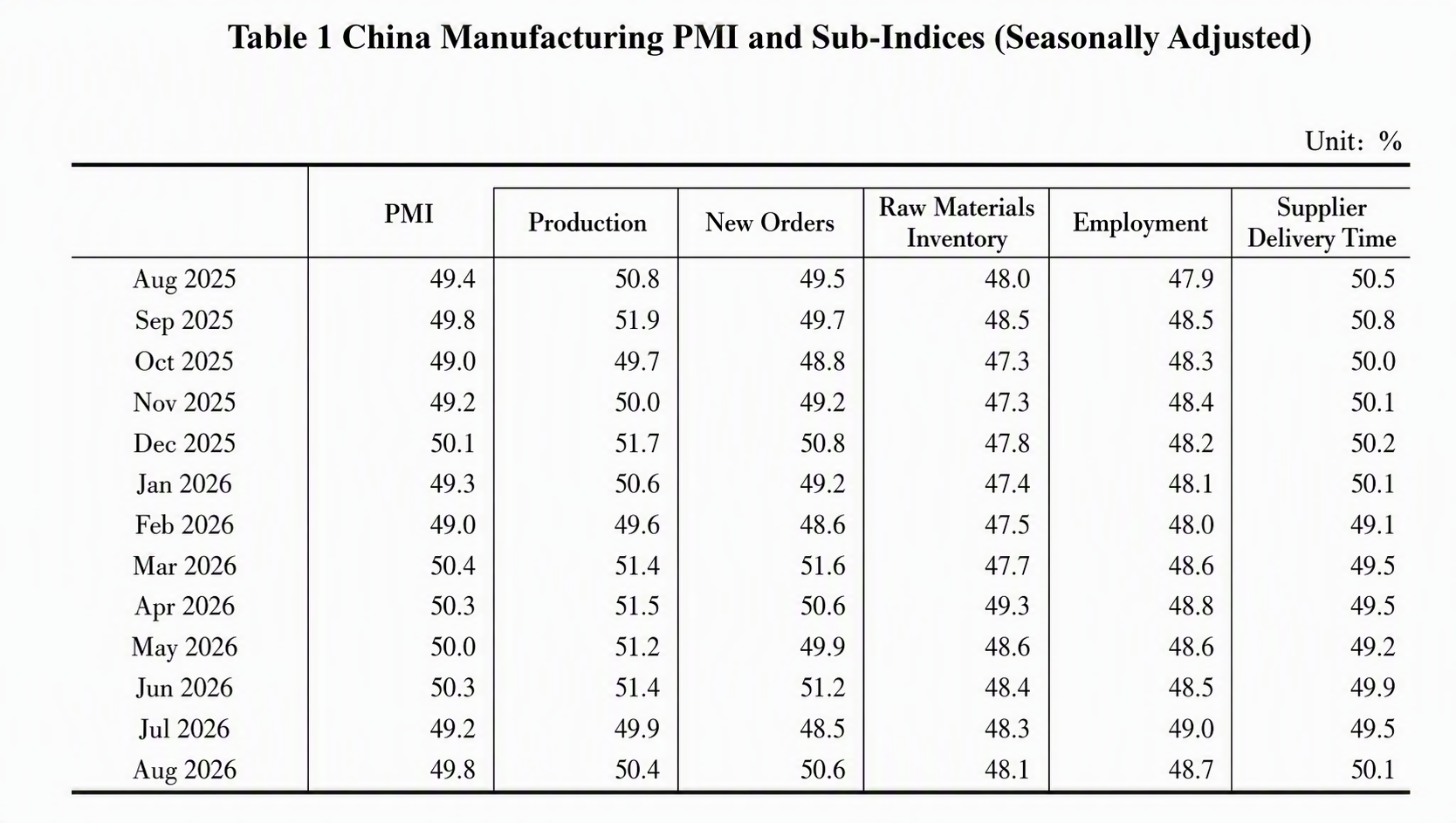
Among the five sub-indices that constitute the manufacturing PMI, the production index, new orders index, and supplier delivery time index were all above the threshold, while the raw material inventory index and employment index were below the threshold.
The production index was 50.4%, up 0.5 percentage points from the previous month, indicating that manufacturing production activity accelerated somewhat.
The new orders index was 50.6%, up 2.1 percentage points from the previous month, indicating that market demand in the manufacturing sector improved notably.
The raw material inventory index was 48.1%, down 0.2 percentage points from the previous month, indicating that inventory levels of major raw materials in manufacturing continued to decline.
The employment index was 48.7%, down 0.3 percentage points from the previous month, indicating that the employment climate at manufacturing enterprises pulled back somewhat.
The supplier delivery time index was 50.1%, up 0.6 percentage points from the previous month, indicating that delivery times for raw material suppliers in manufacturing were faster.
II. Performance of China's Non-Manufacturing PMI
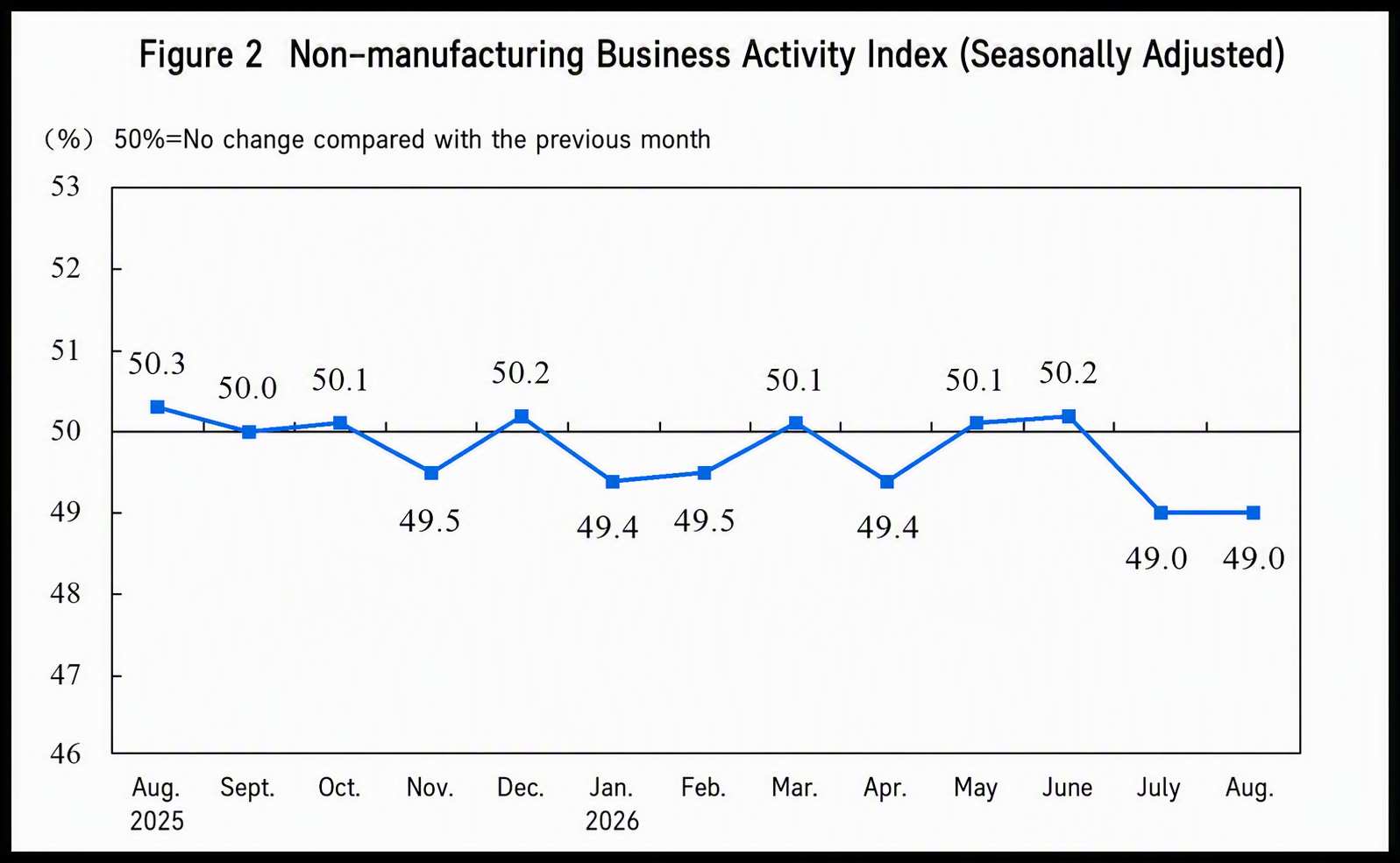
In August, the non-manufacturing business activity index was 49.0%, unchanged from the previous month.
By sector, the construction business activity index was 46.9%, down 0.1 percentage points from the previous month; the services business activity index was 49.3%, unchanged from the previous month. Within the services sector, the business activity indices for postal services, telecommunications, broadcasting and satellite transmission services, Internet software and information technology services, and other industries were all in the relatively high prosperity range above 55.0%, while the business activity indices for wholesale, retail, and capital market services and other industries were all below the threshold.
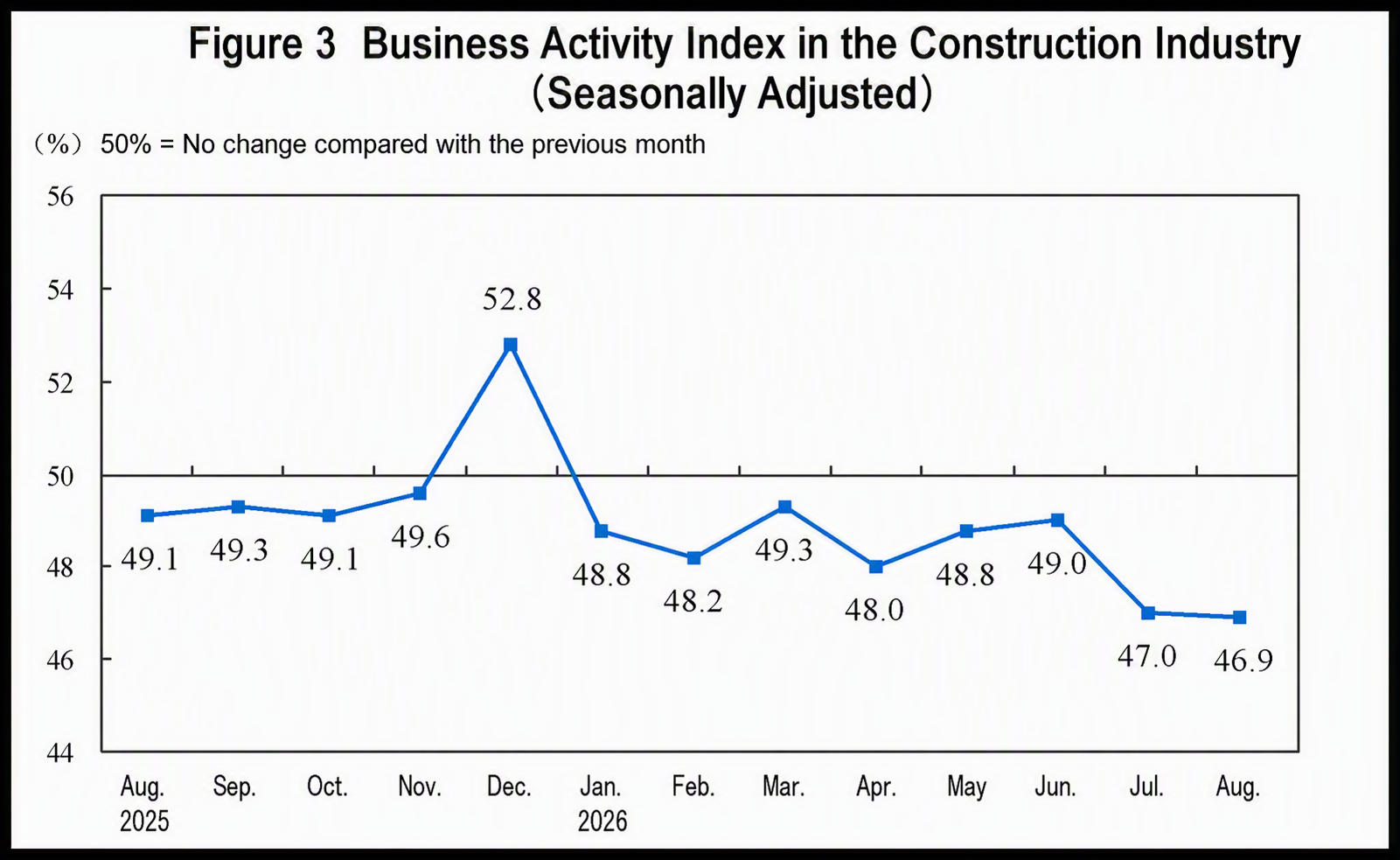
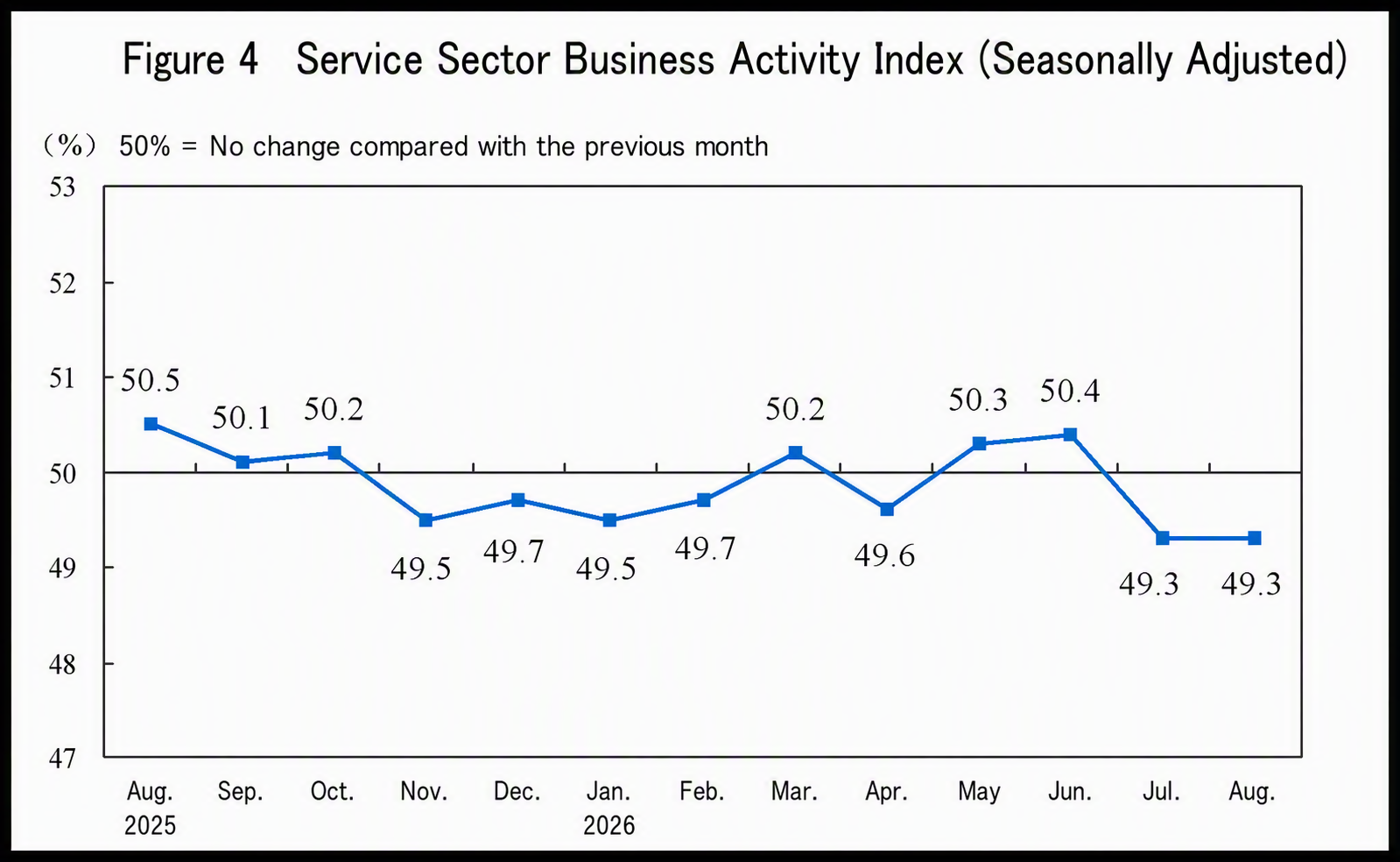
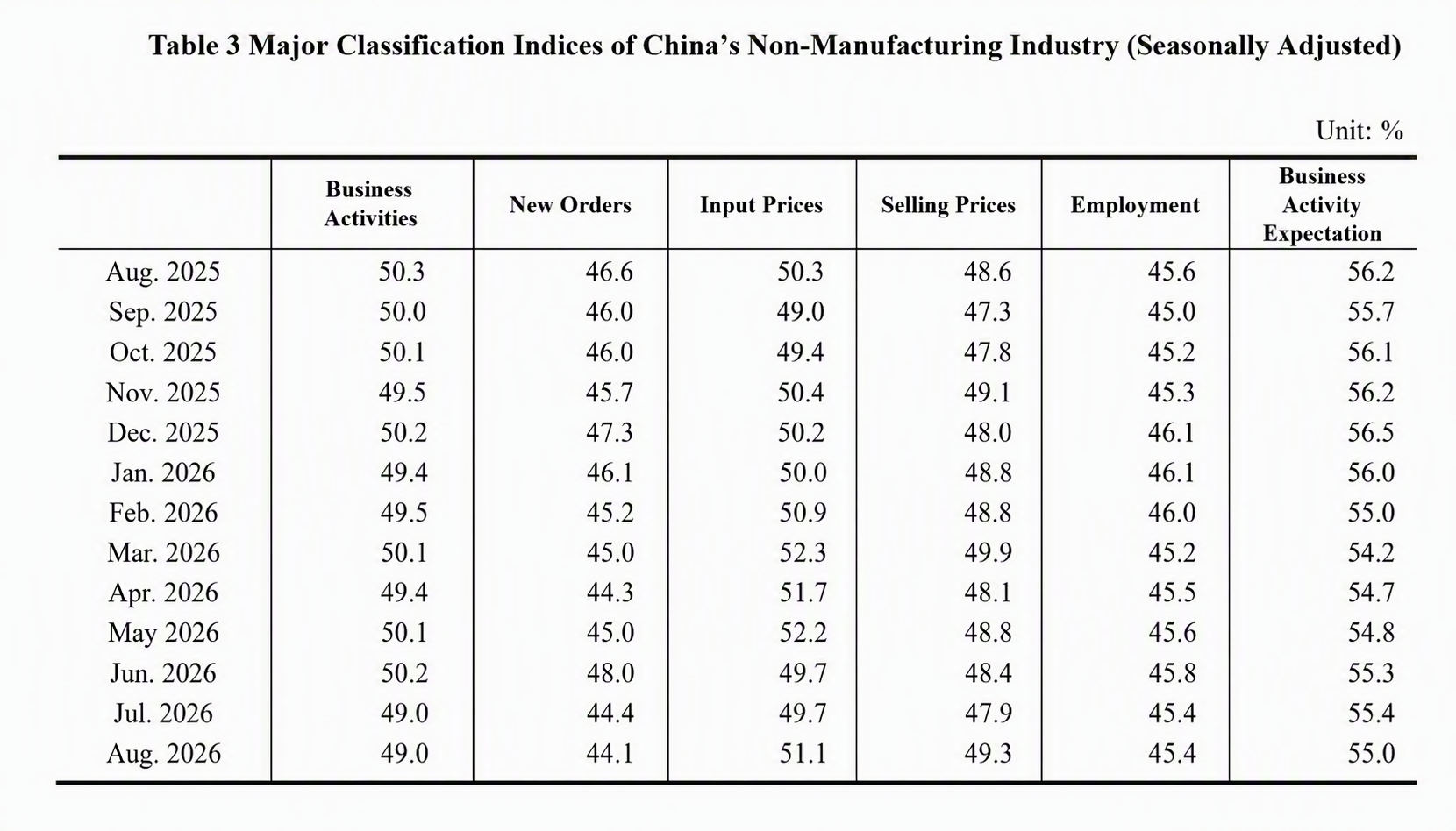
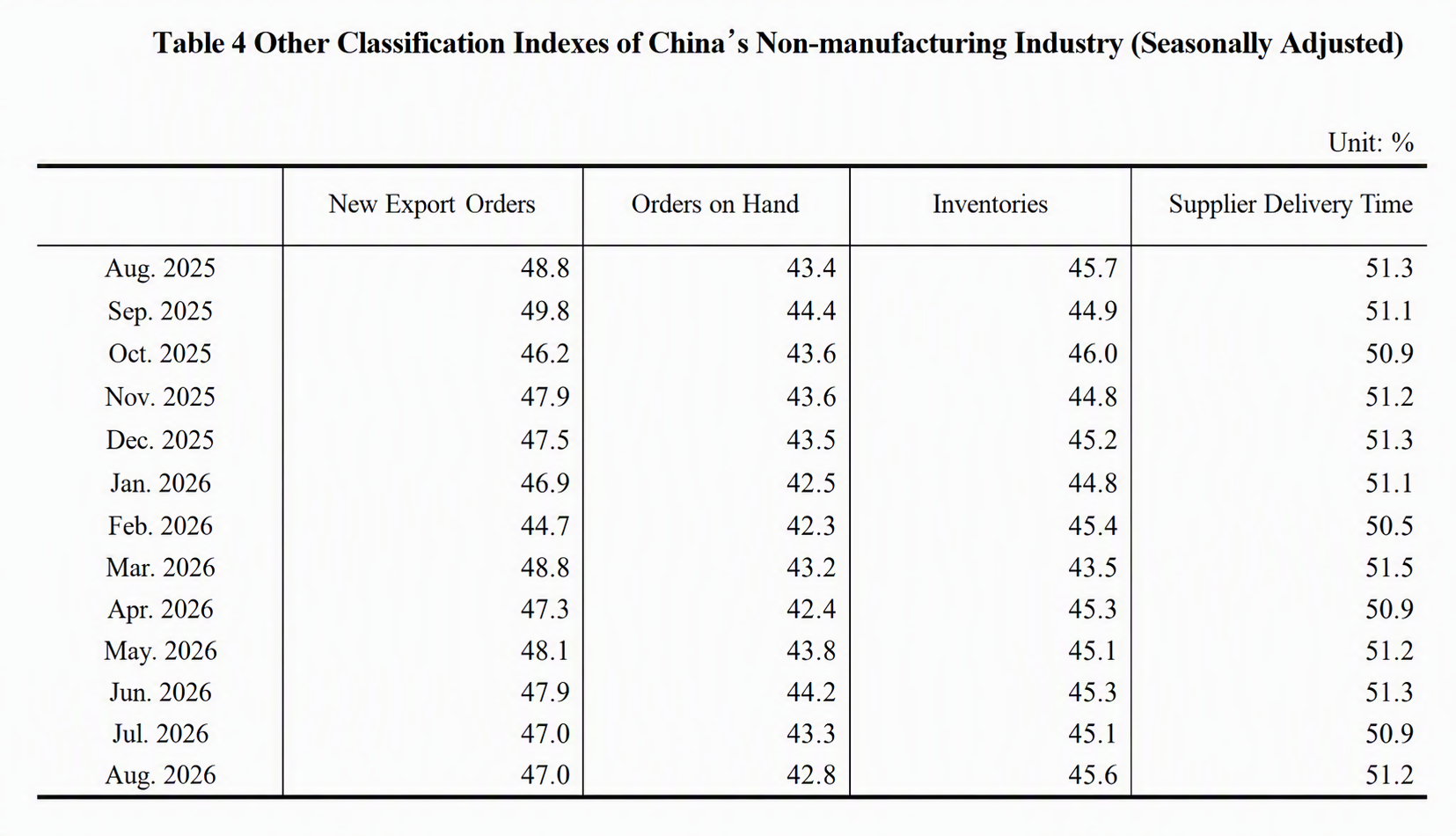
The New Orders Index stood at 44.1%, down 0.3 percentage points from the previous month, indicating that non-manufacturing market demand conditions weakened somewhat. By industry, the Construction New Orders Index stood at 42.4%, up 2.3 percentage points from the previous month; the Services New Orders Index stood at 44.5%, down 0.7 percentage points from the previous month.
The Input Price Index stood at 51.1%, up 1.4 percentage points from the previous month, indicating an overall rebound in input prices used by non-manufacturing enterprises for business activities. By industry, the Construction Input Price Index stood at 51.2%, up 2.5 percentage points from the previous month; the Services Input Price Index stood at 51.1%, up 1.2 percentage points from the previous month.
The Sales Price Index stood at 49.3%, up 1.4 percentage points from the previous month but still below the threshold, indicating that the overall decline in selling prices at non-manufacturing enterprises narrowed. By industry, the Construction Sales Price Index stood at 49.8%, up 2.1 percentage points from the previous month; the Services Sales Price Index stood at 49.2%, up 1.3 percentage points from the previous month.
The Employment Index stood at 45.4%, unchanged from the previous month and below the threshold, indicating that the employment climate at non-manufacturing enterprises remained weak. By industry, the Construction Employment Index stood at 43.0%, up 2.1 percentage points from the previous month; the Services Employment Index stood at 45.8%, down 0.4 percentage points from the previous month.
The Business Activity Expectations Index stood at 55.0%, down 0.4 percentage points from the previous month but still above the threshold, indicating that non-manufacturing enterprises remained optimistic about market development. By industry, the Construction Business Activity Expectations Index stood at 51.8%, unchanged from the previous month; the Services Business Activity Expectations Index stood at 55.5%, down 0.5 percentage points from the previous month.
III. China's Composite PMI Output Index Performance
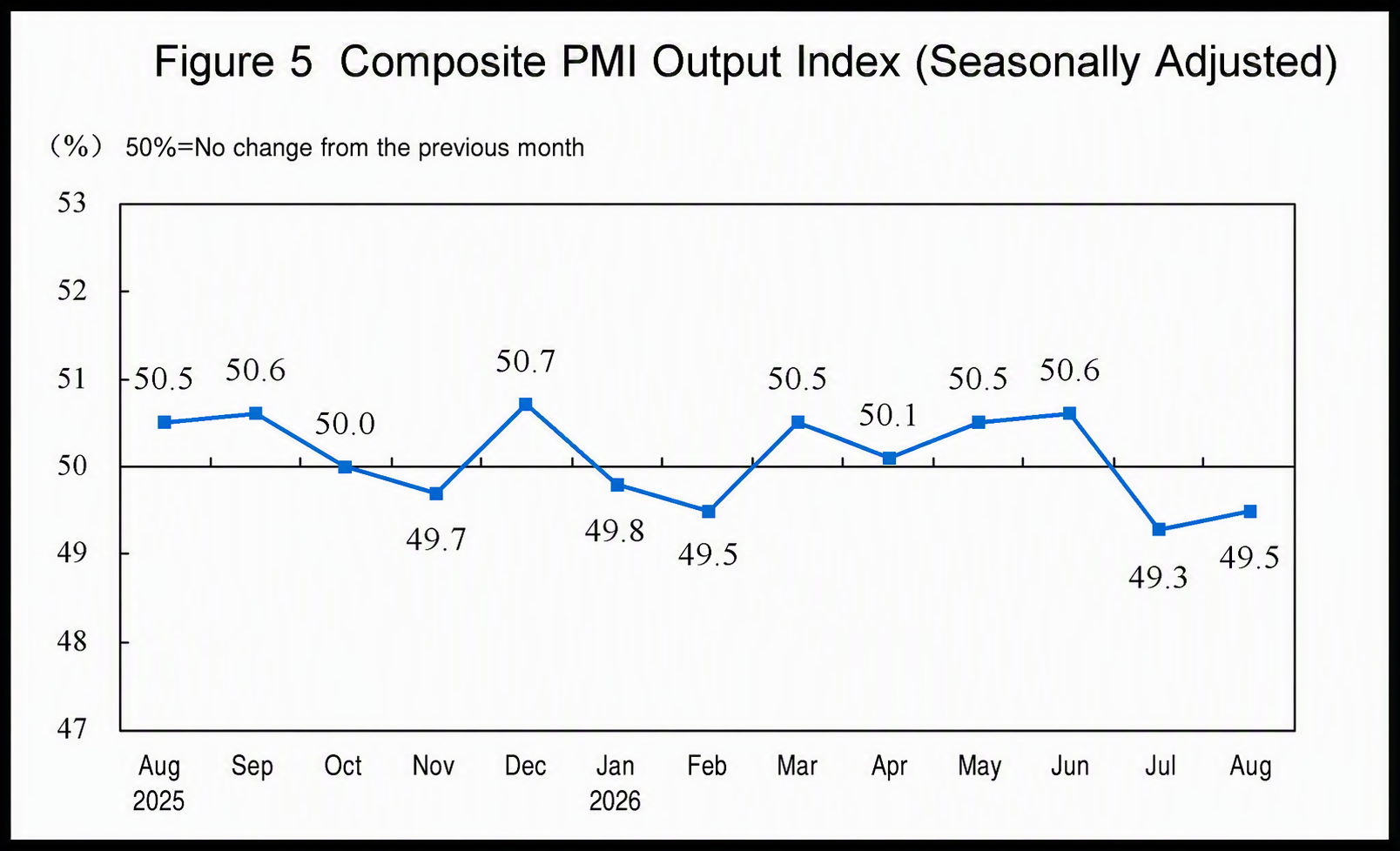
In August, the Composite PMI Output Index stood at 49.5%, up 0.2 percentage points from the previous month, indicating an overall rebound in the production and business activity climate of Chinese enterprises.
Manufacturing PMI Rebounded in August
——Huo Lihui, Chief Statistician of the Service Survey Center of the National Bureau of Statistics (NBS), Interprets China's PMI for August 2026
On August 31, 2026, the NBS Service Survey Center and the China Federation of Logistics and Purchasing released China's PMI. In this regard, Huo Lihui, Chief Statistician of the NBS Service Survey Center, provided an interpretation.
In August, the manufacturing PMI stood at 49.8%, up 0.6 percentage points from the previous month, with the business climate rebounding; the Non-Manufacturing Business Activity Index stood at 49.0%, unchanged from the previous month; the Composite PMI Output Index stood at 49.5%, up 0.2 percentage points from the previous month, and the overall output climate of China's economy improved somewhat.
I. Manufacturing PMI Rebounded
In August, the manufacturing PMI rose to 49.8%. Among the 21 surveyed industries, 16 posted a higher PMI than in the previous month, indicating a notable improvement in the manufacturing business climate.
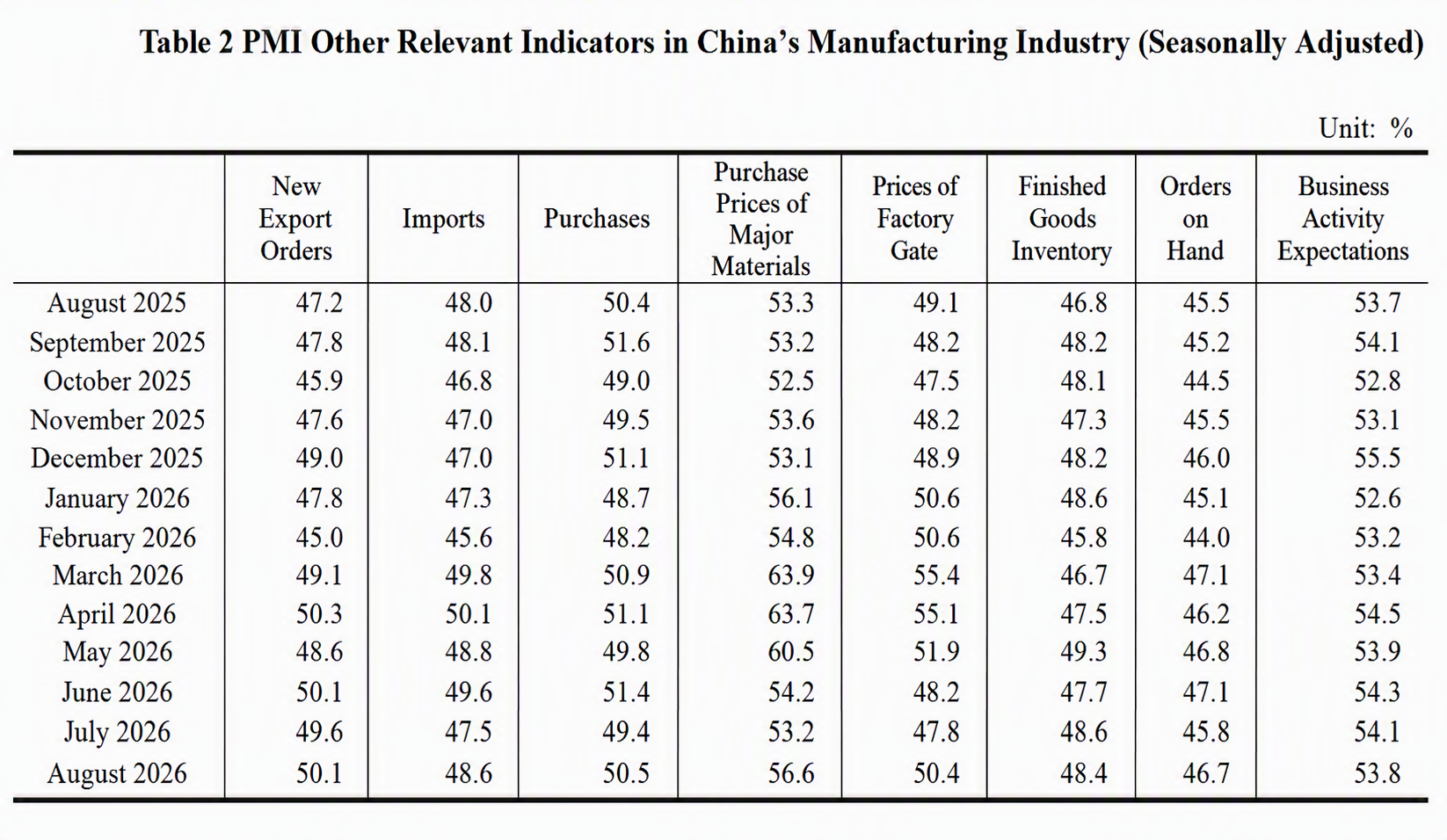
(1) Both production and demand expanded simultaneously. The manufacturing production index and new orders index stood at 50.4% and 50.6%, respectively, up 0.5 and 2.1 percentage points MoM. Both production at manufacturing enterprises and market demand expanded from the previous month. By sector, the production index and new orders index for industries such as electrical machinery and equipment, computer and communication electronic equipment, and others were both above 53.0%, with production and demand released relatively quickly; for industries such as chemical raw materials and chemical products, and ferrous metal smelting and rolling processing, the production index and new orders index were both below the threshold, and market activity was relatively weak. Driven by factors including the rebound in production and demand, enterprises' purchase willingness increased, with the purchasing volume index at 50.5%, up 1.1 percentage points MoM.
(2) The development momentum of new growth drivers continued to improve. The PMI readings for equipment manufacturing and high-tech manufacturing stood at 51.4% and 52.9%, respectively, staying in expansion territory; related industries maintained relatively rapid growth, and the trend of structural optimization and upgrading in manufacturing was evident. The PMI readings for consumer goods and high-energy-consuming industries stood at 49.0% and 47.9%, respectively, up 1.2 and 0.9 percentage points MoM, with both seeing a rebound in business conditions.
(3) Both price indexes rebounded. Affected by factors including the recent rise in crude oil and nonferrous metal prices, the manufacturing purchase price index for major raw materials and the EXW price index stood at 56.6% and 50.4%, respectively, up 3.4 and 2.6 percentage points MoM, with the EXW price index returning to expansion territory. By sector, both price indexes for the nonferrous metal smelting and rolling processing industry rose above 60.0%, with marked increases in raw material procurement and product selling prices in related industries.
(4) The PMI for large enterprises rose into expansion territory. The PMI for large manufacturing enterprises was 50.6%, up 1.1 percentage points MoM, rising above the threshold, and their production and operating conditions improved significantly from the previous month. The PMI for medium-sized enterprises was 49.4%, down 0.3 percentage point MoM, and business conditions pulled back somewhat; the PMI for small enterprises was 47.9%, up 0.5 percentage point MoM, and business conditions rebounded somewhat.
II. Non-Manufacturing Business Activity Index Unchanged from the Previous Month
In August, the non-manufacturing business activity index was 49.0%, unchanged from the previous month.
(1) The services business activity index was unchanged from the previous month. The services business activity index was 49.3%, and business conditions were basically stable. By sector, business activity indexes for postal services, telecommunications, broadcasting and satellite transmission services, and internet software and information technology services were all above 55.0%, with the total business volume of related enterprises maintaining relatively rapid growth; business activity indexes for wholesale, retail, and capital market services were below the threshold, and industry sentiment was relatively weak. The Business Activity Expectation Index for the service sector stood at 55.5%, remaining in a relatively high prosperity range above 55.0%, with enterprises remaining optimistic about the future development of the industry.
(2) The Construction Business Activity Index was generally stable with a slight decline. Affected by extreme weather such as rainstorms and typhoons in some regions, construction progress slowed, and the Business Activity Index stood at 46.9%, down 0.1 percentage point from the previous month. The Business Activity Expectation Index for the construction sector stood at 51.8%, unchanged from the previous month, while enterprises' confidence in near-term market development remained relatively stable.
3. The Composite PMI Output Index rebounded somewhat
In August, the Composite PMI Output Index stood at 49.5%, up 0.2 percentage point from the previous month, and the production and business activity climate of Chinese enterprises rebounded somewhat overall. The Manufacturing Production Index and the Non-Manufacturing Business Activity Index, which constitute the Composite PMI Output Index, stood at 50.4% and 49.0%, respectively.
![[SMM Oil & Gas Flash] SKK Migas Sees Investment Opportunities in Idle Southern Sumatra Oil and Gas Blocks](https://imgqn.smm.cn/usercenter/obeMy20251217171735.jpg)
![Guangdong Zinc: Zinc Price Center Falls and Inventory Drops, Spot Premiums Rise [SMM Midday Review]](https://imgqn.smm.cn/usercenter/ipTIN20251217171755.jpg)
![[SMM Energy Flash] Central Java Sees 55 MW Geothermal Potential at Gunung Ungaran](https://imgqn.smm.cn/usercenter/qopTu20251217171736.jpg)