SMM, August 27:
Metal markets:
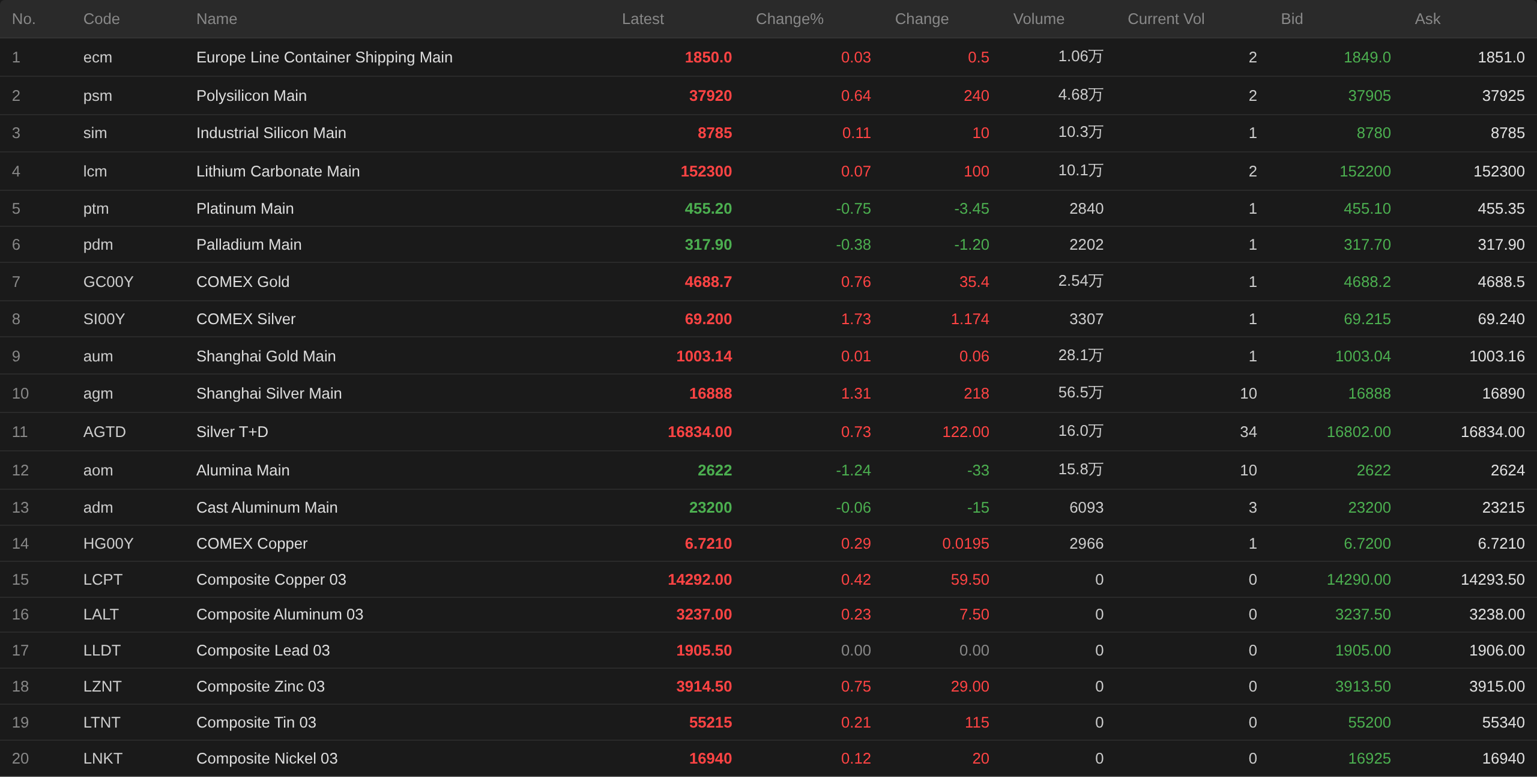
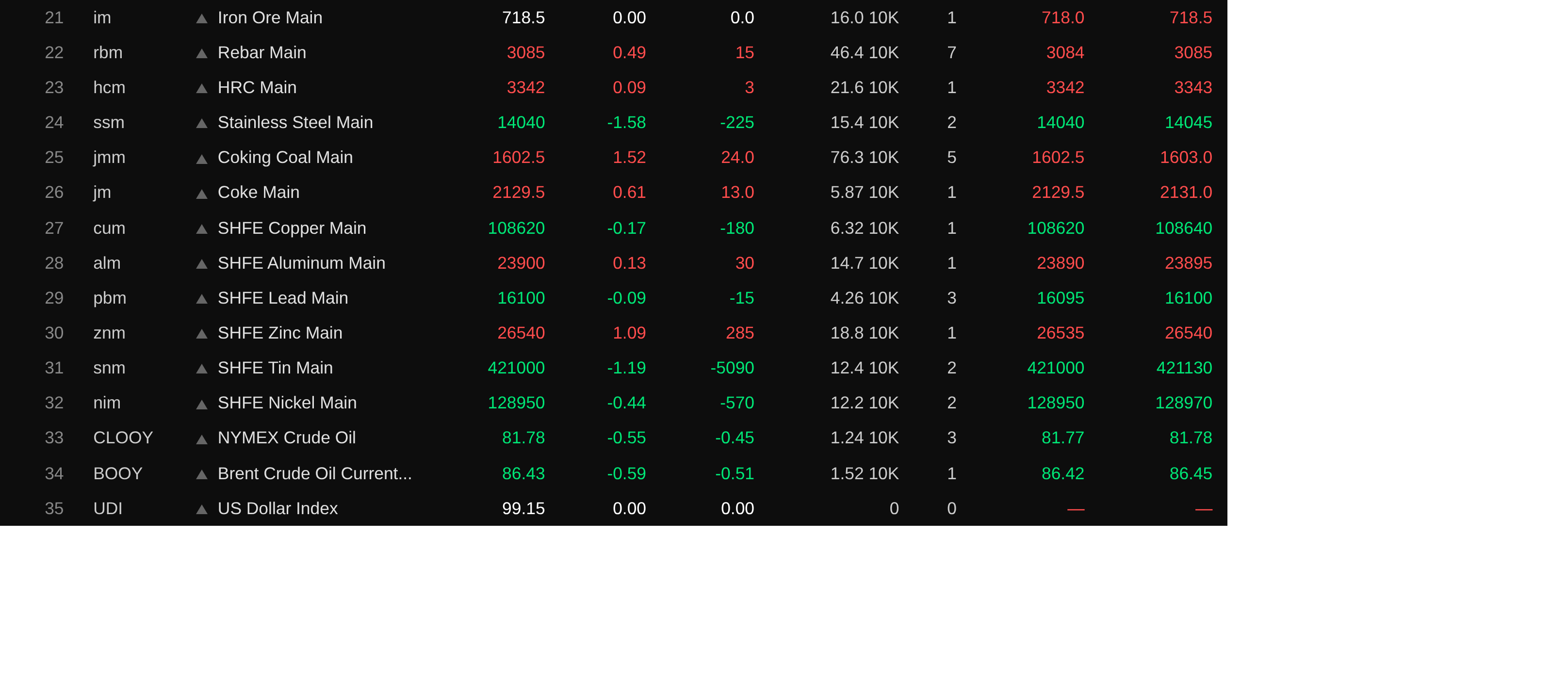
As of the midday close, base metals in the domestic market mostly fell. SHFE copper fell 0.17%, SHFE aluminum rose 0.13%, SHFE lead fell 0.09%, SHFE zinc rose 1.09%, SHFE tin fell 1.19%, and SHFE nickel fell 0.44%.
In addition, the most-traded foundry aluminum futures fell 0.06%, the most-traded alumina futures fell 1.24%, the most-traded lithium carbonate futures rose 0.07%, the most-traded silicon metal futures rose 0.11%, and the most-traded polysilicon futures rose 0.64%.
Ferrous metals mostly rose. Iron ore was parity at 718.5 yuan/mt, rebar rose 0.49%, and HRC rose 0.09%. Stainless steel fell 1.58%. For coking coal and coke: the most-traded coking coal contract rose 1.52%, and the most-traded coke contract rose 0.61%.
In overseas base metals markets, as of 11:45, LME metals mostly rose. LME copper rose 0.42%. LME aluminum rose 0.23%. LME lead was parity at $1,905.5/mt. LME zinc rose 0.75%. LME tin rose 0.21%. LME nickel rose 0.12%.
For precious metals, as of 11:45, COMEX gold rose 0.76% and COMEX silver rose 1.73%. In the domestic precious metals market: SHFE gold rose 0.01%, and the most-traded SHFE silver futures rose 1.31%.
Additionally, as of the midday close, the most-traded platinum futures fell 0.75%, and the most-traded palladium futures fell 0.38%.
As of the midday close, the most-traded European container shipping futures contract rose 0.03% to 1,850 points.
As of 11:45 on August 27, selected futures midday quotes:
Spot and Fundamentals
Copper: Today, Guangdong #1 copper cathode spot against the front-month contract saw high-quality copper quoted at a premium of 260 yuan/mt, up 10 yuan/mt from the previous trading day; standard-quality copper at a premium of 170 yuan/mt, up 10 yuan/mt; and SX-EW copper at a premium of 110 yuan/mt, up 10 yuan/mt. The average price of Guangdong #1 copper cathode was 109,080 yuan/mt, down 125 yuan/mt from the previous trading day, and the average price of SX-EW copper was 108,975 yuan/mt, down 125 yuan/mt. In the spot market: Guangdong inventory has declined for eight consecutive days, primarily due to reduced arrivals...
Macro Front
Domestic:
[NBS: Profits of Industrial Enterprises Above Designated Size Up 17.6% in January-July; Electronics Industry Profit Up 1.1x YoY] The National Bureau of Statistics (NBS) announced that total profits of industrial enterprises above designated size reached 4,582.06 billion yuan in January-July, up 17.6% YoY. From January to July, among industrial enterprises above designated size, state-controlled enterprises realized total profits of 1,491.89 billion yuan, up 16.3% YoY; joint-stock enterprises realized total profits of 3,549.40 billion yuan, up 23.6% YoY; enterprises funded by foreign investors or investors from Hong Kong, Macao and Taiwan realized total profits of 1,013.78 billion yuan, up 1.2% YoY; and private enterprises realized total profits of 1,135.22 billion yuan, up 10.9% YoY. Yu Weining, Chief Statistician of the Industrial Department of the National Bureau of Statistics (NBS), interpreted the profit data of industrial enterprises for January–July 2026. From January to July, profits in the electronics industry surged 1.1 times YoY, boosting the profit growth of all industrial enterprises above designated size by 9.3 percentage points and serving as the main support for the relatively fast profit growth of these enterprises. Among them, the integrated circuit industry, represented by computing chips and storage chips, saw profits surge 18.5 times YoY, contributing over 80% to the overall profit growth of the electronics industry. In other related industries, profits of computer whole-unit manufacturing, computer peripheral equipment manufacturing, and industrial control computer and system manufacturing, which are related to computers and servers, grew 3.3 times, 2.5 times, and 1.6 times, respectively; in the fields of electronic device manufacturing and electronic component manufacturing, profits of electronic special material manufacturing, semiconductor discrete device manufacturing, and electronic circuit manufacturing grew 226.8%, 45.8%, and 37.1%, respectively.
[National Energy Administration: Electricity traded in the national power market grew 23.4% YoY in January–July 2026] In July 2026, the electricity traded through all power trading institutions nationwide reached 740.4 billion kWh, up 18.5% YoY. By trading scope, intra-provincial traded electricity was 549.1 billion kWh, up 19.0% YoY; inter-provincial and inter-regional traded electricity was 191.3 billion kWh, up 17.2% YoY. By trading category, medium and long-term traded electricity was 678.6 billion kWh; spot electricity was 61.8 billion kWh. Green electricity traded reached 27.7 billion kWh, up 2.7% YoY. Electricity procured by grid enterprises through market-based agency purchases amounted to 87.2 billion kWh. (National Energy Administration)
[PBOC’s reverse repo operations resulted in a net injection of 606.5 billion yuan on the day] The PBOC conducted 103 billion yuan of 7-day reverse repo operations today, along with 503.5 billion yuan of overnight reverse repo operations. With no reverse repos maturing on the day, a net injection of 606.5 billion yuan was realized. (Jinshi Data APP)
US Dollar:
As of 11:45, the US dollar index was flat at 99.15. Market pricing showed a slight increase in expectations for a US Fed rate hike next month, after US government data showed that the inflation gauge the Fed closely watches rose 3.7% YoY in July, slightly above economists' expectations. Interest rate futures data indicated that after the release, the market priced in about a 42% probability of a Fed rate hike in September, up from about 36% before the data.
US annual inflation in July unexpectedly held steady, remaining significantly above the Fed's 2% target for the 65th consecutive month. Affected by the Iran war, the pullback after inflation recently surged to high levels has stalled, which may intensify the intense debate within the Fed over whether to raise rates or hold them steady. Data released by the Bureau of Economic Analysis of the US Commerce Department on Wednesday showed that the Fed's favoured gauge, the US PCE price index, registered an annual rate of 3.7% in July, unchanged from June, versus analysts' expectations of 3.6%. With trade negotiations between the US and its second-largest trading partner Canada breaking down on Friday, a new round of tariff-induced inflationary pressures may be about to emerge. On a MoM basis, the PCE price index rose 0.2% in July, also above economists' expectations. In June, the index had fallen 0.1% MoM, its lowest reading since April 2020. The Bureau of Economic Analysis also updated its Q2 economic growth data, leaving the US annualized real GDP growth rate for Q2 unchanged at 1.5%.
According to CME "FedWatch": the probability of the US Fed keeping rates unchanged in September stood at 63.5%, with a 36.5% chance of a cumulative 25-basis-point rate hike. For October, the probability of the Fed holding rates steady was 47.3%, the chance of a cumulative 25bp hike was 43.4%, and a cumulative 50bp hike was 9.3%.
Market attention turned to the highly anticipated speech by Fed Chairman Warsh this week. OANDA senior market analyst Kelvin Wong added, "The market is waiting for Warsh's speech to get a clearer picture of how the Fed will respond to the current economic situation. If he doesn't provide specific forward-looking monetary policy guidance, then the market's current pricing for rate hikes will likely remain largely unchanged." (Jinshi Data APP)
Other currencies:
The Bank of Korea on Thursday raised its benchmark interest rate by 25 basis points to 3.00% as expected, the second consecutive hike, as inflation remained above target and financial stability risks persisted. The Bank of Korea's seven-member monetary policy board voted to raise the 7-day repo rate to its highest level since February 2025. 18 out of 35 economists surveyed by Reuters had forecast a rate hike. Bank of Korea also raised its economic growth forecast for this year from 2.6% forecast in July to 3.3%, while maintaining its inflation rate forecast for this year at 2.7%. Currently, median market expectations show that the Bank of Korea will raise interest rates once more in Q1 2027, and then keep rates unchanged at least until the end of next year. Daishin Securities economist Kong Dong-rak said: “I now think the terminal rate will reach 3.50%, up from my previous forecast of 3.25%, because economic growth this year could be as high as 3.5%.” (Jin10 Data APP)
Bank of Japan Deputy Governor Himino Ryozo said on Thursday that timely interest rate hikes will help avoid a sharp rise in inflation, thereby preventing the need for sudden rate hikes in the future. In a speech to business leaders, Himino Ryozo said: “If core inflation deviates and exceeds our 2% target, it will negatively impact the economy. Compared to the past, we should pay more attention to the upside risks to prices.” He said: “At each monetary policy meeting, we should conduct in-depth discussions from these perspectives.” (Jin10 Data APP)
Australian businesses cut investment in the three months to June, with a decline in data center spending being the main reason for the investment slowdown. Data from the Australian Bureau of Statistics on Thursday showed that business investment in Q2 was close to A$51 billion (US$37 billion), down 3.6% from Q1. Spending in data centers and other IT areas fell by nearly a third from the record level set in Q1. However, compared to the same period last year, business investment still grew by nearly 11%, driven mainly by a surge of nearly 80% in data center investment, highlighting the sector's strong momentum as a driver of Australian economic activity. Business investment intentions for the fiscal year 2026-27 rose to A$200.7 billion, up 15.5% from the forecast three months earlier, also supported by AI and renewable energy projects. (Jin10 Data APP)
Data Highlights:
Today will see the release of US initial jobless claims for the week ending August 22, Germany's Gfk consumer confidence index for September, Canada's Q2 current account balance, and other data. Additionally, attention should be paid to: the Ministry of Commerce holding its second regular press conference in August, the European Central Bank releasing the minutes of its monetary policy meeting, and the Jackson Hole Global Central Banking Annual Symposium being held from August 27 to 29. Nvidia released its earnings report after the US market close on August 26, and held its earnings conference call.
Crude Oil:
As of 11:45 a.m., both oil prices fell, with WTI crude down 0.55% and Brent crude down 0.59%. Shipping volume in the Strait of Hormuz saw a slight rebound on Wednesday, while shipping volume in the Bab el-Mandeb Strait slowed down.
Data showed that shipping traffic through the Strait of Hormuz edged up slightly despite the ongoing geopolitical standoff between the US and Iran. Kpler data showed that on Wednesday, a total of 10 trackable commodity-carrying vessels transited the Strait of Hormuz, a slight increase from eight on Tuesday but still below the 10-day moving average of around 15. Two medium-range product tankers, one LPG carrier, one Panamax tanker, and three handysize tankers entered the Strait of Hormuz from the Gulf of Oman. One medium-range product tanker, one asphalt carrier, and one bulk carrier exited the waterway from the Gulf side. Meanwhile, shipping traffic through another critical chokepoint, the Bab el-Mandeb strait, slowed for a second consecutive day. Kpler data showed that a total of 19 commodity-carrying vessels transited the Bab el-Mandeb on Wednesday, including six outbound tankers, one of which was a very large crude carrier. The total vessel transits were down from 24 the previous day. (Jin10 Data APP)
US diesel inventories have fallen to the lowest level for the same period in history, according to a US media report on the 26th. With demand from agricultural use and winter heating increasing, diesel prices, already near record highs, may rise further. Data released that day by the US Energy Information Administration showed that US distillate fuel oil inventories (of which diesel is the primary component) stood at 103.4 million barrels for the week ended August 21, down 2.2 million barrels from the previous week and about 14% below the five-year average for the same period. Bloomberg, citing data dating back to the early 1980s, said current inventories are at the lowest level for the same period in history. Data from the American Automobile Association showed that the national average retail price for diesel was $5.62 per gallon on August 26, up from $3.7 a year earlier and approaching the record high of $5.82 per gallon set in June 2022.
Additionally, Iraq's State Oil Marketing Organization (SOMO) issued a second tender this week to sell Basrah crude for September loading with delivery outside the Strait of Hormuz, according to trade sources and a document. Trade sources said the tender involves loading via ship-to-ship transfer off the coast of Oman, with a deadline of August 28. In a tender issued on Monday, SOMO offered crude loaded from its Basrah Oil Terminal, requiring buyers to charter tankers to enter the Strait of Hormuz. The first tender closed on Wednesday. Iran has approved some Iraqi tankers to transit the Strait of Hormuz after repeated requests from the Iraqi government through multiple channels, IRNA news agency reported on Saturday. (Jin10 Data APP)
Spot Market Overview:
►
►
►
►
►
►
►
►
![Available supply continues to tighten, Shanghai spot copper premiums approach the year's high [SMM Shanghai spot copper].](https://imgqn.smm.cn/usercenter/udUol20251217171712.jpg)
![Inventory Falls for 8 Consecutive Days, Suppliers Actively Hold Prices Firm, but Downstream Restocking Is Weak [SMM South China Spot Copper]](https://imgqn.smm.cn/usercenter/EFLYr20251217171714.jpeg)
![Month-end supply tightened, spot premiums surged sharply [SMM North China Spot Copper]](https://imgqn.smm.cn/usercenter/CJXfS20251217171710.jpg)