From 1st October, every importer bringing steel into the EU must prove where the metal was first melted and cast into solid form. The obligation is written into Regulation (EU) 2026/1384. What it still lacks is a rulebook.
Article 4(2) of the same regulation requires the European Commission to adopt an implementing act specifying acceptable evidence by 31 August 2026. As of 20 August, nothing has appeared in the Official Journal, and the Commission's implementation page has not been updated since 30 June.
The obligation is firm. The rules are absent.
I. What the rule is built to close
The EU no longer asks only which country a shipment was exported from. It asks where the metal was originally melted and first cast — as slab, billet, ingot or finished product.
This targets a trade pattern that has run for the better part of a decade. Indonesian melt becomes slab, ships to Vietnam, is rolled into cold-rolled coil, and enters the EU declared as Vietnamese origin. The same route through Turkey produces the same result. Chinese semi-finished stainless steel re-rolled in Turkey follows the identical logic.
Under the new rule, that path closes at the documentation layer. Rolling, coating and slitting no longer reset the origin clock. If the melt is Indonesian, the melt is Indonesian.
The commercial stakes are not marginal. In-quota material enters duty-free; anything outside quota carries 50%. That gap is not a cost variable — it is a business-model threshold.
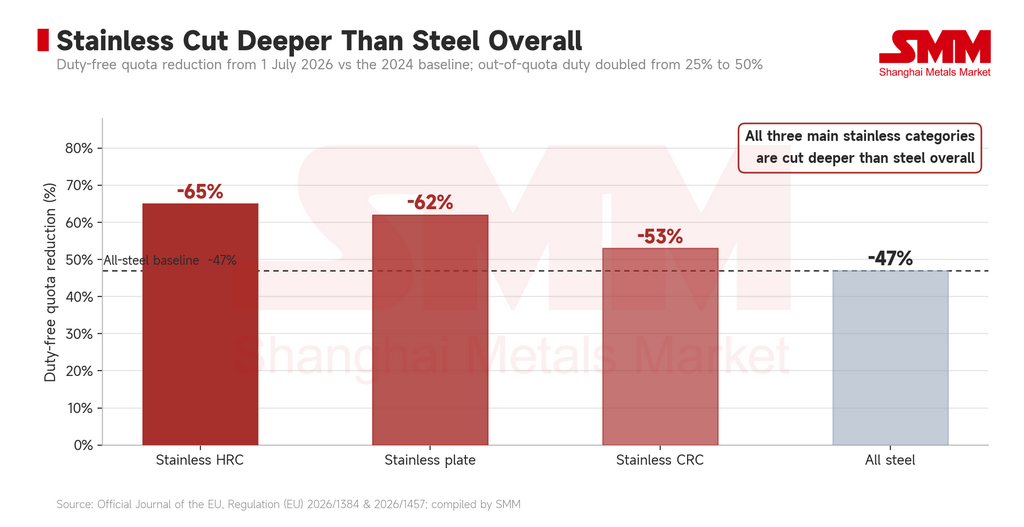
Stainless was cut harder than steel overall in this round. Total quota fell about 47%, but hot-rolled stainless was cut 65%, plate 62% and cold-rolled 53% — all three main categories above the headline figure.
II. Industry proposed a simple standard. The Commission hasn't answered
The consultation closed on 2nd July. The market has been waiting since for a single answer: which documents satisfy the requirement?
The proposal from trading participants is unglamorous and practical — invoice, packing list, and mill test certificate. All three already exist in every normal steel transaction. Nothing new has to be created, and no fresh certificate has to be issued for each customs entry. Article 4 requires the Commission to take the position of SMEs into account. That is a legal obligation, not a courtesy.
The Commission has the legal text and the consultation responses. Ten months have passed since the draft was tabled in October 2025, and nine weeks since the regulation entered into force. The implementing act is still not published.
III. Two variables decide where the line cuts
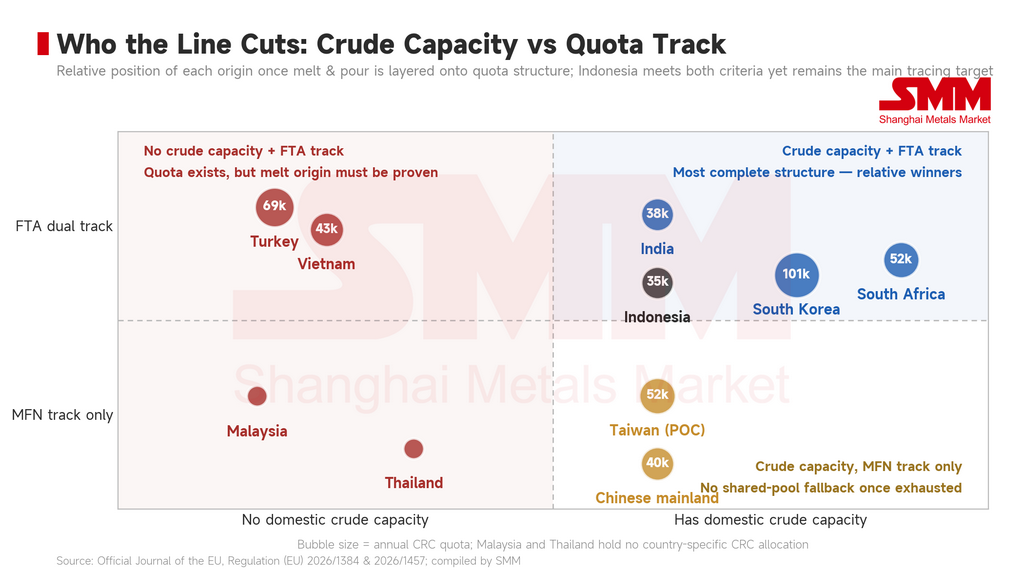
Sorting out who is exposed requires only two questions: does the origin have domestic crude stainless melting capacity, and does its quota run on the MFN track or the FTA dual track?
The first determines how hard melt-origin evidence is to produce. If you melt your own stainless steel, the proof is your own mill's test certificate. If you buy someone else's slab, you have to trace back to someone else's furnace.
The second determines whether there is a fallback. FTA-track origins can access the shared pool once their country-specific quota is exhausted. MFN-track origins have no such buffer.
Cross the two variables and exporters fall into four groups.
IV. Highest exposure: the four markets with no crude capacity
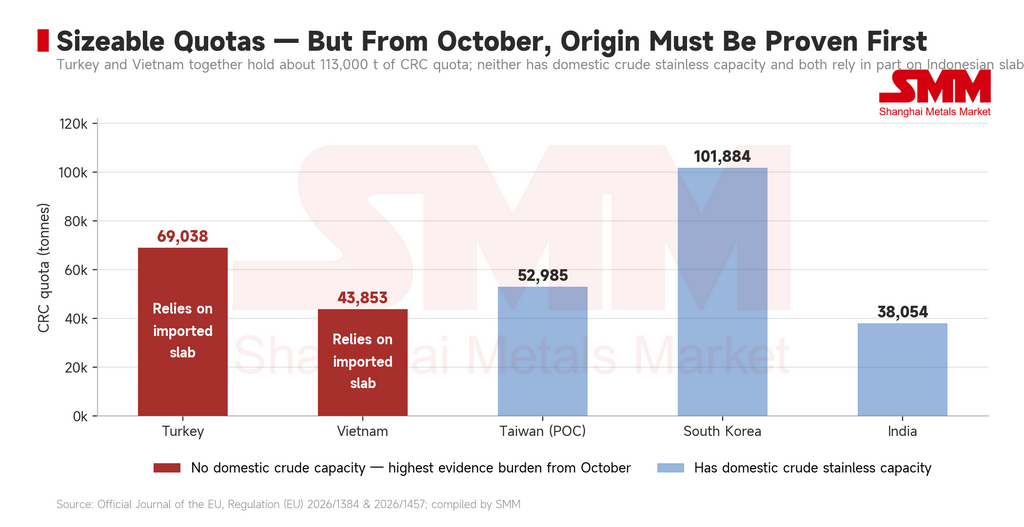
Turkey holds 69,038 mt of cold-rolled quota, Vietnam 43,853 mt. Neither figure is small. Malaysia and Thailand hold no country-specific CRC allocation at all and draw on the residual pool.
What the four share is the absence of domestic crude stainless melting capacity. The melt-and-pour rule may in practice reduce their usable quota space: if the paperwork shows Indonesian melt, the tonnage should in principle count against Indonesia's allocation rather than the processing country's.
Turkey and Vietnam carry an additional layer of legal exposure. The EU's anti-dumping duty of 19.3% and countervailing duty of 20.5% on Indonesian stainless CRC were already extended to Taiwan (Province of China), Turkey and Vietnam through anti-circumvention Regulation 2024/1267. All three sit inside an existing anti-circumvention perimeter; melt-and-pour adds a documentation gate on top of duties already in force.
Malaysia is worth isolating. Local capacity is cold-rolling only — hot-rolled coil and slab are bought in entirely. From October, every shipment to the EU must be traceable to an upstream melting furnace, and where that furnace sits depends on whether the feedstock of the moment came from Indonesia, Taiwan (POC) or South Korea. This is not a one-off compliance exercise. It is a continuous, per-shipment burden of proof.
Turkey is already moving. Nikel Paslanmaz announced investment of more than $150 million this year in an integrated stainless long-product plant and a cold-rolling mill, with commissioning staged across 2027 and 2028. Turkey imports roughly 700,000 mt of stainless a year; the strategic case for domestic integration tracks closely with the melt-and-pour timetable.
V. Middle tier: crude capacity, but only one track
Taiwan (POC) holds 52,985 mt of cold-rolled quota, third-largest in the category; the Chinese mainland holds 40,431 mt. Both have domestic crude stainless melting capability, so melt-origin evidence is not technically difficult — the stainless steel is their own and the mill certificate is available.
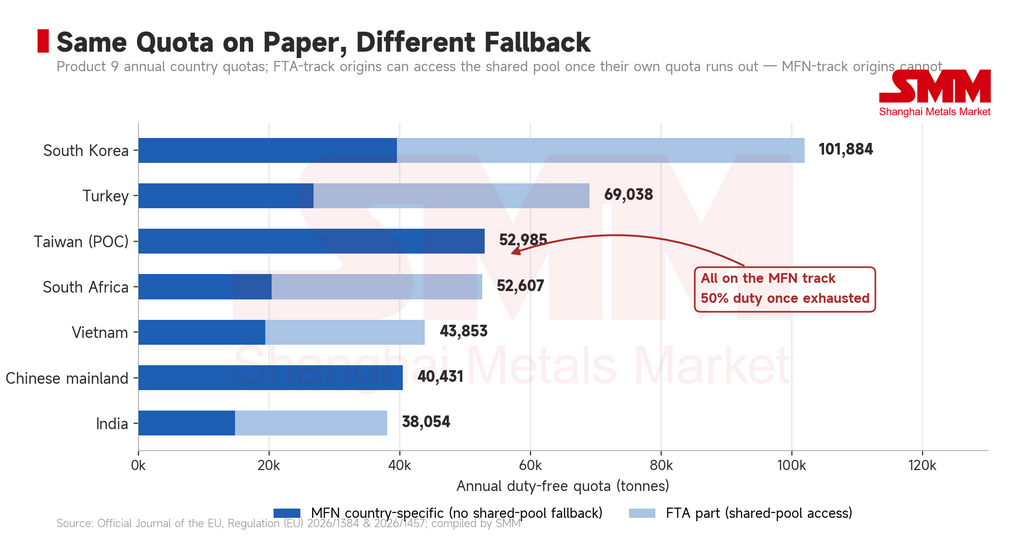
The problem is quota structure. Both allocations sit entirely on the MFN track with no FTA component, and under Annex II Section 3 neither may draw on residual quota. Once the country-specific allocation is exhausted, exporters face the 50% duty with no cushion.
The contrast with South Korea is instructive. Of Korea's 101,884 mt, 39,565 mt is MFN and 62,319 mt is FTA — and once the country quota runs out, the shared pool remains open. Same allocation on paper; one is a pass with a fallback, the other a one-way ticket.
Taiwan (POC) carries a further complication. It was named in the 2024 anti-circumvention proceedings; eight companies secured exemptions but must continue demonstrating they have not materially increased purchases of Indonesian-sourced material. EUROFER subsequently challenged those exemption decisions in two cases (T-390/24, T-391/24), still pending.
What changes in October is granularity. Proving at annual compliance level that Indonesian feedstock was not used in volume is one exercise. Evidencing melt origin on every customs declaration is another — a different order of workload and a different order of risk.
VI. Relative winners: South Korea, India, South Africa
South Korea takes the largest cold-rolled allocation in the field at 101,884 mt, has domestic crude capacity and sits on the FTA track. Structurally it has no meaningful weak point under the new regime.
India's advantage is in long products and tube. Bars at 92,557 mt, wire rod at 18,772 mt and seamless pipe at 15,329 mt are all first by a wide margin. Cold-rolled at 38,054 mt is unremarkable but also FTA-track. India has full domestic crude stainless capacity, so melt-origin evidence presents no obstacle.
South Africa's 52,607 mt of CRC quota is close to Taiwan (POC)'s, but with an FTA component behind it — a better position on the same headline number.
All three score favourably on both variables. The rule narrows other people's channels, and their relative share rises accordingly.
VII. Indonesia: traced upstream, yet top of the list
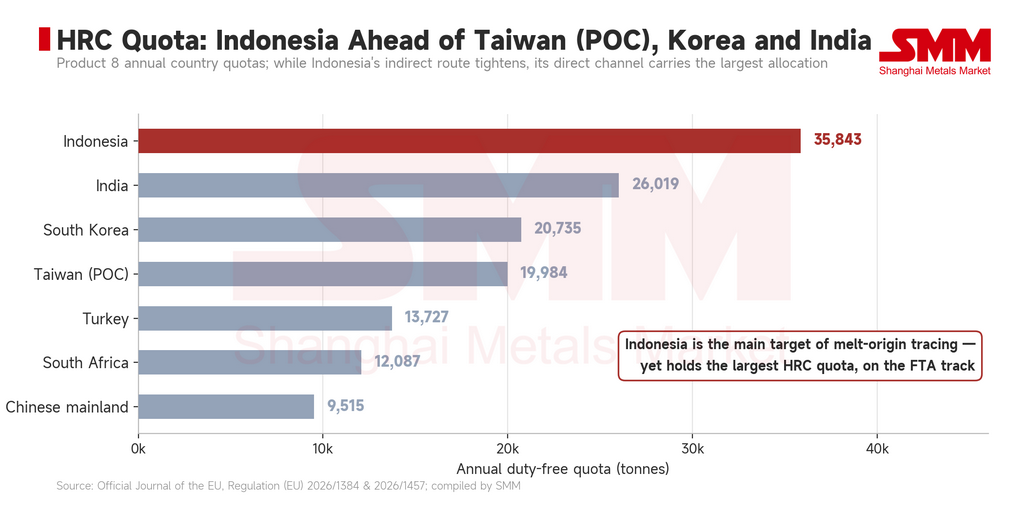
The melt-and-pour rule points most directly at Indonesian metal moving through third-country processing. Yet on the same quota list, Indonesia holds the largest country allocation in hot-rolled stainless at 35,843 mt — ahead of India, South Korea and Taiwan (POC) — and sits on the FTA track with shared-pool access behind it.
The indirect channel narrows while the direct channel stays open and well supplied.
The reasonable inference is that if documentation costs on third-country routing keep rising, some Indonesian volume currently moving via Vietnam or Turkey shifts toward direct export under a clean Indonesian origin. That is not a win for Indonesia so much as a reallocation of routes — the same metal, travelling the path that is easier to evidence.
For Vietnam and Turkey it means upstream feedstock has to be reassessed. Sourcing non-Indonesian slab is the medium-term option; building domestic crude capacity is the long-term one. Neither is cheap and neither is fast.
VIII. Japan: the only public protest so far
In early July, five Japanese industry bodies — including the Japan Iron and Steel Federation, the Special Steel Club and the Japan Stainless Steel Association — issued a joint statement criticising the sharp tightening of market access under the new EU regime.
The central figure in the statement: Japan's country-specific allocation has been cut to roughly 800,000 mt, well below the annual average of about 1.5 million mt it exported to the EU between 2022 and 2024. The associations also objected to the EU's September 2025 definitive anti-dumping ruling on Japanese hot-rolled flat products, arguing it failed to properly account for the suppressive effect of the July 2024 safeguard tightening on import volumes.
The statement argues the measures run counter to the spirit of the Japan-EU Economic Partnership Agreement and may be inconsistent with WTO rules, and calls on Tokyo to use the dispute settlement procedures available under both.
It remains the only public move by an exporting country's industry body pointing toward formal dispute settlement.
IX. The rule is designed to escalate
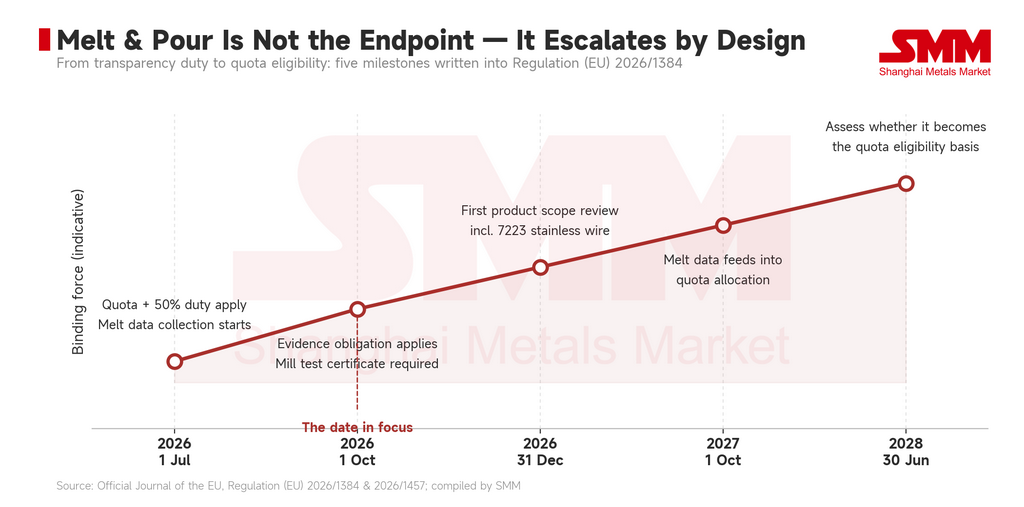
1st October is a starting point, not an endpoint.
The regulation sets out the sequence. By 31st December 2026, the Commission completes the first product scope review. By 30th June 2027, it assesses whether downstream goods with significant steel content should be brought in. From 1st October 2027, melt-and-pour data is expected to feed more actively into quota allocation. By 30th June 2028, the Commission must evaluate whether melt origin should become the basis for quota eligibility, and may table legislation accordingly.
Today it is a transparency obligation. From late 2027 it starts shaping how quota is distributed. By 2028 it may determine who qualifies for quota at all. That trajectory is written into the legislation, not inferred from it.
Outlook
Corporate deadlines are hard. If the implementing act does not appear by 31st August, the 1st October obligation does not move with it. Commission deadlines, by contrast, are behaving more like statements of intent — and the asymmetry is expensive. One side risks a 50% duty, competitiveness and jobs. The other pays nothing.
For Asian stainless exporters there is one actionable step, and it does not depend on Brussels. Map melt origin across the product portfolio now, and secure mill test certificates from upstream suppliers now. When the implementing act lands, exporters who have prepared will be checking formats. Those who have not will be rebuilding an entire evidence chain in under four weeks.
1st October is not waiting for anyone.
![[SMM Nickel Flash] Safety Incident Reported at Nickel Pig Iron Smelter in China](https://imgqn.smm.cn/usercenter/UruWE20251217171732.jpg)