SMM August 25 News:
Metal Market:
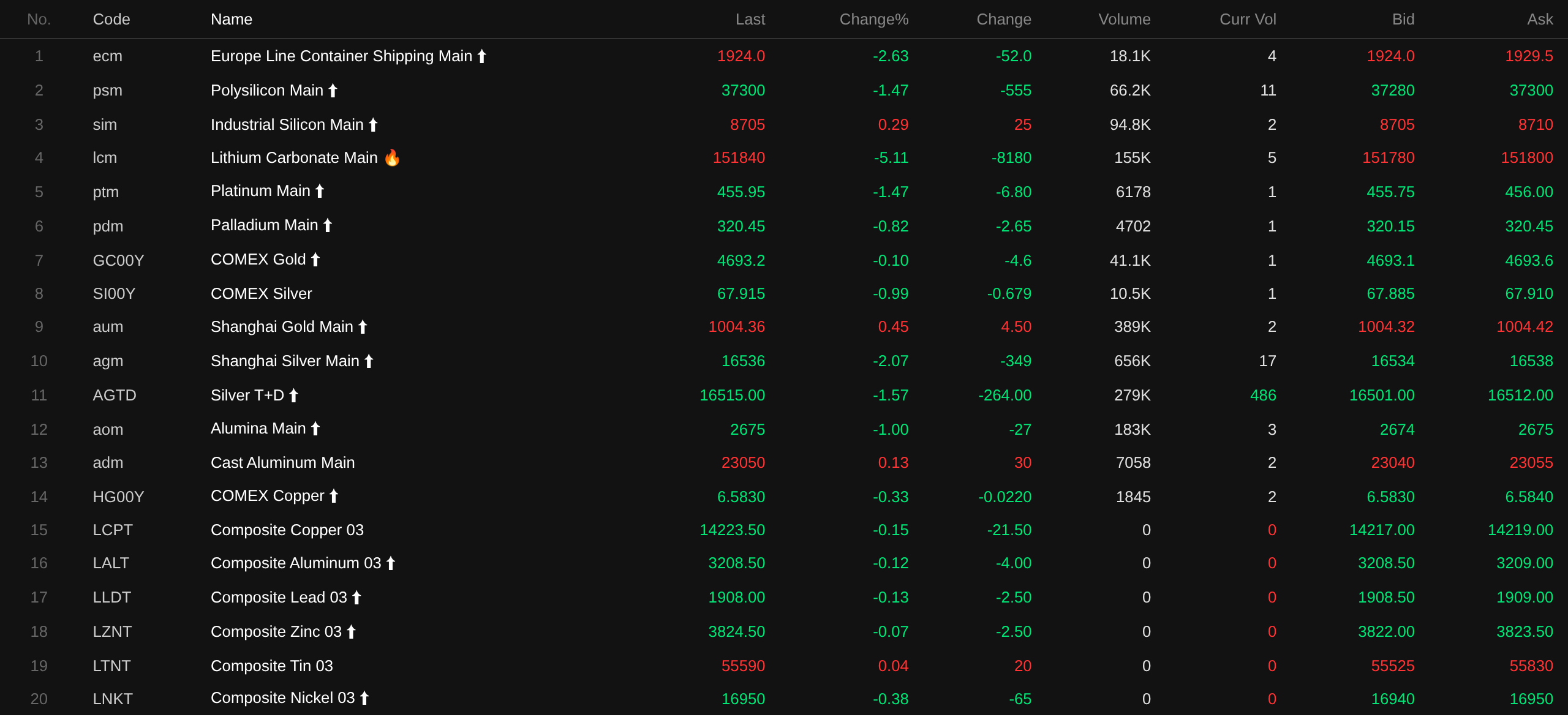
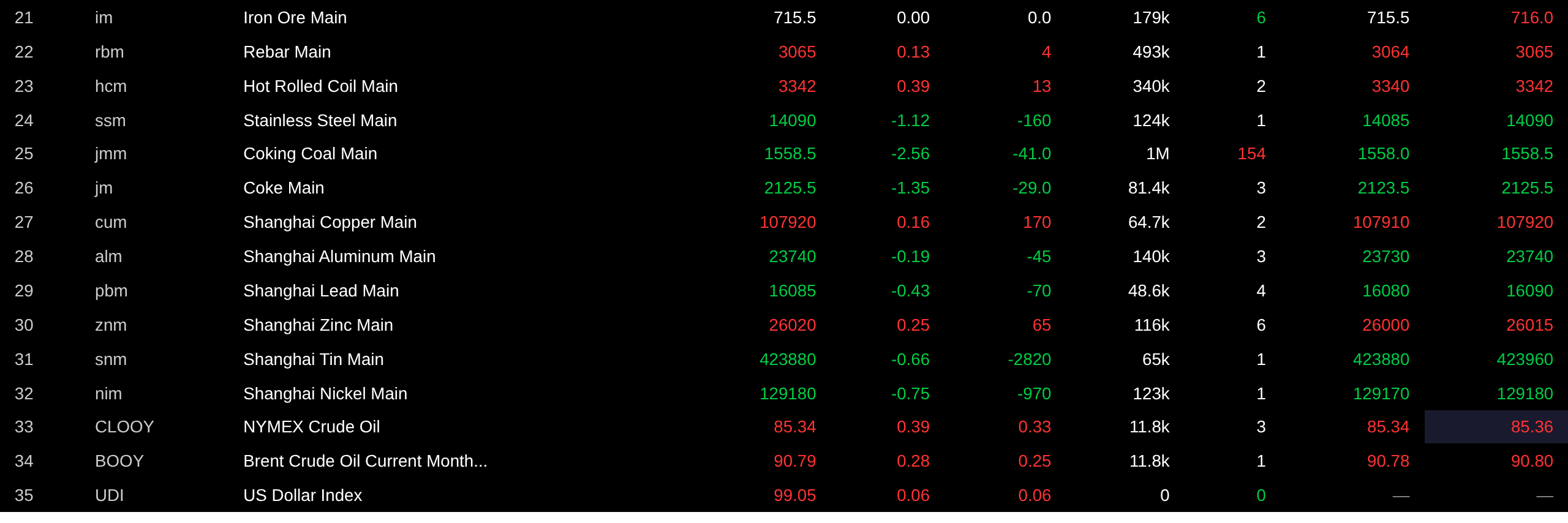
As of the midday close, domestic base metals generally fell. SHFE copper rose 0.16%, SHFE aluminum fell 0.19%. SHFE lead fell 0.43%. SHFE zinc rose 0.25%. SHFE tin fell 0.66%. SHFE nickel rose 0.75%.
In addition, the most-traded cast aluminum futures contract rose 0.13%, the most-traded alumina contract fell 1%. The most-traded lithium carbonate contract fell 5.11%. The most-traded silicon metal contract rose 0.29%. The most-traded polysilicon futures contract fell 1.47%.
Ferrous metals showed mixed performance. Iron ore settled flat at 715.5 yuan/mt, rebar rose 0.13%, hot-rolled coil rose 0.39%. Stainless steel fell 1.12%. For coking coal and coke: the most-traded coking coal contract fell 2.56%, the most-traded coke contract fell 1.35%.
For overseas base metals, as of 11:39, LME metals generally fell. LME copper, LME aluminum, LME lead and LME zinc all fell within 0.2%. LME tin rose 0.04%. LME nickel fell 0.38%.
For precious metals, as of 11:39, COMEX gold fell 0.1%, COMEX silver fell 0.99%. Domestic precious metals: SHFE gold rose 0.45%, the most-traded SHFE silver contract fell 2.07%.
In addition, as of the midday close, the most-traded platinum futures contract fell 1.47%, the most-traded palladium futures contract fell 0.82%.
As of the midday close, the most-traded Europe container shipping futures contract fell 2.63%, reported at 1,924 points.
As of 11:39 on August 25, some futures midday quotes:
Spot Market and Fundamentals
Zinc: Today, the mainstream transaction prices for #0 zinc were concentrated at 25,915-26,085 yuan/mt, with Shuangyan mainly traded at 26,055-26,215 yuan/mt, and #1 zinc mainstream traded at 25,845-26,015 yuan/mt. In the morning session, the market offered premiums of 60-70 yuan/mt against the SMM average price, with no quotes against the futures contract for now...
Macro Front
Domestic:
[Road Traffic Safety Law Revision Draft Adds Special Chapter on Autonomous Vehicles] On August 25, the draft amendment to the Road Traffic Safety Law, which was submitted for initial deliberation at the meeting of the 14th National People's Congress Standing Committee, set up a special chapter "Special Provisions on Autonomous Vehicles", clarifying the concepts of autonomous vehicles and driver-assistance functions, and stipulating that if a road traffic safety violation occurs while the autonomous driving function is activated, the producer or importer of the autonomous vehicle shall accept the penalty. For autonomous vehicles with the autonomous driving function not activated and vehicles equipped only with driver-assistance functions driving on roads, they shall be managed according to the regulations for non-autonomous vehicles. (Xinhua News Agency)
PBOC: Today, it conducted a 7-day reverse repo operation of 386 billion yuan, with a bid amount of 386 billion yuan and a winning bid amount of 386 billion yuan, at an operation interest rate of 1.40%, unchanged from before. (Jin Shi Data APP)
[Chengdu: For the purchase of newly built commercial housing in the city applying for housing provident fund loans, the minimum down payment ratio is 15%]The Chengdu Municipal Bureau of Housing and Urban-Rural Development, the Chengdu Municipal Bureau of Planning and Natural Resources, the Chengdu Municipal Bureau of Finance, and the Chengdu Housing Provident Fund Management Center jointly issued the "Notice on Further Optimizing Policies and Measures to Promote the Stable and Healthy Development of the Real Estate Market." It clarifies that for the purchase of newly built commercial housing in the city applying for housing provident fund loans, the minimum down payment ratio is 15%, and a one-year, 20% interest subsidy will be provided, with a maximum subsidy amount of 25,000 yuan. For the purchase of newly built commercial housing that meets the green building one-star standard or above, the maximum housing provident fund loan quota will be increased by 20%. Districts (cities) and counties, based on existing policies, will issue subsidies or consumption vouchers in areas such as group purchases, parking space purchases, and trade-ins according to local conditions, to stimulate potential demand and accelerate its release.
US dollar side:
As of 11:39, the US dollar index rose 0.06% to 99.05. According to CNBC, two senior US Treasury officials revealed that the US Treasury may use nearly $1 trillion from the General Account (TGA) to fund its recently announced expanded government bond purchase plan. Using the TGA account will give the Treasury greater capacity to influence long-term bond yields. Last week, the US Treasury unexpectedly announced it would increase the repurchase scale of long-term "off-the-run securities" from $2 billion to at least $4 billion. US Treasury Secretary Bessent said that the scale of such operations could even exceed this new minimum level. However, the Treasury did not explain at the time how it would fund these purchases. Most market participants previously believed the Treasury would raise funds by increasing the issuance of short-term Treasury bills (T-bills). If the TGA account is used, market views on this plan may change. The TGA is essentially the US government's "checking account" at the Fed, similar to the government's emergency fund pool. The funds in this account already come from existing tax revenues. (Jin Shi Data APP)
CICC Research noted that the market's focus this week is on the Jackson Hole meeting and Warsh's speech. Earlier, Warsh's statement "let the market raise interest rates for the Fed" failed to ease inflation concerns, coupled with the failure of Treasury intervention, policy credibility was damaged, and US Treasury yields continued to rise. We expect Warsh to reiterate inflation risks this time and retain the option to raise interest rates to rebuild credibility, but he will also continue to adhere to long-standing views such as reducing central bank intervention and lowering communication frequency. We believe Warsh has not abandoned the policy philosophy of "balance sheet reduction + interest rate cuts," but the premises on which it relies are misaligned with current realities, requiring coordination and clearer expression. If Warsh can demonstrate sufficient policy flexibility, market concerns about U.S. Treasuries may be partially alleviated, supporting the US dollar; otherwise, trust will continue to erode, long-end US Treasury yields will continue to rise, and the US dollar will come under pressure.
Citadel Securities said the US Treasury's attempt to curb long-term borrowing costs through bond repurchases constitutes "financial repression," which could weaken the US dollar and push up inflation. CNBC reported Monday that US Treasury Secretary Bessent may use the Treasury's cash balance at the US Fed—the Treasury General Account (TGA)—to fund the bond repurchases. Citadel Securities believes this intervention could alter the market's response path to US fiscal prospects and inflation concerns, shifting pressure to the foreign exchange market, as lower yields reduce the US dollar's attractiveness and could push up imported goods prices. Shah noted that suppressing long-term yields does not eliminate the economic factors driving yields higher, as loose fiscal and monetary policies are stimulating the economy amid full employment and heavy investment in artificial intelligence. "The message from the bond market is clear: fiscal or monetary policy should tighten," Shah wrote. "The lasting solution is not repeated intervention, but making tougher choices on fiscal policy and central banks being willing to act ahead of inflation, including raising interest rates when necessary."
According to CME's "FedWatch": The probability of the US Fed maintaining rates unchanged until September is 58.6%, and the probability of a cumulative 25-basis-point rate hike is 41.4%. The probability of the US Fed maintaining rates unchanged until October is 43.0%, the probability of a cumulative 25-basis-point rate hike is 46.0%, and the probability of a cumulative 50-basis-point rate hike is 11.0%. (Jin Shi Data APP)
For other currencies:
The nine members of the Reserve Bank of Australia's policy committee were divided on whether to raise rates at the August meeting, with "several" members arguing that given upside inflation risks, a rate hike might be necessary. Minutes of the meeting released Tuesday by the RBA showed other members believed the current cash rate of 4.35% was working, helping to lower inflation, and allowing "some time" to observe economic developments. The minutes warned that future data releases need to show inflation pulling back further to the 2% to 3% target range within a reasonable timeframe. The committee has listed the Middle East conflict, the global AI and data center investment boom, and low productivity as key risks. However, some members believe these risks remain uncertain, and recent economic developments imply more time to keep policy unchanged. Current market pricing shows that the probability of the Reserve Bank of Australia raising the cash rate to 4.6% at its next meeting on September 28-29 is only 13%, while the likelihood of a rate hike by February next year is about 67%. (Jin10 Data APP)
Three members of BofA Global Research said the Bank of Japan may take the lead using its main tool of raising interest rates to stabilize the yen. "For FX intervention to be durable and to achieve long-term yen stability, Japan will ultimately need to adjust its policy mix. Currently, the most likely policy mix remains monetary tightening against a backdrop of fiscal expansion." They added that the BOJ may proceed at a quarterly hiking pace and end the rate hike cycle after raising the terminal rate to 2% in July 2027. BofA's forecast for the USD/JPY exchange rate at the end of 2026 remains unchanged at 149. (Jin10 Data APP)
Data:
Today's releases include: US ADP employment change for the week ending August 8, US FHFA house price index MoM for June, US S&P/CS 20-city not seasonally adjusted home price index YoY for June, US new home sales annualized for July, US Conference Board consumer confidence for August, US Richmond Fed manufacturing index for August, Germany Q2 unadjusted GDP YoY final, Germany August IFO business climate index, and others. Additionally, note: 2027 FOMC voter, Richmond Fed President Barkin to speak on "The Mysterious American Economy".
Crude oil:
As of 11:39, both crude oil prices edged up, with US crude up 0.39% and Brent crude up 0.28%. The market weighs the impact of the US expanding sanctions on Iran.
According to Xinhua News Agency, US Treasury Secretary Bessent held a press conference on the afternoon of the 24th, announcing that the US launched a new round of sanctions on Iran for "economic isolation" on the same day to further increase pressure on Iran. According to a statement released by the US Treasury's Office of Foreign Assets Control (OFAC) on the 24th, the US expanded the scope of economic sanctions on Iran to five sectors: aviation, digital assets, gold, shipping, and technology industries, effective from that day. The statement said the US would also suspend several permits related to Iran, covering some educational activities and services, personal remittances, sports, and academic exchanges. In addition, about 60 Iran-related entities, individuals, and vessels were added to the sanctions list, covering nuclear and missile technology, cyber operations, oil trade, etc.
Preliminary shipping data showed that only one bulk commodity vessel passed through the Strait of Hormuz on Monday, the lowest level since May 7. Initial data from shipping tracker Kpler indicated that a very large gas carrier entered the Strait of Hormuz from the Gulf of Oman on Monday, while six vessels of various types passed through the strait on Sunday. The data may still change as some vessels turned off their transponders while transiting the strait. (Jin Shi Data APP)
Separately, Japan's Minister of Economy, Trade and Industry, Ryosei Akazawa, said on Tuesday that Japan plans to refrain from releasing additional national oil reserves in September and October. He stated that due to oil tankers normally transiting the Bab el-Mandeb Strait are rerouting to the longer Suez Canal route, Japan's crude oil procurement volume in September is expected to drop from 100% in August to about 80% of the average monthly volume last year. "For the already decided national reserve releases, some portions remain unused due to progress in securing alternative supply. Using these reserves will ensure that crude oil supply in September reaches the average monthly level of last year," he added. Japan expects crude oil procurement volume in October to recover to the average monthly level of last year. (Jin Shi Data APP)
Spot Market Overview:
►
►
►
►
►
►
►
►
►
►
►

![[Xiaomi Xuanjie O3 Officially Announced Support for LPDDR6, ChangXin Memory as Domestic Memory Partner]](https://imgqn.smm.cn/usercenter/nBLhE20251217171750.jpg)