SMM August 25 News:
Metal Market:
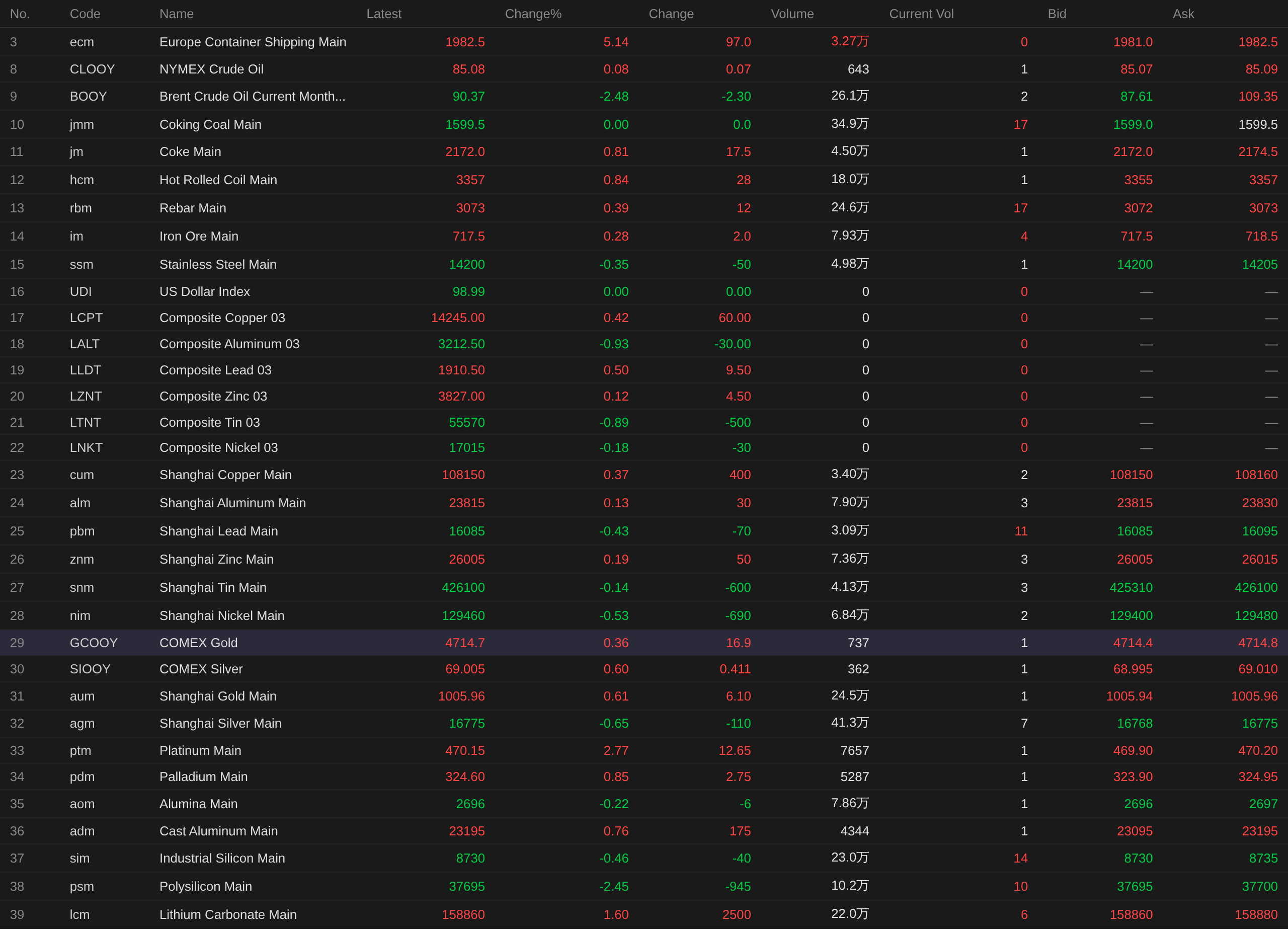
Overnight, base metals in both domestic and overseas markets showed mixed performance. LME aluminum led the declines with a 0.93% drop, followed by LME tin, which fell 0.89%. LME lead led the gains with a 0.5% increase, while the percentage changes for other base metals were relatively small. Alumina futures main contract fell 0.22%, and cast aluminum futures main contract rose 0.76%.
Overnight, ferrous metals other than stainless steel all rose. Stainless steel fell 0.35%, while hot-rolled coil rose 0.84%. The gains for rebar and iron ore were both within 0.4%. For coking coal and coke, coking coal closed flat at 1,599.5 yuan/mt, while coke rose 0.81%.
Overnight in precious metals, COMEX gold rose 0.63%, marking its fourth consecutive gain, while COMEX silver fell 0.81%. In China, SHFE gold rose 2.86% overnight, and SHFE silver rose 1.4%, both achieving their third consecutive gains.
As of 6:42 a.m. on August 25, overnight closing quotes:
Macro Front
China:
[New Policy for Central Government Agencies' Housing Provident Fund: Maximum Loan for First Home Up to 3.4 Million Yuan] The Central Government Agencies Housing Fund Management Center recently issued a notice announcing optimization and adjustment of the housing provident fund policy. Consistent with the adjustment in the previous Beijing property market policy regarding the housing provident fund, the maximum loan amount for first homes also reached 3.4 million yuan. (CCTV News)
[Shanghai: Comprehensively Enhance Intelligent Computing Capabilities, Explore Innovative Architectures Such as Heterogeneous Computing, Optical Computing, and Quantum AI] Shanghai issued the "Shanghai 15th Five-Year Plan on Accelerating the Promotion of New-type Industrialization and Building a Modern Industrial System". The plan proposes to comprehensively enhance intelligent computing capabilities, make breakthroughs in high-performance, low-power, and high-efficiency AI computing chips, improve cluster networking and cloud service capabilities, and explore innovative architectures such as heterogenous computing, optical computing, and quantum artificial intelligence; optimize AI computing infrastructure and build a city-wide computing power network. Continue to focus on large models, accelerate R&D of next-generation large models, overcome key technologies such as architecture design and training optimization, promote the coordinated development of chips, large models, and AI computing cloud, and build an independent ecosystem. Deeply carry out the "Model Convergence in Shanghai" action, accelerate the maturation of embodied AI technologies, strengthen the layout of the entire industry chain of intelligent robots, improve key process performance, and promote practical applications in key areas such as industrial manufacturing, logistics and assembly, commercial retail, medical care and elderly care, and household services. (Jin Shi Data APP)
US Dollar:
As of overnight close, the US dollar index rose 0.14% to 98.99. Market focus turned to key US inflation data and the speech by Fed Chairman John Williams later this week. KCM Trade Chief Market Analyst Tim Waterer said the market will focus on the July PCE price index and Warsh's speech at the Jackson Hole Symposium this week for new clues on the interest rate outlook. (Jin10 Data APP)
According to CME's "Fed Watch": the probability of the US Fed keeping rates unchanged by September is 58.6%, with a 41.4% chance of a cumulative 25-basis-point hike. The probability of the Fed keeping rates unchanged by October is 43.0%, with a 46.0% chance of a cumulative 25-basis-point hike and an 11.0% chance of a cumulative 50-basis-point hike. (Jin10 Data APP)
Fed Chairman Warsh is about to deliver his debut speech at the Jackson Hole annual symposium, with external scrutiny over his stance on inflation intensifying.A prediction record from 15 years ago reveals that the current chairman has always been more vigilant about inflation than the vast majority of his peers, even though that inflation has yet to materialize.Warsh is scheduled to appear at the Jackson Hole Economic Policy Symposium on August 28. With inflation exceeding the 2% target for five consecutive years and Warsh himself maintaining a deliberate silence, the market has high expectations for this speech. Patrick Harker, a professor at the Wharton School of the University of Pennsylvania and former president of the Philadelphia Fed, pointed out: "He has to say more than 'we are dealing with it.' That kind of statement is no longer sufficient." (Wall Street CN)
On the macro front:
Data to be released today includes the US ADP employment change for the week ending August 8, US FHFA house price index month-over-month for June, US S&P/CS 20-city not seasonally adjusted home price index year-over-year for June, US new home sales annualized for July, US Conference Board consumer confidence index for August, US Richmond Fed manufacturing index for August, Germany's final Q2 unadjusted GDP year-over-year, and Germany's August IFO business climate index.
In addition, US Treasury Secretary Bessent will hold a press conference on specific actions to intensify economic sanctions against Iran, the Reserve Bank of Australia will release the minutes of its August monetary policy meeting, and 2027 FOMC voter and Richmond Fed President Barkin will speak on "The Mysterious US Economy."
On crude oil:
Both oil prices fell overnight, with WTI crude down 2.39% and Brent crude down 2.48%, as the market has already digested the impact of the US's new round of sanctions against Iran.
According to the Wall Street Journal, the Trump administration stated that large amounts of oil are being transported through the Strait of Hormuz, but tracking agencies responsible for counting global oil flows found that actual volumes are far lower than this claim. US Energy Secretary Wright said last week that the US military assisted in transporting over 15 million barrels of crude oil and petroleum products through the waterway last Tuesday. He stated that over the past seven days, average oil exports through the Strait of Hormuz exceeded 8 million barrels per day. Earlier this month, Wright said the seven-day average export volume was about 9 million barrels per day. However, data from commercial vessel tracking agencies tell a completely different story, with their estimates ranging from approximately 2 million to 6 million barrels per day. Industry data also fail to corroborate the US claim regarding the volume of crude oil and petroleum products loaded in the Persian Gulf region and shipped to buyers. (Jin10 Data APP)
With the dual blockade by the US and Iran still restricting oil passage through the Strait of Hormuz, the Tehran government faces mounting economic pressure. Its crude oil exports to Asia have almost completely halted, driving related transportation costs to multi-year highs. Additionally, tensions in the global energy market are prompting Iran's clients to accelerate the shift away from fossil fuels. (Wall Street Insights)
The CEO of TotalEnergies said that the cost of transporting oil via a supertanker through the Strait of Hormuz is approximately $20 million, a figure highlighting the substantial profit margins available to traders and shipowners. Patrick Pouyanne, the company's Chairman and CEO, stated that the company is currently purchasing crude oil within the Persian Gulf at $50-60 per barrel, as oil-producing countries, after six months of conflict, are eager to push supply to market. He said the additional freight cost for supertankers translates to about $10 per barrel. Benchmark Brent crude futures traded above $90 on Monday. Pouyanne noted that the French energy giant is one of the largest oil traders in Iraq and Qatar, both of which have been shipping crude oil through the Strait of Hormuz in recent weeks. Pouyanne indicated a divergence between the crude oil market and the refined products market—the crude market is bearish due to factors such as traffic flow through the Strait of Hormuz, while the refined products market remains tight with supply. Prices for refined products such as gasoline and diesel have risen sharply, impacted by Ukrainian attacks on Russian refineries and crude oil's dominance in Strait of Hormuz traffic. The $20 million is the total round-trip cost for a Very Large Crude Carrier (VLCC, with a capacity of about 2 million barrels), including freight and war risk insurance, translating to about $10 per barrel. In other words, the $20 million cost disclosed by the TotalEnergies CEO effectively tells the market that the transport premium for the Strait of Hormuz is not as exaggerated as market panic suggests; the additional cost of $10 per barrel is entirely within an acceptable range, which is one of the key reasons Brent crude has not broken through $100. (Wall Street News)
![Guangdong Zinc: Zinc Price Center Rises, Spot Cargo Trading Sluggish [SMM Midday Review]](https://imgqn.smm.cn/usercenter/Txorc20251217171755.jpg)
![Market available supply decreased, suppliers actively held prices firm [SMM South China spot copper]](https://imgqn.smm.cn/usercenter/EOMNB20251217171709.jpg)
![Downstream rigid demand moderately released, spot premiums slightly recovered [SMM North China spot copper]](https://imgqn.smm.cn/usercenter/Fxolk20251217171712.jpg)