SMM August 24, 2026:
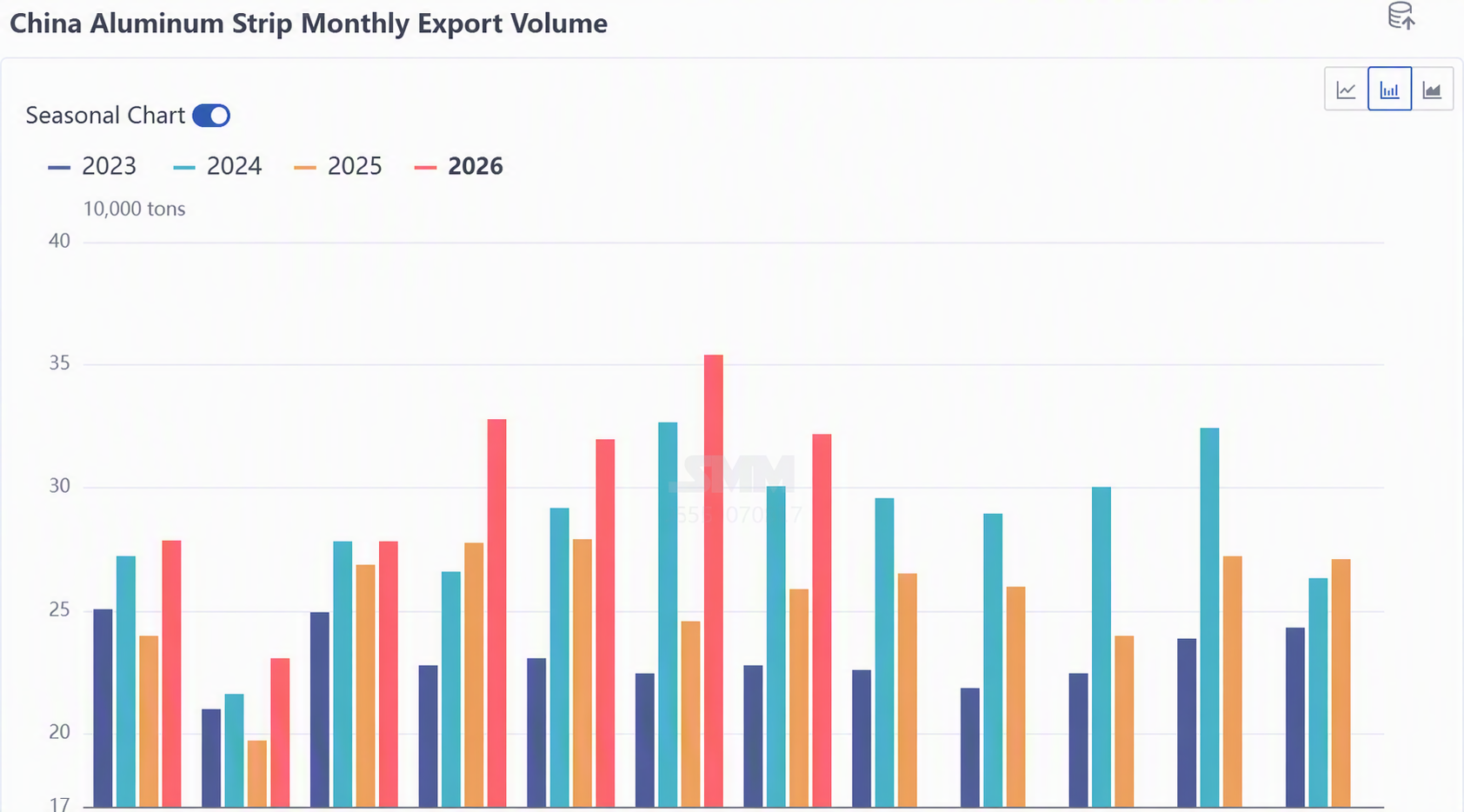
According to customs data, China's exports of aluminum plate/sheet and strip (including aluminum plates, sheets, strips, and aluminum-plastic composite panels) reached 321,900 mt in July 2026. On a MoM basis, July exports fell 9.1% from June's 354,000 mt, a decrease of about 32,100 mt, ending three consecutive months of growth. Exports rose 24% YoY in July, and cumulative exports for January-July 2026 totaled 2.1113 million mt, up 19.5% YoY.
By product structure, aluminum alloy sheet dominated July's aluminum plate/sheet and strip exports. Among them, rectangular aluminum alloy sheet with thickness of 0.2-0.28mm (mainly can stock) had exports of 139,100 mt, accounting for 43.2% of total July exports, but down 9.5% MoM (June: 153,700 mt), a decrease of about 14,600 mt. Cumulative exports of this category for January-July reached 916,400 mt, contributing 43.4% of total exports, remaining the core product. The second-largest was other rectangular aluminum alloy sheet with thickness of 0.35mm-4mm, with July exports of 62,500 mt, down 10.7% MoM, and cumulative January-July exports of 424,200 mt. The third was other non-alloy rectangular aluminum sheet (thickness >0.2mm), with July exports of 32,600 mt, edging down only 1.5% MoM, showing relative resilience. Rectangular aluminum alloy sheet with thickness >4mm saw the largest decline, with July exports of 27,800 mt, down 17.4% MoM, reflecting higher price sensitivity for thick plate demand and greater impact on thick plate exports from narrowing arbitrage after SHFE/LME price ratio recovery. Overall, the across-the-board pullback across all categories confirms the judgment that export demand has entered a contraction channel.
By country, Mexico ranked first with 34,900 mt in July, but down 22.8% MoM (June: 45,300 mt), accounting for 10.8% of total monthly exports. Cumulative exports to Mexico for January-July reached 257,400 mt, firmly the top destination. The US ranked fifth, with July exports of only 16,200 mt, plunging 37.8% MoM (June: 26,100 mt), and cumulative exports to the US for January-July totaled 200,300 mt. The sustained sharp pullback in exports to the US is directly due to the full resumption of production in July at a major North American plant's production line, which pulled back all can stock and automotive sheet orders previously diverted to China enterprises due to a fire. Only about 2,000 mt of residual volumes remained in August. Exports to the US will gradually pull back to the low level of 3,000-5,000 mt under the new tariff regime in H2. Southeast Asia showed strong resilience: Vietnam (25,000 mt, -3.8%), Thailand (17,300 mt, +0.3%), and Indonesia (12,100 mt, +3.8%) combined for exports of 54,400 mt, accounting for 16.9% of the month's total. As a traditional core market for aluminum plate/sheet and strip exports, Southeast Asia's demand remained stable. Among emerging markets, Nigeria (10,300 mt, +16.9%), Turkey (9,500 mt, +12.8%), and Kazakhstan (5,400 mt, +180.0%) saw significant MoM growth.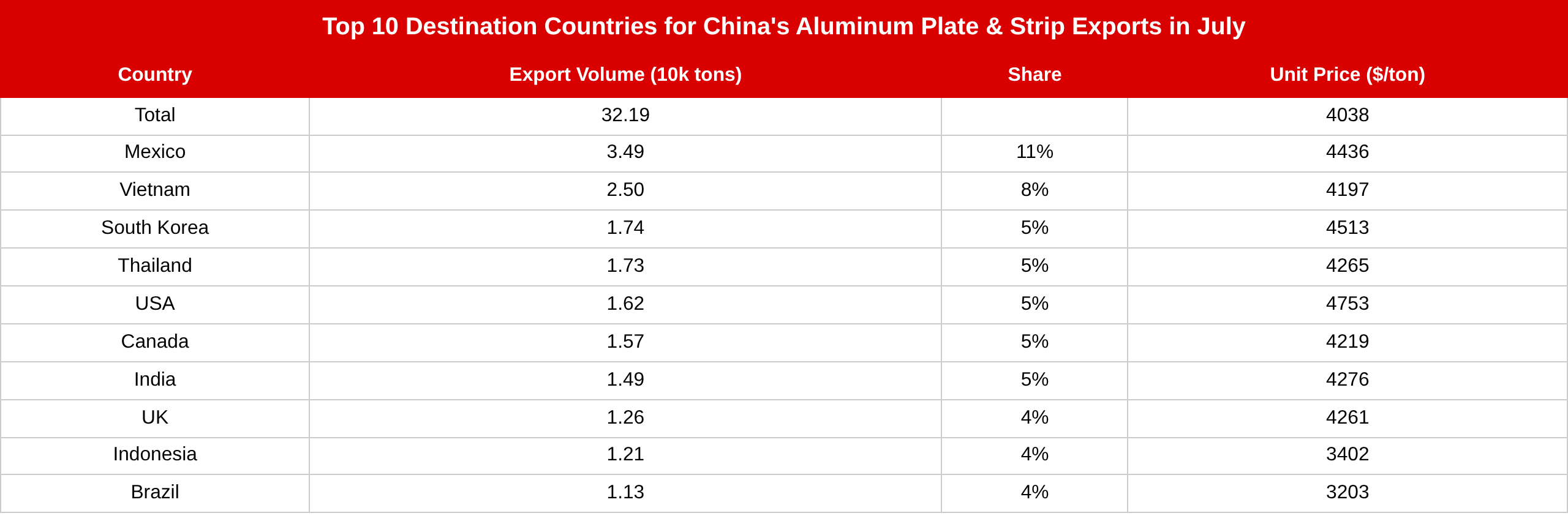
Previously, the SHFE/LME price ratio was in a range favorable for exports, driving sustained volume growth in Q2. However, from end-July to early August, the SHFE/LME price ratio widened significantly, compressing export profit margins substantially. Against this backdrop, for Chinese aluminum smelters to maintain export competitiveness, they need to raise processing fees to offset losses from the price spread between Chinese and overseas markets, but raising processing fees will further dampen overseas clients' willingness to place orders—this contradiction has already emerged first in the thick plate category. Looking ahead to H2, exports to the US will pull back to low levels, the widening SHFE/LME price ratio will continue to suppress new orders, and exports are expected to further pull back starting from August, with average monthly exports in H2 falling within the 260,000-30,000 mt range. Combining the solid base of 2.11 million mt in January-July, with a neutral estimate for the remaining months of 2026 (average monthly of 70,000 mt, about 1.35 million mt over five months), total annual exports are still expected to reach 3.4-3.5 million mt, which would be higher than 3.07 million mt in 2025 and could also surpass the 3.43 million mt level in 2024, but the Q2 export boom will be dificult to replicate in H2.
![July aluminum foil exports pulled back 9.3% MoM, but the full-year target of 1.3 million mt remains achievable [SMM Analysis]](https://imgqn.smm.cn/usercenter/fFkYh20251217171651.jpg)