According to customs data, China’s high-grade NPI imports in July 2026 extended the downward trend, falling for the third consecutive month and hitting a year-to-date low. Total imports in July were 641,400 mt in physical content, down 15.2% MoM and down 23.3% YoY; in metal content, this equated to 75,800 mt Ni, down 29.9% YoY.
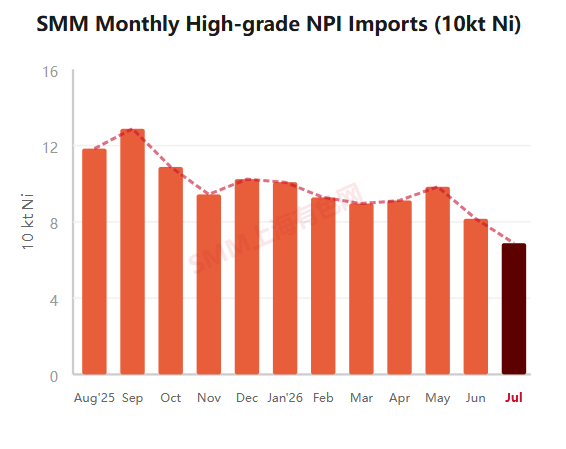
SMM data showed that July high-grade NPI imports came in at 68,900 mt Ni, down 12,500 mt Ni from 81,400 mt Ni in June, a decrease of 15.4% MoM. This also marked the third consecutive monthly decline since May (98,500 mt Ni). July imports were already below 70% of the May level, the lowest in the past 12 months. On a YoY basis, total customs NPI imports in July 2025 were 835,900 mt in physical content and 108,100 mt Ni in metal content. By comparison, in July 2026, physical content fell 23.3% YoY and metal content fell 29.9% YoY, with the declines further widening versus H1. Notably, July 2025 imports still maintained positive YoY growth (physical content +1.8% YoY; metal content +6.0% YoY), whereas July 2026 turned to a sharp YoY decline, reflecting a substantive shift in the high-grade NPI import landscape.
With imports trending lower, this can be viewed from both the supply and demand sides.
Supply side: Changes in the arrivals pace of Indonesian cargoes. Indonesia still accounted for the primary source of imports, but recently, due to factors such as typhoons, incremental cargoes from outside China have yet to arrive in a concentrated manner, and port arrivals were temporarily low. According to SMM, the market generally expected arrivals to increase next month, with port operations seeing some recovery. However, ocean freight rates fluctuated at highs and prices trended weaker, which to some extent dampened traders’ willingness to import.
Demand side: Stainless steel production pulled back, and steel mills slowed procurement. Entering July, China’s monthly stainless steel production came under pressure. According to SMM, mainstream steel mills had basically completed stockpiling for the peak season, and the overall procurement pace slowed markedly, with only a small number of enterprises having restocking needs. Downstream purchasing sentiment was relatively cautious; there was a clear price spread between steel mills’ acceptable levels and suppliers’ offers, and acceptance of high-priced cargoes was low. As futures moved lower, steel mills’ procurement interest further edged down, wait-and-see sentiment intensified, and spot deals in the market were relatively limited.