SMM August 20 News:
I. Imports: Up Slightly MoM, Surging YoY
According to the latest import and export data released by the General Administration of Customs, China's imports of nutshell charcoal reached 18,472.3 mt in July 2026, up 2% MoM from June and a sharp 67% YoY from the same period last year.
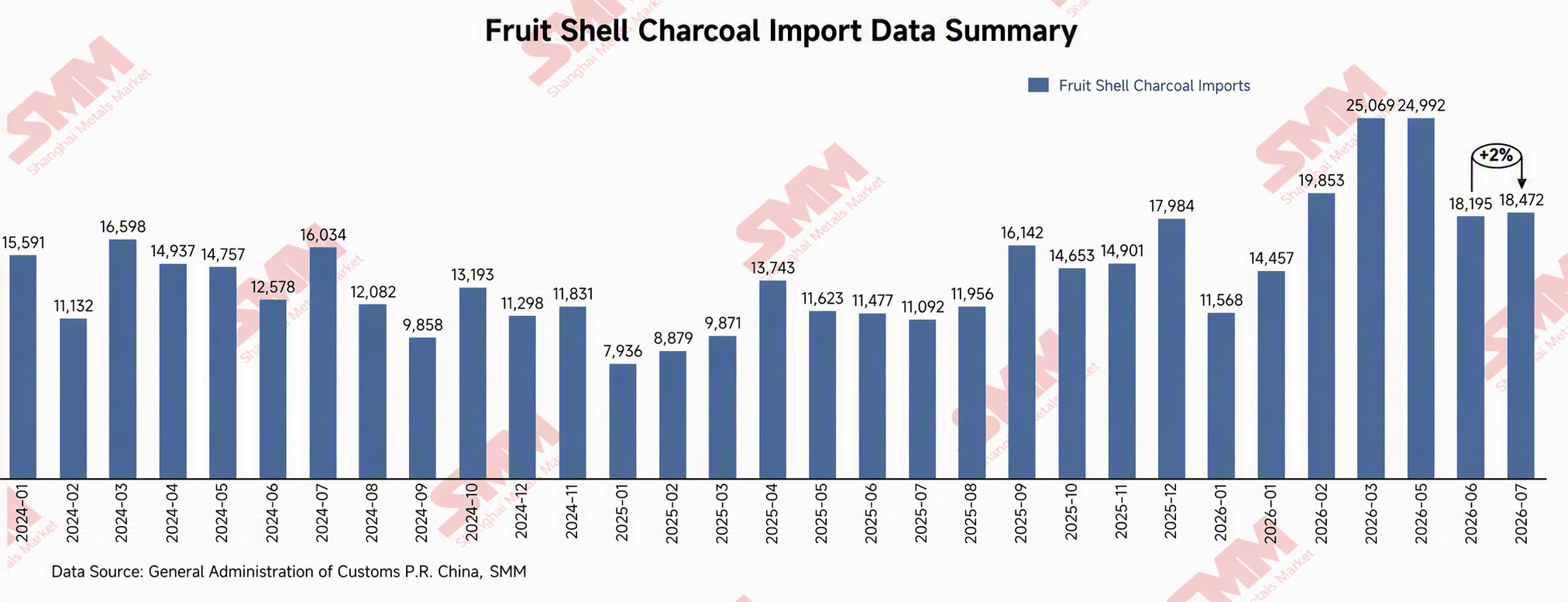
On a YoY basis, the 67% growth was particularly notable, reflecting a significant expansion in domestic demand for nutshell charcoal over the past year. This trend is closely tied to the rapid development of the sodium-ion battery industry—with the acceleration of sodium-ion battery industrialisation, nutshell charcoal (especially coconut shell charcoal), as an important precursor for hard carbon anode material, has seen its market demand continuously boosted. The mild 2% MoM growth indicates that, after the rapid volume expansion in the earlier period, import growth is stabilising, and the market has entered a relatively steady restocking pace.
II. Import Prices: Pull Back MoM, Cost Pressure Eases
The price side also showed notable changes. In July, the average import price of nutshell charcoal was $765/mt, down 5% MoM from $805/mt in June. The pullback in import prices means that enterprises producing hard carbon using coconut shell charcoal as raw material have seen some relief in cost pressure at the raw material procurement stage.
The price pullback may stem from multiple factors: on one hand, supply from major global nutshell charcoal-producing countries (such as Indonesia, the Philippines, Sri Lanka and other Southeast and South Asian regions) remained relatively ample in 2026, leading to a looser supply-demand pattern; on the other hand, domestic buyers have improved their bargaining power, and as import channels diversify and bulk procurement advances, unit prices have some downside room.
III. Cost Pass-Through: Hard Carbon Production Benefits
Nutshell charcoal (coconut shell charcoal) is one of the core precursors for hard carbon anode material in sodium-ion batteries. Hard carbon anode, as a key link in the sodium-ion battery industry chain with high technical barriers and a significant cost share, has its raw material cost directly affect the overall cost competitiveness of sodium-ion battery cells.
The 5% MoM decline in the average import price in July will, to some extent, be passed through to the hard carbon production side, lowering the production cost of hard carbon using coconut shell charcoal as raw material. For hard carbon producers, raw material costs account for a large proportion; the price decline provides them with more flexible pricing room and profit buffer, and also creates favorable conditions for the overall cost reduction and efficiency improvement of the sodium-ion battery industry chain.
IV. Localisation: Most Sodium-Ion Hard Carbon Raw Materials Have Achieved Domestic Substitution
Although imported nutshell charcoal has shown favorable changes in both volume and price, an industry trend that cannot be ignored is that most of China's domestic sodium-ion hard carbon raw materials have now achieved localisation.
In recent years, China's hard carbon producers have actively diversified their precursor sources, gradually reducing dependence on imported coconut shell carbon. Localisation substitution is mainly reflected in the following directions:
First, the local development of biomass precursors. In addition to coconut shell carbon, domestic enterprises are extensively exploring the use of agricultural and forestry waste (such as bamboo, walnut shells, apricot shells, etc.) and various biomass residues as hard carbon precursors, enriching raw material sources while reducing dependence on imports.
Second, coal-based and resin-based hard carbon routes. Some enterprises adopt non-coconut shell precursors such as coal tar pitch and phenolic resin to produce hard carbon. The raw materials for these routes are entirely based domestically, resulting in a higher degree of autonomous control over the supply chain.
Third, technology iteration and cost optimisation. As domestic hard carbon technology continues to mature, some domestic precursors have gradually approached or even reached the level of imported coconut shell carbon-based hard carbon in key electrochemical indicators such as capacity per gram, initial coulombic efficiency, and cycle life, and their cost-performance advantages are becoming increasingly prominent.
The continuous advancement of localisation has gradually diluted the impact of imported coconut shell carbon price fluctuations on China's sodium-ion battery industry chain. Even though the decline in the average import price has brought some cost benefits, its marginal impact is being weakened by the long-term trend of domestic substitution.
V. Outlook and Summary
Overall, the import data for coconut shell carbon in July 2026 shows a pattern of "volume increase and price decline." The imports fluctuating at highs and the MoM pullback in prices provide favourable support for hard carbon producers on the raw material cost side in the short term. However, from a longer-term perspective, the fact that most of China's domestic sodium-ion battery hard carbon raw materials have been localised means that the strategic position of imported coconut shell carbon in the industry chain is gradually shifting from "core dependency" to "supplementary adjustment."
For enterprises in the industry chain, on the one hand, they can make good use of the window period of declining import prices to optimise procurement strategies and lock in cost advantages; on the other hand, they should place strategic focus on continuous R&D of domestic precursors and supply chain construction, taking localisation as the core leverage to further consolidate the cost competitiveness and supply chain security of the sodium-ion battery industry chain.
As the industrialisation of sodium-ion batteries enters a fast track, the dual approach of "broadening sources" (diversified precursor development) and "reducing costs" (cost reduction through domestic substitution) at the raw material end will provide solid underlying support for the large-scale commercialisation of sodium-ion batteries.
SMM New Energy Research Team
Wang Cong 021-51666838
Feng Disheng 021-51666714
Lv Yanlin 021-20707875
![Sodium-ion Battery Industry Insight: Key Paths to Industrialisation and Evolution of Pricing Mechanisms [SMM Analysis]](https://imgqn.smm.cn/usercenter/JSjkr20251217171728.jpg)
![Analysis of Morocco's Phosphate Chemical Industry: Resource Endowment, Export Patterns, and Capacity Expansion [SMM Analysis]](https://imgqn.smm.cn/usercenter/EPIrk20251217171726.jpg)
![[SMM Cobalt & Lithium Morning Meeting Minutes] Lithium Chemicals Remained Relatively Strong as Industry Chain Divergence Intensified; Peak-Season Demand Support Gradually Strengthened](https://imgqn.smm.cn/usercenter/fblvS20251217171729.png)