Highlights: Morocco's phosphate ore reserves account for about 68% of the global total, with a grade as high as 33% (P₂O₅). Mining is predominantly open-pit, delivering significant cost advantages. Exports are shipped through four major ports—Casablanca, Safi, Jorf Lasfar, and Laayoune—with Safi emerging as a strategic hub. In 2025, raw ore exports reached 6.8 million mt, with India as the largest buyer. OCP dominates the entire industry chain, and phosphate fertiliser capacity has been expanded to 16 million mt/year. Under the SP2M plan, the 2027 target is 20 million mt/year, and the group's influence on global fertiliser pricing continues to strengthen. Tracking points: pace of capacity release, port logistics bottlenecks, and changes in export flows.
Foreword
The global distribution of phosphate ore resources is extremely uneven, and Morocco is undoubtedly at the pinnacle of this resource pyramid. As the country with the richest phosphate ore reserves, Morocco, leveraging its exceptional resource endowment and continuously expanding capacity deployment, holds an unshakable strategic position in the global phosphate chemical supply chain. More critically, Morocco is making a decisive shift from a mere resource exporter to a global phosphate chemical manufacturing hub through the OCP Group. Its integrated entire industry chain deployment and aggressive capacity expansion cycle are profoundly reshaping the supply-demand pattern and pricing logic of global phosphate fertilisers and phosphate chemicals. This article provides a panoramic analysis of Morocco's phosphate chemical industry from multiple dimensions, including resource reserves, product characteristics, export trade, industry layout, and capacity planning.
1. Resource Endowment: Reserves Alone Account for 70% of Global Total, High Grade and Low Cost Build Core Barriers
Reserve Scale : According to USGS data, Morocco's phosphate ore reserves in 2025 were approximately 50 billion mt, accounting for 68% of the global total. Some institutions estimate this proportion at around 70%–73%. Regardless of the metric, Morocco firmly holds the top spot in global phosphate ore resources. Africa as a whole possesses about 80% of the world's phosphate ore reserves, with Morocco contributing the vast majority.
In stark contrast to its reserve scale is its production level. In 2025, Morocco's phosphate ore production was about 36 million mt, representing only 14% of global production. For comparison, China's phosphate ore production in 2025 reached 129 million mt, or 49% of the global total, while its reserves were just 3.4 billion mt, accounting for 5% of the total. Morocco's pattern of "large reserves, small production" implies vast room for capacity expansion—the underlying logic behind OCP Group's sustained heavy investment in recent years.
Resource Characteristics: The core competitiveness of Morocco's phosphate ore lies not only in "quantity" but also in "quality." Its average ore grade is as high as 33% (P₂O₅), with some mining areas even exceeding 34%. Compared with China, where the average phosphate ore grade is only 16.85% and nearly 90.8% of ore is low-to-medium grade, Morocco's high-grade advantage is extremely pronounced.
More notably, Morocco’s phosphate deposits are almost entirely sedimentary, with the majority being open-pit mines suited for mechanized large-scale extraction. Additionally, the major mining areas are located near ports along the Atlantic coast, offering clear transportation cost advantages. High-grade ore means lower beneficiation costs and greater economic value, while open-pit mining translates to lower per-unit extraction costs and a faster pace of capacity release. This triple advantage of “resource endowment + mining conditions + logistical location” builds a cost barrier for Moroccan phosphate ore that is difficult to replicate in the global market. Furthermore, the rare earth element (TREO) content in Moroccan phosphate ore ranges from 500 to 800 ppm, presenting potential value for associated resource development. As global attention on critical minerals continues to intensify, this characteristic could also bring an additional strategic premium to Moroccan phosphate ore.
II. Export Landscape: Four Major Ports with Distinct Roles, Safi Port Emerging as a Strategic Hub
Morocco’s phosphate ore and related product exports are primarily handled through four major ports—Casablanca, Safi, Jorf Lasfar, and Laayoune—each with clearly differentiated functional positioning.
The Port of Casablanca is the traditional primary port for Moroccan phosphate ore exports, with most unprocessed ore exports concentrated there. OCP’s first phosphate shipments were exported through this port in 1921. However, as OCP shifts its strategic focus, the ore export terminals at Casablanca are planned to be gradually decommissioned.
The Port of Jorf Lasfar serves as OCP’s primary export hub for phosphoric acid and finished fertilizers. The port is connected to the Khouribga mining area by the world’s longest gravity pipeline, significantly lowering transportation costs and water consumption. At present, the three ports of Jorf Lasfar, Tanger Med, and Casablanca collectively handle nearly 88% of Morocco’s total port cargo throughput.
The Port of Safi is the strategic export hub that OCP is currently prioritizing.OCP has signed a contract worth $205 million with China’s ZPMC to supply advanced bulk handling equipment for Safi port. Once the new equipment is operational, the Port of Safi will have the handling capacity to process tens of millions of mt of phosphate ore and finished fertilizer products annually. Safi Port is replacing the increasingly congested Jorf Lasfar Port to become OCP’s core export gateway to the Americas and West African markets.
The Port of Laayoune, located in southern Morocco, exports phosphate ore transported from the Boucraa mining area via the world’s longest conveyor belt (102 km), primarily serving ore exports from the southern mining area.
Overall, Morocco's phosphate ore exports are evolving from the old pattern dominated by Casablanca to a new structure where Safi Port is emerging as a strategic hub, Jorf Lasfar Port is focusing on downstream processed products, and port operations are becoming more specialized.
Export data: volumes and prices both rose, market diversification accelerated
In terms of export volume, Morocco's phosphate ore exports showed strong performance in 2025. Full-year raw phosphate ore exports reached 6.8 million mt, up 4% YoY. In H1 2025 (from January to June), phosphate ore exports rose 26% YoY to 3.42 million mt. Exports in the first four months had already reached 1.94 million mt, up 240,000 mt YoY.
In terms of export value, the growth was even more pronounced. In the first seven months of 2025, total exports of phosphates and derivatives reached 55.18 billion dirhams (approximately €5.2 billion). For the full year, the export value of phosphates and derivatives exceeded 99.8 billion dirhams, up 14.6% YoY. Among this, phosphate ore export revenue alone surged 112% YoY in the first three quarters. OCP Group's full-year 2025 revenue reached approximately 114 billion dirhams (around $11.4 billion), up 17% YoY.
In terms of export destinations, India is the largest single buyer of Moroccan phosphate ore. In H1 2025, India imported 958,000 mt, up 20% YoY. OCP estimates that its 2025 full-year exports of phosphorus products (including DAP and phosphate ore) to India could exceed 2.5 million mt, up nearly 40% from 1.8 million mt in 2024.
Meanwhile, Morocco is actively implementing a market diversification strategy. H1 2025 export data showed: exports to Mexico rose 16% to 451,000 mt, to Turkey surged 58% to 223,000 mt, and to Lebanon jumped from 33,000 mt to 252,000 mt. New destinations included Poland (161,000 mt), Lithuania (144,000 mt), and New Zealand (87,000 mt). Furthermore, among phosphate ore exports from the Western Sahara region, India ranked first with 1.34 million mt, followed by Mexico (508,000 mt) and New Zealand (171,000 mt).
Price-wise, in Q2 2025, the FOB quotes for Moroccan phosphate ore with 68-72% BPL grade were $153-268/mt, a slight move up from the Q1 range of $150-263/mt. The uptrend in prices for high-grade ore persisted.
3. Industry Layout: An Integrated Network from Mines to Chemicals
Morocco's phosphate chemical industry is dominated by the state-owned giant OCP Group (Office Chérifien des Phosphates). Founded in 1920 and headquartered in Casablanca, OCP is 95% owned by the Moroccan government. After over a century of development, OCP has built a complete value chain from phosphate mining to high-end chemical production, covering the entire industry chain of mining, processing, fertilizer manufacturing, and global sales.
Upstream Mining: Three Major Mines Support Raw Material Supply
OCP’s phosphate ore mining is mainly concentrated in three major mine areas: Khouribga, Gantour, and Laayoune. Among them, the Khouribga mine is the core production area, accounting for about 70% of OCP’s phosphate ore production since first mining in 1921.
Midstream processing: Two major chemical hubs with division of labour
The process of converting phosphate ore into phosphoric acid and downstream fertiliser products is centred on two major chemical platforms: Jorf Lasfar and Safi. These two complexes serve as OCP’s strategic bases for turning phosphate ore into phosphoric acid and various fertilisers, equipped with world-class chemical units.
Downstream extension: Specialised operation of business units
To meet diverse market demands, OCP has divided its operations into several strategic units. Among them, OCP Nutricrops focuses on plant nutrition and fertiliser production, serving as the main driver of capacity expansion; OCP Specialty Products & Solutions concentrates on high-value-added specialty chemicals, covering industrial salts derived from purified phosphoric acid, precision plant and animal nutrition solutions, and serving advanced industries such as electronics and energy transition.
IV. Current Capacity and Expansion Plans: Global Phosphate Fertiliser Leader, SP2M Plan Driving a New Round of Growth
4.1 Current Capacity Scale
In 2025, Morocco’s phosphate ore production was approximately 36 million mt, with H1 production up 15.1% YoY. OCP is the world’s largest phosphate fertiliser producer. Its phosphate fertiliser capacity surged from 3 million mt/year in 2008 to 16 million mt/year in 2025. In the first seven months of 2025, Morocco’s total exports of phosphate and derivatives reached 55.18 billion dirhams, of which phosphate fertiliser exports were up 16.7% YoY. In terms of phosphoric acid, OCP’s phosphoric acid capacity at Safi is approximately 1.63 million mt/year. In March 2025, a new phosphoric acid treatment unit was commissioned at Jorf Lasfar, producing 1,500 mt of phosphorus pentoxide (P₂O₅) daily. In H1 2025, production of phosphoric acid derivatives increased 6.8% YoY, and export revenue grew 12.8% YoY.
4.2 Capacity Expansion: SP2M Plan Leads, Targeting 20 Million mt by 2027
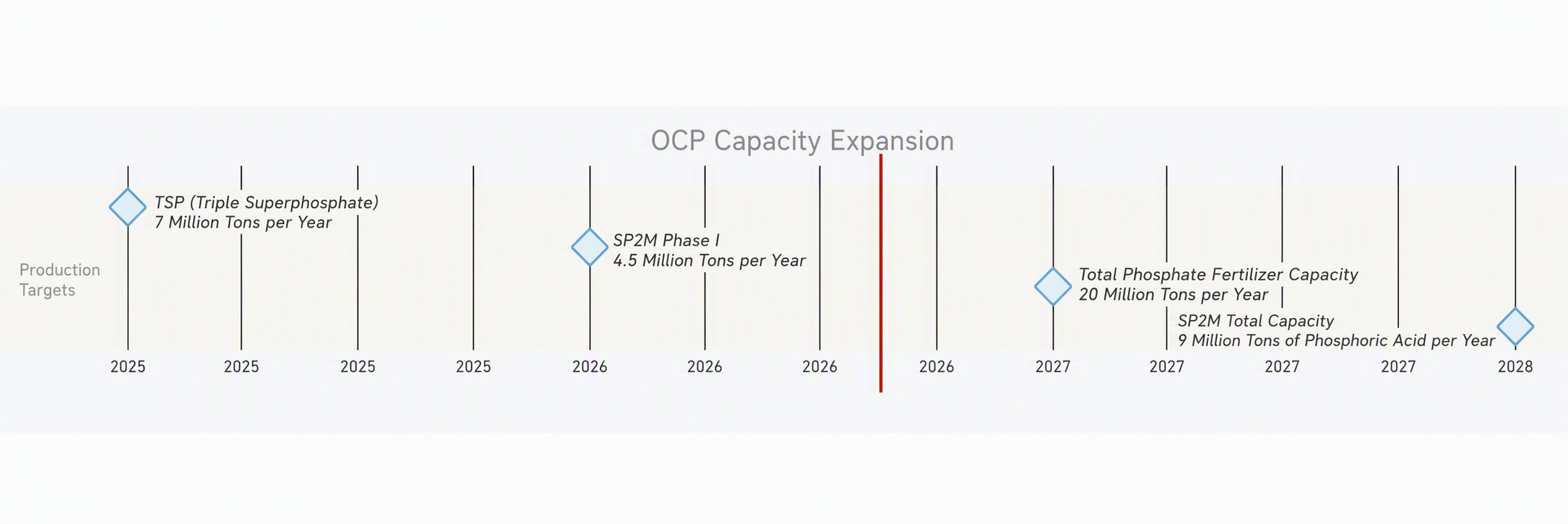
OCP is in an unprecedented capacity expansion cycle, with the core driver being the Mzinda-Meskala Strategic Plan (SP2M). The specific targets are as follows:
To achieve the above targets, OCP has formulated a massive investment plan. The investment plan from 2023 to 2027 totals $13 billion; from 2025 to 2028, OCP plans to invest $10 billion. In Q2 2025 alone, OCP invested 9.23 billion dirhams (approximately €870 million) in capacity expansion.
At the specific project level, OCP is building three new granulation units with a capacity of 1 million mt/year each at the Jorf Lasfar platform, and constructing a brand-new Mzinda chemical complex in the Safi corridor. Additionally, a new phosphate ore project with an annual production of 15 million mt is under construction, providing sufficient raw material security for downstream expansion.
The product structure is also being optimised simultaneously. Facing a market environment with high sulphur costs, OCP Nutricrops has increased the proportion of low-sulphur-consumption TSP product output. TSP now accounts for approximately 65% of OCP's phosphate fertiliser production, a substantial increase from the level of around 30% in 2025, reflecting OCP's flexible response strategy under cost pressure.
V. Summary and Outlook
Morocco's phosphate chemical industry presents distinct characteristics of "resource monopoly, integrated operation, and aggressive capacity expansion." Rooted in nearly 70% of the world's phosphate ore reserves, OCP has built an entire industry chain extending from ore extraction at mines like Khouribga, to phosphate and fertiliser processing at the two major chemical hubs of Jorf Lasfar and Safi, and further downstream to specialised business units such as Nutricrops and Specialty Products.
On the export front, Morocco is undergoing a logistical restructuring with a strategic shift from the traditional Casablanca Port to Safi Port. While India's position as the largest buyer remains solid, development in emerging markets such as Mexico and Turkey is accelerating, leading to more diversified export markets.
On the capacity side, OCP is at the peak of an expansion wave led by the SP2M plan—its phosphate fertiliser capacity target is aimed at 20 million mt/year (2027), with the SP2M plan adding 9 million mt/year (2028), 4.5 million mt/year of which is scheduled to be commissioned first in 2026. With the progressive realisation of major projects like the new granulation units at Jorf Lasfar and the Mzinda chemical complex, Morocco's position as a manufacturing hub in the global phosphate chemical supply chain will be further solidified.
Looking ahead, against the backdrop of rigid growth in global fertiliser demand and the increasing scarcity of high-grade phosphate ore, Morocco's pricing influence on global phosphate fertiliser and chemical product prices is expected to continuously rise, driven by its irreplicable resource and cost advantages, full industry chain integration capabilities, and aggressive capacity expansion strategy. For market participants, consistently tracking the pace of OCP's capacity release, the progress in alleviating port logistics bottlenecks, and shifts in export flows will be a key clue for grasping the evolution of the global phosphate chemical market's supply-demand pattern.
Note: For any additions to the details mentioned in this text, please feel free to contact us anytime at the following:
Phone: 021-20707860 (or add WeChat: 13585549799), Yang Chaoxing. Thank you!