- 2026 HRC-CRC Price Spread Consolidates at Lows, Below 2025 Average Level
Since the start of 2026, the HRC-CRC price spread has been moving sideways in a narrow range of 450-550 yuan/mt, with an average of 489 yuan/mt, lower than the 2025 average of 556 yuan/mt in the same period.
SMM HRC-CRC Price Spread Trend Chart
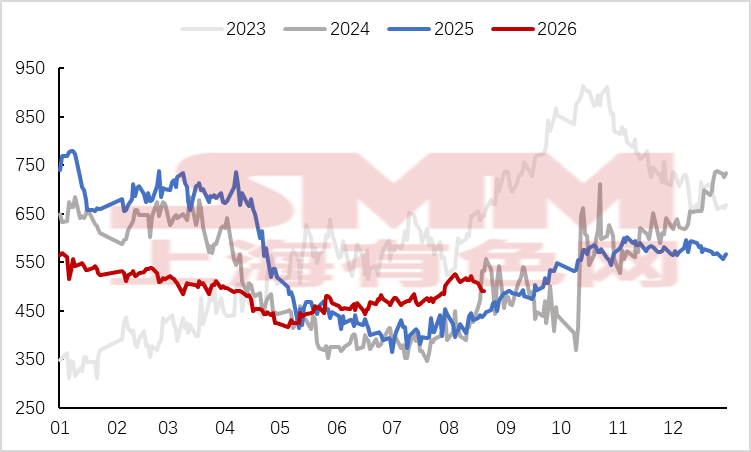
Source: SMM
This year, the HRC-CRC price spread has narrowed significantly YoY. The core reason for the price spread in the doldrums lies in the mismatch in the supply-demand pattern of cold-rolled and hot-rolled products. On the cost side, HRC closely tracks raw material trends, supported by fluctuations in iron ore and coke prices, with strong bottom support and notable price resilience. In contrast, the cold-rolled market relies more on downstream manufacturing rigid demand, with overall demand showing clear structural divergence: weak domestic sales and resilient exports. The domestic market has been a significant drag. According to CAAM data, China's cumulative auto production from January to July 2026 reached 17.567 million units, down 3.7% YoY, with traditional ICE vehicle production and sales continuing to weaken. The white goods sector also experienced sluggish domestic demand; from January to August, the overall production schedule for the three major white goods fell 6.3% YoY, among which household air conditioner production saw a YoY decline of over 14%. Terminal home appliance channels continued destocking, and OEMs were less willing to operate. Exports became the sole support for the industry, with auto exports particularly strong. From January to July, China's cumulative auto exports reached 6.14 million units, surging 66.8% YoY, with NEV exports leading the growth. White goods exports showed a divergent pattern: air conditioner exports were slightly under pressure, while refrigerator and washing machine exports maintained steady YoY growth of 6%-20%, offsetting part of the domestic sales gap. Overall, however, the growth in auto and white goods exports is limited and insufficient to offset the sharp decline in domestic manufacturing demand. Terminal stockpiling remained cautious, and speculative demand was absent, causing cold-rolled prices to struggle to catch up and exhibit greater downside flexibility, unable to follow HRC's strength.
- 2026 H2 HRC-CRC price spread expected to recover modestly but unlikely to break through current range
Overall, the HRC-CRC price spread in H2 2026 will show a phased trend of consolidating at lows, modest recovery, and difficulty returning to the mean, unlikely to break through the reasonable profit range of 450-550 yuan/mt. The low-profit pattern in the cold-rolling industry may persist. From end-Q3 to the peak season in Q4, there is limited room for the spread to recover, with core support from seasonal recovery in traditional manufacturing. As the high-temperature off-season ends, automakers and home appliance companies rush to meet deadlines and restock, coupled with continued release of export orders. Cold-rolled terminal rigid demand will improve MoM, boosting cold-rolled price elasticity and gradually widening the spread with HRC.
However, multiple factors will continue to cap the height of spread recovery, making a trend-like strengthening difficult. On the supply side, seasonal maintenance at steel mills in H2 is limited, with ample cold-rolled capacity released, and the industry's model of sacrificing prices for volume remains difficult to reverse.
In summary, the HRC-CRC price spread's center in H2 2026 will edge up slightly. Unless peak-season demand surges beyond expectations and steel mills actively control production to destock, which could pull the spread above the current range, or if terminal restocking is weak and domestic demand remains sluggish, the spread may pull back again, and the profit recovery process for the cold-rolling industry will continue to be hindered.
![[SMM Steel] India Domestic Steel Market Shows Mixed Price Movement](https://imgqn.smm.cn/usercenter/FFFrV20251217171719.jpg)
![[SMM Steel]](https://imgqn.smm.cn/usercenter/DpLok20251217171715.png)