Key Points: Nuvvon is a solid-state battery start-up based in New Jersey, US, pursuing a pure solid polymer electrolyte (SPE) route that contains no sulphide/oxide and can operate at ambient temperature and pressure, without cooling, heating or pressurisation systems. Its 1Ah/5Ah pouch cells are equipped with an NMC811 cathode and a lithium metal anode, achieve more than 2,000 cycles, operate from -20°C to +60°C, and have had their safety validated through independent nail penetration testing. The company is now moving from the laboratory to commercial sample delivery, has secured $5.3 million in seed funding, and has opened a new laboratory.
Introduction
Nuvvon is a solid-state battery technology company headquartered in Parsippany, New Jersey, US, focused on the R&D and commercialisation of next-generation energy storage solutions. The company was founded in 2022 (though some reports state 2017) by Dr Simon Madgwick, an engineering PhD, and Manveer Sidhu, a polymer battery scientist. With its independently developed solid polymer electrolyte (SPE) technology at the core, Nuvvon is committed to creating all-solid-state batteries with high safety, high energy density and low-cost advantages. Since 2025, the company has made successive breakthroughs in commissioning a new laboratory, releasing cell samples and validating safety, becoming a closely watched US-based innovation force in the global solid-state battery field.

1. Technology Route
Nuvvon follows the solid polymer electrolyte (SPE) technology route, which falls within the all-solid-state battery category.
1.1 Core Features
Pure Polymer System
Nuvvon's solid polymer electrolyte is a pure polymer system containing no sulphide or oxide nanoparticles. This marks a significant difference from the mainstream inorganic solid electrolyte routes based on sulphide and oxide.
Multifunctional Integration
The electrolyte serves simultaneously as the catholyte, anolyte and separator, achieving an integrated design in which one material performs multiple functions.
Zero Liquid, Zero Pressure
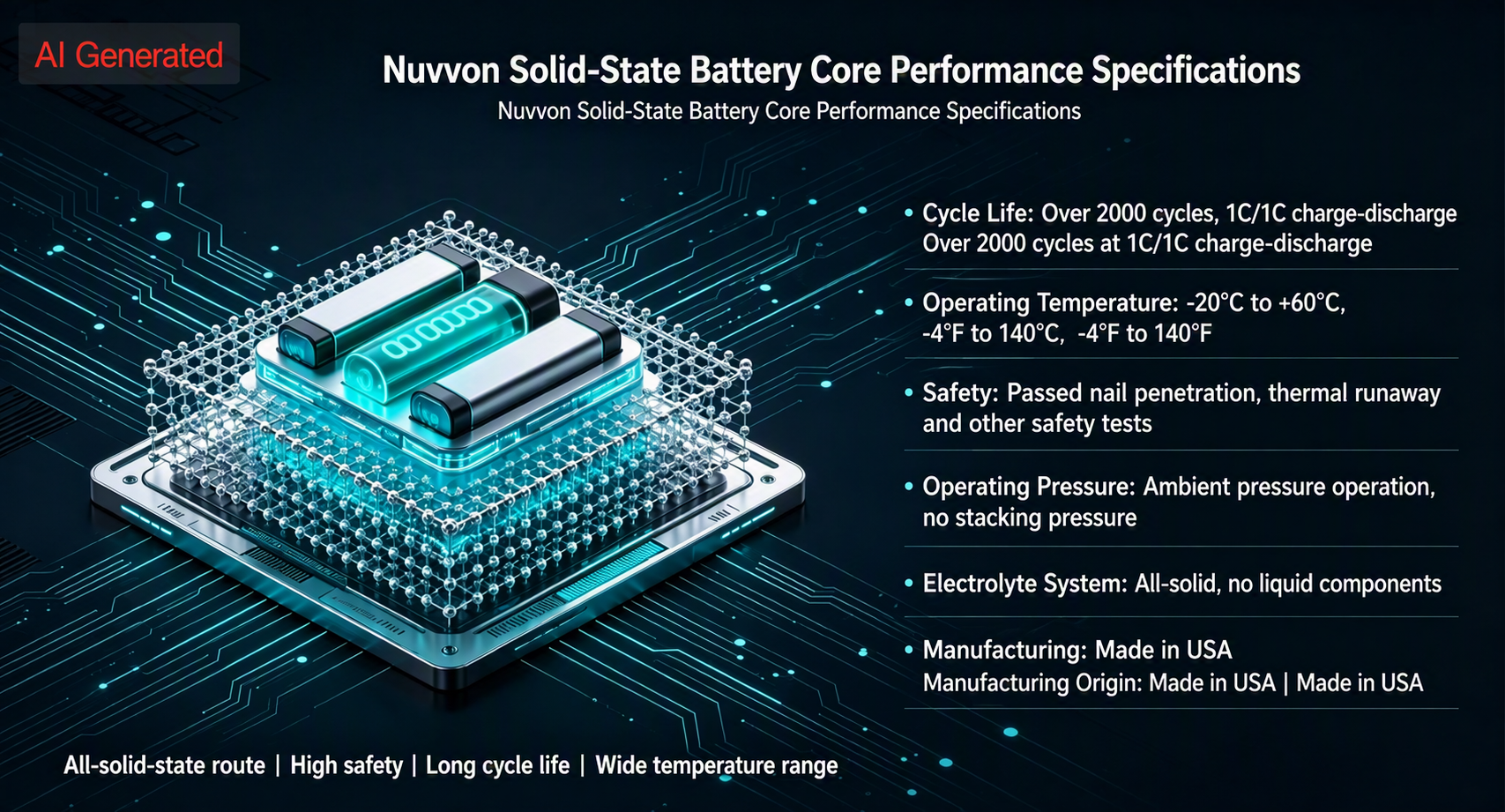
The cells are completely solid, without any liquid components (not even plasticisers). At the same time, the battery can operate at atmospheric pressure without the need for the high stack pressure applied in many ceramic electrolyte systems.
Wide-Temperature Operation
It operates normally over a temperature range of -20°C to +60°C without cooling, heating or pressurisation systems.
Room-Temperature Ionic Conductivity
Ionic conductivity at 25°C is greater than 1mS/cm.
Ultrathin Separator
A separator thickness of ≤20μm can be achieved.
1.2 Technology Advantage Positioning
Nuvvon's technology is designed to address the three core challenges of solid-state batteries:
Pressure issue: Ceramic electrolytes have high interfacial resistance and require enormous pressure or liquid assistance, while Nuvvon's SPE requires no pressure.
Temperature issue: Liquid electrolytes are unstable above 40°C, and conventional solid polymers cannot operate below 70°C, while Nuvvon's SPE can operate at room temperature and elevated temperatures.
Compatibility issue: Most electrolytes are incompatible with lithium metal and high-voltage cathodes (such as LNMO), while Nuvvon's SPE is compatible with both.
Process issue: Ceramics and other new technologies are difficult to manufacture on existing equipment, while Nuvvon's pouch batteries can be manufactured directly on standard lithium-ion production equipment.
2. Battery Introduction
Nuvvon's current flagship product is a solid-state rechargeable lithium-ion pouch cell, featuring an NMC811 cathode and a lithium metal anode.
2.1 Key Performance Parameters of Solid-State Batteries (Nuvvon)
2.2 Product Models (Nuvvon)
72mAh: Early laboratory-scale prototype
1Ah and 5Ah: Commercial-grade samples, officially launched in fall 2025
10-20Ah: Can be customized and supplied according to client needs
20Ah: Initiated in Q4 2025
2.3 Safety Validation Milestones
In October 2025, Nuvvon's SPE technology completed independent nail penetration testing at the University of Texas at Austin (UTA). The test compared conventional 1Ah commercial-grade cells equipped with Nuvvon's SPE and those equipped with a conventional liquid electrolyte.
The result was that the liquid electrolyte cell exploded instantly, while the Nuvvon SPE cells (both the graphite-NMC811 and lithium-NMC9 systems) neither caught fire nor exploded.
3. Planned Capacity
Nuvvon is still in the early stages of commercialization and has not yet disclosed any GWh-level capacity plans for mass production. However, based on its development pace:
Laboratory Stage: The company initially conducted R&D at the Rutgers University EcoComplex incubator.
New Laboratory Opening: In February 2025, Nuvvon opened a new laboratory in Parsippany, expanding its area to four times the original space and integrating R&D, manufacturing, and testing. The laboratory supports the scale-up of the solution casting process, can internally produce 1-2Ah lithium solid-state cells, and can further develop solid-state lithium-sulfur batteries.
Sample Sales Stage: 1Ah and 5Ah commercial-grade cells have already begun production and sales for relevant parties to perform prototype analysis.
Overall, Nuvvon's current focus is transitioning from laboratory validation to delivery of commercial samples, while large-scale capacity construction remains in the early preparation stage.
IV. Company Profile and Patents
4.1 Company Profile
Nuvvon Inc. is a US high-tech company focused on the R&D and commercialization of solid polymer electrolytes and all-solid-state batteries, headquartered in Parsippany, NJ. Founded in 2022 (some reports indicate that its nanotechnology research dates back to 2017), the company is currently privately held and venture capital-backed, with around nine employees. The core management team includes CEO Dr. Simon Madgwick, COO Jonathan Lex, and President and Head of Innovation Manveer Sidhu.
Nuvvon's core technology is its proprietary solid polymer electrolyte (SPE). This is a pure polymer system that contains no sulphide or oxide nanoparticles, with an ionic conductivity exceeding 1 mS/cm at room temperature (25°C) and a separator thickness of ≤20 µm. Based on this technology, Nuvvon has developed fully solid-state pouch batteries that can operate stably over a wide temperature range without requiring cooling, heating, or external pressure systems. The technology also offers plug-and-play compatibility and can be directly integrated into existing lithium-ion battery production lines.
4.2 Patents
Nuvvon has 10 patent documents (including applications and granted patents), of which five are granted and five are pending.
Representative patents include:
1. High-Performance Solid-State Electrolyte and Battery Based on Polysiloxane Si-tripodand Polymers, pending, May 19, 2023
2. Solid Polymer Electrolyte with Elastic Properties and Method for Producing Same, pending, January 18, 2023
3. High-Performance Solid-State Electrolyte and Battery Based on Cyanoethylated Polymers and Additives (WO), invalid, May 19, 2023
Its core technologies cover polysiloxane-based polymer electrolytes, elastic solid polymer electrolytes, and cyanoethylated polymer electrolytes.
V. Funding and Partnerships
5.1 Funding
Nuvvon's current funding scale is relatively small, and the company is at an early stage.
On April 12, 2024, a $5.3 million seed round was completed, and the company has generated revenue
The company is seeking a new financing round of up to approximately $10.3 million. Its overall valuation has not been publicly disclosed.
5.2 Partnerships
Thermo Fisher Scientific: Nuvvon is collaborating with Thermo Fisher Scientific on material solutions to advance all-solid-state battery manufacturing.
Rutgers University EcoComplex: In its early stage, the company conducted R&D incubation at the Rutgers University EcoComplex incubator, successfully graduated in May 2025, and moved into a new laboratory.
VI. Company Developments
February 2025: Nuvvon held a ribbon-cutting ceremony in Parsippany, officially opening a new R&D laboratory that expanded to four times its original size and integrates R&D, manufacturing, and testing.
May 2025: Nuvvon successfully graduated from the Rutgers University EcoComplex incubator and moved into larger new facilities.
June 20, 2025: Nuvvon announced a major technology breakthrough and said it would officially launch 1 Ah and 5 Ah solid-state rechargeable lithium-ion pouch battery samples in fall 2025, marking that its technology had moved beyond the laboratory prototype stage.
October 2025: Nuvvon's solid-state polymer electrolyte technology successfully passed independent nail penetration testing. Neither the graphite-NMC811 nor the lithium-NMC9 cells caught fire or exploded, validating the inherent safety of the technology.
2026: The company continued to advance commercialization. Its products are viewed by the industry as an important breakthrough for US companies to compete from the same starting line in the solid-state battery race after falling behind China in liquid batteries.
From an industry analyst's perspective, Nuvvon's pure polymer SPE route offers a unique and pragmatic alternative to the current mainstream sulphide/oxide inorganic solid-state electrolyte approaches. Its ability to operate at room temperature and ambient pressure, as well as its good compatibility with existing lithium battery manufacturing infrastructure, significantly lowers the barriers to commercialization—a key advantage that many competing products still struggling under high-pressure, high-temperature conditions can hardly match. The successful independent nail penetration test further corroborates its intrinsic safety, which is a key selling point for automotive and aviation applications.
However, the challenges are equally clear. The published cycle life (>2,000 cycles) is encouraging, but energy density data have not yet been disclosed. To compete with top-tier liquid systems and other solid-state rivals, Nuvvon must deliver competitive gravimetric and volumetric energy density at scale. In addition, while the 5 Ah sample is a positive development, starting from 20 Ah and then moving to GWh-scale mass production still requires substantial capital, process engineering, and supply chain development. If the planned $10.3 million financing is secured, it will provide critical bridge funding, but it still appears modest compared with the investment amounts of hundreds of millions or billions of US dollars commonly seen in the industry.
For Chinese battery companies, Nuvvon's progress highlights the importance of technology route diversification. Although most efforts in China are concentrated on sulphide and oxide electrolytes, the polymer route—if it can deliver on its performance promises—could achieve faster mass production at lower manufacturing costs. Chinese companies should closely track Nuvvon's scale-up progress and carefully assess whether hybrid routes or polymer-enhanced strategies can supplement the existing technology landscape. In the medium term, Nuvvon is unlikely to pose a direct threat to top-tier domestic players, but if it can successfully cross the "valley of death" from prototype to mass production, it could carve out a place in high-value market segments (such as aviation and high-end EVs) and become a trusted domestic alternative in the US.
Overall, Nuvvon's development trajectory is a positive signal for the global solid-state battery industry, proving that multiple technology routes can coexist. Its ultimate success or failure depends on execution capabilities, partnerships, and sustained funding support, but the initial technical validation is already convincing. We will continue to monitor its commercialization progress and potential impact on the competitive landscape.
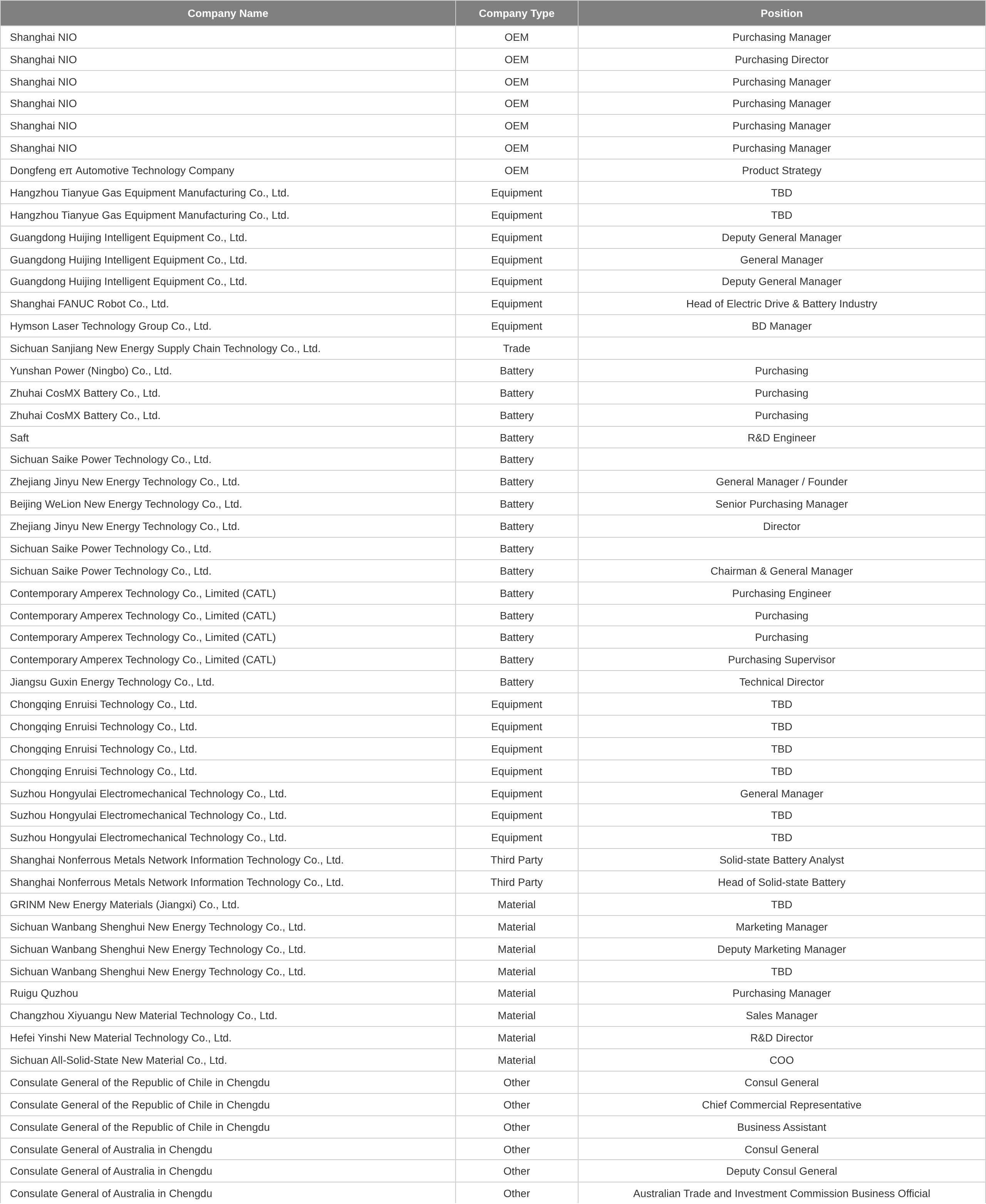
Finally, we would like to recommend SMM's premium conference. Current progress and some participating companies and representatives are as follows:
Tel: 021-20707860 (or add WeChat 13585549799), Yang Chaoxing. Thank you!
Related Information
Over 600 GWh of Demand; Solid-State Battery Equipment Market Faces Value Restructuring
[Solid-State Battery: Chery Solid-State Battery R&D Center Signed and Launched]
[Solid-State Battery: 800 Million Yuan, 2.2 GWh Solid-State Battery Project Lands in Hohhot]
[Solid-State Battery: A Solid-State Battery Pack Project Starts Construction in Qingyang, Gansu]
In July 2026, 10 Discussion Meetings on Solid-State Lithium Battery Standards Will Be Held
![[Lithium battery: China exported 3.69 billion lithium-ion batteries in Jan-Aug, up 22.9% YoY]](https://imgqn.smm.cn/usercenter/BQoXd20251217171731.jpg)
![Solid-State Battery Next Decade Series, Part 9 of 9: A Brand-New Track, Not a "Simple Sequel" to Liquid Lithium Batteries [SMM Analysis]](https://imgqn.smm.cn/usercenter/ezoBg20251217171730.jpg)
![[Weekly Observation] Cobalt industry chain in the doldrums in first week after holiday; cobalt salt prices continue to grind lower; some enterprises remain in reduced or halted production](https://imgqn.smm.cn/usercenter/GVVKq20251217171728.jpg)