SMM August 12 News:
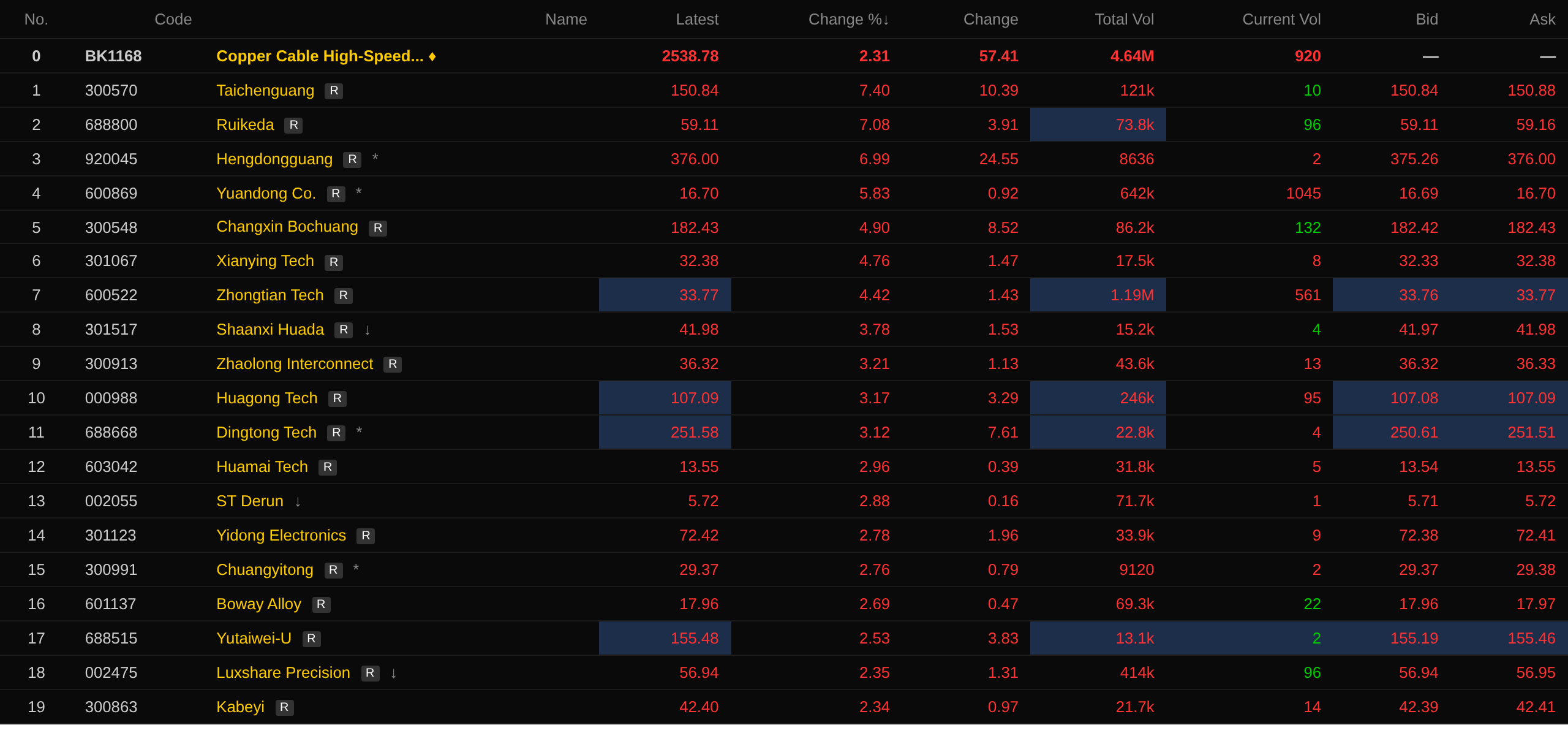
Foxconn Industrial Internet’s semi-annual report posted robust growth, further confirming the high prosperity of AI computing infrastructure and driving a recovery in sentiment across the high-speed interconnect industry chain. Against the backdrop of expanding computing power, high-speed copper cables, as a key short-reach interconnect solution for AI servers, attracted attention from some market funds; meanwhile, according to SMM, the installation rush for power batteries, strong prosperity in the energy storage sector, and booming AI computing demand combined to push copper foil industry operating rates steadily higher. As of 10:47 on August 12, the high-speed copper cable interconnect concept rose 2.31%. Among individual stocks: T&S Communications and Recode Era gained over 7%, while Hengdong Optics, Far East Smarter Energy, Changxin Bochuang, Xinying Technology, ZTT, and Zhaolong Interconnect led the advance.
News
[Shanghai to Build 100,000-Card-Class Ultra-Large Intelligent Computing Clusters in Songjiang, Lingang, Qingpu, etc.]The Shanghai Municipal Commission of Economy and Informatization issued the “Shanghai Software and Information Service Industry Development 15th Five-Year Plan.” It calls for a tiered supply system with coordinated “large clusters + small clusters + edge computing,” building 100,000-card-class ultra-large intelligent computing clusters in Songjiang, Lingang, and Qingpu, and 1,000-card-class clusters in Baoshan, Pudong, and Jiading. Traditional data centers and telecom rooms will be guided toward 100-card-class edge intelligent computing centers to meet ultra-low-latency computing needs of enterprises and individuals. Focusing on sectors such as finance, education, healthcare, culture and tourism, and manufacturing, the plan will build Model as a Service (MaaS) platforms, offering industry application marketplaces, model customization and hosting, agent construction, low-code development, API interfaces, computing power provision and management, AI inference, and other services to upgrade intelligent computing cloud capabilities. It also highlights tackling next-generation model architectures and promoting multi-technical route exploration based on non-Transformer architectures such as state space models, recurrent neural network variants, and liquid neural networks. Efforts will be accelerated to lay out frontier foundational model technology systems for physical intelligence, world models, quantum intelligence, and brain-inspired intelligence. Ultra-large-scale intelligent computing cluster networking technologies will be addressed, with a focus on core segments including high-performance computing chips (GPU/NPU), quantum chips (QPU), high-speed optical interconnects (CPO), high-bandwidth memory (HBM), and heterogeneous servers, to enhance intelligent computing hardware supply and drive deep integration of indigenous chips with mainstream large models. Emphasis will also be placed on new-type storage retrieval and digital-analog synergy to make breakthroughs in key technologies such as high-precision heterogeneous processing, native multimodal fusion, and dynamic value alignment, and to build automated complex reasoning that covers the full life cycle of corpora.
[FII: H1 2026 Net Profit up 95.99% YoY, AI Computing Demand Continued to Surge During the Reporting Period]FII announced on August 11 that H1 2026 revenue was RMB557.861 billion, up 54.63% YoY. Net profit attributable to shareholders of the listed company was 23.74 billion yuan, up 95.99% YoY. Net profit attributable to shareholders of the listed company after deducting non-recurring profit or loss was 22.984 billion yuan, up 96.99% YoY. Basic earnings per share was 1.2 yuan. The company plans not to distribute cash dividends, not to issue bonus shares, and not to convert capital reserve into share capital. The change in operating revenue was mainly due to the benefit from the continued surge in AI computing power demand, steady increase in market share among major clients, and strong performance of cloud service business, driving overall revenue growth. The change in net profit was mainly due to the benefit from the continued surge in AI computing power demand, with the company's main business operations achieving steady improvement in profitability. (Jin10 Data)
[CoreWeave Second-Quarter Revenue Doubles, Shares Surge 12% After Hours] CoreWeave (CRWV.O) rose 12% in after-hours trading on Tuesday after reporting second-quarter revenue of $2.58 billion, up 112% YoY and surpassing Wall Street expectations, indicating that demand for AI computing power is still growing rapidly; net loss was $626 million, compared to $290 million in the same period last year; order backlog reached $104 billion, with projects under construction totaling 1.5 gigawatts of capacity. CoreWeave is accelerating the expansion of its data center business, competing with cloud computing giants such as Amazon, Google and Microsoft to capture the market for data centers equipped with chips capable of running generative AI models. However, CoreWeave has yet to achieve profitability. As of the end of the quarter, its debt on the balance sheet reached $35 billion, used to cover NVIDIA GPU and other equipment procurement costs. This quarter, Meta said it would invest an additional $21 billion in CoreWeave. Additionally, CoreWeave announced a multi-year cooperation agreement with Anthropic and received a $6 billion commitment from quantitative trading firm Jane Street. (Jin10 Data)
[Axera Next-Generation High-Power AI Chip Completes Tape-Out, Supports Multi-Chip Cascading for Full-Fledged Large Model Inference on the Edge] From the earnings call of Axera's 2026 semi-annual report, it was learned that the company's next-generation high-performance, high-power AI chip has completed tape-out, with a significant increase in computing power specifications, equipped with high bandwidth, and supports two-chip or four-chip cascading, enabling high-performance inference of full-fledged large models on the edge.
[Strategic Cooperation Intent Reached, Huawei to Provide Ascend Computing Equipment to Beijing Data Group] According to Beijing Data Group, on August 7, Beijing Data Group and Huawei held working talks and reached a strategic cooperation intent. Next, the two sides will focus on deepening cooperation in computing power clusters and city-level computing infrastructure construction. Beijing Data Group’s subsidiary Tongniu Information will participate in the construction of Beijing's city-level computing infrastructure, coordinating the deployment, daily operations, and computing services of the group's self-innovated computing clusters. Huawei will fully support Beijing Data Group in advancing the city-wide layout of self-innovated computing, providing advanced Ascend computing equipment, comprehensive technical solutions, and service support to jointly build a trusted city-level computing foundation in Beijing, continuously releasing the value of computing engines and offering stable, reliable computing support for the development of “Digital Intelligence Beijing.”
[Nvidia Announces Partnership with Six Financial Giants to Arrange $500 Billion AI Infrastructure Financing System]Nvidia (NVDA.O) announced on the 10th local time that it has established a strategic partnership with Apollo, BlackRock, Blackstone, Brookfield, Goldman Sachs, and KKR to create an independent computing financing platform, aiming to mobilize over $500 billion in third-party capital over the long term for building artificial intelligence infrastructure. Nvidia stated that the new financing platform transforms Nvidia’s computing and full-stack AI infrastructure into an investable asset class for global capital, expands access to AI factories, achieves long-term revenue tied to usage, and supports Nvidia’s ecosystem growth in hardware sales and software applications.
[Tesla: Terafab Plan Launches in Texas, Targeting Over 1 Terawatt of Computing Capacity Annually]On August 6, Tesla (TSLA.O) stated that earlier this year, SpaceX and Tesla announced the launch of the “Terafab” project—the world’s largest chip manufacturing initiative, integrating logic chips, memory chips, and advanced packaging technology within a single facility. In April, Tesla broke ground on a new R&D fab at the northern campus of its Texas Gigafactory, which served as the predecessor to Terafab. And today, we officially announced that Terafab will be located in Grimes County, Texas. This facility will be an advanced semiconductor wafer fab, designed to bridge the vast gap between current global chip supply capability and future computing demand. The combined chip demand of SpaceX and Tesla is expected to exceed 1 terawatt (TW) of computing power, far surpassing the current global supply capability. We greatly appreciate our existing chip suppliers and encourage them to expand capacity where possible, but the widening supply-demand gap in the future is the core reason for the Terafab project. Terafab’s goal is to manufacture new computing capacity at unprecedented scale and speed. The project plans to build a vertically integrated factory with a manufacturing area exceeding 100 million square feet. The facility will cover the manufacturing, packaging, and testing of advanced logic chips and memory chips. Concentrating these processes at a single location will facilitate rapid iteration and accelerate the deployment of new computing power.
[ZTE Partners With Sky47 to Build Pakistan's Largest Intelligent Computing Data Center] Recently, the inauguration ceremony of Sky47 Karakoram-01, the largest integrated general-purpose and intelligent computing data center in Pakistan, jointly built by ZTE and Pakistan's leading cloud service provider Sky47, was held in Islamabad. As Pakistan's first customized AI-native Tier III data center, Sky47 Karakoram-01 has a total power supply capacity of 8.5 MW. The center will provide robust cloud computing, data hosting, and advanced digital service support across Pakistan, fully meeting the computing power needs of government and enterprises in fields such as artificial intelligence (AI), machine learning (ML), and high-performance computing (HPC).
Power Battery Cell Installation Rush and Robust AI Industry Chain Demand Keep Copper Foil Operating Rate Climbing
According to SMM, In July, the operating rate of the copper foil industry continued to climb, supported by strong end-use demand from downstream. In the lithium battery sector, production schedules of major Chinese lithium battery companies hit another record high in July. The installation rush for power battery cells boosted production schedules, and demand for lithium battery copper foil remained positive. In the electronic circuit segment, AI industry chain-related demand remained strong; capacity continued to shift toward high-end products, and demand for electronic circuit copper foil across all specifications stayed robust.
Voices From All Parties
CSC Financial’s research report notes that the scaling of frontier models has entered a stage of parallel multi-path development. Anthropic Mythos 5 and Fable 5 are estimated by the industry to have 8 trillion and 5 trillion parameters respectively; Kimi K3 has a total of 2.8 trillion parameters; and ByteDance is reportedly pretraining a model with up to 10 trillion parameters. Post-training is further extended to million-token agent trajectories, thousands of tool calls, and complex tasks lasting several hours. The RSI review published on July 8 covered 1,250 papers, 74% of which were published in 2026, indicating a clear acceleration in AI R&D automation. We believe that model competition is shifting from single-parameter expansion toward coordinated evolution involving pretraining, reinforcement learning, inference-time computing, RSI, and long-term agent capabilities. Computing power demand will expand from training to inference and agent execution. We remain bullish on the Capex ecosystem of major players, domestic chips and super-nodes, computing services, Pre-AI, B-end AI applications, and local inference.
Founder Securities' research report indicates that the market's oversold rebound has entered a critical phase, with divergence unfolding across tech and cyclical growth sectors. Continue to focus on allocation opportunities in three areas. First, tech stocks also require selective positioning by structure. At the index level, the Sci-Tech Innovation Board and ChiNext have rebounded about 10% from their lows, and there remains upside relative to the typical oversold rebound amplitude of major themes. The AI narrative has seen some shifts after US CSP earnings reports, with competitive capex marginally weakening; cloud business and healthy cash flow are decisive factors. Therefore, within AI, hardware and applications will become more balanced. Focus on core overseas computing power names with low crowding, as well as domestic computing power segments with high earnings visibility such as semiconductor equipment and materials; relatively undervalued AI applications and Hang Seng Tech deserve attention. Second, watch for opportunities in HALO assets, as expectations for US Fed interest rate hikes are easing. Beyond core resource-related non-ferrous metals and chemicals, oversold old and new energy, including power grids and electrical equipment, coal and petrochemicals, etc. Third, leading pharmaceutical names with improving fundamentals, low crowding, and abating headwinds.
CITIC Securities' research report notes that since 2023, the rapid development of AI has driven the iterative upgrade of optical module technology. New technologies such as optical chip speed upgrades, silicon photonics integration, and CPO architecture are jointly driving the iterative upgrade of optical module testing equipment. Combined with the rapid expansion of AI computing power infrastructure, this is driving a "volume and price increase" for optical module testing equipment. Currently, international players remain relatively ahead in the 1.6T high-end market, but domestic enterprises are accelerating their catch-up, with the gap steadily narrowing. We are bullish on the long-term development of the domestic optical module industry and the trend of import substitution for high-end optical module testing equipment.
China Merchants Securities, reviewing nine sharp A-share market corrections since 2015, found that sharp declines were mostly triggered by external shocks or liquidity risks, with stabilization marked by policy responses. The average rebound window after a correction is 34 trading days, with the Wind All A-Share Index rebounding by more than 19% on average, and the larger the prior decline, the greater the subsequent rebound tends to be. Sector performance exhibits "two-phase" rotation: in the first 10 trading days of a rebound, high-beta, oversold sectors such as electronics and computers lead the gains; after 20 to 60 trading days, the market shifts to themes with fundamental support, such as electrical equipment and food & beverage. For the current cycle, a two-step allocation is recommended: initially, prioritize TMT and other oversold, high-beta sectors (with focus on computing power leaders in China and overseas); after 10 to 20 trading days, return to a rebalancing of fundamentals, focusing on electrical equipment, chemical pharmaceuticals, coal, and non-bank financials. Along sector themes, key opportunities to capture are the catch-up potential in the overseas computing power price-hike chain, the elasticity of domestic computing power hardware, and gold's value as a safe-haven and rebalancing asset. The overall allocation revolves around three main themes: technology innovation, enterprises going global, and rebalancing of traditional low-valuation sectors.
According to CICC research, since mid-to-late June, global AI chains experienced notable pullbacks, with South Korea—characterized by high leverage, high crowding, and high retail participation—being the most severe. Behind this were the amplifying effects of high crowding and high leverage, disturbances from macro factors (such as rising expectations for US Fed interest rate hikes and the renewed blockade of the Strait of Hormuz driving up oil prices), and market concerns over a re-emerging AI bubble (e.g., Meta renting out computing power, declining token spending). In fact, before the bubble finally burst in March 2000, the tech stock market saw at least four rounds of large-scale, prolonged corrections. The triggers for these declines are highly similar to the current adjustment: short-term setbacks in industry trends, headwinds in the macro environment, and overheated valuation sentiment. The eventual rebound in tech stocks was also due to the easing of these three pressures. Therefore, corresponding to the present, for the market to stabilize and even start a new round of increases, these three factors are needed: the digestion of high crowding and high leverage (largely achieved), the easing of expectations for US Fed interest rate hikes or the actual announcement (watch the July FOMC meeting), and more importantly, new catalysts from earnings reports and industry developments (the July-August earnings season).
Recommended reading:
![Futures Remain Stable at High Levels; Spot Discounts Continue to Widen [SMM North China Spot Copper]](https://imgqn.smm.cn/usercenter/Dtcte20251217171710.jpg)
![Price spread between futures contracts widened significantly, prompting suppliers to aggressively cut prices to sell, but trading remained unsatisfactory [SMM South China spot copper]](https://imgqn.smm.cn/usercenter/tXxfd20251217171713.jpg)
![[SMM Analysis] Indonesia Sulphur & Sulphuric Acid Imports H1 2026: Volume, Price, Origin, Ports](https://imgqn.smm.cn/usercenter/CaLPF20251217171713.jpg)