SMM August 11:
Metals market:
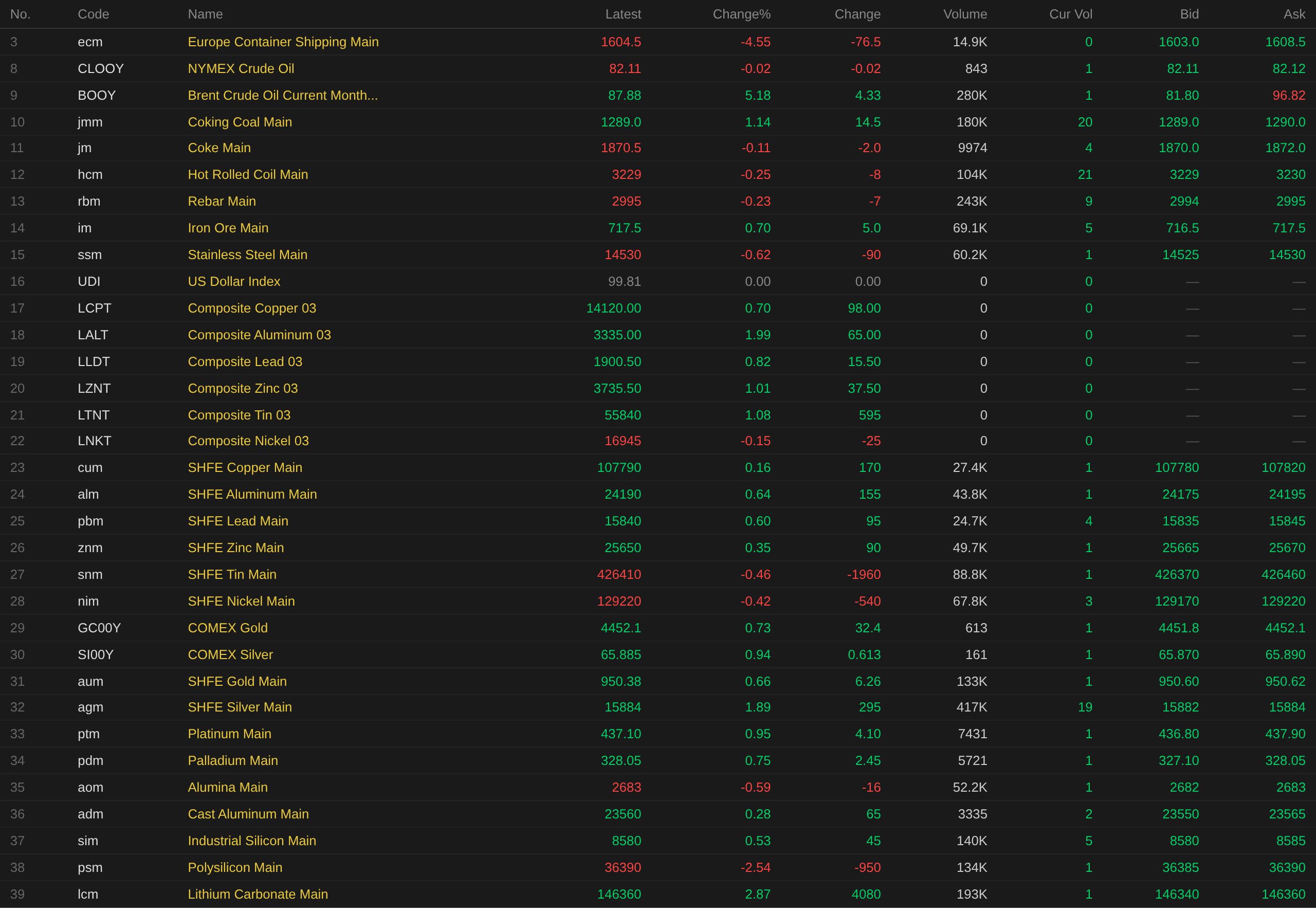
Overnight, most base metals on both domestic and overseas markets rose, with only LME nickel, SHFE tin, and SHFE nickel falling; SHFE tin fell 0.46%, SHFE nickel fell 0.42%, and LME nickel fell 0.15%. LME aluminum, LME zinc, and LME tin all gained over 1%, with LME aluminum up 1.99%, LME zinc up 1.01%, and LME tin up 1.08%, while the rest of the metals rose within 1%. Alumina main contract fell 0.59%, and cast aluminum main contract rose 0.28%.
Overnight, ferrous metals mostly fell, with iron ore up 0.7%, stainless steel down 0.62%, and hot-rolled coil and rebar both down around 0.2%. In the coking coal and coke segment, coking coal rose 1.14% and coke fell 0.11%.
Overnight, in precious metals, COMEX gold rose 1.11% and COMEX silver jumped 3.75%. On the domestic market, SHFE gold rose 0.66% and SHFE silver gained 1.89%.
As of 6:43 AM, August 11, overnight closing prices:
Macro Front
Domestic:
[National Bureau of Statistics (NBS): July CPI up 0.5% YoY, PPI up 3.5% YoY] NBS data showed: In July, affected by international imported factors, the Consumer Price Index (CPI) fell 0.1% MoM and rose 0.5% YoY. Excluding food and energy prices, the core CPI rose 0.3% MoM and 0.9% YoY, with the overall CPI maintaining a mild increase. Domestic demand in some sectors increased, but affected by imported and seasonal factors, the Producer Price Index (PPI) fell 0.7% MoM and rose 3.5% YoY, with the growth slowing by 0.6 percentage points from the previous month. In July 2026, the national PPI rose 3.5% YoY, down 0.7% MoM. The purchasing price index of industrial producers rose 5.5% YoY, down 1.0% MoM. From January to July on average, the PPI rose 1.8% from a year earlier, and the purchasing price index of industrial producers rose 2.8%. NBS chief statistician Dong Lijuan interpreted the July CPI and PPI data.
US Dollar:
As of the overnight close, the US dollar index rose 0.21% to 99.81, and markets now look to Wednesday's July CPI report. Cleveland Fed President Hammack said inflation has yet to return to target and the Fed may need to raise rates multiple times. She said a single 25bp rate hike "would not have much impact on the economy," but she was reluctant to prejudge the exact number of hikes or the terminal rate. Hammack believed the current 3.50%-3.75% rate range had not exerted significant restraint on the economy, and firms were not yet cutting growth investment due to high rates, so "it's time to act." She said the longer they wait, the harder it will be to get inflation back to 2%. Hammack also stressed that the job market had no obvious issues and the July employment data would not change her focus on inflation. She argued that markets can only assist the Fed, not replace the Fed in taking action. At the Fed's July meeting, Hammack dissented against holding rates steady, preferring a 25bp hike. (Jin10 Data APP)
According to the CME FedWatch Tool: The probability that the Fed will hold rates unchanged in September is 48.8%, while the probability of a cumulative 25bp rate hike is 51.2%. For October, the probability of holding rates steady is 34.7%, that of a cumulative 25bp hike is 50.5%, and that of a cumulative 50bp hike is 14.7%. (Jin10 Data APP)
On the macro front:
Today will see the release of China's July M2 money supply YoY (TBD), the US July NFIB Small Business Optimism Index, the US ADP employment change for the week ended July 25, US July existing home sales annualized, and the Reserve Bank of Australia rate decision on August 11, among others.
In addition, the RBA will release its rate decision and monetary policy statement, and RBA Governor Bullock will hold a monetary policy press conference.
Crude Oil:
Overnight, oil prices surged on both sides of the Atlantic, with WTI up 5.27% and Brent up 5.18%. In news, Iran's Foreign Ministry reiterated that the US naval blockade against Iran is an act of aggression against Iran. (Jin10 Data APP)
The key backdrop to Monday's oil rally was shaken market expectations for a return to normal shipping in the Strait of Hormuz. Reports said Iran claimed its agreement with Oman on a new shipping lane in the Strait of Hormuz had entered its final stage, but Iran also raised other conditions, leaving uncertainty over when normal commercial shipping would resume. Analysts said traders would not fully unwind the geopolitical risk premium priced into oil prices until they see "verifiable evidence" such as actual tanker transits or a formal deal. Reports pointed out that Iran had made demands including a US military withdrawal, sanctions relief, and war reparations for the reopening of Hormuz, leading the market to reassess the likelihood of a near-term return to normal shipping. This shifted the trading logic in the oil market. (Wall Street News)
Additionally, the US Strategic Petroleum Reserve (SPR) hit a record low again last week, falling below 300 million barrels for the first time since 1983. Data from the US Department of Energy (DOE) showed that for the week ended August 7, the US SPR fell by about 6.1 million barrels to 298.3 million barrels, not only breaching the 300-million-barrel mark but also setting a new low since 1983, continuing to approach the record low around 270 million barrels set in April 1982. This drawdown occurred against the backdrop of continued SPR releases by the US in recent years. The US released large volumes from the SPR in 2022 amid energy supply concerns triggered by the Russia-Ukraine conflict, and inventories have since stayed near historical lows. Although refilling began in recent years, the pace has not been enough to reverse the previous massive drawdown. Therefore, the significance of the current inventory level lies not merely in the loss of a few million barrels, but in the shrinking policy buffer that US strategic oil reserves can provide against future supply shocks. (Wall Street News)
![Supply-Side Contraction Eases Inventory Buildup Pressure; Lead Prices Expected to Maintain Consolidation Trend [SMM Lead Morning Summary]](https://imgqn.smm.cn/usercenter/hrxHx20251217171721.jpeg)
![The most-traded SHFE tin contract maintains a consolidation pattern, with spot market transactions recovering [SMM Tin Morning Brief]](https://imgqn.smm.cn/usercenter/reOma20251217171751.jpg)
![LME zinc inventory remains low, LME zinc consolidates at highs [SMM Zinc Morning Meeting Minutes]](https://imgqn.smm.cn/usercenter/nlmjY20251217171755.jpg)