[SMM Analysis] South Africa's High-Carbon Ferrochrome Exports Dip Slightly in June, Reflecting Supply Constraints

Published: Aug 7, 2026 22:09

South Africa exported 123,310.23 tonnes of high-carbon ferrochrome in June 2026, down a modest 0.32% month-on-month but sharply lower — down 44.57% — year-on-year. The near-flat monthly reading suggests exports have found a temporary floor after an extended period of decline, but the scale of the annual drop confirms that South Africa's ferrochrome trade remains firmly on the back foot, in stark contrast to the chrome ore side of the business, which posted export volumes nearly 39% higher than a year earlier over the same month.
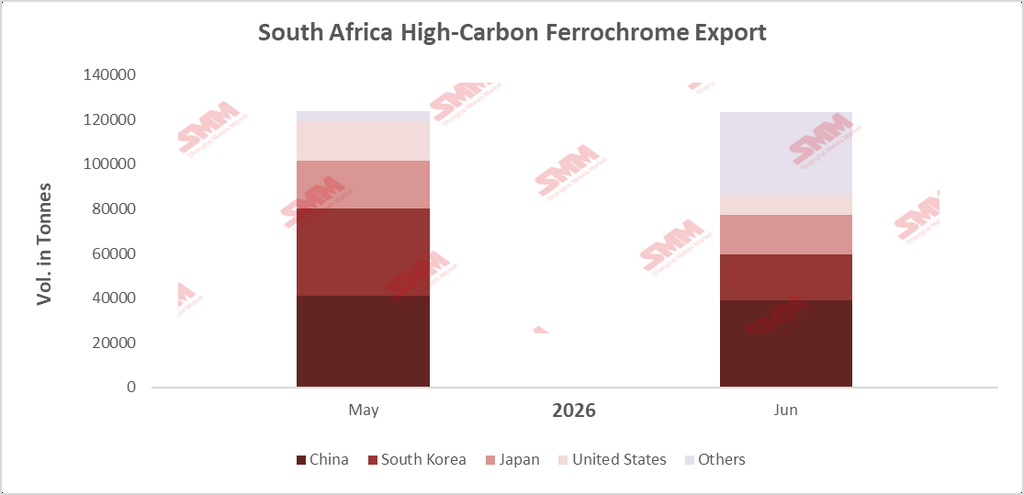
Figure 1: South Africa high-carbon ferrochrome export volume and destination breakdown, June 2026

A Decline Rooted in the Smelters, Not the Market

The subdued year-on-year performance is best explained by looking at what has been happening inside South Africa's ferrochrome furnaces rather than at demand abroad. Merafe Resources' H1 2026 production report, released in late July, showed the scale of the domestic problem directly: attributable ferrochrome production from the Glencore Merafe Chrome Venture collapsed 75% to just 28,000 tonnes, driven by extended suspensions at the Wonderkop and Boshoek smelters and a partial suspension at Lion. With a significant share of the country's ferrochrome-producing capacity effectively offline for much of the period being compared against, a steep year-on-year export decline is a direct, mechanical consequence of reduced output — not evidence that international buyers have gone elsewhere. Read this way, June's export weakness is a supply-side story, not a demand-side one.

A Destination Mix That Looks Nothing Like Chrome Ore's

China remained South Africa's largest ferrochrome destination in June, but at 31.56% of shipments, its share was far lower than the 67.61% it commanded in the equivalent chrome ore export data for the same month. That gap is telling: China's ferrochrome smelters are built to process imported raw chrome ore into alloy domestically, which is precisely why the country absorbs such an outsized share of South African ore but a comparatively smaller share of already-finished ferrochrome. South Korea's position as the second-largest destination, at 16.63%, fits the same logic from the opposite direction — Korea has limited domestic chrome ore resources and no comparable smelting base, so its stainless steel producers rely on imported semi-finished ferrochrome rather than ore. Together, the two destinations underscore how the ferrochrome trade is shaped by which countries can smelt their own ore and which cannot, a very different dynamic from the ore trade's concentration around Chinese furnace demand alone.

A Possible Turning Point Ahead

The timing of June's data is worth noting. Around the same period, Eskom and South Africa's ferrochrome producers reached a negotiated electricity tariff agreement, and Merafe subsequently announced the restart of the Wonderkop and Boshoek smelters at the very end of June. If that restart translates into a sustained production ramp-up through the second half of 2026, it raises the prospect that the worst of the year-on-year export declines may be behind the industry, with H2 2026 figures potentially beginning to narrow the gap against 2025 comparatives. That said, restarting idled smelters is rarely instantaneous, and the extent of any recovery will depend on how quickly output ramps back toward pre-suspension levels — a trend worth tracking closely over the coming months rather than assuming resolved.

A Policy Backdrop Pulling in the Opposite Direction

It's worth noting that ferrochrome sits on the other side of South Africa's chrome policy debate compared with raw ore. Where chrome ore exports have drawn government intervention — export permitting through ITAC and a proposed export tax, aimed specifically at discouraging raw shipments and pushing more material toward domestic beneficiation — ferrochrome is the very outcome that policy is designed to encourage more of. Seen against that backdrop, June's weak ferrochrome export figures represent something close to the opposite of the government's stated goal: less beneficiated product reaching export markets, even as raw ore shipments continue to climb. That contrast adds a layer of urgency to the smelter restart story, since a durable recovery in ferrochrome export volumes would be a more direct sign of the beneficiation strategy gaining traction than any adjustment to ore-export policy alone.

A Note on Demand Resilience

While South Korea's steady share of June shipments points to continued underlying buying interest, it's worth flagging that Chinese domestic high-carbon ferrochrome tender pricing had shown signs of softening in mid-July, with a bearish outlook for the following month's tender round. That suggests demand resilience may not be uniform across all destination markets, and is a detail worth weighing alongside the export volume data rather than assuming steady global demand across the board.

Bottom Line

June's ferrochrome export data tells a story of a market held down by supply constraints rather than weak demand, with a destination mix shaped by which countries smelt their own ore and which import the finished alloy. With Wonderkop and Boshoek now restarted and a new electricity tariff framework in place, the coming months will be the real test of whether South Africa's ferrochrome trade can begin closing the gap with 2025 levels, or whether the divergence between a booming chrome ore trade and a struggling ferrochrome trade becomes the defining feature of the country's chromium sector for the rest of 2026.

Data Source Statement: Except for publicly available information, all other data are processed by SMM based on publicly available information, market communication, and relying on SMM's internal database model. They are for reference only and do not constitute decision-making recommendations.

For any inquiries or for more information, please contact: lemonzhao@smm.cn
For more information on how to access our research reports, please contact:service.en@smm.cn
Related News
DRC’s Rubaya Mines Remain at the Centre of Conflict and Critical Minerals Race
1 hour ago
DRC’s Rubaya Mines Remain at the Centre of Conflict and Critical Minerals Race
Read More
DRC’s Rubaya Mines Remain at the Centre of Conflict and Critical Minerals Race
[SMM Flash] The coltan-rich Rubaya mining area in eastern Democratic Republic of Congo remains central to the region’s conflict and the global race for critical minerals. Reuters reporting from the area found that M23 controls the mines and has established an organised system covering mining, transportation and taxation. Rubaya is reported to produce a significant share of global coltan, from which tantalum is extracted for electronics, aerospace and medical applications. The reporting also highlighted harsh artisanal mining conditions, including the involvement of children, limited safety equipment and intense physical labour, while M23 reportedly collects taxes on production and controls who can trade the ore. The mineral trade is increasingly intertwined with diplomatic efforts to end the conflict. A US-backed peace process between the DRC and Rwanda and Qatar-mediated talks between the DRC and M23 are seeking to establish a lasting settlement, with access to the DRC’s vast mineral resources also attracting Western investment interest. However, analysts cited by Reuters stressed that peace agreements alone may not be sufficient without stronger mineral traceability to prevent smuggling and conflict financing. The DRC is also seeking to diversify investment and reduce its dependence on China, which remains deeply involved in the country’s copper and cobalt supply chains.
1 hour ago
[SMM Chromium Flash] South Africa's Chrome Industry Balances Ore Export Growth Against Costly Ferrochrome Processing
1 hour ago
[SMM Chromium Flash] South Africa's Chrome Industry Balances Ore Export Growth Against Costly Ferrochrome Processing
Read More
[SMM Chromium Flash] South Africa's Chrome Industry Balances Ore Export Growth Against Costly Ferrochrome Processing
[SMM Chromium Flash] South Africa's Chrome Industry Balances Ore Export Growth Against Costly Ferrochrome Processing
South Africa's chromium sector remains split between two very different trajectories. Chrome ore exports stayed structurally strong in June at 2.404 million tonnes, up nearly 39% year-on-year, with China absorbing more than two-thirds of that volume, and PGM producers including Sibanye-Stillwater, Northam Platinum, Eastplats and Southern Palladium's Bengwenyama project all adding further ore supply through chromite by-product growth. Ferrochrome, by contrast, is recovering only slowly despite real intervention — NERSA's 62c/kWh tariff, the Lion Smelter's phased restart, and the withdrawal of Section 189 retrenchments. Merafe's full H1 results, released 11 August, showed production still down 75% year-on-year, with sales held up mainly by drawing down existing inventory and by firmer prices, not by smelters running at anything close to pre-crisis capacity. That gap is being reinforced from multiple directions at once. The 13 August tailings dam failure at Samancor's Dikwena Chrome mine served as a reminder that even the ore-export side of the business, for all its trade-data strength, is not without operational risk. Further afield, the international market's expectations are evolving too: Kazakhstan's Kazchrome secured a registered Environmental Product Declaration for its ferrochrome in March, following Finland's Outokumpu, which set the industry precedent in 2023, pointing to a growing role for verified carbon credentials in how ferrochrome buyers assess supply options. With tariff relief and smelter restarts having done enough to arrest ferrochrome's decline but not yet enough to restore meaningful production growth, South Africa's chrome industry enters the second half of 2026 still leaning on ore exports and drawn-down inventory to carry its earnings, even as the broader market it sells into continues to evolve.
1 hour ago
[SMM Chromium Flash] Samancor Takes Full Responsibility as Dikwena Chrome Tailings Dam Fails Near Brits
2 hours ago
[SMM Chromium Flash] Samancor Takes Full Responsibility as Dikwena Chrome Tailings Dam Fails Near Brits
Read More
[SMM Chromium Flash] Samancor Takes Full Responsibility as Dikwena Chrome Tailings Dam Fails Near Brits
[SMM Chromium Flash] Samancor Takes Full Responsibility as Dikwena Chrome Tailings Dam Fails Near Brits
A dam wall failure at compartment 1B of Samancor Chrome's Dikwena tailings storage facility near Brits, North West province, released the bulk of its stored waste material on 13 August 2026, sending sludge toward the neighboring Eland Mine, operated by Northam Platinum. The spill blocked an access road to Eland's Maroelabult shaft, damaged a railway line and Eskom power infrastructure — triggering power interruptions in Brits and surrounding areas — and polluted a nearby watercourse. A railway embankment and earthen berms prevented the material from reaching the adjacent R566 public road. No injuries or fatalities have been reported. Samancor Chrome's CEO acknowledged that while a third party operates the facility, the company accepts full responsibility for the incident, and clean-up and repair teams have since restored access to the affected routes and begun repairing damaged Eskom infrastructure. South Africa's Department of Water and Sanitation, alongside the Limpopo-Olifants Catchment Management Agency, has opened a formal investigation and collected water samples from the affected area to assess the extent of contamination. Mineral and Petroleum Resources Minister Gwede Mantashe visited the site on 17 August alongside Water and Sanitation Deputy Minister David Mahlobo for a high-level assessment of the damage. Preliminary analysis points to a combination of factors behind the failure, including light rainfall in the days before the collapse and possible structural vulnerability in the facility's design. According to one tailings expert, the affected dam was a newly engineered structure that only began operating in 2024, following the re-mining of an older facility on the same site between 2019 and 2022 — meaning the failure occurred roughly two years into the new facility's operating life. The findings of the ongoing government investigation are expected to determine the precise cause and any regulatory or remedial action required.
2 hours ago
[SMM Analysis] South Africa's High-Carbon Ferrochrome Exports Dip Slightly in June, Reflecting Supply Constraints - Shanghai Metals Market (SMM)