SMM, August 6 –
The tungsten market has continued to move sideways since July 13, with transactions trending mediocre. From upstream tungsten ore to downstream powder products, the market is in an off-season state. On August 5, major domestic tungsten enterprises released their long-term contract prices for the first half of August. The price for 55% wolframite concentrates was set at 412,000 yuan/mt, up 1,000 yuan per standard tonne from the second half of July. The APT long-term contract price was similarly raised by 1,000 yuan/mt to 606,000 yuan/mt. The slight upward adjustment in long-term contract prices has to some extent boosted market confidence, but downstream remains in the off-season. Spot transactions in the APT and powder markets remain weak, with the center of spot order transactions slightly below long-term contract and institutional quotations.
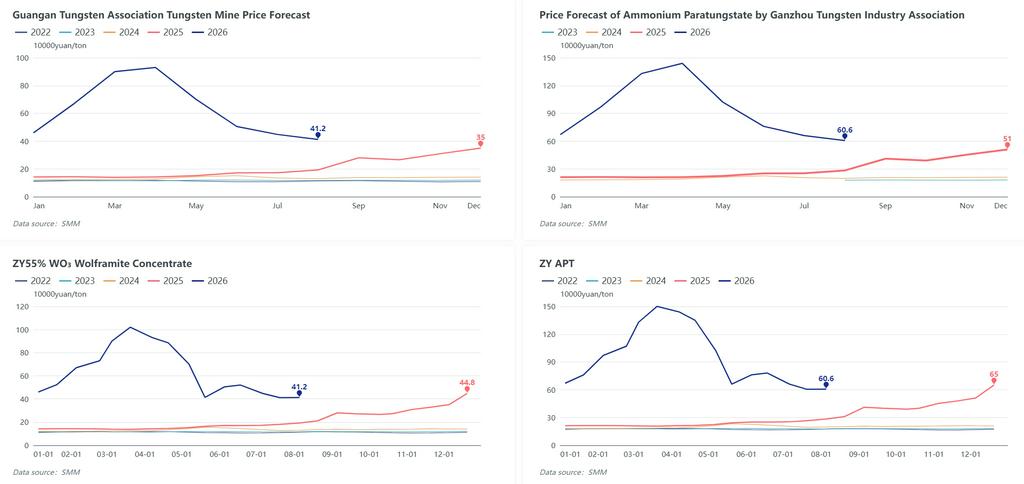
However, the market has recently started pricing in expectations of tungsten-related policies both in China and overseas. Key events are as follows, and SMM shares some views on these hot topics.
Event 1: On June 25, 2026, the National Mine Safety Administration issued the "Opinions on Regulating the Mining (Stripping) Construction Teams for Metal and Non-metal Production Mines."The document requires that, by May 1, 2027 for underground mines and by May 1, 2028 for open-pit mines, operators must choose one of two options: ① establish their own mining teams, or ② adopt compliant overall contract management. Fragmented task-based outsourcing and multi-tier subcontracting are prohibited, and labor dispatch is banned for underground operations. Mines failing to complete rectification by the deadline will be ordered to suspend production for rectification.Brief Analysis of Impact on the Tungsten Industry: In the short term, domestic tungsten mines are predominantly underground (wolframite concentrates are mostly mined underground, while some scheelite is mined in open pits or underground). In major producing areas such as Jiangxi and Hunan, a large number of small and medium-sized tungsten mines have long relied heavily on external outsourced mining teams, imposing real constraints on the supply side, cost side, and the survival of small mines. The rectification timeline for underground mines is tight; mines face pressure from recruiting skilled underground workers, personnel training, and labor relation transitions, driving up labor and management costs in the mining end. Some small and medium-sized tungsten mines may struggle to meet staffing requirements on schedule, posing risks of phased production cuts or shutdowns for rectification. The market is pricing in expectations of future tungsten ore supply contraction. However, there is still a time window before the rectification deadline, and no large-scale concentrated supply disruptions will occur in 2026, with the actual impact to be released gradually. From a long-term perspective, this will force outdated small mines to exit the market, while leading resource enterprises will leverage their own team advantages to further consolidate their position, benefiting the standardized operation of the tungsten ore supply side. Recently, many mining enterprises have already begun recruiting personnel to establish or improve their own mining teams.
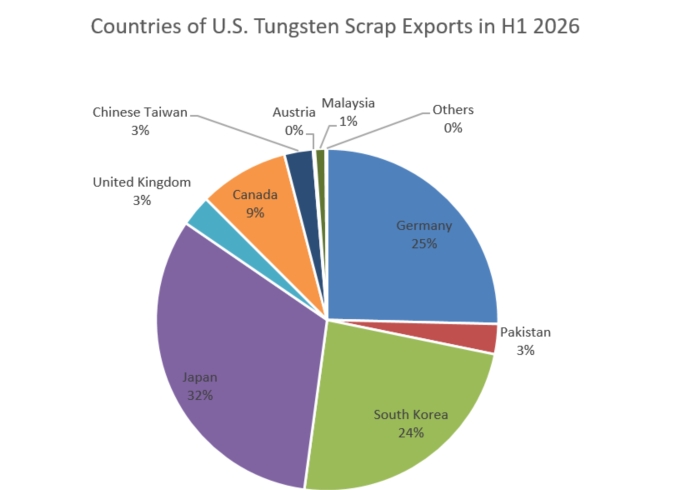
Event 2: On August 6, 2026, the United States released a temporary final rule on recyclable critical minerals, imposing mandatory domestic sales controls on tungsten shredded scrap.On August 6, 2026, the United States officially published the "Allocation Order and Additional Requirements for Recyclable Critical Minerals and Materials" temporary final rule in the Federal Register. Based on the Defense Production Act (DPA) and the Presidential Determination of July 30, 2026, mandatory domestic sales controls are imposed on two types of critical recycled minerals: tungsten shredded scrap and lithium battery black mass. The materials subject to mandatory allocation this time fall into two categories: Tungsten shredded scrap: corresponding to US export Schedule B code 8101.97.00.00, the core tungsten category under this control; Lithium battery shredded black mass (black mass): i.e., shredded material from used lithium-ion batteries containing lithium, cobalt, nickel, manganese, graphite, and other components, corresponding to three Schedule B codes, with only materials meeting the definition of "black mass" being controlled, requiring a special BIS exemption license for export. This event primarily affects trade flows in the scrap tungsten market outside China and the supply sources of tungsten raw materials in some countries. According to US Customs data, total exports of US tungsten shredded scrap in H1 2026 were approximately 2,183 mt, up 69% YoY. The main export destinations were Japan, South Korea, Germany, and other countries and regions, with exports to Japan totaling about 708 mt, compared to zero in the same period last year, a significant increase. The US is a major global exporter of tungsten scrap. Previously, large volumes of scrap tungsten flowed to alloy enterprises in Japan and Europe. After the control measures took effect, this cross-border supply of recycled tungsten contracted, making it harder for recyclers outside China to obtain raw materials, intensifying competition for global recycled tungsten resources, and creating upside room for scrap prices. Recycled tungsten has a substitution relationship with primary tungsten concentrates and APT, indirectly supporting the bottom of global tungsten product prices. At the same time, it reinforces the market valuation logic of tungsten as a critical mineral. It is also necessary to monitor the actual scale of subsequent BIS exemption approvals; if a large volume of materials obtains export licenses, the actual market disruption will be mitigated. For the Chinese market, since China has not yet explicitly liberalized the import of tungsten scrap resources, domestic tungsten scrap primarily comes from the domestic recycling system. This US policy has no direct impact on the Chinese tungsten market. However, the tightening circulation of tungsten scrap outside China has, to some extent, continued to push up the prices of products like crude sodium tungstate produced from scrap tungsten in Southeast Asia. This will keep domestic imports of tungsten intermediate products such as crude sodium tungstate from Southeast Asia on a downward trend.
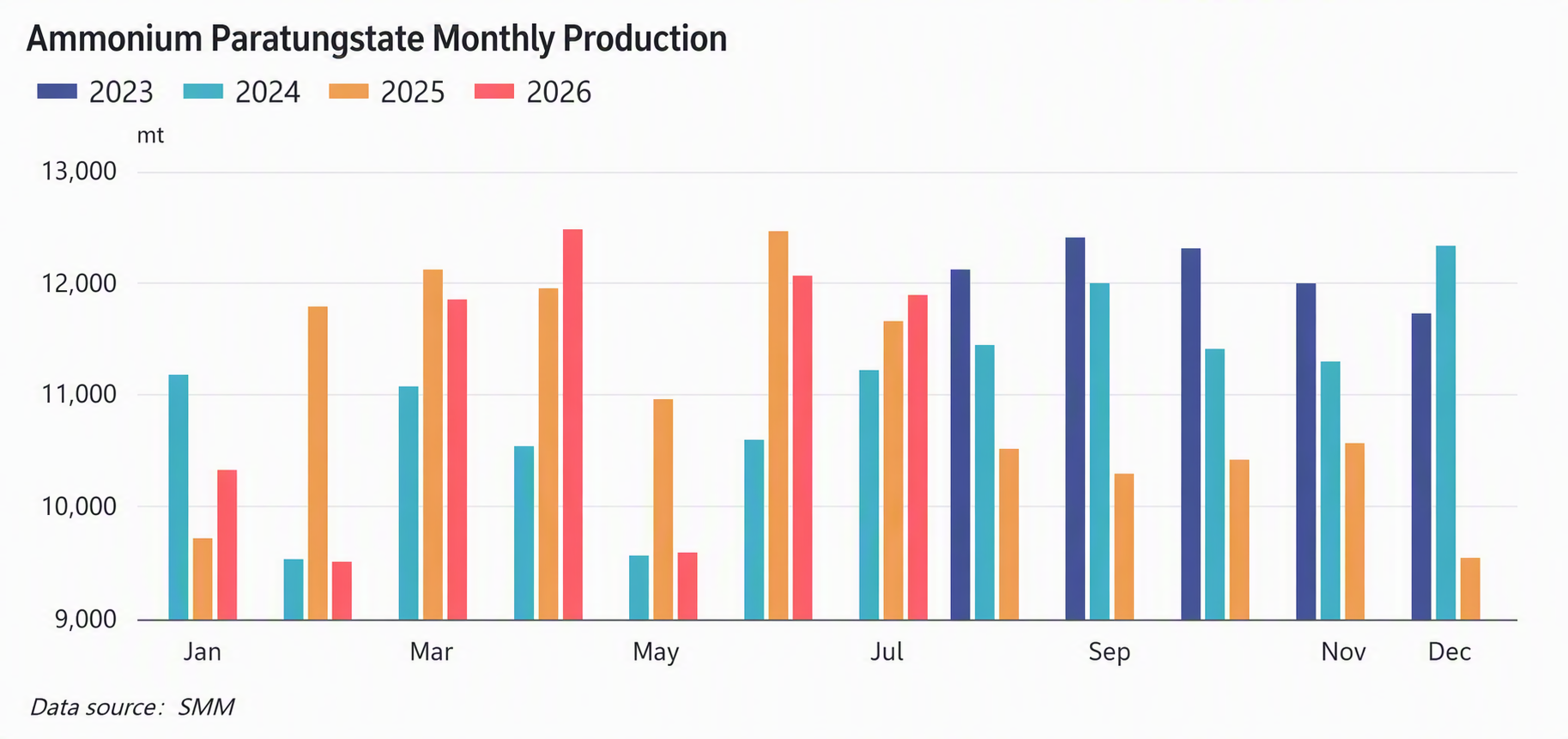
Overall, the two events—China’s mine labor rectification policies and the US export controls on tungsten shredded scrap—are unfolding, and the market is pricing in medium and long-term supply contraction expectations for critical minerals, leading to a clear divergence between sentiment and spot fundamentals. Returning to the domestic spot market, since mid-July, the fundamentals of the Chinese tungsten spot market have shown a divergence pattern of "weak reality, heating expectations." At the spot level, the traditional off-season has suppressed actual procurement of downstream powder and cemented carbide sectors. APT spot order transactions are weaker than long-term contract prices, and real transactions have not expanded in line with the increase in long-term contract prices. Recently, due to safety inspections in Henan, Jiangxi, Yunnan, and other places, some tungsten and molybdenum mines in Henan have been in a state of production suspension and cuts. The mine supply side has seen much disruption, providing good support for mine-side prices. However, downstream industries such as APT still have inventories to digest. According to SMM data, domestic APT production in July only fell by 1.5% MoM. Up about 2% YoY, while the downstream off-season in July brought weak demand. The volume of long-term contracts for some enterprises also declined. The industry was in a state of inventory buildup. Under significant financial pressure in the sector, some enterprises expected to offer discounts to facilitate sales, and prices lacked upward momentum. The tungsten market entered a phase of divergence with strong mine-side performance and weak smelting products.
Entering August, China's tungsten market is likely to maintain narrow range-bound movements at high levels , with constraints on both upward and downward price movements. Supply side, tungsten concentrate mine production saw no new mines coming on stream in the short term, and some mines in Henan and other areas struggled to resume production in the near term. In addition, mine inventories in south-west China were cleared. As the new round of quotas has not yet been implemented, the pace of mine shipments may slow down. Meanwhile, the rectification work under the Mine Safety [2026] No. 78 document has been gradually advancing, and mine recruitment and workforce restructuring continued to move forward. The market continued to assess potential supply disruption risks from small and medium-sized mines. In August, market support from the mine side strengthened; the downstream demand side remained the core variable constraining an upward breakthrough in this round of the market. In early August, the cemented carbide and cutting tool industries were still in the traditional off-season, with downstream enterprises mainly restocking based on rigid demand, lacking the momentum for large-scale proactive stockpiling. Spot transactions for APT and tungsten powder may continue a weak pattern, with spot order prices potentially staying below long-term contract prices. However, in late August, demand is expected to see a mild recovery, and the tungsten market may break out of its sideways consolidation. Going forward, two key validation signals need close attention: first, the recovery of orders in downstream manufacturing, observing the operating rate and raw material restocking pace of cemented carbide enterprises; second, the auction transaction prices of mines such as YTC Kafang, to gauge the true nature of mine-side transactions.
![Tight supply supports the rise in germanium prices, the minor metal sector strengthens, Yunnan Germanium and China Tungsten High-Tech lead the gains [SMM Flash]](https://imgqn.smm.cn/usercenter/tjmLW20251217171722.jpeg)