SMM August 5 news:
Expectations for easing geopolitical tensions in the Middle East, a sharp pullback in oil prices over two consecutive trading days, cooling inflation worries, and declining expectations for a US Fed September rate hike drove precious metals futures and associated stocks higher. In the futures market: as of around 11:18 a.m. on August 5, COMEX gold rose 0.94% to $4,191.5/oz; SHFE gold main contract rose 1.96% to 900.34 yuan/g; COMEX silver rose 1.4% to $61.09/oz; SHFE silver main contract rose 5.35% to 14,860 yuan/kg; silver T+D rose 4.45% to 14,796 yuan/kg.
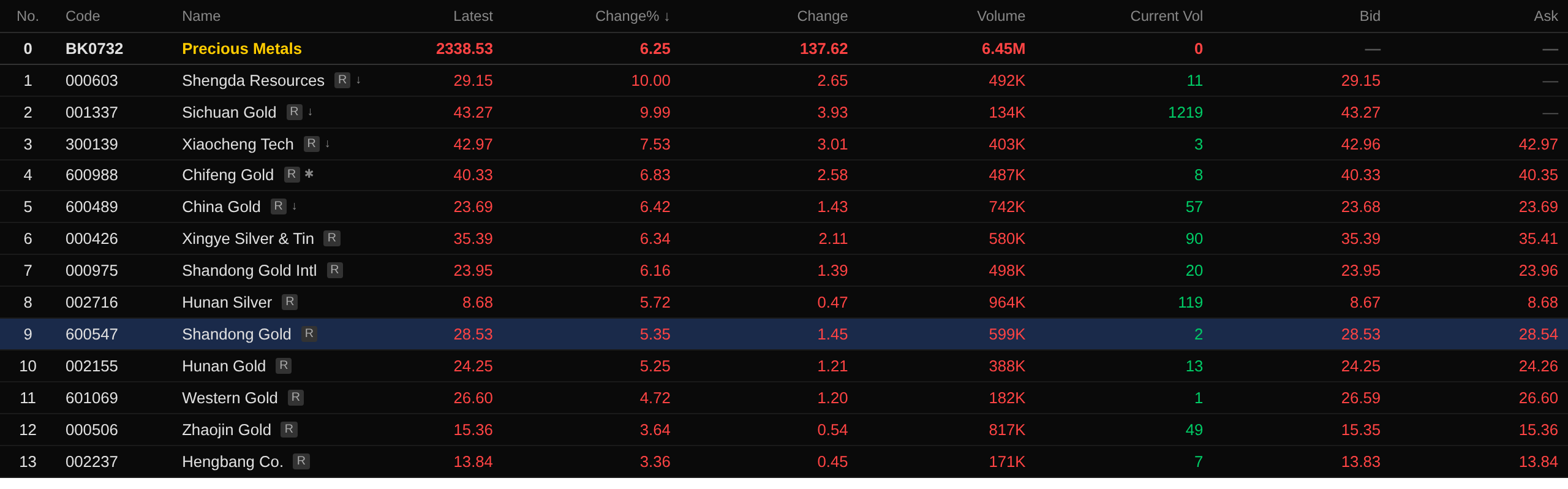
In the stock market: as of 11:19 a.m. on August 5, the precious metals sector rose 6.25%. Among individual stocks: Shengda Resources and Sichuan Gold hit the daily limit up; Xiaocheng Technology, Chifeng Gold, Zhongjin Gold, Xingye Silver&Tin, and Shanjin International led the gains.

News
[Bank of Korea Plans First Purchase of Domestically Refined Gold Bars in 13 Years] According to South Korean media, the Bank of Korea said on Monday that it will work with LS MnM, the Korea Exchange (KRX), and the Korea Securities Depository (KSD) to purchase domestically produced gold for the first time in 13 years through over-the-counter transactions, as geopolitical risks increased the need to diversify foreign reserves. LS MnM and Korea Zinc produce about 40 to 45 mt of gold annually as a by-product of smelting, with about 10% exported. The central bank said that if relevant companies apply, it will consider using the trading and settlement system of KRX and the storage facility being prepared by KSD to purchase some of the gold destined for export. The central bank added that it will arrange bulk transactions after prior consultation on price and quantity to limit the impact on domestic gold prices, and the new channel should reduce foreign exchange risk since previous overseas purchases were paid in US dollars. In addition, the central bank said it purchased a small amount of gold ETFs in Q2. It was also reported that its gold holdings remained unchanged as of July at 104.4 mt, while South Korea's foreign reserves at the end of June stood at $427.36 billion, including $4.79 billion in gold reserves.
[World Gold Council: Gold Investment Demand Expected to Remain Positive] A World Gold Council report noted that investment demand is expected to be the main driver of gold demand growth for the remainder of 2026, increasingly supported by OTC trading activity and Asian investment demand. Central banks will remain significant gold buyers. High gold prices will continue to suppress gold jewelry demand, but the response from gold mine production and recycled gold supply is expected to be mild. For the remainder of 2026, gold investment demand is expected to remain positive. OTC activities and Asian investment demand are expected to play a larger role, while Western gold ETF flows may stay sensitive to US Treasury real yields, the US Fed's monetary policy expectations, and the US dollar's movements. Although consumer spending remains relatively resilient in value terms, high gold prices will continue to suppress gold jewelry demand; technology gold demand is expected to benefit further from AI investment, though downside risks are accumulating. (Golden Ten Data)
[Zijin Mining: Terminates Acquisition of United Gold, Plans to Subscribe for 9.2% Equity Stake]Zijin Mining announced on the Hong Kong Stock Exchange that on January 26, 2026, its controlled subsidiary Zijin Gold International signed an Arrangement Agreement with United Gold, under which Zijin Gold International would acquire all issued common shares of United Gold at a cash price of C$44 per share, for a total consideration of approximately C$5.5 billion (approximately $4 billion). However, after a comprehensive assessment, both parties believe that by the deadline for satisfaction of the conditions precedent to closing under the acquisition (extended to July 29, 2026) and within a reasonable period thereafter, the aforesaid conditions precedent would still be difficult to fully satisfy or waive. The parties agreed to terminate the acquisition, with no termination fee or any other fees payable by either party to the other in respect thereof. Concurrently, the parties entered into a separate Share Subscription Agreement, under which Zijin Gold International intends to subscribe for 12.8 million common shares (approximately 9.2% of the enlarged total share capital) from United Gold in a directed issuance at a cash price of C$32.55 per share, for a total subscription amount of C$416.6 million, equivalent to approximately $295 million.
[Chifeng Gold: Expects H1 2026 Net Profit to Rise 54%-61% YoY]Chifeng Gold disclosed its performance forecast on the evening of July 14, expecting attributable net profit for H1 2026 to be between 1.7 billion yuan and 1.78 billion yuan, up 54% to 61% YoY.
[Zhaojin Gold: Expects H1 2026 Net Profit to Rise 347.48%-436.98% YoY]Zhaojin Gold disclosed its performance forecast on the evening of July 14, expecting attributable net profit for H1 2026 to be between 200 million yuan and 240 million yuan, up 347.48% to 436.98% YoY; and recurring/underlying net profit to be between 80 million yuan and 116 million yuan, up 490.44% to 756.14% YoY.
[Shandong Humon Smelting: Expects H1 2026 Net Profit to Rise 81.06%-122.36% YoY]Shandong Humon Smelting disclosed its performance forecast on the evening of July 14, expecting attributable net profit for H1 2026 to be between 570 million yuan and 700 million yuan, up 81.06% to 122.36% YoY; and recurring/underlying net profit to be between 272 million yuan and 402 million yuan, down 2.03% to 33.73% YoY.
[Western Gold: H1 2026 Net Profit Expected to Rise 280.16%-333.39% YoY] Western Gold disclosed on the evening of July 13 that it expects its H1 2026 net profit attributable to the parent company to be 500 million to 570 million yuan, up 280.16%-333.39% YoY; and adjusted net profit to be 490 million to 580 million yuan, up 172.96%-223.09% YoY.
[Zhongjin Gold: H1 2026 Net Profit Expected at 4.1-4.6 Billion Yuan, up 52.15%-70.7% YoY] Zhongjin Gold disclosed on the evening of July 13 that it expects its H1 2026 net profit attributable to the parent company to be 4.1 billion to 4.6 billion yuan, up 52.15%-70.7% YoY; and adjusted net profit to be 4.05 billion to 4.55 billion yuan, up 36.96%-53.87% YoY.
Spot Market
Silver
On August 5, the morning ex-factory reference average price of SMM #1 silver was 14,556 yuan/kg, up 2.38% from the previous trading day.
In the spot market, downstream demand remained sluggish this month, with limited new orders overall. The strengthening silver price further weakened downstream purchase willingness; market transactions mainly relied on support from banking institutions, with deals concentrated around parity, and traders were reluctant to quote. Morning quotations in Shanghai were mostly at parity to a premium of up to 10 yuan/kg against TD; in Shenzhen, some national standard goods were quoted around parity. Although low-priced goods existed, they did not significantly disturb spot trade. Today, the market quoted a discount of 60 to 50 yuan/kg against the most-traded SHFE contract 2610. Overall, expectations for a Strait of Hormuz agreement heated up, inflation concerns eased briefly, and precious metals recovered slightly. In the spot market, the rise in silver prices further suppressed demand, with orders remaining sluggish and trading staying thin.
Voices
Regarding the future trend of precious metals, some institutions' views are as follows:
CITIC Securities research report stated that this year gold prices shot up and then fell rapidly, but we believe gold is still in a major bull market, with reasons including the accelerating expansion of the US fiscal deficit, irreconcilable geopolitical rifts under deglobalization, and continued gold purchases by global central banks providing a floor. Therefore, we think this round of decline in gold prices is merely a temporary correction within the bull market. The current pullback has approached historical extremes, and the $4,000/oz area is highly likely to be the bottom zone for this round. Looking ahead, the impact of the Strait of Hormuz situation on gold prices is expected to shift from a drag to a boost, the Fed's monetary policy may be more optimistic than market expectations, and coupled with surging US military spending driving up the deficit, gold prices are expected to return to an uptrend within the year.
Deutsche Bank precious metals strategist Hsueh Michael stated that the "explosive rally phase" for gold prices that began in August 2024 is not yet over, and maintains the forecast of gold at $4,600/oz in Q4 2026. This assessment rests on a triple framework of fair value models, statistical tests, and official demand data, discounting the significant downside risk implied by commodity price ratios. (Zhitong Finance)
A research report from CICC Wealth Futures shows: oil prices pulled back, gold rebounded, and currently, the yen's disruption causing moves in the US dollar index is a new disturbance factor, which is expected to have a relatively limited impact on gold price trends. The biggest pressure on gold currently still comes from oil prices. CICC Wealth Futures believes that if oil prices are not excessively strong, the probability of gold maintaining a fluctuating trend or drifting higher is relatively high.
Everbright Futures' outlook for August suggests that the short-term gold price trend depends on the evolving US-Iran situation. If the conflict persists or its spillover expands, market sentiment may weaken again, and under liquidity risk expectations, gold prices may continue to underperform. However, if a substantive breakthrough in negotiations occurs, gold prices could stabilize in the short term and undergo a recovery and rebound. At that point, if domestic and overseas financial markets show a synchronized recovery, it can be further confirmed. Nevertheless, it can be expected that with support from rigid central bank purchases and allocation demand, even if a pullback occurs again, the downside should be relatively limited. Additionally, at the Jackson Hole Economic Symposium at the end of August, Warsh may outline a medium-term policy framework. Before that, the US CPI data on the 12th will be a key verification indicator. Overall, gold is likely in a stage of bottom consolidation and sentiment repair, and we hold a cautiously optimistic view. The core risk is that the US-Iran conflict once again pushes oil prices above $90/oz, a significant rebound in US inflation data far exceeding expectations, and the evolving probability of a September rate hike continuing to suppress market sentiment. However, judging from the performance of overseas financial markets and oil prices, a full-scale escalation of the US-Iran conflict is largely unsupported.
A Reuters survey showed that after gold prices pulled back significantly from their record highs in January, analysts cut their gold price forecasts for the first time since the end of 2023, though most still expect support from central bank buying and concerns over fiscal sustainability. In the survey of 29 analysts and traders conducted over the past three weeks, the median forecast for gold prices in 2026 was $4,509/oz. That figure is down from $4,916 three months ago and marks the first downgrade in 11 quarters. The average forecast for 2027 is $4,610, compared to a forecast of $5,100 in the previous poll. Gold prices hit an all-time high of $5,595/oz in January, but suffered a sharp pullback in Q2 as the Iran war exacerbated energy inflation and boosted rate hike expectations, marking the worst quarterly performance since 2013. Since the outbreak of the war, spot gold has fallen about 22%. (Jinshi Data APP)
Analysts Warren Patterson and Ewa Manthey from ING noted that gold prices rose on Monday, as a sharp decline in oil prices eased inflation concerns and pressured the US dollar and US bond yields. The large drop in oil prices on Monday alleviated inflation worries and the prospect of further monetary tightening. The move came after a pause in US-Iran hostilities. Lower oil prices also weighed on the US dollar and bond yields, improving the outlook for non-yielding assets ahead of this week’s Fed meeting. Markets are now focused on the Fed and the upcoming US inflation data for further guidance on the interest rate outlook. If yields remain subdued, gold prices should continue to be supported near current levels. However, any hawkish surprise from the Fed could limit further upside room in the near term.
Commerzbank has lowered its year-end gold price forecast to $4,500 per troy ounce, and now expects platinum to reach $2,000 per troy ounce by year-end, down from a previous forecast of $2,100.
Citi said its base case shows that India’s gold imports will remain subdued in the third quarter, despite historically being a seasonal peak for stockpiling. The reasons include ample scrap supply, cautious consumer sentiment and local price discounts curbing demand for fresh imports. However, Citi maintains its short-term gold price target of $4,500 for 0–3 months. This target, the bank said, assumes an easing of tensions in the Strait of Hormuz and a less hawkish turn by the Fed; in the short term there remain many risks that could push gold prices lower again, including a major re-escalation, AI-driven de-risking, and a persistently hawkish stance by the Fed.
UBS gold strategist Joni Teves remains optimistic on the medium to long-term outlook for gold. She noted in her comments that gold prices have been rising since the start of this week, with gold stocks in mainland China and Hong Kong surging around 20% over three days – a positive signal. “We believe confidence in gold is starting to improve and continue to expect that prices will rebound from current levels by year-end,” she said. UBS’s global team remains upbeat on gold’s medium-term outlook and forecasts prices will reach $4,675 per ounce by end-2026 and $4,800 per ounce by end-2027. She indicated that the key events to watch going forward are the Fed’s policy tone at the FOMC meeting at the end of July and further developments in the Middle East. (Jinshi Data APP)
Analysts at ANZ Research said in a report that physical demand for the metal and central bank purchases are supporting the gold market. These analysts added that while gold prices face short-term headwinds from the US Fed's tightening expectations and a strong US dollar, after months of outflows from exchange-traded funds, gold investment positions look thin, suggesting limited room for further declines. A high-interest-rate environment typically weighs on non-yielding assets like gold. (Zhitong Finance)
Goldman Sachs stated that despite pressure from the US Fed's tightening expectations, central bank purchases are expected to provide a floor for gold. Demand remains robust, with the bank estimating that central banks bought 81 mt of gold in May and the three-month average of monthly purchases at 67 mt, far above the pre-2022 average of 17 mt. Goldman Sachs analysts said, "We believe the trend of central banks increasing their gold holdings will continue for many years as they diversify reserves to hedge geopolitical and financial risks." The bank forecasts average monthly purchases will be 50 mt this year and 40 mt next year. (Jin10 Data)
Kim Soojin, analyst at Mitsubishi UFJ Financial Group, said, "Recent price action suggests that the market is placing more weight on the likelihood that US interest rates will stay high for longer rather than on gold's traditional safe-haven demand. This leaves gold vulnerable to pressure unless geopolitical risks further translate into a broad deterioration in financial market sentiment." (Jin10 Data)
Fidelity International, an asset manager, said it plans to add to its gold positions again at an appropriate time after reducing them earlier this year, believing gold's long-term momentum remains strong. Ian Samson, multi-asset portfolio manager at Fidelity International, said recently, "We plan to add to our gold positions again; the question is just the timing." He said he reduced his gold allocation to a neutral level from January to February this year, when gold's multi-year bull market abruptly ended. Samson expects the gold market to re-enter a bull market sometime in 2027. The logic for a return to a bull market would only be undermined if "governments re-embrace fiscal discipline and central banks are truly committed to bringing inflation back down," "but I don't think we're in that world right now." Samson also noted that continued central bank gold purchases, a key driver of the previous bull market, will continue to support gold prices.
A research report from Guoxin Securities shows that after a deep correction in H1, gold prices near $4,000 are gradually showing signs of bottoming out, with further upside only awaiting event catalysts. It recommends building positions in batches near $4,000 on dips and avoiding chasing rallies. Key allocation logic: First, valuations are at historically low levels, providing a notable margin of safety. After a deep pullback in H1, current valuations of gold mining companies have retreated sharply from the beginning of the year to low levels, offering high odds. Going forward, aside from a valuation repair rally, they are expected to further benefit from the price elasticity driven by rising gold prices. Second, earnings elasticity advantage is significant. Gold stocks act as an "amplifier" for gold prices—the cost of gold mining is rigid, so rising gold prices directly translate into profit growth, making earnings elasticity far exceed the gold price increase itself.
A research report from Huayuan Securities points out: from a medium-term perspective, the market’s core trading logic has anchored on the pricing chain of "inflation stickiness and resilience exceeding expectations → extended period of high rates by the US Fed → repeated intensification of rate hike expectations within the year," and gold's price center remains dominated by US real bond yields and the US dollar index, with the overall market likely to consolidate on a subdued note. Ceasefire consultations in the Middle East are currently mired in back-and-forth maneuvering, with the two sides significantly diverging on core demands such as troop withdrawal arrangements, nuclear facility inspection mechanisms, and control rights and toll rules for navigation in the Strait of Hormuz. The recurring geopolitical conflicts continue to disrupt global crude oil supply expectations, and the upside risk of energy prices may further entrench inflation stickiness, in turn supporting the US Fed's tightening policy stance. Meanwhile, the simultaneous rise in the US dollar index and US bond yields is creating a dual suppression effect; coupled with gold's safe-haven attributes temporarily yielding to interest rate pricing logic, the upside room for gold prices may continue to be constrained. Key events to watch over the next two weeks include: 1) developments in the Middle East conflict and navigation conditions in the Strait of Hormuz; 2) the US Fed’s interest rate decision to be announced on July 30; 3) the US June PCE to be released on July 30. In the long term, gold’s bullish logic has not weakened but has been further strengthened amid changes in the global macro and geopolitical landscape. 1) The constraints of US fiscal deficits, debt expansion, rising trade protectionism, and intensifying major-country competition are weakening the stability of the US dollar credit anchor, driving a reallocation of global reserve assets toward diversification. Gold is gradually evolving into an important asset for hedging sovereign credit risks, geopolitical fragmentation risks, and risks of restructuring the global monetary system. 2) Continued gold purchases by global central banks still provide solid bottom support for gold prices, and the PBOC’s continued increase in holdings further confirms the official sector’s long-term allocation demand. 3) The late-cycle US economy faces multiple constraints of high interest rates, credit contraction, and a growth slowdown. In the future, whether the US Fed cuts interest rates due to an economic slowdown or is forced to maintain higher rates for longer due to sticky inflation, gold possesses strong long-term allocation value: the former is favorable for declining real interest rates, while the latter strengthens demand for safe-haven and credit-risk protection. Overall, gold remains in a favorable window in the medium and long term, and its price center is expected to continue shifting upward amid the reshaping of the global macro and geopolitical landscape.
Recommended Reading:
![Platinum and palladium surge violently, spot consumption remains sluggish [SMM Daily Review]](https://imgqn.smm.cn/usercenter/YKilH20251217171735.jpg)