Recently, upstream raw materials for electrolyte have experienced a collective price hike. Prices of core additives, lithium chemicals, and solvents have risen simultaneously, continuously squeezing the profit margins of electrolyte enterprises. As cost pressure gradually passes downstream, expectations of rising electrolyte market prices are clear, and an industry-wide price hike cycle has begun.
In this round of price increases for upstream raw materials in the electrolyte industry, the additive VC has been the core variety leading the gains and one of the most critical variables driving up electrolyte production costs. Currently, the average spot transaction price for battery-grade VC in the market has exceeded 200,000 yuan/mt, with a cumulative increase of over 40% over the past month. On the demand side, downstream battery sector support has been ample. Power battery producers have sufficient orders on hand, and coupled with stockpiling in advance for the traditional September-October peak season for production and sales, the operating rate and total production of power battery cells have been steadily climbing. The long-term high prosperity logic of the energy storage sector has continued to materialize, further amplifying the overall rigid demand for VC. From a formulation structure perspective, energy storage battery cells have stringent requirements for cycle life, and the proportion of VC added to the electrolyte generally reaches over 3%, higher than the 1%-3% standard for power batteries. The continuous expansion of ESS installations has directly driven a substantial increase in VC demand, with overall industry demand continuing to surge. On the supply side, the intensifying supply-demand imbalance has become the core support for the price strength of VC. The VC production process involves a high-risk chlorination reaction, and project implementation requires completing the entire rigorous process of safety and environmental assessments, with a lengthy approval and construction cycle, creating significant barriers to industry expansion. At the same time, the technical threshold for stable mass production is high, making it difficult to rapidly add new effective supply in the short term. Judging by the pace of capacity commissioning, the new VC facilities planned for the year are expected to gradually begin production and ramp up only at the end of Q3 or in Q4 at the earliest, unable to bridge the supply gap in the short term. Additionally, with individual producers currently halting production or undergoing maintenance, the industry’s overall inventory has pulled back to historical lows, spot market circulation is tight, and the tight supply-demand situation continues to support VC prices in maintaining a sharp uptrend.
The lithium salt and solvent sectors both strengthened cost support, further amplifying the upward cost pressure on electrolytes as a whole. As the core solute in electrolytes, LiPF6 accounted for approximately 40% of total electrolyte cost and was the key raw material influencing electrolyte prices. While the spot lithium carbonate price edged down slightly upstream, lithium fluoride producers, having purchased expensive raw materials earlier, faced high overall costs and showed a strong willingness to hold prices firm and hold back from selling. For enterprises that externally purchase lithium fluoride to produce LiPF6, costs did not decline significantly. Moreover, LiPF6 producers’ own inventory levels were low, and combined with the continued release of downstream demand and supply-side disruptions, electrolyte enterprises’ stockpiling sentiment warmed up, and they showed fairly high acceptance of moderate LiPF6 price increases. Multiple factors jointly drove the LiPF6 market price to drift higher. The solvent sector strengthened in tandem, with geopolitical conflicts outside China acting as the core driver. The geopolitical situation in the Middle East continued to disrupt international crude oil prices, and the industry chain’s top-down transmission drove up the prices of upstream solvent raw materials such as propylene oxide and ethylene oxide. Cost pressure gradually transmitted downstream, and the EXW prices of mainstream carbonate solvents such as DMC and EC edged up slightly, continuously elevating the overall production cost in the electrolyte solvent sector.
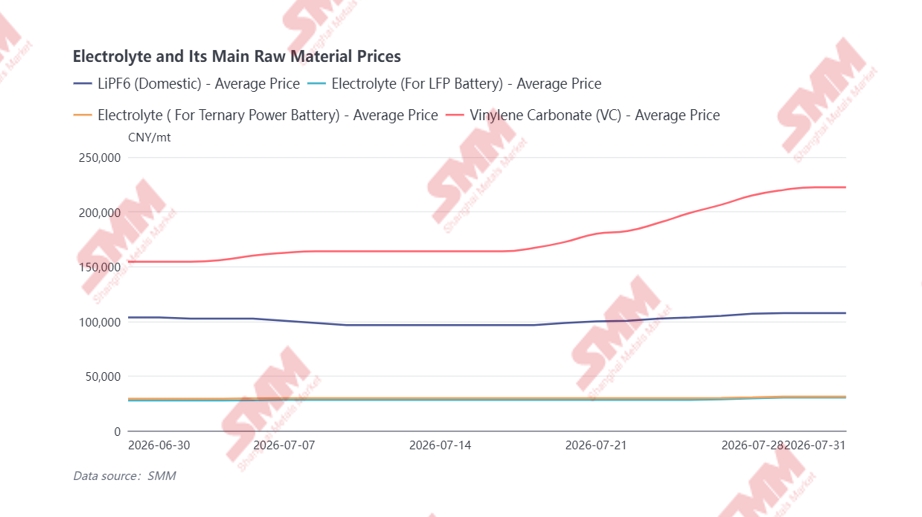
Overall, lithium salt, solvent, and additive prices rose simultaneously, and raw material costs upstream of electrolytes formed a resonant upward pattern. However, some long-term contract orders, constrained by pricing terms, could not quickly pass on all the incremental raw material costs to downstream battery cell manufacturers, with only a portion being passed on. For some small and medium-sized battery cell enterprises, on the one hand, their bargaining power was weak; on the other, their electrolyte suppliers were rarely equipped with raw material production lines, leaving very limited room to buffer cost fluctuations. As continuous raw material price hikes accumulated cost pressure, it was transmitted to downstream battery cell enterprises, and electrolyte prices rose.
Note: If you have any supplements or corrections regarding the details mentioned in this article, please feel free to contact us. Contact information is as follows:
Tel: 021-20707858 Hu Xuejie, Thank you!
SMM New Energy Research Team
Wang Cong 021-51666838
Ma Rui 021-51595780
Feng Disheng 021-51666714
Lyu Yanlin 021-20707875
Zhang Haohan 021-51666752
Wang Zihan 021-51666914
Wang Jie 021-51595902
Xu Yang 021-51666760
Xu Mengqi 021-20707868
Hu Xuejie 021-20707858
![[SMM Separator Weekly Review] Production growth continued to lag end-use demand, with the supply-demand gap widening](https://imgqn.smm.cn/usercenter/BmqWy20251217171726.jpg)
![[SMM Analysis] Cobalt Market's Peak Season Begins Slowly: Demand Recovery Fails to Gain Momentum](https://imgqn.smm.cn/usercenter/olwlF20251217171731.jpg)
![Second-life application market stable, lithium carbonate rises then falls, LFP demand outperforms ternary [SMM weekly review]](https://imgqn.smm.cn/usercenter/GVVKq20251217171728.jpg)