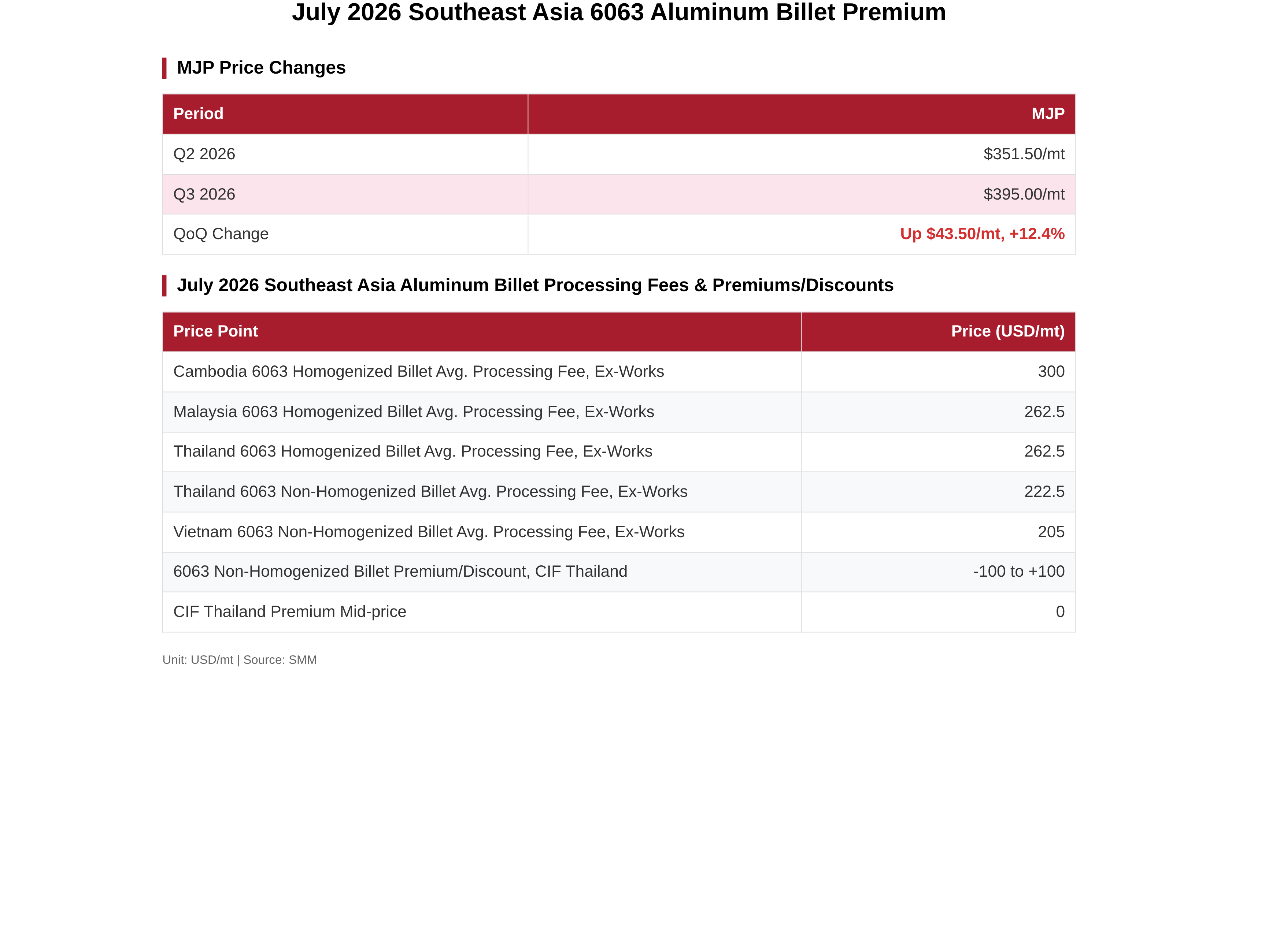
As of July 24, the premium for 6063 aluminum billets in major Southeast Asian markets remained stable throughout July, with no adjustments for four consecutive weeks. Among them, the local ex-works premium average for 6063 homogenized aluminum billets in Cambodia was $300/mt; the local ex-works premiums for 6063 homogenized aluminum billets in Malaysia and Thailand were both $262.5/mt; the local ex-works premium for 6063 non-homogenized aluminum billets in Thailand was $222.5/mt; and the local ex-works premium for 6063 non-homogenized aluminum billets in Vietnam was $205/mt. The assessed range for CIF premium of 6063 non-homogenized aluminum billets exported from China to Thailand remained between -$100 and +$100/mt, with a midpoint of $0/mt.
From a price trend perspective, the premiums for 6063 homogenized aluminum billets in Thailand and Malaysia pulled back in June from their highs in May, and the price center temporarily stabilized after entering July. However, the stability of premiums did not indicate an improvement in market demand. The MJP for Q3 2026 settled at $395/mt, up $43.5/mt from $351.5/mt in Q2, an increase of approximately 12.4%, remaining at a historically high level. As the all-in reference price for Southeast Asian aluminum billets is mainly composed of the LME spot settlement price, MJP, and premium, the rise in MJP further drove up local procurement costs for billets, somewhat dampening downstream purchase willingness.
Meanwhile, China's exported aluminum billets continued to compete with locally produced billets in Southeast Asia. Taking the Thai market as an example, the CIF premium range for 6063 non-homogenized aluminum billets exported from China was -$100 to +$100/mt, significantly lower than the ex-works premium of $222.5/mt for locally produced non-homogenized billets in Thailand. Although the delivery terms and specific cost structures of the two supply sources are not entirely identical, Chinese export cargoes still held a strong competitive advantage in terms of landed price.
According to SMM market surveys, some Chinese export cargoes consisted of secondary aluminum remelt billets with relatively low production costs, while others were produced under a processing trade with supplied materials before being exported, offering relatively competitive overall trade costs. Driven by price differences, purchases of Chinese aluminum billets in Southeast Asian markets increased, squeezing orders from local producers. As aluminum billets and ingots share a combined HS code in existing customs statistics, it is currently difficult to separately quantify the supply growth of billets through import and export data, and relevant assessments are mainly based on SMM survey feedback.
Supply side, in July, the situation in the Middle East tightened again, continuing to affect shipping on Asia-Europe routes, and the shipment of Southeast Asian aluminum billets to the European market was somewhat restricted. Some cargoes that had originally planned to be exported to Europe were instead diverted for sale in the local Southeast Asian and surrounding markets, further increasing regional supply absorption pressure.
Demand side, the growth in local aluminum billet consumption in Southeast Asia is limited, not enough to fully absorb the supply diverted back to the local market by local producers and the new supply from China. Weighed down by intensified supply competition, high procurement costs, and weak end-use demand, overall deals in the Southeast Asian aluminum billet market were subdued in July. Although premiums in various regions have not yet seen further declines, actual procurement pace slowed down, and buyers' willingness to bargain increased.
Looking ahead to the near term, with Q3 MJP staying high, Chinese exports continuing to maintain a price advantage, and limited diversion capacity of the European market, the premium for locally produced aluminum billet in Southeast Asia is expected to still lack clear upward momentum. High MJP will continue to support the all-in price of aluminum billet, but if local consumption does not show significant improvement, the pressure to digest regional supply may persist, and market transactions are expected to remain in the doldrums. To get closer to buyers' target transaction levels and cope with the price competition from Chinese exported aluminum billet, some billet sellers in Southeast Asia may need to either lower premiums, make concessions on MJP pricing, or adopt more flexible pricing methods such as spot MJP to facilitate deals.