SMM, July 29 news:
On the metals market front:
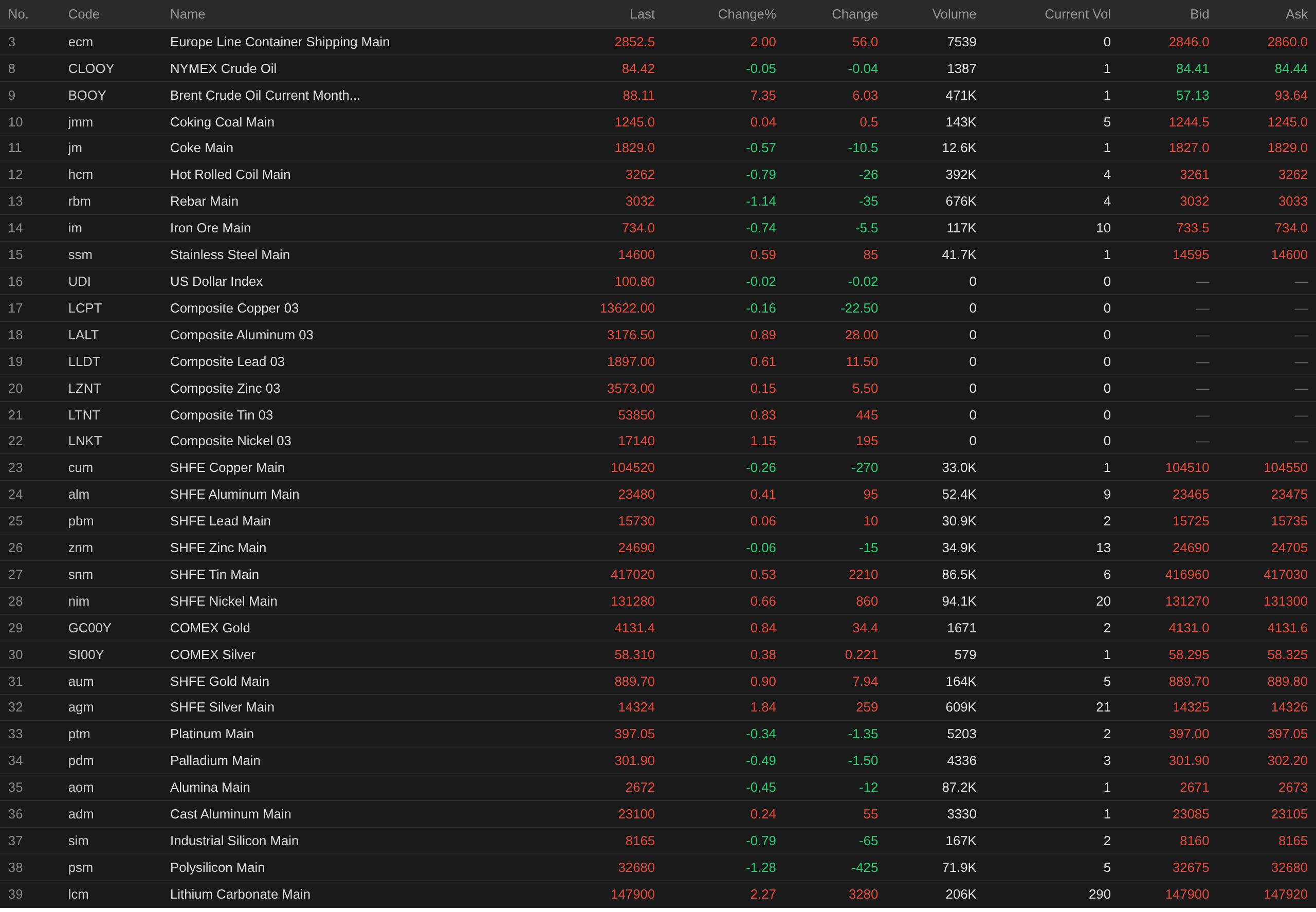
Overnight, base metals on both overseas and domestic markets broadly rose, with only SHFE copper, SHFE zinc, and LME copper falling together. SHFE copper fell 0.26%, SHFE zinc fell 0.06%, and LME copper fell 0.16%. LME nickel led the gains with a 1.15% rise, while the rest of the metals rose within 1%. Alumina main contract fell 0.45%, and foundry aluminum main contract rose 0.24%.
Overnight, ferrous metals broadly fell. Stainless steel rose 0.59%, while rebar led the declines with a 1.14% drop. HRC and iron ore both fell around 0.7%: HRC down 0.79% and iron ore down 0.74%. For coking coal and coke, coking coal rose 0.04%, and coke fell 0.57%.
On the precious metals front, overnight COMEX gold rose 0.66%, and COMEX silver rose 0.64%. Domestically, SHFE gold rose 0.9%, and SHFE silver rose 1.84%.
A Reuters survey showed that analysts have cut their gold price forecasts for the first time since the end of 2023, after prices pulled back sharply from record highs in January. However, most still expect central bank buying and concerns over fiscal sustainability to provide support. The median forecast for gold prices in 2026 was $4,509 per ounce in the survey of 29 analysts and traders over the past three weeks. This was below the $4,916 seen three months ago and was the first quarterly cut in forecasts in 11 quarters. The average forecast for 2027 was $4,610, compared with $5,100 in the previous survey. Gold hit an all-time high of $5,595 per ounce in January but saw a sharp pullback in Q2, posting its worst quarterly performance since 2013, as the Iran war fueled energy inflation and pushed up rate hike expectations. Spot gold has fallen around 22% since the geopolitical conflict erupted. (Jin10 Data APP)
As of 6:42 am on July 30, overnight closing prices:
Macro Front
China:
[Total social logistics value in China exceeded 18.11 trillion yuan in H1] The China Federation of Logistics and Purchasing today (29th) reported logistics operation data for H1. In H1, the scale of logistics demand continued to expand, marked by structural optimization and shifts in growth momentum. Total social logistics value reached 18.11 trillion yuan in H1, rising 5.1% YoY, 0.4 percentage points higher than GDP growth for the same period, showing a strengthening role for logistics demand in underpinning and driving national economic growth. By quarter, growth was 6.2% in Q1 and 4.4% in Q2, with an overall stable yet increasing trend. (CCTV News)
[CO2 emissions per unit of GDP to be cut by 17% during the 15th Five-Year Plan period] The Ministry of Ecology and Environment, together with 18 other departments including the National Development and Reform Commission (NDRC), jointly released the National Climate Change Response 15th Five-Year Plan. According to the Plan, by 2030, carbon dioxide emissions per unit of GDP will be reduced by 17% from 2025 levels. The CO2 emissions per unit of product in sectors covered by the national carbon emissions trading market will drop by around 3% from 2025 levels. A credible, transparent, methodologically unified, broadly participated, and internationally aligned national voluntary greenhouse gas emissions reduction trading market will be established. A product carbon footprint management system will basically be in place, and non-CO2 greenhouse gas monitoring and control will be strengthened, building a 30 million-tonne carbon dioxide equivalent (CO2e) reduction capacity. The climate change adaptation work system will be further improved, phased progress in building a climate-resilient society will be achieved, and awareness and capacity for climate change response will be continuously enhanced. China’s influence, guiding power, shaping power, and moral appeal in global climate governance will be notably elevated. (From Wall Street CN APP)
US Dollar:
As of the overnight close, the US dollar index fell 0.59% to 100.82. The Fed kept rates unchanged at 3.50%-3.75%, a fifth consecutive meeting on hold; the vote was 9-3, with three regional Fed committee members dissenting in favor of a rate hike. Fed Chairman Warsh said that the Fed’s move to reduce forward guidance on future policy intentions gave the central bank more room to listen to market voices instead of unilaterally steering market expectations. Warsh noted that US Treasury yields had risen over the past few months, which he saw as reflecting relatively strong economic fundamentals. He said: “Economic output has been solid. Capital spending and productivity have performed strongly. The job market is stable and resilient. The bond market is sending many of the same messages.” (Jin10 Data)
Fed Chairman Warsh said that since the June meeting, financial markets have already priced in the bulk of the Fed’s tightening effects, so he pushed back on describing the decision to hold rates steady this time as a “pause.” Warsh said: “I would not call today’s decision any sort of ‘pause.’ If one had to label it a ‘pause,’ then the performance of financial markets suggests exactly the opposite.” Since the Fed’s mid-June meeting, both 2-year and 10-year US Treasury yields have cumulatively risen about 20 basis points. Warsh pointed out that over this period, financial markets have not “paused” their adjustments but have been continuously repricing based on inflation data and economic growth performance: on one hand, inflation data influenced market expectations; on the other, strong growth pushed up both nominal and real interest rates. He said: “Today, the Fed did not explicitly adjust the policy rate — that point is true. But I think this is simply the beginning of the whole policy story, not the end.” (Jin10 Data APP)
According to CME “FedWatch”: The probability of the Fed keeping rates unchanged through September is 36.8%, the probability of a cumulative 25bp rate hike is 63.2%, and the probability of a cumulative 50bp rate hike is 0% (compared with 17.8%, 60.2%, and 22%, respectively, before the Fed decision). The probability of the Fed keeping rates unchanged through October is 26.2%, the probability of a cumulative 25bp rate hike is 55.6%, the probability of a cumulative 50bp rate hike is 18.2%, and the probability of a cumulative 75bp rate hike is 0% (compared with 11.9%, 46.1%, 34.7%, and 7.3%, respectively, before the Fed decision). (Jin10 Data APP)
After the Fed announced it was holding rates steady on Wednesday, Citibank still expects the Fed to cut rates later this year. Economists Andrew Hollenhorst and Veronica Clark noted in a client report that Warsh’s press conference sent two dovish signals: first, he said he would look at a broad range of data to assess the progress the Fed has made in curbing inflation; second, he hinted that the rise in real yields has already tightened financial conditions to some extent. Citi continues to expect that unemployment will rise in coming months, leading the Fed to cut rates in October, December, and January. (Wall Street CN)
Macro Front:
Data releases today include the US Fed interest rate decision through July 29, US initial jobless claims for the week ending July 25, US core PCE price index YoY for June, US personal spending MoM for June, preliminary US Q2 real GDP annualized QoQ, preliminary US Q2 real personal consumption expenditures QoQ, preliminary US Q2 core PCE price index annualized QoQ, US core PCE price index MoM for June, preliminary Eurozone Q2 GDP YoY, Eurozone June unemployment rate, Eurozone July industrial confidence index, Eurozone July economic confidence index, preliminary French Q2 GDP YoY, Swiss July KOF Economic Barometer, UK central bank rate decision through July 30, preliminary German Q2 unadjusted GDP YoY, and preliminary German July CPI MoM, etc.
Crude Oil:
Overnight, oil prices on both sides jumped, with WTI up 6.74% and Brent up 7.35%. Hopes for an imminent end to the US-Israel conflict with Iran were dashed as major airstrikes resumed in the Middle East; in parallel, industry data showed a draw in US crude inventories, lending further support to oil prices. UBS analyst Giovanni Staunovo noted that the resumption of military strikes in the Middle East, combined with renewed emphasis by Iranian officials on wanting to control shipping activities in the Strait of Hormuz at a time when oil flows there are sluggish, is again pushing oil prices higher. Oil prices extended gains after US President Trump stated a few hours before the Fed decision that retaliatory strikes would be carried out against Iran. Suvro Sarkar, head of energy research at DBS Bank, said that with the ebb and flow of Middle East conflict, Brent crude prices are likely to continue swinging wildly within the $80-100 per barrel range in the near term. (Jin10 Data APP)
Kpler Head of Commodity Research Matt Smith said that global fuel supply is extremely tight, spurring refiners to run at full throttle to capture unusually fat margins. Following supply disruptions triggered by the wars in Ukraine and Iran, there is virtually no buffer left in the fuel market. “Super-sized refining margins continue to encourage refiners to run as close to full capacity as they can, leading to a massive drawdown in crude inventories.” (Wall Street CN)
US refiners are turning crude into refined products such as gasoline and diesel at a pace not seen since before the COVID-19 outbreak, but given the historic fuel shortage crisis, even running flat out is unlikely to rein in surging prices in the short term. According to Energy Information Administration (EIA) data, last week US refineries processed an average of 17 million barrels of crude per day, operating full bore to meet global and domestic fuel demand. That was the highest weekly average since September 2019. In the Midwest, weekly crude processing hit an all-time high. (Wall Street CN)
![Downstream consumption was sluggish, inventory increased, and spot premiums declined [SMM South China Copper Cathode Spot Weekly Report]](https://imgqn.smm.cn/usercenter/KytYP20251217171712.jpg)
![Base metals rose broadly, SHFE aluminum gained over 1%, lithium carbonate, alumina and polysilicon were among the biggest decliners, and iron ore led the decline [SMM midday commentary]](https://imgqn.smm.cn/usercenter/YKilH20251217171735.jpg)
![Month-end consumption weakened, Shanghai spot copper premiums fell under pressure [SMM Shanghai spot copper]](https://imgqn.smm.cn/usercenter/ULCXN20251217171714.jpeg)