As demand brought forward ahead of the policy change faded, end users resisted higher prices and manufacturers came under greater pressure to meet first-half shipment targets. By the second quarter, international module markets had returned to a demand-led pricing environment. Prices in Europe, Southeast Asia and India all moved lower to varying degrees from mid-to-late June.
As of July 29, SMM assessed average China-port FOB prices for 182mm(M10), 210R(G12R) and 210mm(G12) TOPCon modules at $0.107/W, $0.108/W and $0.109/W, respectively. Compared with their early-April highs, the three assessments were down by approximately 8.5%, 10.4% and 10.3%.
Although the regional markets share a downward direction, the underlying drivers differ. Europe is shaped by inventory digestion and a widening gap between distributed-generation and utility-scale applications. Southeast Asia remains highly price-sensitive, with buyers delaying procurement as they wait for projects and lower prices. In India, both Domestic Content Requirement (DCR) and non-DCR products have become cheaper despite sharply different policy constraints and price levels.
China FOB: Policy Support Fades as Price Competition Intensifies
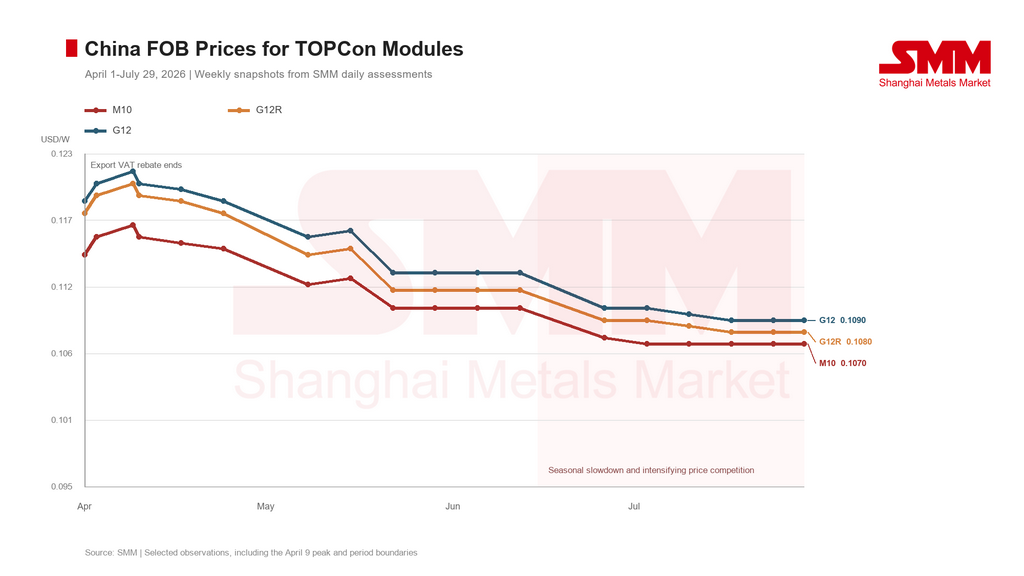
After the export VAT rebate ended, module manufacturers initially attempted to pass the additional cost on to international customers. Around April 9, SMM's average China FOB assessments for 182 mm, 210R and 210 mm TOPCon modules rose to $0.117/W, $0.1205/W and $0.1215/W, respectively.
Procurement then shifted from accelerated shipments ahead of the policy deadline to inventory digestion. With end users increasingly unwilling to accept higher prices, the market's center of gravity began to move lower.
Since May, European channel inventories, delayed project procurement in Southeast Asia and seasonal weakness across major markets have combined to increase pricing pressure. From mid-June, second-tier manufacturers led a new round of price reductions, forcing leading suppliers to follow in order to defend orders and distribution channels.
The three size formats still carry a spread of roughly $0.001/W, but their trajectories have become closely aligned. This suggests that the focus of competition has moved away from recovering the lost tax rebate and back toward order capture, channel access and shipment execution.
Europe: Distributed Generation Offers Support, but Inventories Still Weigh on the Market
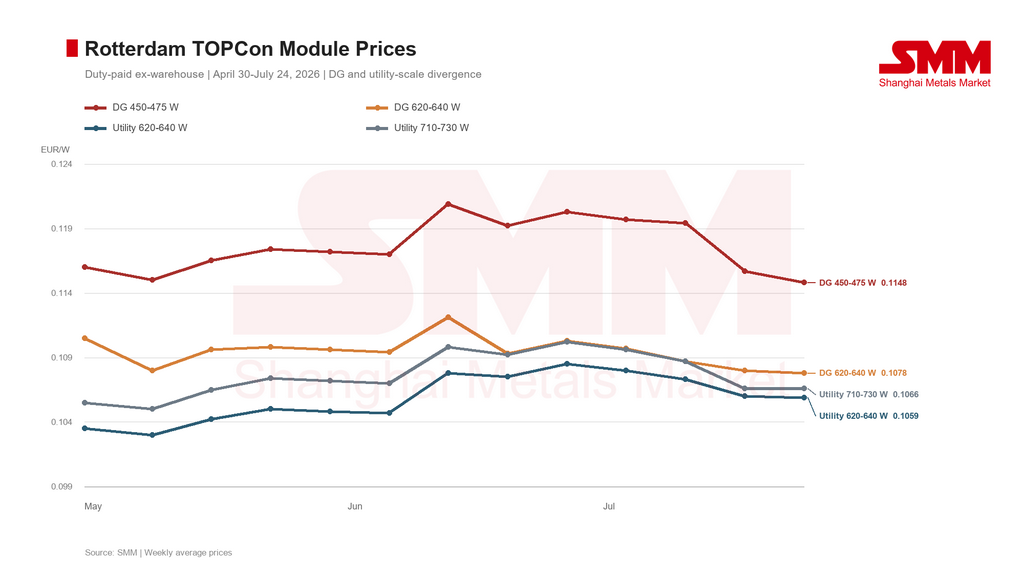
As of July 24, SMM's average duty-paid ex-warehouse assessment in Rotterdam stood at EUR 0.1148/W for 450-475 W distributed-generation modules and EUR 0.1078/W for 620-640 W distributed-generation modules. Utility-scale 620-640 W and 710-730 W products were assessed at EUR 0.1059/W and EUR 0.1066/W, respectively.
The clear premium for 450-475 W modules reflects their use in specific rooftop and distributed-generation applications, where product substitution is more limited. Europe's summer heatwave has lifted power demand and renewed interest in behind-the-meter generation among commercial and industrial users as well as households.
Back-contact, or BC, modules remain particularly competitive in premium rooftop applications because their higher conversion efficiency can increase generation from limited roof area. That advantage has, in turn, placed additional pricing pressure on TOPCon products serving the same market segment.
Europe is now in the final week before the main summer holiday period. Some projects that remain under construction, or are scheduled for delivery during the holidays, have generated modest replenishment demand. These orders are generally intended to close gaps in earlier purchases, keep installation schedules on track or cover small increases in project requirements. They tend to be limited in volume, require short delivery times and favor collection from nearby warehouses.
The pre-holiday restocking has provided some near-term support for spot transactions, but it is better understood as project-specific procurement than a reversal in the demand trend. Distributors remain cautious about slower construction and logistics during the holiday period, while overall European warehouse inventories are still elevated. Most buyers are therefore reluctant to rebuild stocks aggressively.
Inquiry and transaction activity may soften again during the main vacation period. A more durable recovery is likely to depend on project teams returning from late August, together with clearer delivery and grid-connection schedules toward the end of the third quarter.
The limited demand support has not changed the market's broader weakness. Inventory accumulated during the first-quarter shipment rush is still being absorbed. Frequent negative power prices in parts of Europe, grid-connection constraints and weaker project economics continue to weigh on utility-scale procurement. Higher ocean freight rates briefly lifted warehouse prices in June, but assessments across all four product categories resumed their decline in July as price competition intensified.
Southeast Asia: Low-End Offers Test 10 Cents/W as Buyers Wait
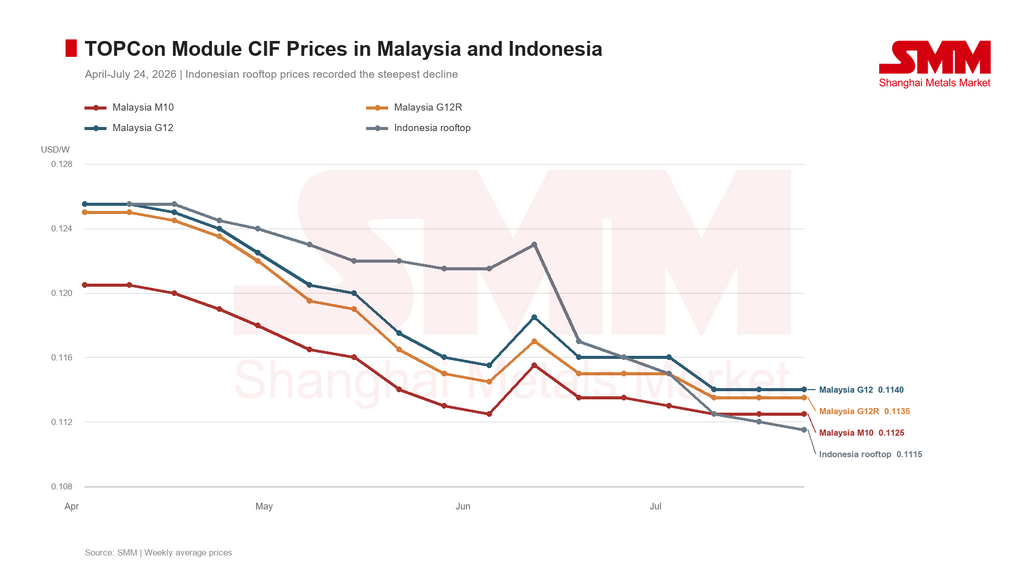
Southeast Asian buyers are particularly sensitive to changes in module prices. The end of the second quarter would normally be a period when some projects advance into procurement, but expectations of further price declines have kept many end users on the sidelines. Purchases remain focused on immediate requirements and small-volume replenishment.
As of July 24, average CIF prices in Malaysia for 182 mm, 210R and 210 mm TOPCon modules stood at $0.1125/W, $0.1135/W and $0.1140/W, respectively, down by approximately 6.6%, 9.2% and 9.2% from early-April levels. Indonesia's CIF assessment for rooftop TOPCon modules fell to $0.1115/W, around 11.2% below its April high and a steeper decline than the main Malaysian product formats.
Offers of $0.10-0.105/W, equivalent to 10-10.5 cents/W, have also appeared in Southeast Asia. These should be treated as low-end market indications rather than representative regional CIF transaction prices.
Such offers often come with restrictive commercial terms. They may involve inventory clearance by second-tier brands, older wattage classes or specific product formats, large-volume purchases, short payment terms, designated destination ports, or prices that cover only FOB value and part of the logistics cost. Where a quote genuinely covers a standard high-efficiency product on a full CIF basis, it signals an aggressive attempt to secure a limited pool of orders and may be close to the supplier's cost line. Actual volumes, warranty coverage and delivery capability still require transaction-level verification.
Rather than immediately stimulating large purchases, low-priced supply has reinforced buyers' expectations of further declines. Some project developers are splitting orders, shortening price-lock periods or waiting for the market to fall again. This dynamic is widening the gap between suppliers. Projects that depend on financing and long-term warranties continue to favor bankable, top-tier manufacturers, while highly price-sensitive commercial, industrial and trading orders are more willing to consider discounted products.
The 10-10.5 cents/W range is therefore best viewed as a signal of the market's lower boundary and intensifying competition, not evidence that all module products in Southeast Asia are trading at that level.
Low import offers are also widening the price gap between imported and locally manufactured modules. In projects without mandatory localization, cheaper imports can directly reduce upfront capital expenditure. In Indonesia, however, projects procured by state-owned utility PLN, government-backed schemes and other programs subject to the country's local-content threshold, known as TKDN, must prioritize compliant local products. A 10-cent import offer may influence market expectations without becoming an executable project price. This is one reason why Southeast Asia may retain a two-track pricing structure.
Malaysia still has policy-driven demand support over the medium term. In July, the country's sixth Large Scale Solar procurement round, LSS6, released 2.65 GW of capacity, including 2.5 GW paired with energy storage. Projects are targeted to achieve commercial operation by the end of 2029. The time between tender launch and concentrated module procurement means that LSS6 is more likely to improve sentiment in the near term than reverse spot-price declines immediately.
New project procurement in Indonesia was comparatively limited in June and July. PLN launched the 1.225 GW Mentari Nusantara I tender on April 30, using the "GIGA ONE" bundled-procurement mechanism for the first time. The projects are targeted for commercial operation in 2029 and emphasize domestic-content compliance, which should primarily support demand for locally manufactured, TKDN-compliant modules.
SMM's June market survey showed that prices for Indonesian modules rise materially with higher localization ratios. The market is increasingly separating into an import-based price for high-efficiency products and a TKDN-compliant price for local-content projects. Public information available at the time of publication had not confirmed the reported July bid deadline or a December award announcement, so neither date is treated here as a firm project milestone.
India: DCR and Non-DCR Prices Decline Despite a Wide Policy-Driven Gap
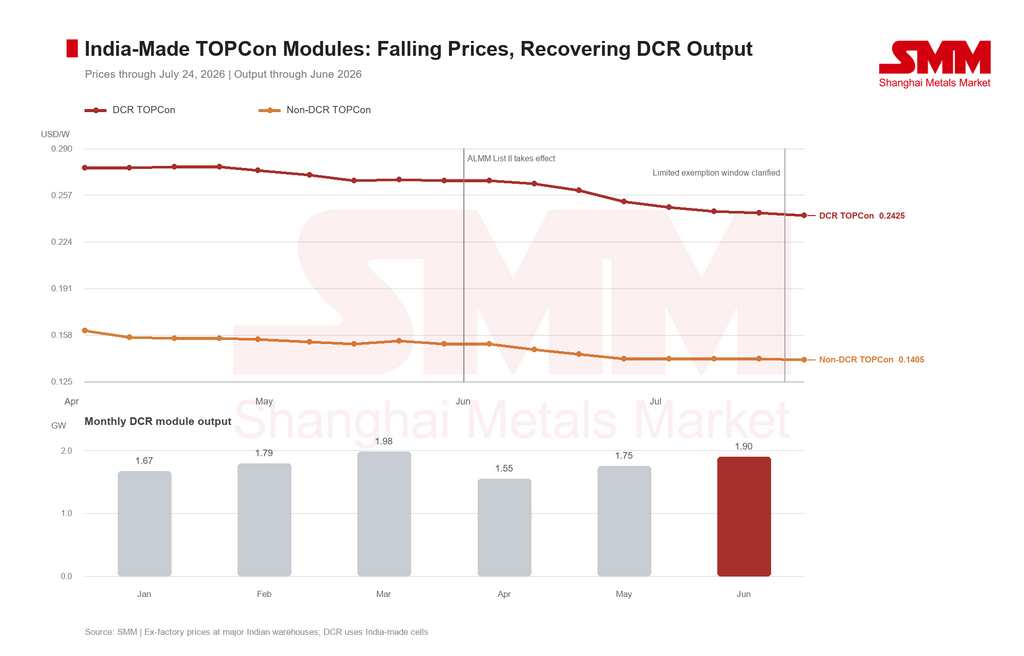
India's module market remains defined by a two-track pricing structure created by domestic-manufacturing rules. On June 12, the average ex-factory price for India-made DCR TOPCon modules was still $0.2650/W. By July 24, it had fallen to $0.2425/W, a decline of around 8.5% in six weeks and approximately 12.5% from its April high.
Over the same period, the non-DCR TOPCon price fell to $0.1405/W, around 12.7% below its early-April level. Despite both categories moving lower, DCR modules still carried a premium of approximately 72.6% over non-DCR products.
Lower DCR prices have improved project acceptance to some extent. Together with deliveries linked to projects contracted around the implementation of the Approved List of Models and Manufacturers List II, or ALMM List II, this has supported a gradual recovery in production from April's low.
SMM data show that Indian DCR module output rose from 1.55 GW in April to 1.75 GW in May and 1.90 GW in June, an 8.6% month-on-month increase. June production nevertheless remained slightly below the first-half peak of 1.98 GW recorded in March. Cumulative DCR module output reached approximately 10.64 GW in the first half of 2026.
ALMM List II took effect on June 1. India's Ministry of New and Renewable Energy subsequently ruled out a blanket postponement, while providing a one-off transition arrangement for certain net-metering and open-access projects. Eligible projects commissioned by December 31, 2026 may continue to receive an exemption from the requirement to use ALMM List II-compliant solar cells.
The limited exemption should help absorb some modules made with cells that are not listed under ALMM List II and provide a temporary outlet for non-DCR products. Large utility-scale and government-backed projects remain subject to domestic-content requirements, however. India's longer-term policy direction, toward locally manufactured cells and tighter DCR compliance, has not changed.
#Outlook: Regional Project Timelines Will Set the Pace
The cancellation of China's export VAT rebate did not produce a sustained increase in international module prices. Once the initial cost shock faded, inventories, project economics and procurement schedules again became the dominant pricing factors.
China FOB assessments are now at relatively low levels, and cost constraints may limit the scope for another sharp decline. Even so, transaction activity will continue to vary by region. Europe depends on the pace of warehouse destocking and the strength of post-summer distributed-generation demand. Malaysia will be shaped by LSS6 tender progress and localization requirements, while Indonesia will depend on the procurement schedule for GIGA-ONE MENTARI projects and the premium attached to TKDN-compliant modules.
In India, the key variables are the actual scale of projects covered by the limited ALMM List II exemption, the expansion of local solar-cell supply and whether further declines in DCR module prices can improve project economics.
For the remainder of 2026, the global module market is likely to remain under broad pressure while becoming increasingly differentiated by region and project type. Competition will gradually extend beyond headline price to module efficiency, bankability, financing terms, local delivery capability and regulatory compliance.
Written by:
Ryan Tey Tze Yang | SMM PV Analyst
+60 127179370 | ryan.tey@metal.com
![U.S. Tightens Access for New Connected Inverters: What is the impact to the current Market? [SMM Analysis]](https://imgqn.smm.cn/usercenter/VEROo20251217171737.jpg)
![[SMM PV Flash] Germany 40 MWh! Jinko Energy Storage New Partnership Announced](https://imgqn.smm.cn/usercenter/NWqnx20251217171739.jpg)
![[SMM PV News] Guangxi: Beibu Gulf Port Group’s 150 MW agrivoltaic project achieves full-capacity grid connection!](https://imgqn.smm.cn/usercenter/Pjwqt20251217171738.jpg)