July 27, 2026
The potential bottoming process in the gold market around the US$4,000 level remains highly volatile. After breaking above the downtrend line that had capped prices since the end of May, gold quickly rallied to US$4,165 before giving back almost all of those gains yesterday as tensions surrounding the Iran conflict and rising oil prices escalated once again.
Price action around the psychologically important US$4,000 level therefore remains fragile and extremely volatile. One day, gold gains US$100; the next, it gives back US$100. Nevertheless, the prospects for a successful bottoming process, followed by a trend reversal and a broader recovery—or even a summer rally—remain intact.
Gold Reflects the Reshaping of Global Markets
Financial markets continue to be driven by an unusually dense combination of geopolitical uncertainty and structural changes in the global monetary system—and nowhere is this more evident than in the gold market.
Following its record high of approximately US$5,600 per ounce in January, gold corrected sharply to just below US$4,000, pressured by profit-taking, the Iran war, rising interest rate expectations, and a modest strengthening of the U.S. dollar.
During the second quarter alone, gold declined by around 14%, while silver lost approximately 22%. However, interpreting this correction as the end of gold's long-term bull market would confuse a cyclical pullback with a structural change in the market. The underlying fundamentals continue to support the view that January's record high did not mark the end of the secular bull market.
Central Banks Remain the Primary Driver
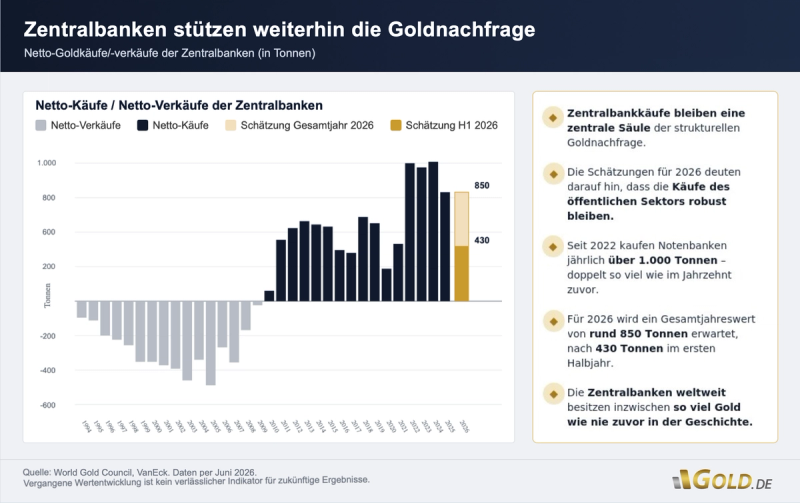
The underlying pillar of the gold bull market continues to be central bank demand. Over the past four years, central banks around the world have purchased an average of 1,000 tonnes of gold annually—roughly double the pace seen during the previous decade.
According to the latest survey by the World Gold Council, 45% of reserve managers expect to increase their gold holdings over the next twelve months. This trend is not simply a short-term hedge against market volatility, but rather reflects a long-term strategy of diversifying away from the U.S. dollar as the sole anchor of the global monetary system.
De-Dollarization Continues to Gain Momentum
The broader geopolitical landscape reinforces the ongoing trend toward de-dollarization. While the United States continues its aggressive—but strategically unfocused and, under international law, illegal—military campaign and air war against Iran using the weapons of the 20th century, Tehran has responded with an asymmetric strategy.
One U.S. military installation after another across the Middle East is being targeted with remarkable precision using missiles, drones, and cruise missiles. Before long, the United States may find itself running short not only of precision-guided munitions and air defense systems—including air-to-air, surface-to-air, and missile defense interceptors—but also of viable operating bases. Without functioning runways and adequate fuel supplies, the paradigm shift in modern warfare unfolding over the Persian Gulf may become impossible to ignore, even for the West. The precision of Iran's attacks is, of course, being significantly supported by China and Russia, as neither country is prepared to allow Iran to collapse.
Against this backdrop, one of the most remarkable developments in recent weeks has received relatively little attention. Beginning July 24, China's largest banks—including the Industrial and Commercial Bank of China (ICBC)—will suspend retail paper gold trading through the Shanghai Gold Exchange.
Officially, the move is intended as a risk-management measure following a period of elevated volatility during which retail investors suffered significant losses on leveraged products. Speculative paper-gold trading is being curtailed, while physical gold ownership, gold savings plans, gold ETFs, and the reserve strategy of the People's Bank of China remain unaffected.
Regardless of the official justification, the move can also be interpreted as another step away from a financial system in which Western paper markets such as COMEX and the London Bullion Market Association (LBMA) facilitate price discovery through extensive leverage, allowing multiple paper claims to exist for every physical ounce of gold.
By encouraging Chinese investors to shift toward physical ownership, China is gradually changing the balance of power between the paper and physical gold markets. The development recalls historical precedents such as the collapse of the London Gold Pool in 1968, although this time the transition is more likely to be gradual, orderly, and largely unnoticed.
Geopolitics Meets Stagflation
This monetary realignment is unfolding against a geopolitical backdrop that has become increasingly concerning even for seasoned market observers.
According to the International Monetary Fund's World Economic Outlook, the conflict in the Middle East is already weighing measurably on global economic growth, which is projected to reach only around 3.1% in 2026.
At the same time, warnings from former U.S. military officials regarding Iran's asymmetric strategy against U.S. and Israeli air forces operating in the Gulf underscore how fragile the regional security architecture has become.
For gold, traditionally regarded as a crisis hedge and store of value, this environment represents a structural tailwind—even if higher interest rates and persistent demand for U.S. dollar liquidity have weighed on prices in the short term.
Meanwhile, the sharp rise in oil prices over the past three weeks has brought the stagflation scenario that we have repeatedly outlined back into focus.
Stagflation—the toxic combination of weak economic growth, high inflation, and rising unemployment—creates a particularly difficult environment for investors, as conventional monetary policy tools often become ineffective or even counterproductive.
During such periods, financial assets and fixed-income investments tend to lose purchasing power in real terms, while tangible assets such as commodities, defensive high-quality equities, and particularly gold have historically served as reliable stores of value.
Gold as a Top Performer During Stagflation
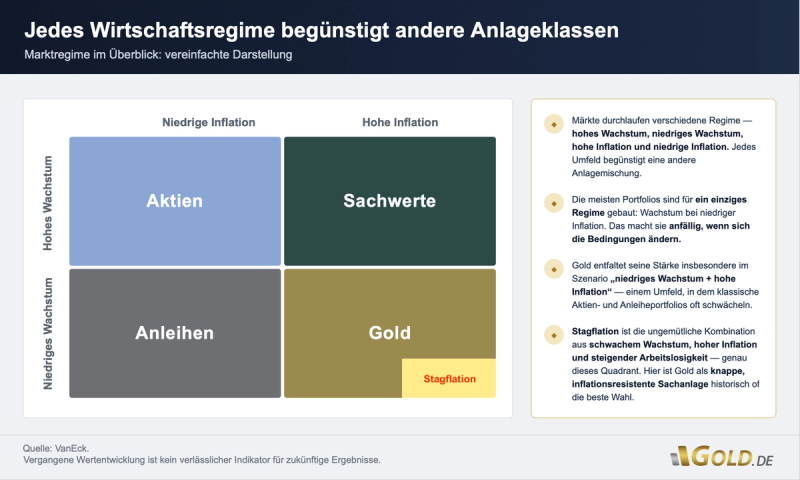
Every economic regime favors different asset classes. © VanEck
Gold tends to perform particularly well during periods of stagflation because its value does not depend on the creditworthiness of an issuer and it cannot be eroded by negative real interest rates. When inflation remains persistently high, economic growth weakens, and confidence in fiat currencies, government bonds, and policymakers continues to deteriorate, gold regains its traditional role as a scarce, liquid, and globally recognized store of value.
The experience of the 1970s illustrates this dynamic particularly well. During that decade's stagflationary environment, gold not only served as an effective hedge but also became one of the very few asset classes capable of preserving purchasing power in real terms.
Gold Battles Around the US$4,000 Level – Bottoming Process Remains Intact
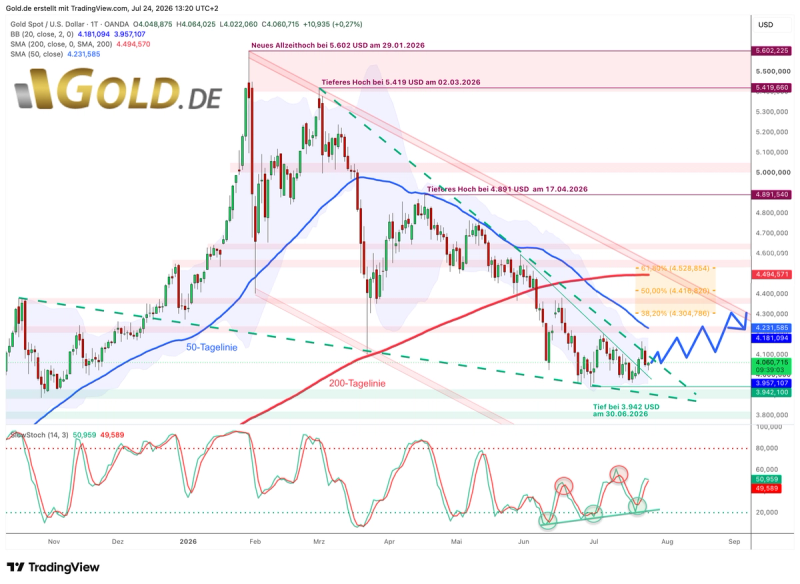
Gold in U.S. Dollars, Daily Chart as of July 24, 2026. © Gold.de
Since the latest sharp decline ended at US$4,023 on June 11, gold has been attempting to establish a bottom around the psychologically important US$4,000 level. After six weeks, this process has produced a nervous back-and-forth trading pattern and one lower low at US$3,942. At the same time, however, the bears have failed to make any decisive progress over the past six weeks. The weekly chart remains clearly oversold, while the daily chart continues to display positive divergences, suggesting at least the potential for a technical rebound.
On some days, buyers regain control and push gold US$100 to US$200 higher within hours. A few days later, the bears return, quickly reclaiming most of those gains on heavy trading volume. It is a highly volatile battle in an exceptionally challenging market environment, with equity markets repeatedly coming under pressure, bond yields moving higher, and rising oil prices once again dominating the news flow.
A Move Above US$4,100 Could Trigger the Next Rally
The gold bulls nevertheless scored an important technical victory on Tuesday when prices broke above a downtrend line that had been in place since the end of May. Although nearly all of those gains were surrendered again on Thursday, the overall market structure has improved modestly.
Should gold now manage to reclaim and hold above the US$4,100 level, another key downtrend line would be eliminated. Such a breakout could open the way toward the upper Bollinger Band on the daily chart, currently located around US$4,181, followed by the declining 50-day moving average near US$4,231.
If the current bottoming process ultimately develops into a confirmed trend reversal, gold could, under favorable conditions, advance toward the 200-day moving average, now situated around US$4,494. This average currently aligns closely with the broader downtrend that has been in place since the January peak and therefore remains the key technical reference for the medium-term outlook.
Overall, our expectations remain unchanged. We continue to believe that the bottoming process is likely to succeed and still see a recovery toward US$4,200 and US$4,300, with a subsequent move toward approximately US$4,500 remaining a realistic possibility. However, we are not yet prepared to declare that the broader correction has come to an end.
Conclusion: Nervous, but the Bottoming Process Remains Intact
While the gold market continues to be driven in the short term by geopolitical developments, interest-rate expectations, U.S. dollar movements, and oil prices, the broader picture remains supportive for precious metals.
The fact that gold has so far managed to defend the US$4,000 area despite the recent sharp swings is less a sign of weakness than evidence of a market attracting value-oriented buyers following a significant correction. As long as central banks continue to accumulate gold, geopolitical risks remain elevated, and real interest rates fail to provide a compelling alternative, the longer-term market structure remains constructive.
The combination of slowing economic growth, persistent inflation, and increasing global uncertainty continues to support gold's role as a monetary safe haven. Stagflation is not an environment in which investors typically chase high-growth assets. Instead, it is one in which scarcity, liquidity, and capital preservation regain importance. Historically, these have been precisely the conditions under which gold has demonstrated its greatest strength—not as a perfect predictor of the next trading session, but as a strategic hedge in an increasingly fragile economic and monetary landscape.
Source: https://goldinvest.de/en/gold-nervous-but-the-bottoming-process-remains-intact