SMM July 24 News:
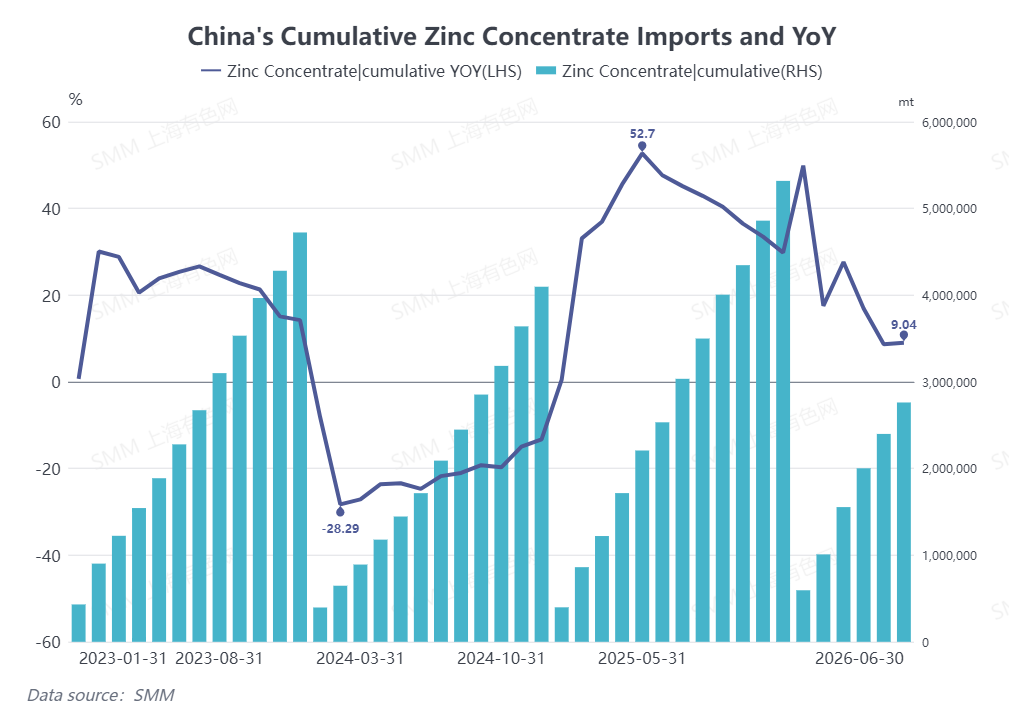
According to China Customs data, China imported 2.7616 million tonnes (gross weight) of zinc concentrate during January–June 2026, up 8.98% year on year, with overall imports posting modest growth compared with the same period last year.
1. H1 2026 Review: The Democratic Republic of the Congo Emerged as the Largest Source of Import Growth
By country of origin, China's zinc concentrate imports in the first half of 2026 remained concentrated in Peru, Australia, and Russia. Imports from Peru totaled 554.7 kt, accounting for 20% of total imports, followed by Australia at 499.0 kt (18%) and Russia at 283.2 kt (10.3%). Together, these three countries supplied nearly half of China's total zinc concentrate imports.
Compared with the same period last year, the Democratic Republic of the Congo (DRC) became the largest contributor to import growth, with shipments increasing by 92.3 kt, accounting for the majority of China's incremental imports during the first half of the year. Imports from Peru, Russia, and Mexico also recorded varying degrees of growth, providing additional support to domestic concentrate supply. In contrast, imports from Australia declined by 40.2 kt year on year, making it the largest source of import reduction.
2. H1 2026 Review: Rising Smelter Demand Continued to Support Zinc Concentrate Imports
From the perspective of China's domestic supply-demand balance, zinc concentrate supply continued to increase in the first half of 2026, although the majority of the incremental production was concentrated in a limited number of large-scale mines.
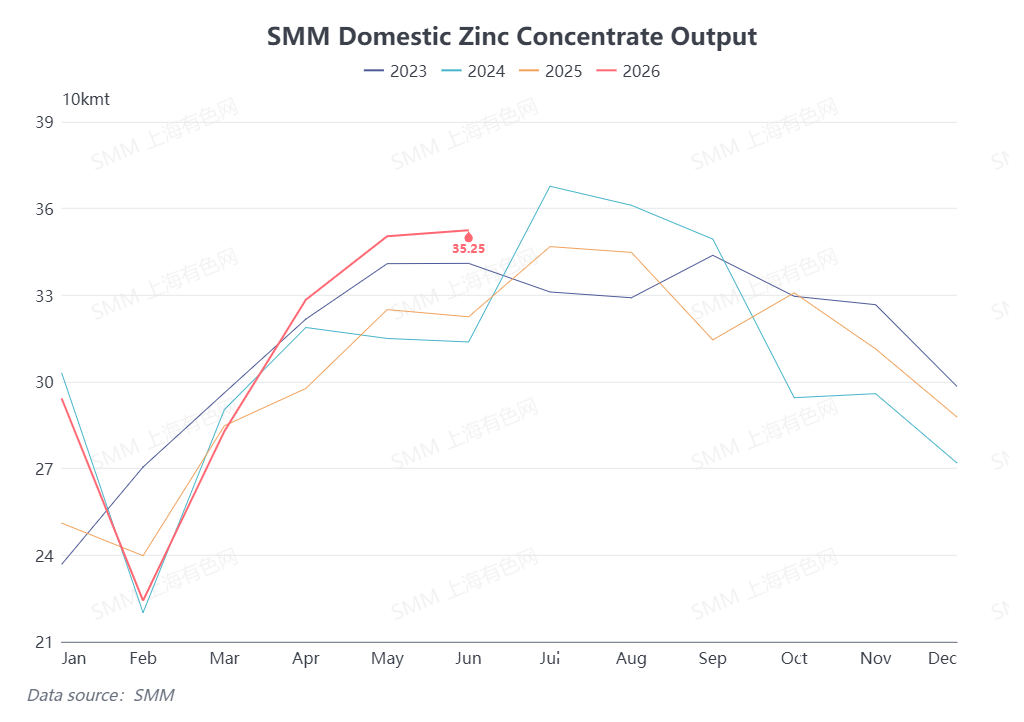
According to SMM statistics, China's domestic zinc concentrate production increased by approximately 6.5% year on year during January–June 2026. However, most of the production growth came from the Huoshaoyun Mine, while capacity expansions at other new mines are expected to be released gradually in the second half of the year. Meanwhile, declining ore grades at several mature mines led to lower concentrate output in some regions. As a result, excluding the contribution from the Huoshaoyun Mine, the increase in spot concentrate available to the domestic market remained relatively limited.
On the demand side, China's zinc smelting capacity has continued to expand in recent years. Several new smelters commissioned in 2025 continued ramping up production this year, while additional smelting capacity also came online during the first half of 2026, further boosting demand for zinc concentrate. According to SMM statistics, China's refined zinc production increased by approximately 4% year on year during January–June 2026, reflecting continued growth in raw material demand from the smelting sector.
Against the backdrop of limited growth in domestic mine supply and steadily expanding smelter demand, imported zinc concentrate remained an important supplement to China's raw material supply, supporting year-on-year growth in imports during the first half of the year.
3. H2 2026 Outlook: Zinc Concentrate Imports Face Downside Risks
Looking ahead to the second half of 2026, China's zinc concentrate imports are unlikely to increase and could even face downside risks.
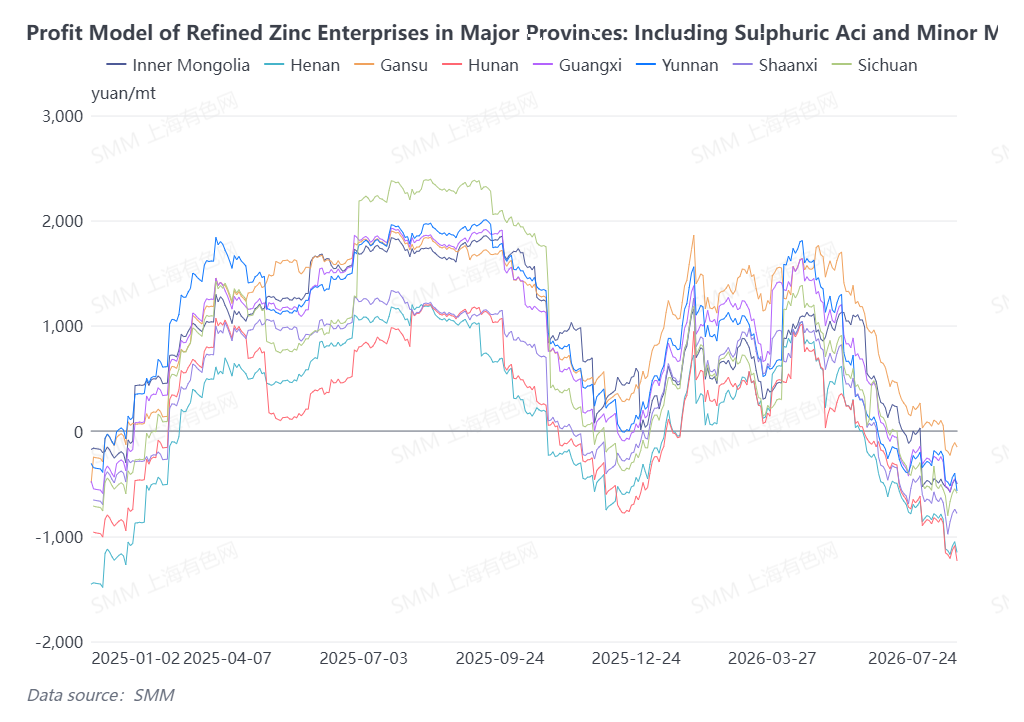
On the supply side, the global zinc concentrate market is tightening once again, with treatment charges (TCs) continuing to decline rapidly, placing significant pressure on domestic smelter profitability. According to SMM estimates, as of July 23, domestic zinc smelters were losing more than RMB 4,000 per tonne on a cash basis, excluding revenues from sulfuric acid and by-product metals. Even after including sulfuric acid and by-product credits, most smelters across China have already fallen into negative operating margins. At the same time, the third quarter is the traditional maintenance season for China's zinc smelting industry, reducing overall demand for zinc concentrate.
On the import side, China's zinc concentrate import arbitrage window has remained closed since mid-2025, as the Shanghai-LME price ratio has stayed at relatively low levels, leaving imported material without a pricing advantage. SMM expects the domestic-to-overseas price ratio to remain weak through the second half of the year. With import economics still deeply negative, Chinese smelters are expected to continue prioritizing domestic zinc concentrate, while spot purchases of imported concentrate are likely to remain subdued.
(The above information is based on market collection and comprehensive evaluation by the SMM research team. The information provided in this article is for reference only. This article does not constitute direct advice for investment research and decision-making. Customers should make cautious decisions and should not replace their independent judgment with this information. Any decisions made by customers are not related to SMM.)

![[SMM Analysis]China's Galvanized Steel Sheet Trade Holds Firm in H1 2026, but H2 Recovery Faces External Headwinds](https://imgqn.smm.cn/usercenter/TeRBO20251217171754.jpg)
![2026 H1 Galvanized Sheet Import and Export Review and H2 Outlook [SMM Analysis]](https://imgqn.smm.cn/usercenter/XrnKf20251217171755.jpg)
![Import Growth Cannot Mask Tightening Supply and Demand – 2026 H1 China Imported Zinc Concentrates Market Review and Outlook [SMM Analysis]](https://imgqn.smm.cn/usercenter/ipTIN20251217171755.jpg)