Key Points: In H1 2026 (from January to June), China's phosphate ore imports were 998,200 mt, up 29.66% YoY; exports were 133,900 mt, up 225.91% YoY; net imports were 864,300 mt.
I. Semi-Annual Import and Export Data Summary, 2020H1-2026H1
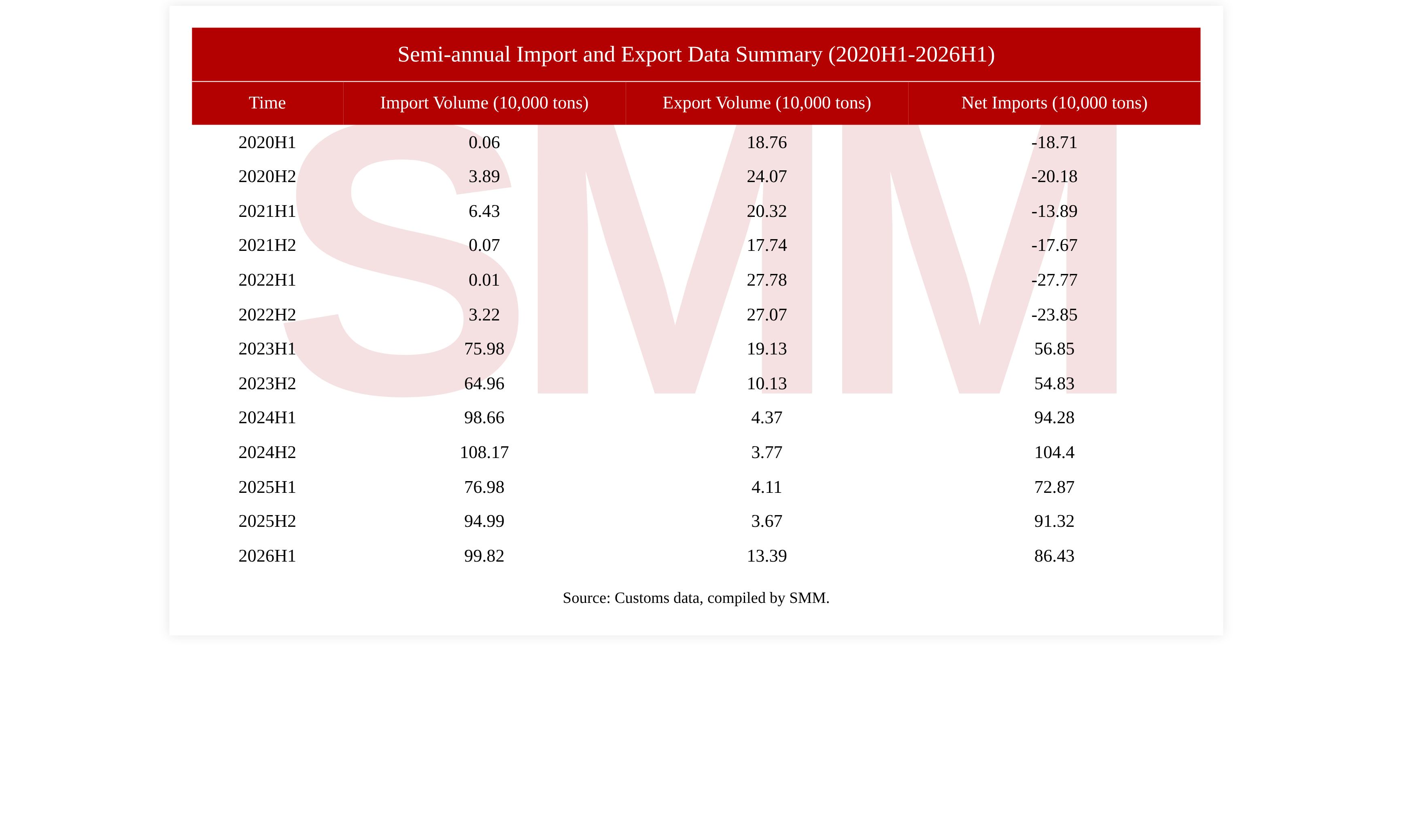
Starting from 2023, China has shifted from a net exporter to a net importer of phosphate ore.
II. Four Key Changes
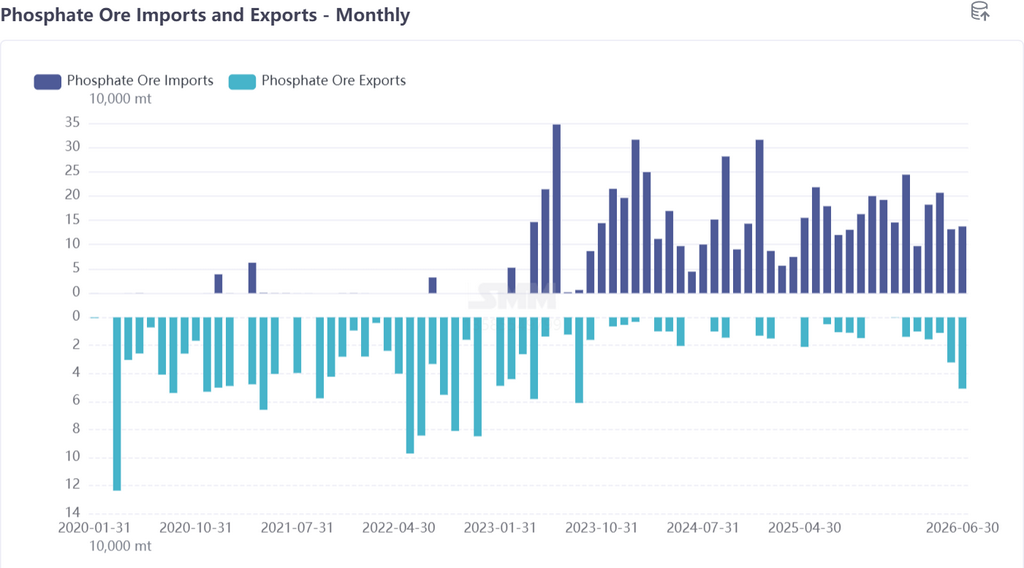
1. Imports Rebound to the High Level of 2024 . H1 2026 imports of 998,200 mt grew 29.66% from 769,800 mt in H1 2025, recovering to the 986,600 mt level of H1 2024. The single-month peak in H1 was 243,900 mt in January, with secondary highs of 206,600 mt in April and 182,100 mt in March. The import side rebounded significantly from the trough of H1 2025 (769,800 mt), confirming that the "high import" norm established since 2024 has taken hold.
2. Export Volumes Triple to a 4-Year High . H1 2026 exports of 133,900 mt surged 225.91% from 41,100 mt in H1 2025, marking the highest level since H1 2023 (191,300 mt). A second-quarter surge structure formed with 50,900 mt in June, 32,200 mt in May, and 11,100 mt in April, aligning closely with the event window of Egypt's announcement on May 13 to cease signing new phosphate ore export contracts (shifting to higher-value phosphate fertiliser exports).
3. Net Imports Remain High but Narrow . H1 2026 net imports of 864,300 mt were significantly higher than the 942,800 mt of H1 2024 (historical peak) and the 728,700 mt of H1 2025, reflecting a persistent domestic supply deficit for phosphate ore and still-elevated import dependency.
4. H1-H2 Seasonal Pattern Broken. Historically, H1 imports were usually lower than H2 imports (cumulative H2 imports from 2020 to 2025 totalled 2.7531 million mt, significantly higher than cumulative H1 imports), but H1 2026 imports of 998,200 mt are already close to the 949,900 mt of H2 2025 — the traditional pattern of winter stockpiling peak being back-loaded into Q3-Q4 has been disrupted, and the pace of imports has become more year-round.
III. Inflection Point Assessment
2023 marked a historic inflection point in China's phosphate ore import and export structure: Before 2023, China was a net exporter of phosphate ore (net imports were negative from 2020 to 2022). Starting from 2023, it turned into a net importer. Moreover, imports first exceeded 980,000 mt in H1 2024 and then broke through 1.08 million mt in H2 2024 . The resource endowment constraint of "high proportion of low-grade ore and low proportion of high-grade ore" in China, coupled with the demand surge from new energy LFP and LMFP, are the two fundamental drivers for the structural shift to net imports.
The export side tripled in H1 2026 : In the short term, this was driven by a "last-train effect" triggered by Egypt's export ban on May 13 , as Chinese phosphate chemical enterprises rushed to fulfill export order deliveries before the window closed; in the medium and long term, the capacity expansion of domestic phosphate fertilisers (MAP/DAP) and LFP cathode materials is shifting China from a "net phosphate ore exporter" to a "global phosphate chemical supply hub."
IV. H2 Outlook
Imports: Imports in H1 already reached 998,200 mt; in H2, along with winter stockpiling purchases and LFP cathode material stockpiling (in preparation for the Q3-Q4 NEV peak season), imports are expected to be 1.1-1.3 million mt, bringing full-year imports to 2.1-2.3 million mt, up 15% to 25% YoY, setting a new high since 2023.
Exports: June’s single-month figure of 50,900 mt already showed signs of acceleration. Exports for July-September are expected at 100,000-200,000 mt. In Q4, driven by overseas demand (India, Southeast Asia, Brazil) plus the reshaping of export competition among Egypt, Jordan, and Morocco, full-year exports are forecast at 200,000-300,000 mt, up 200% to 300% YoY.
Net imports: Net imports in 2026 are projected at 1.7-2 million mt, remaining at a historical high, signaling that the contradiction of phosphate ore undersupply in China is unlikely to be fundamentally resolved in the medium term. Reliance on overseas sources (Egypt, Jordan, Morocco, Kazakhstan, Peru, Algeria) will continue to rise.
Note: Should you have any additions to the details mentioned in this article, or if you are interested in phosphorus chemicals (phosphate ore, iron phosphate, LFP, etc.) and solid-state battery topics, please feel free to contact me. Contact details:
Tel: 021-20707860 (or WeChat: 13585549799), Yang Zhaoxing. Thank you!

![[Lithium Battery: Mitsubishi Motors Plans To Build Battery Plant In Philippines]](https://imgqn.smm.cn/usercenter/fblvS20251217171729.png)
![[Lithium Battery: Environmental Impact Assessment For A Lithium Battery Anode Material Project In Guizhou Announced]](https://imgqn.smm.cn/usercenter/nVnLo20251217171728.jpg)