Highlights: On July 20, 2026, based on customs data, China's phosphate ore imports in June 2026 were 137,000 mt, up 4.5% MoM from 131,000 mt in May. Total import value was $12.567 million, up 2.8% MoM. The average import unit price was $91.5/mt, down 1.7% from $93.0/mt in May.
1. Review of Phosphate Ore Imports and Exports in May
In May 2026, China's phosphate ore imports were 131,000 mt, down 36.4% MoM; total import value was $12.226 million, down 38.1% MoM; the average import unit price was $93.0/mt, down 2.6% MoM. Source countries were highly concentrated in Egypt: imports from Egypt were 128,000 mt (up 31.7% MoM), accounting for 97.7% of total imports; no imports from Peru or Jordan in the month. Key background: On May 13, Egypt's Ministry of Petroleum and Mineral Resources announced it would no longer sign any new phosphate ore export contracts, driving a transition from raw material exports to the manufacturing of high-value-added products such as phosphate fertilisers. Impacted by this policy tightening signal, the Egyptian import unit price rose 14.1% to $93.0/mt in May, with CFR prices (26–27% grade) quoted at $95–100/mt.
Provincial patterns shifted dramatically: Guangxi jumped to first place with 78,000 mt (up 65.9% MoM); Hubei, which led with 157,000 mt in April, saw its May imports drop to zero (down 100% MoM); Shandong imported 3,000 mt (up 171.2% MoM), Zhejiang 1,000 mt, and other provinces together imported 50,000 mt (up 3,602.2% MoM), further diversifying import channels.
On the export side, May exports were 32,000 mt, up 189.6% MoM. Hubei exported 21,000 mt (no exports in April), Fujian 6,000 mt (down 40.6% MoM), and Guizhou 5,000 mt (no exports in April), with provinces such as Hubei and Guizhou seeing a full recovery in exports.
2. Analysis of Phosphate Ore Imports and Exports in June
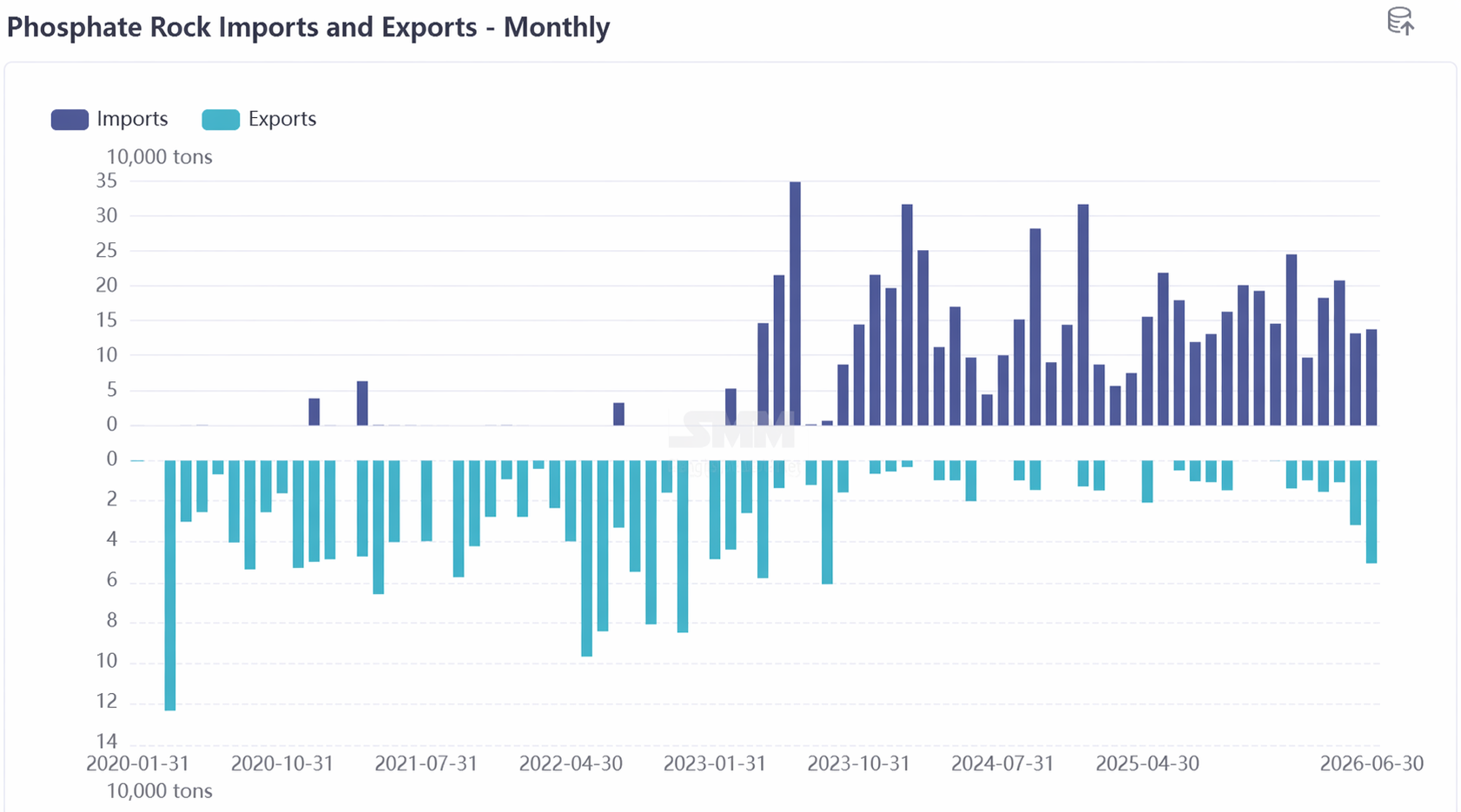
1. Phosphate Ore Imports: Modest Volume Growth, Unit Price Pulls Back Slightly
In June 2026, China's phosphate ore imports were 137,000 mt, up 4.5% MoM from 131,000 mt in May. Total import value was $12.567 million, up 2.8% MoM. The average import unit price was $91.5/mt, down 1.7% from $93.0/mt in May. The slight rebound in imports combined with a simultaneous pullback in unit prices reflected that the market entered a transitional phase of "compensating price with volume and switching source countries" after Egypt's policy shock in May.
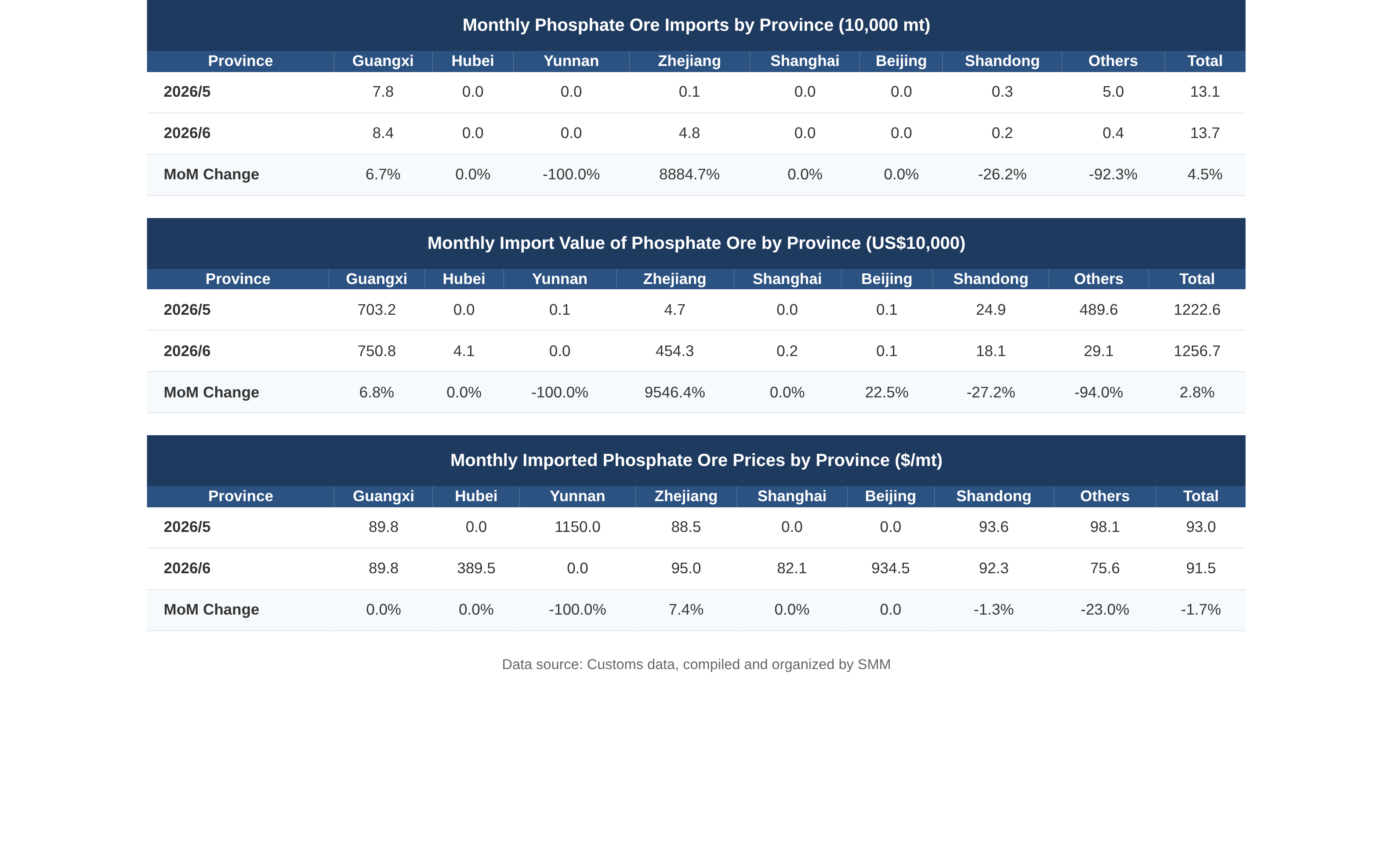
2. Phosphate Ore Imports: Drastic Restructuring of Source Country Patterns, Egypt's Share Plunges to 61%, Jordan/Morocco/Kazakhstan Take Over with Volume Growth
The single‑dominant‑country import structure in May was drastically restructured in June. Imports from Egypt fell from 128,000 mt in May to 84,000 mt, plummeting 34.7% MoM, but it remained the top source country; its share of the total plunged from 97.7% in May to around 61%, indicating that the policy effect of Egypt's May 13 announcement to stop signing new phosphate ore export contracts has begun to be materially transmitted.
Imports from Jordan surged from an extremely low base (about 1 mt) in May to 48,000 mt, a MoM increase of tens of thousands of times, jumping to second place; the import unit price was $95/mt, down 91.7% MoM from May (mainly due to the base effect from the previously high unit price). Jordanian supply, mainly medium-grade with stable prices, became the core alternative source to offset the Egyptian shortfall this month.
Pakistan imported 6,000 mt, up 71.6% MoM, with import unit price edging down, maintaining stable supply as a nearby South Asian source. Other countries including Morocco, Kazakhstan, Peru, and Lebanon together imported about 2,000 mt; Morocco's import unit price was as high as $5,050/mt, and Kazakhstan's $2,895.2/mt, affected by high-grade scarce ores, with unit prices significantly higher than mainstream supply.
In terms of import value, of June’s total $12.567 million, Egypt's share dropped significantly (about $7.7 million, approximately 61%), Jordan accounted for about $4.54 million, and Pakistan, Morocco and others together represented a limited share. The divergence between the overall 2.8% MoM value growth and 4.5% MoM volume growth further confirmed the structural decline in the average price driven by Egypt’s reduced share.
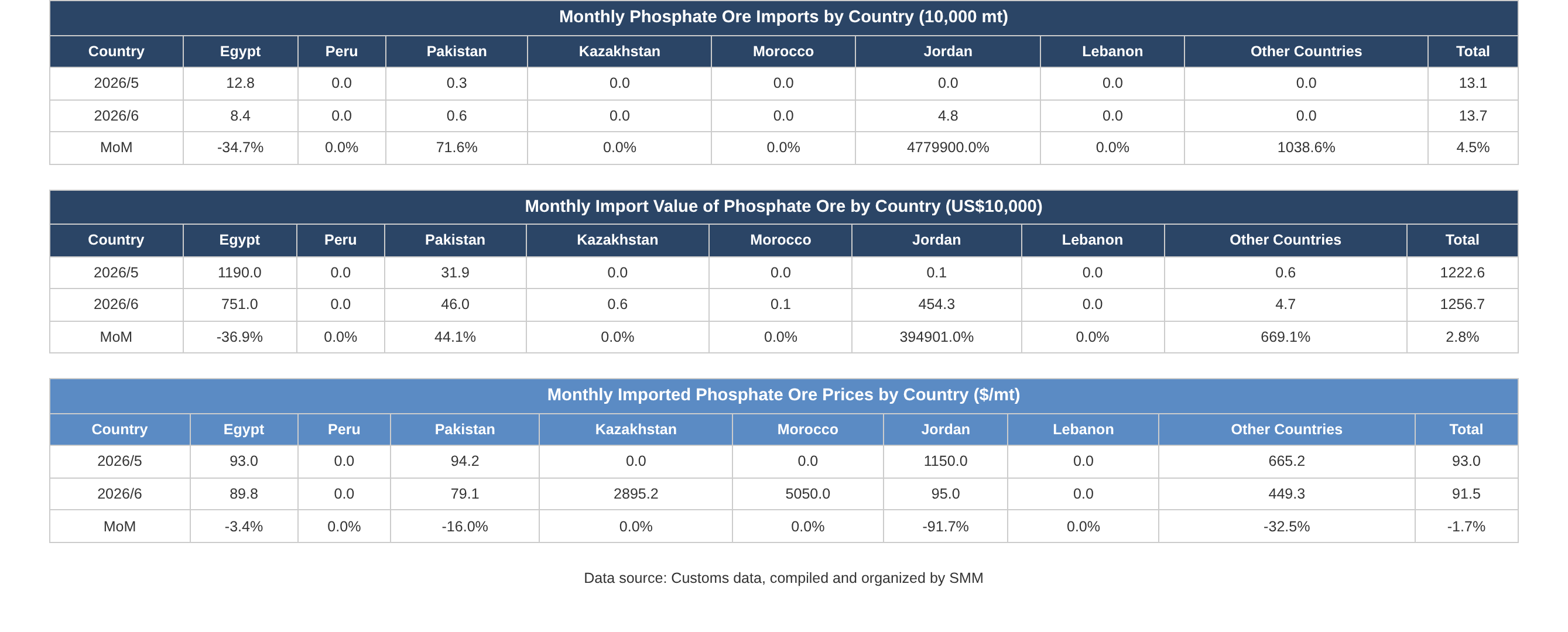
3. Phosphate Ore Imports: Provincial Patterns Shift Again, Guangxi Remains Top, Zhejiang Surges 89-fold
The provincial import structure in June continued the drastic adjustments seen since May. Guangxi remained the top importing province with 84,000 mt , up 6.7% MoM, with import value of $7.508 million (up 6.8% MoM), sustaining its traditional advantage in handling North African and Middle Eastern supplies such as those from Egypt and Jordan. Zhejiang imported 48,000 mt, a staggering 8,884.7% (about 89-fold) surge from 500 mt in May, with import value of $4.543 million, up 9,546.4% MoM, jumping to second place, reflecting that Yangtze River Delta importers rapidly switched to alternative sources such as Jordan after the policy shock in May, significantly outpacing the channel-switching speed of other provinces. Hubei, after zero imports in May, resumed some imports in June, with an import unit price of $389.5/mt, markedly above the national average, reflecting characteristics of high-grade scarce supply. Beijing’s import unit price of $934.5/mt ranked the highest nationwide, mainly for high-grade small-lot procurement. Shandong, Shanghai and other provinces maintained stable small-lot imports. Yunnan had no imports in June, down 100% MoM, indicating notable regional structural adjustments.
Import unit prices, Guangxi’s price in June held steady in the $89-90/mt range, mainstream inter-provincial supply in Zhejiang was around $95/mt, broadly in line with the nationwide average price of $91.5/mt; high-price provinces such as Beijing and Hubei saw unit prices pushed up by small-lot high-grade purchases, without materially driving up the national average.
The import province mix underwent dramatic change in May.Guangxi surged to the top with 78,000 mt of imports, up 65.9% MoM; while Hubei, which led in April with 157,000 mt, saw May imports drop to zero, a 100% MoM decline. Shandong imported 3,000 mt, up 171.2% MoM; Zhejiang imported 1,000 mt. Other provinces combined imported 50,000 mt, surging 3,602.2% MoM, reflecting further diversification of import channels.
Import value, Guangxi $7.032 million (MoM +84.5%), other provinces $4.896 million (MoM +3,936.7%), Shandong $249,000 (MoM +167.6%), Zhejiang $47,000.
Import unit prices, Guangxi’s May price was $89.8/mt, up 11.2% from April; others were $98.1/mt, up 9.0% MoM; Shandong was $93.6/mt.
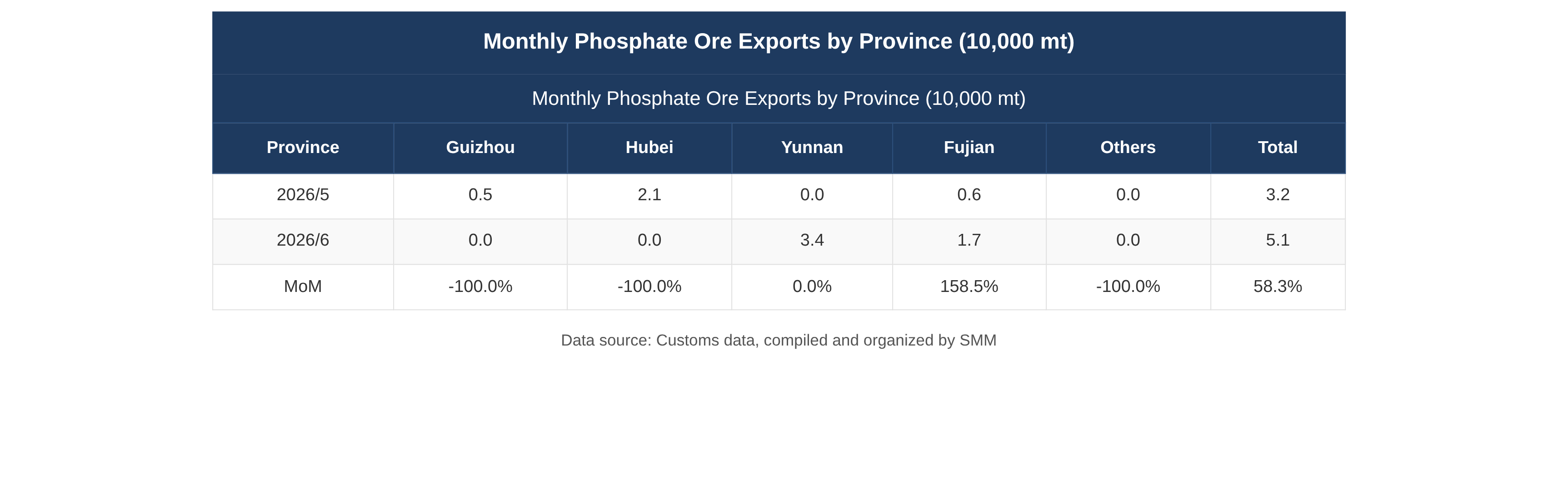
4. Phosphate Ore Exports: 51,000 mt Surge 58.3% MoM, Yunnan and Fujian Lead
In June 2026,China’s phosphate ore exports totaled 51,000 mt, a sharp 58.3% MoM increase from 32,000 mt in May,extending the trend of continuous volume expansion since April.
By export province, Yunnan jumped to first place with 34,000 mt (no exports in May), contributing the bulk of the growth, reflecting the concentrated delivery of prior export orders by industry leaders such as Yunnan Phosphate Chemical Group and Yuntianhua. Fujian exported 17,000 mt, up 158.5% MoM from 6,000 mt in May, maintaining the steady export pace seen from February to May. Guizhou and Hubei had no exports in June, resulting in a new regional structure where “Yunnan takes over and Hubei exits.”
Export Surge Background: Driven by heightened domestic winter stockpiling expectations for phosphate ore (traditional winter stockpiling starts from October to November) and concentrated demand release for iron phosphate in the new energy industry chain, China’s phosphate ore supply-demand balance tightened temporarily. The concentrated export release in June was mainly fueled by prior order deliveries; attention should be paid to changes in the Q3 export pace.
III. Market Outlook
The phosphate ore import market in June exhibited four major features:First, total volumes saw a slight rebound, edging up only 4.5% MoM after the deep pit created by Egypt’s policy shock in May, with the import recovery pace lagging market expectations.
Second, the source country mix underwent dramatic restructuring, with Egypt’s share plunging from 97.7% to about 61%, and alternative origins like Jordan, Pakistan, and Morocco starting to ramp up but still unable to fully offset the gap.
Third, the provincial mix accelerated its shift, with Guangxi firmly at the top, Zhejiang surging 89 times, and Hubei resuming high-price imports—moving the regional channel pattern into a “rebuilding” phase.
Fourth, the export side saw concentrated volume release, led by Yunnan and Fujian, reflecting a temporarily tight domestic supply-demand balance.
Looking ahead to Q3,the impact of Egypt’s halt on new export contracts will continue to unfold—July-August imports could stay in the 130,000-150,000 mt range, with import unit prices moving sideways at $90-100/mt.Three key points to watch:first, the supply stability and grade structure of alternative sources like Jordan and Morocco; second, how the pace of peak-season demand for domestic ammonium phosphate/iron phosphate materializes and stimulates import demand; and third, changes in export policies and customs clearance timing before and after the winter stockpiling season (October-November).
The average Q3 import price is expected tohover within the $90-100/mtrange. As domestic winter stockpiling demand materializes in Q4, imports will surge again, with the price midpoint likely shifting up to$95-105/mt.
Note: Should you have any supplements to the details mentioned in this article or concerns regarding phosphorus chemicals (phosphate ore, iron phosphate, LFP, etc.) and solid-state batteries, please feel free to contact us. Contact details:
Tel: 021-20707860 (or WeChat: 13585549799), Yang Chaoxing. Thank you!

![[Lithium Battery: Mitsubishi Motors Plans To Build Battery Plant In Philippines]](https://imgqn.smm.cn/usercenter/fblvS20251217171729.png)
![[Lithium Battery: Environmental Impact Assessment For A Lithium Battery Anode Material Project In Guizhou Announced]](https://imgqn.smm.cn/usercenter/nVnLo20251217171728.jpg)