In H1 2026, China's aluminum extrusion industry exhibited an extreme structural divergence. Demand for traditional architectural extrusion remained persistently weak, dragging down the overall industry load, while industrial extrusion maintained high prosperity, driven by the new energy, electric power, and heat dissipation sectors, becoming the industry's core support. Meanwhile, the linked volatility of domestic and overseas aluminum prices intensified, with the price spread between Chinese and overseas markets repeatedly narrowing. The export market experienced a "deep-V recovery" trend. The industry overall operated with the characteristics of a "weak recovery in domestic demand, an initial decline followed by a rebound in overseas demand, and distinct structural divergence between strong and weak segments."
Ⅰ. Extrusion Operating Rates: Architectural Extrusion a Persistent Drag, Industrial Extrusion's High Resilience Underpins the Industry
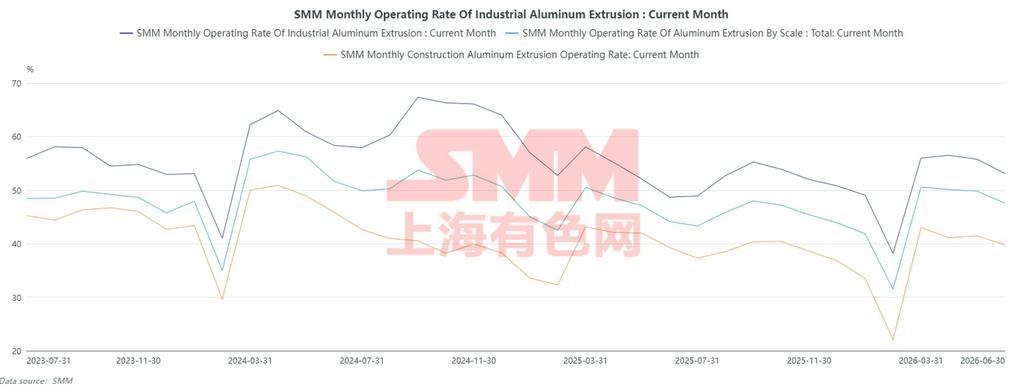
After the 2026 Chinese New Year holiday, the industry entered its traditional post-holiday peak season. In March, extrusion enterprises concentrated on resuming production, and downstream users engaged in concentrated restocking, pushing the industry's comprehensive operating rate to its H1 high of 50.6%. Entering Q2, the industry's operating rate pulled back mildly and persistently, as real end-user demand proved insufficient, raw material prices fluctuated at highs, and factors such as the rainy season in South China and environmental protection inspections in some regions took effect. By June, the overall operating rate had fallen to 47.6%, a level weaker than the average for the same period in the past three years.
Architectural extrusion was the core weak point dragging down the industry's operating rate. In H1, data on commercial housing transactions and new construction starts in China remained persistently weak. Developers' financial conditions showed no significant improvement, leading to slow payment collection on projects. Orders for building and construction-related doors, windows, and curtain wall extrusions continued to shrink. Domestic aluminum prices generally consolidated at highs from January to May. Downstream end-users showed clear resistance to high-priced raw materials, and traders and processing plants generally maintained low inventory with a fast-in, fast-out strategy, showing a low willingness to actively restock. Although the industry actively expanded into non-residential construction demand such as industrial parks, standard factories, and government-enterprise public construction, and there was a mild recovery in home-decoration renovation and retail segments, the incremental volume was limited and completely unable to offset the decline in bulk project orders. The operating rate for architectural extrusion remained under pressure throughout H1, marking it as the industry's largest drag.
The structural prosperity of the industrial extrusion segment continued to climb, providing strong support to the industry's operating rate. Demand in power transmission and distribution, energy-storage structural components, industrial heat-sink extrusion, and rail transit support maintained steady growth. In the PV extrusion sector, due to the official cancellation of an export tax rebate policy for PV-related products on April 1, overseas clients placed rush orders in Q1, and enterprises rushed production schedules to meet deadlines, driving the operating rates for PV frame and support extrusion to a periodic high in March. After the policy took effect, the windfall of rush overseas orders subsided, and from April to June, production schedules for PV extrusion returned to rational, stable operation. NEV extrusion showed a structural divergence, with steady demand for auto-body and chassis lightweight extrusion, but weakening demand for common interior trim extrusion. Overall, the resonance of prosperity across multiple industrial extrusion tracks effectively offset weak demand in traditional architectural materials, highlighting the industry's structural resilience.
II. Aluminum Extrusion Exports: Deep Pressure in Q1, Continued Recovery in Q2, Showing a V-Shaped Reversal in H1
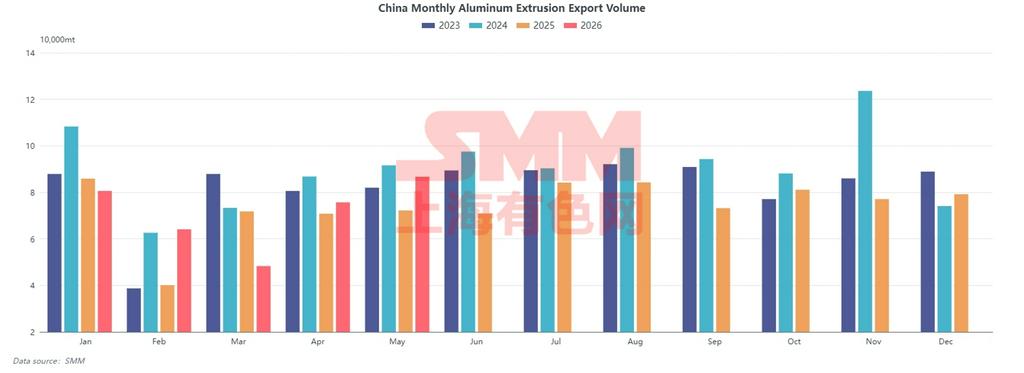
In H1 2026, China’s aluminum extrusion exports overall followed a V-shaped trajectory with a sharp decline in Q1 and a continuous recovery in Q2. The driving forces gradually shifted from inverted prices and the overseas off-season at the start of the year to the release of demand in emerging markets and the transfer of China’s processing and manufacturing advantages.
Q1: Domestic and overseas aluminum price inversion coupled with the overseas off-season caused a significant weakening of exports
Exports showed resilience in the off-season, January-February, mainly supported by front-loaded orders delivered ahead of Chinese New Year. In January, China exported 81,000 mt of aluminum extrusions, up slightly by 1.4% MoM and down 5.3% YoY; in February, exports fell to 64,000 mt amid Chinese New Year holiday disruptions, down 20.4% MoM but surging 62% YoY, significantly outperforming the typical precipitous decline seen during Chinese New Year in previous years. The key reason was that recycled extrusion enterprises in Guangdong and Fujian concentrated on delivering pre-holiday orders to Southeast Asia and the Middle East before the holiday, while some industrial extrusion companies adopted a ‘domestic primary processing, overseas deep processing’ model to speed up fulfillment, supporting the export volume at the start of the year.
In March, industry exports hit the H1 low, with only 48,000 mt exported during the month, down 24.8% MoM and plunging 32.8% YoY. The sharp decline was not driven by a single geopolitical factor but by a confluence of negative catalysts: First, front-loaded orders before Chinese New Year drained demand in February and March, and overseas markets entered the traditional consumption off-season after the holiday. Second, LME aluminum swung wildly in March, and domestic and overseas aluminum prices quickly inverted, compressing export profits for domestic extrusions; enterprises actively controlled and reduced orders. Third, the EU and US CBAM carbon tariffs continued to suppress high-end extrusion exports, causing further contraction in European and US markets, coupled with slower logistics and customs clearance in some Middle Eastern regions. These multiple factors led to a sharp decline in March export volumes.
Q2: Emerging Markets Expand, Exports Grow Both YoY and MoM for Two Consecutive Months
Starting in April, the price spread between Chinese and overseas markets gradually narrowed, the overseas off-season ended, and industry exports embarked on a continued recovery. Exports in April reached 76,000 mt, surging 56.8% MoM and rising 6.9% YoY, returning to the normal range of previous years. Trade and logistics order in the Middle East was restored, and stockpiling in Southeast Asia began ahead of the rainy season. At the same time, Chinese enterprises accelerated expansion into emerging markets in Central Asia and Latin America, leveraging overseas joint-operated warehouses and cross-border stockpiling models to continuously secure essential orders for overseas doors, windows, and curtain walls, rapidly restoring export vitality. May exports sustained their high-growth momentum, reaching a monthly peak for H1, with exports of 87,000 mt in the month, up 14.6% MoM and 20.1% YoY. The export structure continued to improve. Low-end construction profiles registered steady volume growth, while the export share of high value-added industrial aluminum components, outdoor aluminum semis, and PV support profiles kept rising. Southeast Asia, Australia, South America, and Central Asia emerged as the four core growth markets for China's profile exports, effectively offsetting the demand contraction in European and US markets.
III. H2 2026 Industry Outlook: Muted Domestic Demand, Marginally Weakening Exports, Persistent Structural Divergence
Looking ahead to H2 2026, the structural divergence in China's aluminum extrusion industry is expected to solidify further, with overall operations consolidating on a subdued note, as industrial extrusions provide a floor while construction extrusions act as a drag.
Domestic demand side, the fundamentals of the property sector are unlikely to see a substantive recovery in the short term. New starts for commodity housing and project payments remain weak, keeping construction extrusion demand at low levels without any trend-driven recovery. Non-residential infrastructure and home improvement retail can only provide a slight offset and will not reverse the overall weakness in construction extrusions. Industrial extrusions will remain the core pillar for the industry: steady climbing of PV installations in China during H2 will drive continued release of demand for PV frames and mounting extrusions; demand for extrusions used in new-type energy storage, data center cooling, and power equipment will maintain steady growth. New energy vehicle extrusions are seeing divergence between strength and weakness, with firm demand for high-end lightweight structural components. However, with overall overcapacity in the industry and intensifying end-user competition, demand for ordinary automotive extrusions faces marginal contraction pressure. Overall, industrial extrusions can hold the industry's baseline but cannot offset the downward pressure from construction extrusions, leaving the overall operating rate in H2 slightly lower than in H1.
Export pressure is gradually emerging, with performance likely pulling back from Q2's high growth to a mild slowdown. In H2, the typical overseas seasonal boom will gradually fade, compounded by a narrowing aluminum price spread between in and outside China, compressed export processing profits, the continued capacity release from overseas local aluminum semis producers, and persistent trade barriers against Chinese aluminum semis in some countries. These factors will gradually weaken the price advantage of China's extrusions for export. Although secondary aluminum extrusion exports still possess cost advantages, intensifying low-end product homogenization and continuously compressed profits mean that H2 growth in aluminum extrusion exports is expected to slow down gradually, with overall volumes weaker than in Q2.
Overall, the aluminum extrusion industry in 2026 will continue to exhibit structural characteristics of weak construction extrusions, strong industrial extrusions, muted domestic demand, and high-before-low exports. Industry competition will further concentrate on high-end industrial extrusions, high-value-added deep processing, and emerging ex-China markets, while low-end construction extrusion capacity will continue cycling into market clearance.
(The above information is based on market collection and comprehensive assessment by the SMM research team. The information provided in this article is for reference only. This article does not constitute direct advice for investment research decisions. Clients should make cautious decisions and not rely on this information to replace their own independent judgment. Any decisions made by clients are unrelated to SMM.)
Data source: SMM Click on the SMM industry database to learn more

![Slightly Improved Trading Sentiment in Central and East China, Stockpiling Demand Released [SMM Spot Aluminum Midday Comment]](https://imgqn.smm.cn/usercenter/PerRJ20251217171650.jpg)