SMM July 17 News:
Metals Market:
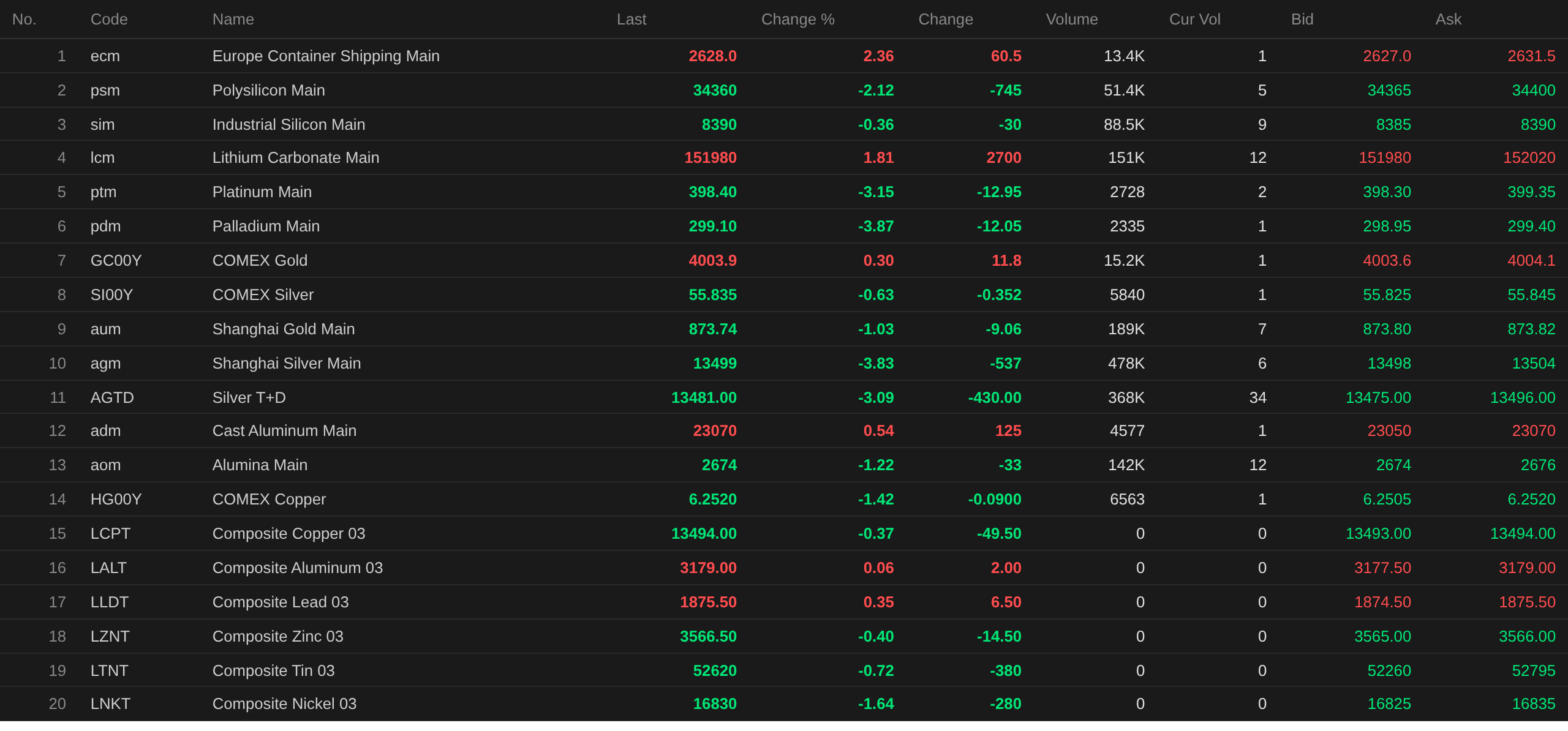
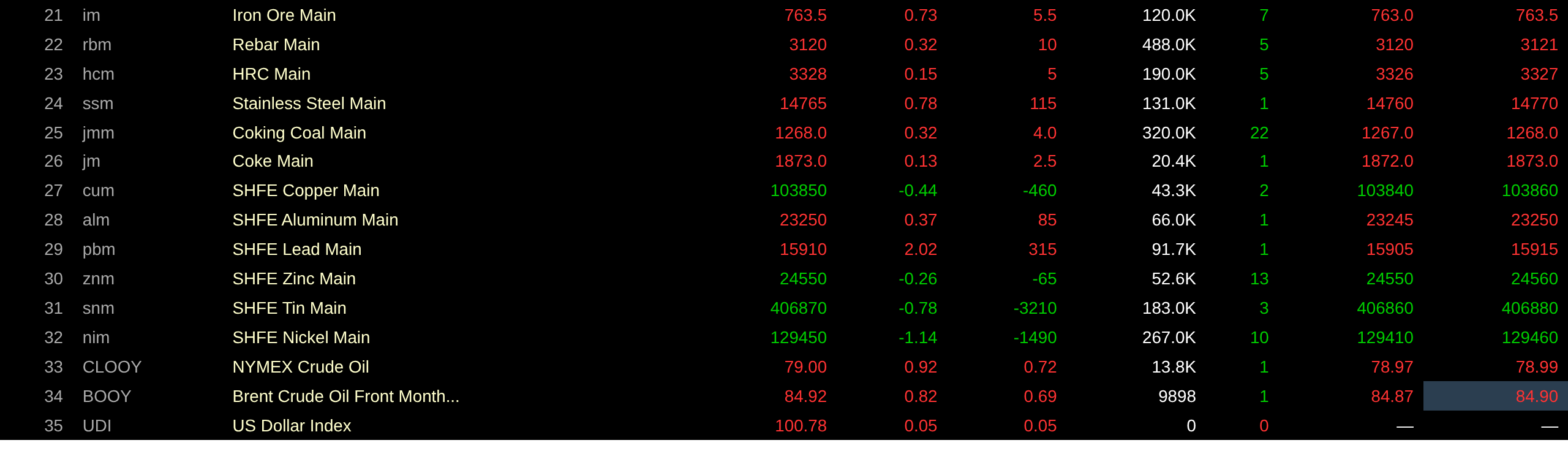
As of the midday close, domestic base metals mostly fell. SHFE copper slipped 0.44%, SHFE aluminum rose 0.37%. SHFE lead jumped 2.02%, SHFE zinc edged down 0.26%. SHFE tin dropped 0.78%. SHFE nickel slid 1.14%.
In addition, the most-traded casting aluminum futures contract rose 0.54%, the most-traded alumina contract fell 1.22%. The most-traded lithium carbonate contract gained 1.81%. The most-traded silicon metal contract edged down 0.36%. The most-traded polysilicon futures contract dropped 2.12%.
Ferrous metals all rose. Iron ore gained 0.73%, rebar and HRC both rose within 0.4%. Stainless steel added 0.78%. Coking coal and coke: the most-traded coking coal contract rose 0.32%, and the most-traded coke contract gained 0.13%.
Overseas base metals: As of 11:40 a.m., LME metals mostly fell. LME copper slipped 0.37%, LME aluminum edged higher, and LME lead rose 0.35%. LME zinc fell 0.4%, LME tin dropped 0.72%. LME nickel slid 1.64%.
Precious metals: As of 11:40 a.m., COMEX gold gained 0.3%, and COMEX silver lost 0.63%. Domestic precious metals: SHFE gold fell 1.03%; the most-traded SHFE silver contract dropped 3.83%.
Additionally, as of the midday close, the most-traded platinum futures contract fell 3.15%, and the most-traded palladium futures contract dropped 3.87%.
As of the midday close, the most-traded container shipping (Europe route) futures contract rose 2.36% to 2,628 points.
As of 11:40 a.m. on July 17, selected futures midday quotes:
Spot and Fundamentals
Lead: This week, Pb50 domestic TC (weekly) remained flat at 150 yuan/mt in metal content, and Pb60 import TC (weekly) stayed flat at -$170/dmt. TCs were largely stable during the week...
Macro Front
China:
[SAFE: Will strengthen counter-cyclical adjustment and expectations guidance when necessary to maintain stable operation of the foreign exchange market] Li Bin, deputy head of the State Administration of Foreign Exchange, said at a press conference of the State Council Information Office that the SAFE always adheres to combining facilitation with risk prevention, resolutely safeguards the security baseline under open conditions, continuously improves the "macro-prudential plus micro-supervision" two-in-one management framework, and will strengthen counter-cyclical adjustment and expectations guidance when necessary to maintain stable operation of the foreign exchange market and prevent systemic risks.
[PBOC's reverse repo operations resulted in a net injection of 430.5 billion yuan today] The PBOC conducted 450.5 billion yuan of 7-day reverse repo operations today. As 20 billion yuan of 7-day reverse repos matured, a net injection of 430.5 billion yuan was achieved on the day.
US dollar:
As of 11:40, the US dollar index rose 0.05% to 100.78. Federal Reserve’s Logan said the US Fed should raise interest rates to tackle elevated inflation — a remark hinting she may be prepared to oppose a decision to hold rates steady later this month. Logan said the June inflation data released on Tuesday showed price increases were slowing, but not enough to convince her that inflation has returned to the Fed’s 2% target path. “The June CPI data do indicate that inflation is likely to return to target, and the outlook is more optimistic,” Logan said, “but this path remains fragile. I currently believe that moderately raising rates would help better balance the outlook and risks.”
Fed Vice Chair Jefferson: If the demand effects from AI infrastructure construction and consumption materialize before the productivity gains from AI, then AI could put upward pressure on inflation.
According to CME “FedWatch”: The probability of the Fed keeping rates unchanged in July is 88.8%, while the probability of a cumulative 25 bp hike is 11.2%. For September, the probabilities are: unchanged 48.8%, cumulative 25 bp hike 46.2%, and cumulative 50 bp hike 5.1%. (Jin10 Data APP)
Data-wise:
Today will see the release of US June housing starts (annualized), building permits, June import price index m/m, June industrial production m/m, July one-year inflation expectations (preliminary), July University of Michigan consumer sentiment (preliminary), as well as Eurozone May seasonally adjusted current account, June CPI final y/y, and June CPI final m/m.
In addition, China’s refined oil products will kick off a new price adjustment window. The 2026 World AI Conference and High-level Meeting on Global AI Governance runs from July 17 to 20 in Shanghai, and President Xi Jinping will attend the opening ceremony and deliver a keynote speech. 2026 FOMC voting member and Dallas Fed President Logan speaks, 2028 FOMC voting member and Kansas City Fed President Schmid speaks, Fed Vice Chair Jefferson speaks on the economy and monetary policy, and US President Trump delivers a national address.
Crude oil:
As of 11:40, both crude oil benchmarks rose, with WTI up 0.92% and Brent up 0.82%.
The US's strikes against Iran escalated further on Thursday, as the US military reportedly attacked an oil tanker near Iran's main export port, causing a marked contraction in shipping traffic through the Strait of Hormuz. (Wall Street CN)
IEA Executive Director Birol Fatih: If oil and gas flows through the Strait of Hormuz do not improve in the coming weeks, we should be concerned about energy security. (Jin10)
Canada's export credit agency stated that the ongoing decline in global oil inventories has made energy markets more vulnerable. Export Development Canada (EDC) expects the average international oil price this year to be around $96 a barrel, and around $84 a barrel in 2027. This forecast reflects persistent market uncertainty and the need to rebuild depleted inventories in response to future potential shocks. EDC Chief Economist Bergman Stuart said that oil storage facilities around the world have now become the "marginal producer" of the oil market. Bergman pointed out that inventories accumulated before the crisis, along with strategic reserve releases, helped offset the impact of supply cuts, but at the cost of global inventories falling below seasonal normal levels. He said that if a permanent agreement is reached to end the war and restore shipping through the Strait of Hormuz to pre-crisis levels, it would help ease tight supply. However, Bergman believes that the oil market remains tight, and once geopolitical risks escalate, the market is highly susceptible to further disruptions and wild swings. (Jin10 Data APP)
Spot Market at a Glance:
►
►
►
►
►
►
►
►
►
![With Limited Available Cargoes, Suppliers Hold Back From Selling, Making Spot Market Offers Hard to Find [SMM Yangshan Copper Spot]](https://imgqn.smm.cn/usercenter/fEiiq20251217171711.jpg)

![US Fed engages in tug of war over rate policy tone, the most-traded SHFE tin contract moved sideways in the morning session [SMM Tin Morning Commentary]](https://imgqn.smm.cn/usercenter/gbiCe20251217171750.jpg)