Copper Price Surge Drives Cathode-Scrap Spread Expansion; Supply Side Resists Declines, Holds Prices Firm, and Arbitrage Purchasing Dominates Transactions [SMM Copper Scrap Weekly Review]

Published: Jul 17, 2026 10:15
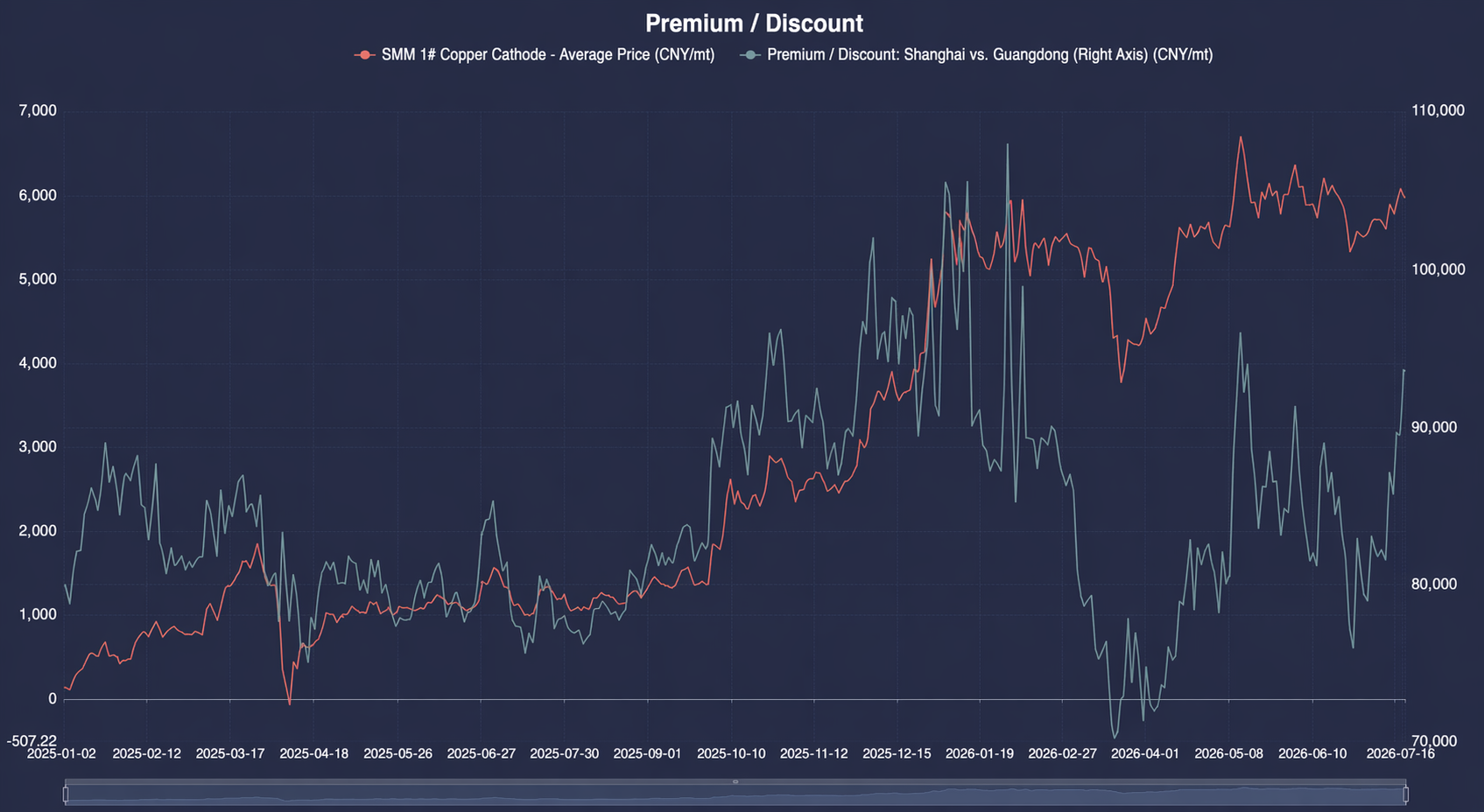
[SMM Analysis: Surge in Copper Prices Drives Widening Price Difference Between Copper Cathode and Copper Scrap; Supply Side Holds Prices Firm Amidst Declines + Arbitrage-Driven Purchases Dominate Transactions] The most-traded SHFE copper contract surged to 105,020 yuan/mt mid-week, rising nearly 2,000 yuan/mt from the beginning of the week. However, as copper scrap was supported by compliance costs and suppliers held prices firm, resisting declines, its price fluctuated by less than 1,000 yuan/mt throughout the week. Consequently, the price difference between copper cathode and copper scrap widened consistently from 2,445 yuan/mt at the start of the week to 3,923 yuan/mt, a WoW increase of over 2,200 yuan/mt. This widening spread was entirely driven by the isolated rise in copper cathode prices. The inherent resilience of copper scrap against price declines was the core feature on the supply side this week......

SMM July 16 News:

       The most-traded SHFE copper contract surged to 105,020 yuan/mt mid-week, gaining nearly 2,000 yuan/mt over the entire week compared to the start of the week. However, copper scrap was supported by compliance costs, with suppliers holding prices firm and resisting declines. The weekly price fluctuation for copper scrap was less than 1,000 yuan/mt. The price difference between copper cathode and copper scrap widened from 2,445 yuan/mt at the start of the week to 3,923 yuan/mt, an increase of over 2,200 yuan/mt from the previous weekend. The expansion in the spread was entirely driven by the unilateral rise in copper cathode prices, while the resilience of copper scrap prices was the core feature of the supply side this week.
       The supply side continued to show a structurally tight pattern since 2026, constrained by two underlying factors. First, reverse invoicing compliance requirements: the aftermath of compliance inspections in south China such as Jiangxi and Hubei had not subsided, and invoicing quotas in places like Shuyang, Jiangsu remained limited, keeping available compliant and deductible copper scrap persistently tight. Second, following the elimination of local illegal tax rebates through Document No. 770 at the end of 2025, the "migratory" small and medium-sized copper scrap traders that had previously relied on subsidies continued to exit the market. Overall available supplies contracted significantly compared to the same period in previous years. Additionally, suppliers generally maintained a psychological barrier of "not selling cheap before copper prices break 100,000 yuan/mt." The weekly pace of shipments closely followed copper price fluctuations: At the start of the week, when copper prices pulled back, the sales sentiment index fell to 2.37, with suppliers widely holding back from selling, market supplies contracted, and secondary copper rod enterprises found it difficult to source low-priced material. Mid-week, as copper prices surged above 105,000 yuan/mt, suppliers' willingness to sell at fixed prices increased, pushing the sales sentiment index to 2.48. However, due to weak off-season orders in downstream scrap-consuming sectors and low acceptance of high-priced material, shipments did not see significant volume. Most of the material was purchased by secondary copper rod enterprises using a hedging strategy of buying raw materials and selling futures, rather than for actual production restocking. Many rod enterprises would stop pricing once they had purchased sufficient material for the day's demand in the morning session, without chasing higher prices to purchase. Towards the end of the week, copper prices consolidated and pulled back, and suppliers once again shifted to holding back from selling, tightening market supplies again. Regional divergence persisted: due to compliance costs and slower capital turnover in south China, purchase prices for bare bright copper were 400-600 yuan/mt lower than in the north. The abnormal structure of different prices for the same material continued, with traders still maintaining a low-inventory, fast-turnover strategy and not daring to stockpile in anticipation of price rises. The issue of payment collection cycles extending to over two weeks remained unresolved, further limiting the elastic release of supply. The demand side was overall weak. Both secondary copper rod and scrap-derived copper anode enterprises were in the high-temperature off-season, with limited new orders. Coupled with expectations of further declines in copper prices, purchases were mainly driven by hedging operations and essential restocking. Even when the cathode-scrap spread surged above 3,900 yuan/mt mid-week, there was no large-scale production restocking. End-user wire and cable enterprises maintained strong wait-and-see sentiment, purchasing only to meet minimum rolling demand. Throughout the week, copper scrap transactions were largely driven by copper price fluctuations and hedging demand, with no trend-based volume increase.

       Going forward, if copper prices stabilize above 105,000 yuan and the price difference between copper cathode and copper scrap remains above 3,000 yuan, arbitrage demand may continue to support the circulation of copper scrap. However, if the detailed reverse invoicing rules remain unclear and off-season orders stay sluggish, the structural tightness on the supply side and the weak reality on the demand side will continue to offset each other, making it difficult for transactions to achieve a trend breakthrough.


     

Data Source Statement: Except for publicly available information, all other data are processed by SMM based on publicly available information, market communication, and relying on SMM's internal database model. They are for reference only and do not constitute decision-making recommendations.

Images in this article contain AI-translated captions for reference only.

For any inquiries or for more information, please contact: lemonzhao@smm.cn
For more information on how to access our research reports, please contact:service.en@smm.cn
Related News
Kazakhstan's Copper and Zinc Production Declines in H1 2023, June Sees Significant Drops
3 hours ago
Kazakhstan's Copper and Zinc Production Declines in H1 2023, June Sees Significant Drops
Read More
Kazakhstan's Copper and Zinc Production Declines in H1 2023, June Sees Significant Drops
Data from the Statistics Agency of Kazakhstan on Friday showed that, in January-June this year, copper cathode production dropped 4.5% YoY to 231,945 mt. Of this, June output was 39,323 mt, a 20.8% YoY decline. The data also showed that the country's refined zinc production in June stood at 19,807 mt, down 22.4% YoY, and for January-June, refined zinc production was 112,861 mt, a 14.8% YoY decline.
3 hours ago
Antofagasta Reports Q2 Copper Output Dip, Maintains Full-Year Guidance Amid Stronger H2 Outlook
4 hours ago
Antofagasta Reports Q2 Copper Output Dip, Maintains Full-Year Guidance Amid Stronger H2 Outlook
Read More
Antofagasta Reports Q2 Copper Output Dip, Maintains Full-Year Guidance Amid Stronger H2 Outlook
Chilean copper miner Antofagasta reported on July 15 that its Q2 copper production edged down, reiterated its full-year production guidance, and expects stronger H2 output to drive achievement of the full-year target. In the three months to June 30, the company produced 142,000 mt of copper, down 0.7% QoQ, as a decline in output at the Antucoya mine offset performance at other mines. Q2 net cash cost climbed nearly 26% QoQ to $1.36 per pound. Antofagasta said quarterly production is expected to ramp up gradually over the remainder of the year, and maintained its 2026 copper production guidance at 650,000 to 700,000 mt and net cash cost guidance at $1.15 to $1.35 per pound.
4 hours ago
Copper Miners Face Short-Term Crisis Amid Sulphuric Acid Market Turmoil, IEA Reports
4 hours ago
Copper Miners Face Short-Term Crisis Amid Sulphuric Acid Market Turmoil, IEA Reports
Read More
Copper Miners Face Short-Term Crisis Amid Sulphuric Acid Market Turmoil, IEA Reports
The International Energy Agency (IEA) warns that copper miners producing more than one-seventh of the world’s primary copper supply are now mired in turmoil in the sulphuric acid market, a crisis triggered by conflicts including geopolitical tensions in the Middle East. The agency notes that while the long-term supply outlook for copper has improved slightly, the metal still faces multiple severe challenges in the short term. In its newly released "Global Critical Minerals Outlook 2026" report, the Paris-based IEA says that the short- and medium-term outlook for the copper market has sharply deteriorated over the past year.
4 hours ago
Register to Continue Reading
Gain access to the latest insights in metals and new energy
Already have an account?Sign in here