[SMM Survey] Steel Mill Losses & Environmental Protection-Driven Production Restrictions: July Hot Metal Production Inflection Point Turns Downward

Published: Jul 2, 2026 14:14
According to SMM's tracking survey data, the daily average pig iron production in June increased by 20,000 mt from May. The average daily hot metal production in July is expected to decline by around 12,000 mt MoM from June.

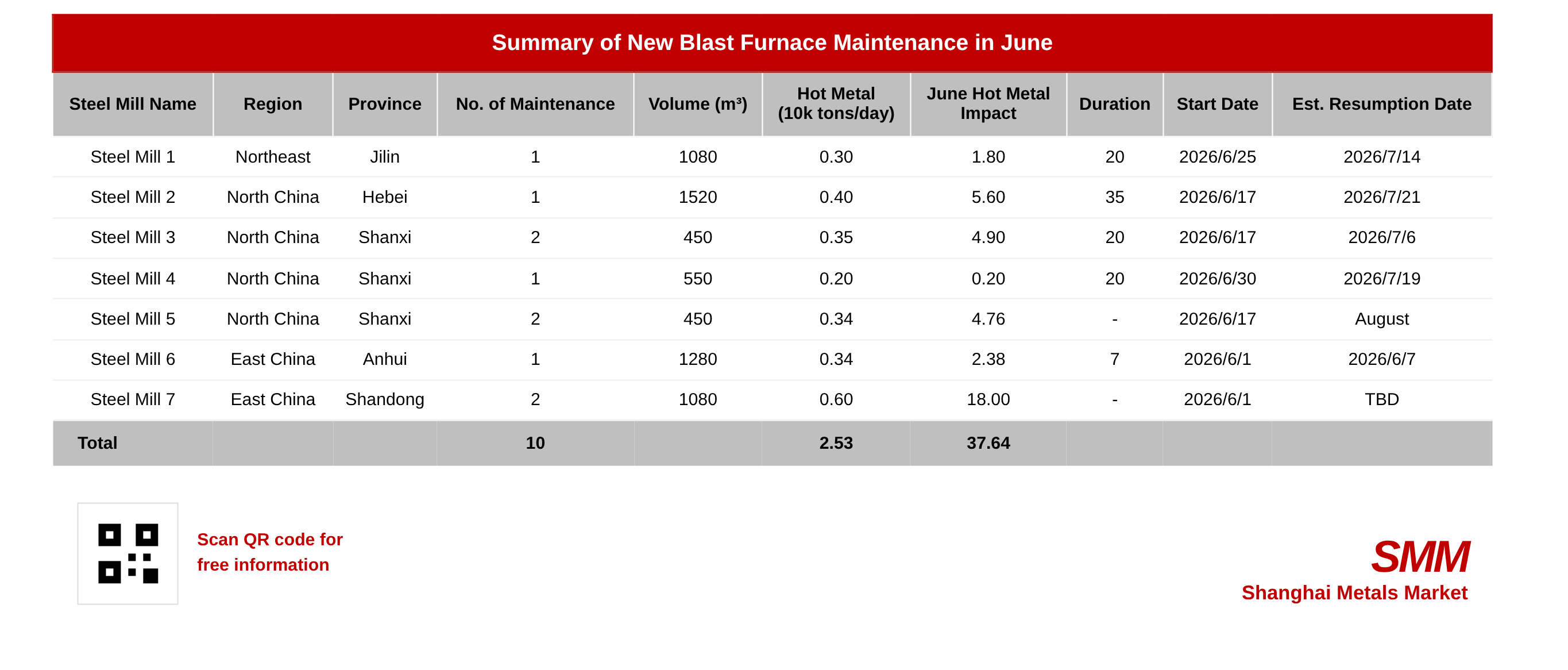
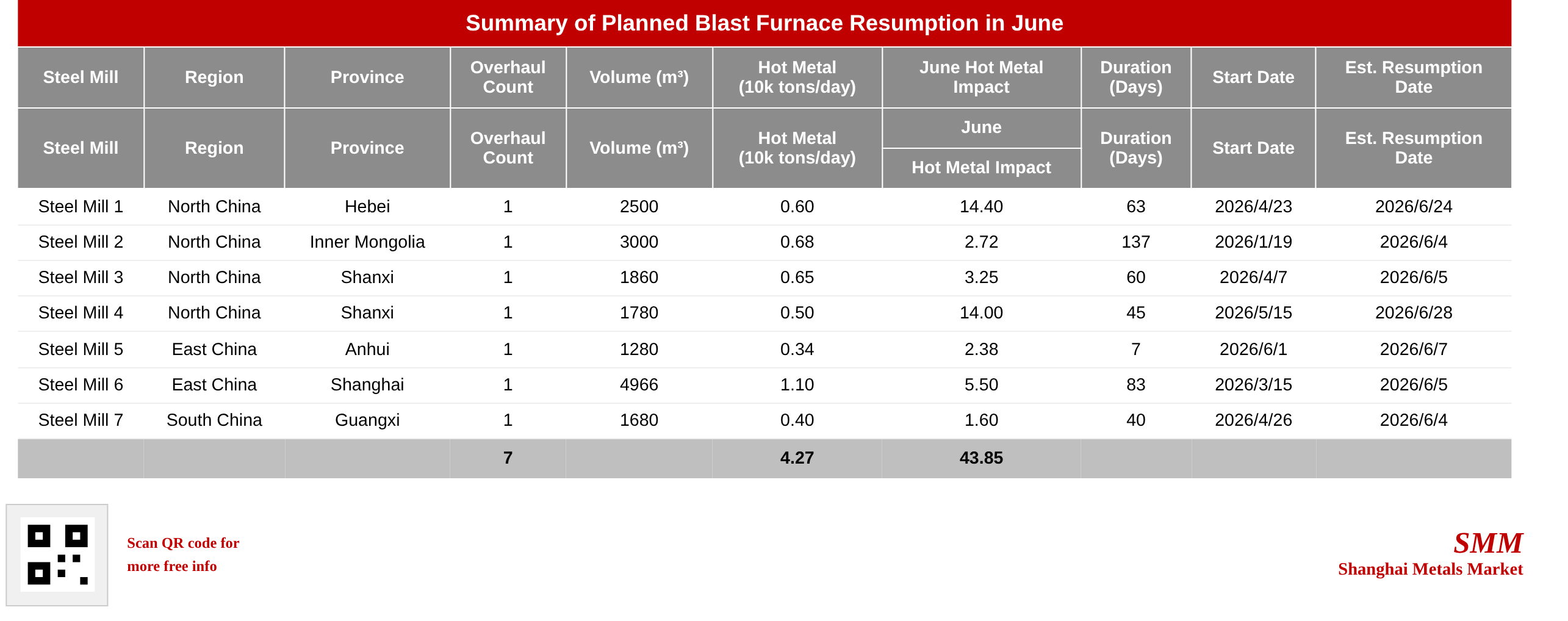
According to SMM's tracking survey data, in June, a total of 10 blast furnaces underwent newly added maintenance across steel mills nationwide, reducing daily hot metal production by approximately 25,300 mt . The maintenance was mainly concentrated in north China. Meanwhile, 7 blast furnaces resumed production, increasing daily hot metal output by around 42,700 mt . Production resumptions were also primarily in north China, mainly from blast furnaces that restarted after prior maintenance. SMM survey data showed that in June, blast furnace maintenance resulted in a net reduction of 5.1581 million mt in hot metal production, down 810,000 mt MoM from May. Based on SMM's daily average hot metal production data, the daily average pig iron production in June grew by 20,000 mt compared with May.
Data source: SMM

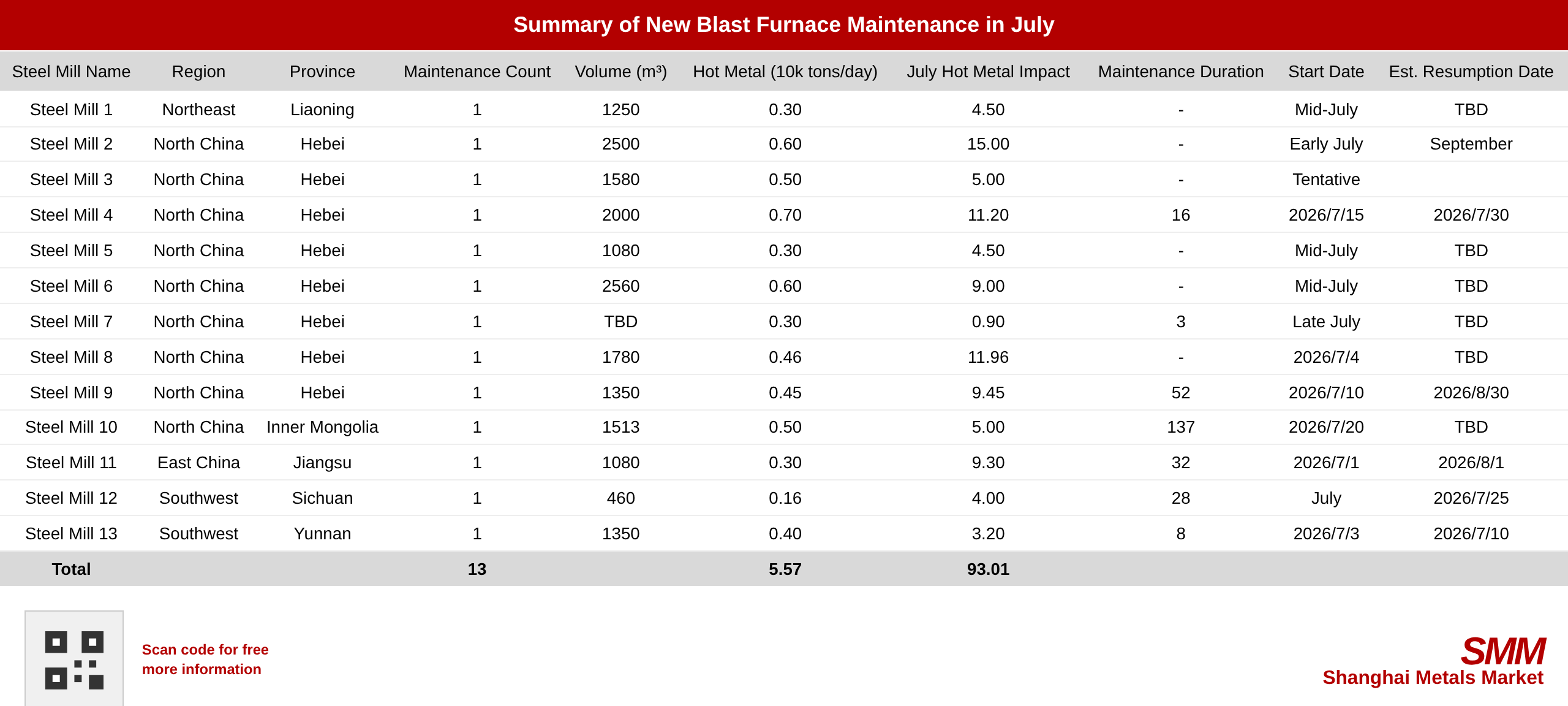
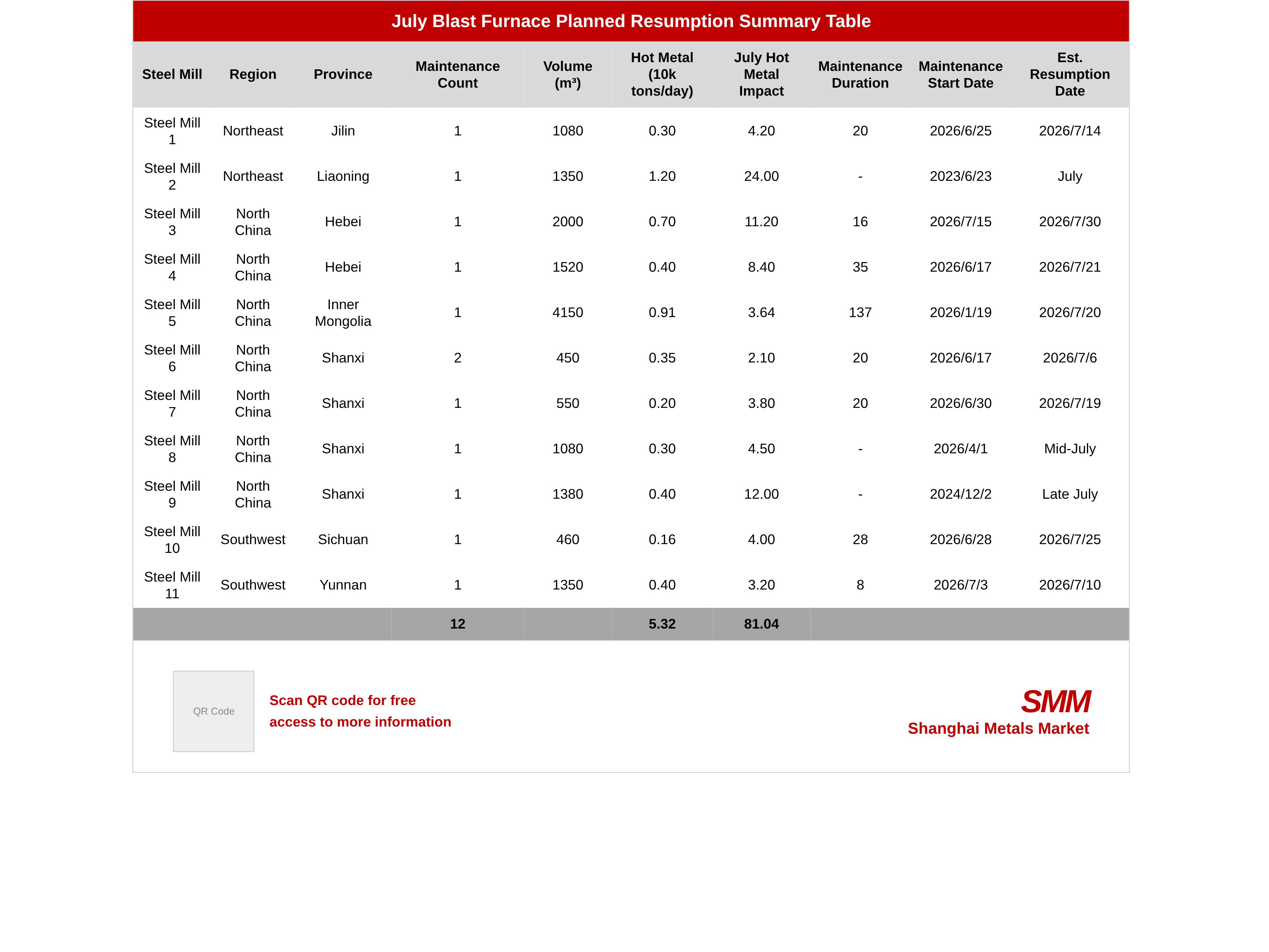
According to SMM's latest survey, in July, steel mills nationwide plan to conduct newly added maintenance on 13 blast furnaces , mainly in east China, reducing daily hot metal output by about 55,700 mt; meanwhile, 12 blast furnaces will resume production , increasing daily hot metal output by around 53,200 mt; based on comprehensive calculations, blast furnace maintenance in July is expected to lead to a net reduction of 5.69 million mt in hot metal production, with the average daily hot metal output down approximately 12,000 mt MoM from June.

In addition, considering the off-season for end-use demand and widening losses among steel mills, along with planned environmental protection-driven production restrictions in Tangshan in July, the maintenance plan for blast furnaces is expected to exceed current statistics, and the decline in daily average hot metal production may be larger than existing data suggest.
Data source: SMM

Stay tuned to SMM's 242-sample blast furnace operating rate and daily average hot metal production figures, released every Wednesday:


Data Source Statement: Except for publicly available information, all other data are processed by SMM based on publicly available information, market communication, and relying on SMM's internal database model. They are for reference only and do not constitute decision-making recommendations.

Images in this article contain AI-translated captions for reference only.

For any inquiries or for more information, please contact: lemonzhao@smm.cn
For more information on how to access our research reports, please contact:service.en@smm.cn
Related News
【Tata Steel's Crude Steel Output Rises Over 10%, Supporting India's Metallurgical Coal Demand】
2 hours ago
【Tata Steel's Crude Steel Output Rises Over 10%, Supporting India's Metallurgical Coal Demand】
Read More
【Tata Steel's Crude Steel Output Rises Over 10%, Supporting India's Metallurgical Coal Demand】
India's second-largest steelmaker, Tata Steel, reported first-quarter FY2026 operating results, with domestic crude steel production increasing by more than 10% YoY to 5.76 million tonnes, while steel deliveries rose nearly 9% YoY to 5.17 million tonnes, driven by higher output at its Jamshedpur and Kalinganagar plants. Meanwhile, elevated coking coal and iron ore prices pushed material costs up 12% year on year. The higher level of steel production indicates that Indian steel demand remains resilient, providing continued support for metallurgical coal consumption. Despite elevated coking coal costs, Tata Steel maintained strong production, suggesting that Indian steelmakers are unlikely to significantly reduce metallurgical coal procurement in the near term. In addition, the company has approved a 4.8 million tonnes per annum steelmaking capacity expansion at its subsidiary Neelachal Ispat Nigam, which could further support metallurgical coal demand over the longer term.
2 hours ago
【Pakistan Coal Mine Blast May Tighten Local Supply, Limited Impact on Seaborne Coal Market】
2 hours ago
【Pakistan Coal Mine Blast May Tighten Local Supply, Limited Impact on Seaborne Coal Market】
Read More
【Pakistan Coal Mine Blast May Tighten Local Supply, Limited Impact on Seaborne Coal Market】
A methane gas explosion at a coal mining complex in Pakistan's Balochistan province killed at least 11 miners, left 25 others missing, and damaged two adjacent mines. Rescue operations are ongoing, while authorities have launched an investigation. Mining activities at the affected site are expected to remain suspended pending safety inspections. The disruption may tighten coal supply in Balochistan in the short term. However, as Pakistan is not a major exporter in the global seaborne coal market and most of its coal is consumed domestically, the incident is expected to have only a limited impact on international thermal and metallurgical coal markets. Market attention will now focus on whether safety inspections are expanded to other mines, which could further tighten domestic supply and increase Pakistan's import demand.
2 hours ago
【Whitehaven Output Reaches Guidance Ceiling as Australian Seaborne Met Coal Supply Recovers】
2 hours ago
【Whitehaven Output Reaches Guidance Ceiling as Australian Seaborne Met Coal Supply Recovers】
Read More
【Whitehaven Output Reaches Guidance Ceiling as Australian Seaborne Met Coal Supply Recovers】
Whitehaven Coal reported FY2026 ROM production of 40.3 Mt, up 3% year on year and at the top end of its production guidance, while equity sales reached 26.0 Mt. June quarter ROM production totaled 10.7 Mt, up 13% quarter on quarter, with Queensland (QLD) operations—the company's key metallurgical coal assets—rising 41% QoQ to 5.7 Mt, largely recovering from weather-related disruptions in the previous quarter. The recovery in Queensland output is expected to lift Australian seaborne metallurgical coal exports, easing earlier supply concerns. Against a backdrop of weak global steel demand and cautious steel mill procurement, improved supply is likely to reduce competition for spot cargoes and place moderate downward pressure on international seaborne metallurgical coal prices.
2 hours ago
Register to Continue Reading
Gain access to the latest insights in metals and new energy
Already have an account?Sign in here
[SMM Survey] Steel Mill Losses & Environmental Protection-Driven Production Restrictions: July Hot Metal Production Inflection Point Turns Downward - Shanghai Metals Market (SMM)