From Stability to Surge: The Overseas Hafnium Market Caught Between AI Demand and Supply Controls

Published: Jun 4, 2026 14:36
Overseas hafnium prices skyrocketed from $5,000 to $13,114.75/kg by April 2026, squeezed by AI-driven semiconductor demand and China's export controls, with high prices likely to persist.

Based on recent market data, overseas hafnium prices surged in Q4 2025 after a prolonged period of stability. From May 2024 to October 2025, prices hovered around $5,000/kg. Starting November 2025, they rose sharply, reaching $13,114.75/kg by April 2026—a gain of over 140%. This was driven by both demand and supply factors.
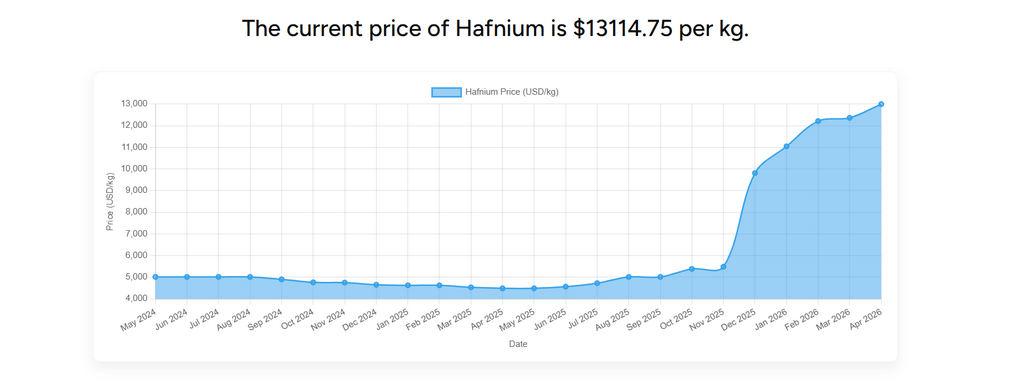
On the demand side, hafnium is critical for advanced semiconductor manufacturing, particularly as hafnium dioxide in high-k metal gates for leading-edge chips. Growth in AI, high-performance computing, high-bandwidth memory, and advanced DRAM has steadily lifted hafnium consumption, given its rigid requirement in wafer fabrication.

On the supply side, China, a dominant refiner, imposed export controls on hafnium from H2 2025 to safeguard strategic resources. This created a significant overseas supply gap. Facing anticipated tightening, chipmakers and traders stockpiled, and some engaged in hedging, leading to a supply-demand imbalance that drove the price spike into early 2026.

In summary, the price rise stems from rising AI-driven semiconductor demand and supply shortages triggered by export controls. Since hafnium is a by-product of zirconium mining, capacity cannot be quickly ramped up, and developing alternative supply chains requires long validation and build-out cycles. Prices are therefore expected to remain elevated unless the supply-demand structure improves. For downstream users, building strategic supplier partnerships and appropriate inventories is currently the primary approach to managing price volatility.


Data Source Statement: Except for publicly available information, all other data are processed by SMM based on publicly available information, market communication, and relying on SMM's internal database model. They are for reference only and do not constitute decision-making recommendations.

For any inquiries or for more information, please contact: lemonzhao@smm.cn
For more information on how to access our research reports, please contact:service.en@smm.cn
Related News
Zimbabwe's Chrome Beneficiation Strategy Remains in Focus
Jul 24, 2026 23:38
Zimbabwe's Chrome Beneficiation Strategy Remains in Focus
Read More
Zimbabwe's Chrome Beneficiation Strategy Remains in Focus
[SMM Express] Zimbabwe's long-standing strategy to expand domestic chrome beneficiation continues to attract industry attention as the country seeks to increase local ferrochrome production and capture more value from its abundant chromite resources. The policy direction remains centered on encouraging in-country processing while gradually reducing reliance on exports of unprocessed chrome ore. Market participants continue to monitor investment in new smelting capacity and the implementation of beneficiation measures, as these developments could progressively reshape regional chrome ore trade flows. If Zimbabwe succeeds in increasing ferrochrome production, a larger share of domestically mined chrome ore would be consumed locally, potentially reducing ore availability for export while increasing the country's presence in the global ferrochrome market.
Jul 24, 2026 23:38
South Africa's Ferrochrome Recovery Remains Under Market Watch
Jul 24, 2026 23:28
South Africa's Ferrochrome Recovery Remains Under Market Watch
Read More
South Africa's Ferrochrome Recovery Remains Under Market Watch
[SMM Express] South Africa's ferrochrome industry remains under close market watch as producers gradually advance production recovery following the implementation of preferential electricity tariffs for major smelters. The lower power tariff has improved the operating environment, supported the restart of some idle furnace capacity and eased immediate pressure on the sector after a prolonged period of production cuts driven by high electricity costs. Market participants, however, remain cautious over the pace of recovery. Although the tariff relief is expected to support higher ferrochrome output in the short term, producers continue to face challenges from global price competition and operating costs. The speed at which additional smelting capacity returns to operation will be closely monitored, as stronger ferrochrome production could gradually increase domestic chrome ore consumption and influence South Africa's export mix.
Jul 24, 2026 23:28
Spot prices continued to grind lower, and off-season supply generally saw production cuts [SMM SiMn Weekly Review]
Jul 24, 2026 18:06
Spot prices continued to grind lower, and off-season supply generally saw production cuts [SMM SiMn Weekly Review]
Read More
Spot prices continued to grind lower, and off-season supply generally saw production cuts [SMM SiMn Weekly Review]
As of this Friday, SiMn 6517 (cash) in north China was 5,650-5,700 yuan/mt, down WoW; SiMn 6517 (cash) in south China was 5,700-5,750 yuan/mt, down from last Friday, and SiMn 6014 (cash) in south China was 5,350-5,400 yuan/mt, flat WoW. Recently, SiMn futures were weak and moved sideways in a narrow range, the market was in a strong wait-and-see mood, spot prices fell, and futures and spot prices were largely aligned.
Jul 24, 2026 18:06