【SMM Analysis】High Costs Worsen Loss Risks, Limited Demand Release Keeps Ferrochrome Stable

Published: Mar 31, 2026 17:12
As of March 31, faced with upward cost pressure from high chromium ore prices, most ferrochrome producers have planned maintenance and output cuts recently. The supply-demand relationship of ferrochrome is expected to gradually adjust to a tight balance in the outlook.

As of March 31, retail prices of ferrochrome remained stable. Quotes in Inner Mongolia stood at 8,600–8,700 yuan per 50% basic ton, while those in Sichuan were 8,650–8,800 yuan per 50% basic ton, up 100 yuan month-on-month. The price gap between northern and southern regions narrowed, yet the spread between retail and long-term contract prices remained notable. Faced with upward cost pressure from high chromium ore prices, most ferrochrome producers have planned maintenance and output cuts recently. The supply-demand relationship of ferrochrome is expected to gradually adjust to a tight balance in the outlook.

1. Costs Keep Rising, Leading to Price Inversion

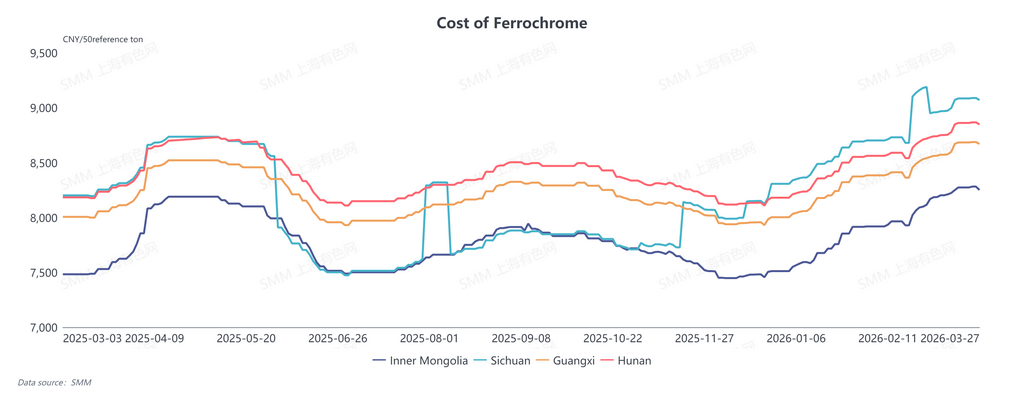
At present, the spot cost of ferrochrome in Inner Mongolia has reached 8,320 yuan per 50% basic ton, and the average cost in southern China hit 8,876 yuan per 50% basic ton, rising 3.75% month-on-month. On one hand, continuous gains in raw material chromium ore prices have driven up costs; on the other hand, frequent adjustments to power policies have intensified electricity cost pressure.
Chromium Ore

Post-holiday futures and spot prices of chromium ore have kept climbing. Geopolitical conflicts in the Middle East pushed up fuel prices and ocean freight rates, with some shipping companies imposing war surcharges, significantly raising landed costs of chromium ore, while overseas futures quotes trended steadily upward. South African fine ore was quoted at 318 USD/ton, and Turkish fine ore exceeded 400 USD/ton. Meanwhile, low-priced inventories from earlier periods have been cleared. Amid high receiving costs, domestic traders hold a strong attitude of supporting and probing price increases, keeping spot chromium ore prices at high levels.

Electricity

Policy adjustments have lifted electricity costs for ferrochrome producers. In southern China (e.g., Guizhou), electricity prices rose by 0.08–0.12 yuan per kWh, pushing up costs by nearly 400 yuan; in northern China (Inner Mongolia), settlement electricity prices increased by 0.02 yuan per kWh, lifting costs by nearly 100 yuan. Shrinking profit margins have put ferrochrome enterprises in a cost-price inversion dilemma.

2. High Downstream Scheduling but Limited Demand Release

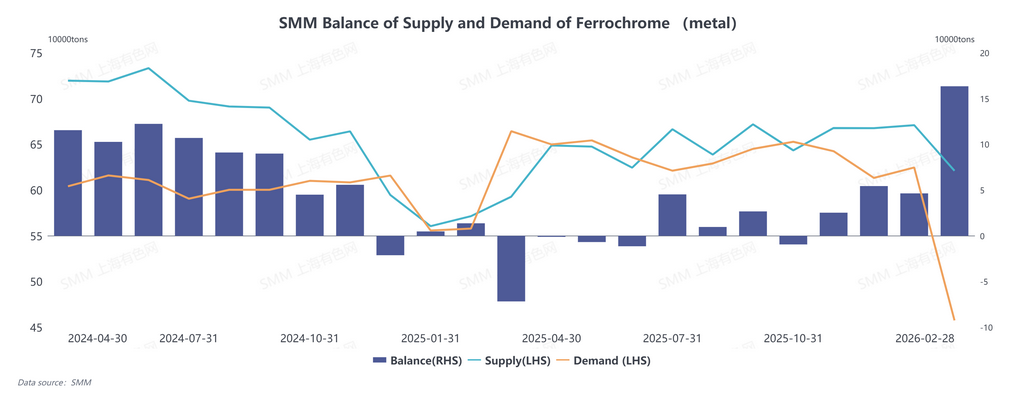
According to SMM statistics, stainless steel output in March 2026 surged 44.65% month-on-month, generating ferrochrome demand of approximately 617,500 metal tons. Although production scheduling rebounded to historical highs, purchasing activity by downstream steel mills was muted, as most consumed pre-holiday raw material inventories, resulting in thin inquiry and transaction sentiment in the ferrochrome market. Meanwhile, major steel mills set their March steel tender prices flat at 9,245 yuan per 50% basic ton month-on-month, falling short of bullish expectations amid the traditional peak consumption season of "Golden March, Silver April". Market participants lacked confidence, leading to overall weak performance during the month.
3. Industry Maintenance Plans to Tighten Future Supply

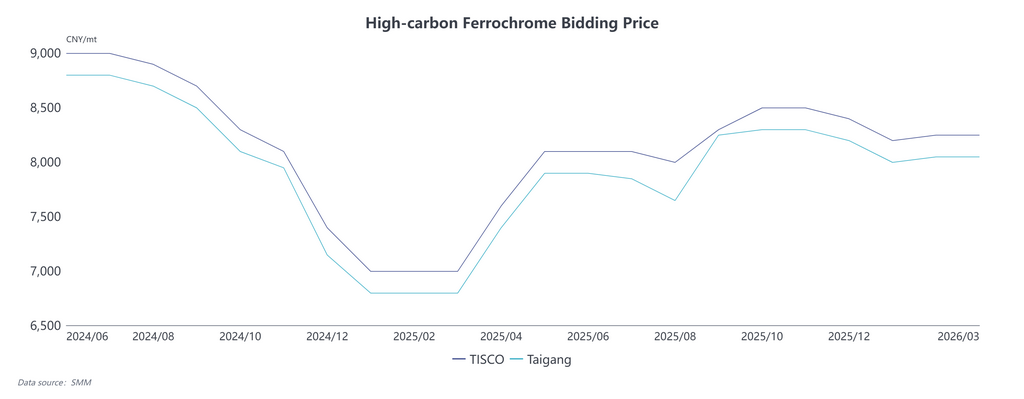
On March 20, Tsingshan and TISCO announced their April 2026 tender purchase prices for high-carbon ferrochrome at 8,395 yuan and 8,195 yuan per 50% basic ton respectively, up 150 yuan from March but below earlier bullish market forecasts. The wide spread between retail and long-term contract prices dampened market confidence. Coupled with heavy losses from soaring costs, the industry held meetings to discuss countermeasures. Some producers announced maintenance and output reduction plans, meaning China’s high-carbon ferrochrome output is likely to decline in April.

In overseas markets, negotiations over South Africa’s temporary electricity price policy have stalled. Major chromium producer Glencore stated that contract terms are unfeasible, leading to limited actual resumption of local ferrochrome production. China Customs data showed that China imported 265,100 tons of high-carbon ferrochrome in January–February 2026, down 51.6% year-on-year. It will take time for ferrochrome imports to return to average historical levels, so their impact on the domestic market will remain limited in the short term, with imports expected to stay low.

Overall, while downstream stainless steel maintains high production scheduling, ferrochrome supply is set to tighten. China’s ferrochrome supply-demand relationship is forecast to gradually shift from surplus around the Spring Festival to a tight balance.
Data Source Statement: Except for publicly available information, all other data are processed by SMM based on publicly available information, market communication, and relying on SMM's internal database model. They are for reference only and do not constitute decision-making recommendations.

For any inquiries or for more information, please contact: lemonzhao@smm.cn
For more information on how to access our research reports, please contact:service.en@smm.cn
Related News
Disturbance from Expectations for Production Cuts on Supply Side Intensifies, Silicon Metal Prices Continue Strengthening [SMM Silicon Industry Weekly Review]
10 hours ago
Disturbance from Expectations for Production Cuts on Supply Side Intensifies, Silicon Metal Prices Continue Strengthening [SMM Silicon Industry Weekly Review]
Read More
Disturbance from Expectations for Production Cuts on Supply Side Intensifies, Silicon Metal Prices Continue Strengthening [SMM Silicon Industry Weekly Review]
[Supply Side Production Cut Expectations and Disruption Intensify, Silicon Metal Prices Continue Strong]: On the market quotation and transaction side, affected by expectations for month-end production cuts at large plants in Xinjiang, silicon enterprises generally have a strong sentiment to hold prices firm. Their quotes increased WoW, and futures-spot traders also raised their quotes following the rise in futures prices, leaving almost no low-priced supply in the market. The center of suppliers' quotations generally increased, while China's downstream users and users outside China show little willingness to chase price rises. Some downstream users have poor acceptance of high prices and mainly place orders on demand for restocking.
10 hours ago
Criminal Networks Target Amazon’s Critical Minerals
10 hours ago
Criminal Networks Target Amazon’s Critical Minerals
Read More
Criminal Networks Target Amazon’s Critical Minerals
[SMM Flash] Criminal organisations in the Amazon are increasingly positioned to expand from illegal gold mining into coltan, cassiterite, lithium, nickel, niobium and rare earth elements as demand grows for minerals used in batteries, semiconductors, defence, AI and clean-energy technologies. Existing networks controlling territory, clandestine airstrips, river routes and money-laundering channels can be adapted to support illicit mineral extraction and trade. In June 2026, Brazil’s Federal Police identified an illegal mining site in Pará where nearly 80 kg of gold was reportedly extracted over three years. The growing concern is that illegally sourced minerals can be mixed with legally mined material and laundered through forged documentation, intermediary companies and cross-border trade, making their origins difficult to detect. In April 2025, Colombian authorities seized nearly 49 tonnes of coltan and tin reportedly extracted from areas controlled by armed groups and destined for illegal export to China. Strengthening mineral traceability, financial intelligence, border controls and international cooperation will therefore be critical to protecting emerging critical-mineral supply chains from criminal infiltration.
10 hours ago
[SMM Chromium Flash] China July 2026 HC FeCr Imports Fall 9.9% MoM to ~132,825 t as South Africa Drops Out
11 hours ago
[SMM Chromium Flash] China July 2026 HC FeCr Imports Fall 9.9% MoM to ~132,825 t as South Africa Drops Out
Read More
[SMM Chromium Flash] China July 2026 HC FeCr Imports Fall 9.9% MoM to ~132,825 t as South Africa Drops Out
[SMM Chromium Flash] China July 2026 HC FeCr Imports Fall 9.9% MoM to ~132,825 t as South Africa Drops Out
China's high carbon ferrochrome (HC FeCr) imports totalled approximately 132,825 tonnes in July 2026, down 9.9% month-on-month from around 147,361 tonnes in June, per Chinese customs data. Kazakhstan retained its position as China's largest HC FeCr supplier in July, shipping approximately 84,429 tonnes, up a marginal 1.2% MoM from June's 83,415 tonnes. With other origins pulling back more sharply, Kazakhstan's share of total imports rose to roughly 63.6%, up from 56.6% in June. Zimbabwe posted the strongest gain among suppliers, with volumes climbing 72.1% MoM to approximately 22,901 tonnes in July from around 13,306 tonnes in June, lifting its import share to roughly 17.2% from 9.0% the previous month. India also grew its share, with shipments up 50.8% MoM to approximately 23,889 tonnes in July from around 15,845 tonnes in June, taking its share of total imports to roughly 18.0% from 10.8%. Imports from other origins fell sharply, down 55.7% MoM to approximately 1,607 tonnes in July from around 3,628 tonnes in June. South Africa recorded no HC FeCr shipments to China in July, a sharp reversal from June's approximately 31,166 tonnes, which had accounted for around 21.2% of that month's total. Overall, July's data shows a rebalancing of China's HC FeCr supply base, with Kazakhstan consolidating its lead while Zimbabwe and India expanded their footholds to help offset South Africa's exit from the month's import mix.
11 hours ago
【SMM Analysis】High Costs Worsen Loss Risks, Limited Demand Release Keeps Ferrochrome Stable - Shanghai Metals Market (SMM)