[SMM Analysis] Impact of US Tariffs on China on the Export Methods and Prices of China's ESS Battery Cells to the US - Exploring Three Methods: "Direct Export from China, Re-export via Malaysia, and US Domestic Production" (Part II)

Published: May 31, 2025 11:48
[SMM Analysis] This is the second article in the series, aiming to analyze the impact of price changes on energy storage battery cells produced in China, exported directly, re-exported via Malaysia, and potentially produced locally in the US for LFP (for ESS) from August 13 to January 1, 2026. Some of the data values are relatively theoretical, so the results may appear high. The author will explain the reasons for each data value in detail to enable readers to replace the relevant data themselves and obtain more targeted conclusions. There will be a subsequent (Part III) article to analyze the impact of tariffs on prices after January 1, 2026.

This article is the second installment in a series exploring the impact of US tariffs on China on the export methods and pricing of Chinese ESS battery cells to the US, examining three approaches: "direct export from China, re-export via Malaysia, and domestic production in the US." The previous article mentioned that despite the current uncertainty surrounding US tariffs on China, the existing ESS tariff measures are divided into three periods: May 14, 2025, August 13, 2025, and January 1, 2026, with tariffs set at 40.9%, 64.9%, and 82.4%, respectively.

This article, the second in the series, aims to analyze the impact of price changes on Chinese-made ESS battery cells exported directly, re-exported via Malaysia, and potentially produced domestically in the US using LFP for ESS storage from August 13, 2025, to January 1, 2026. Some data values are theoretical, which may result in seemingly high outcomes. The author will explain the reasons for each data value in detail to enable readers to substitute relevant data independently for more targeted conclusions. A subsequent article, the third in the series, will analyze the price impact of tariffs after January 1, 2026.

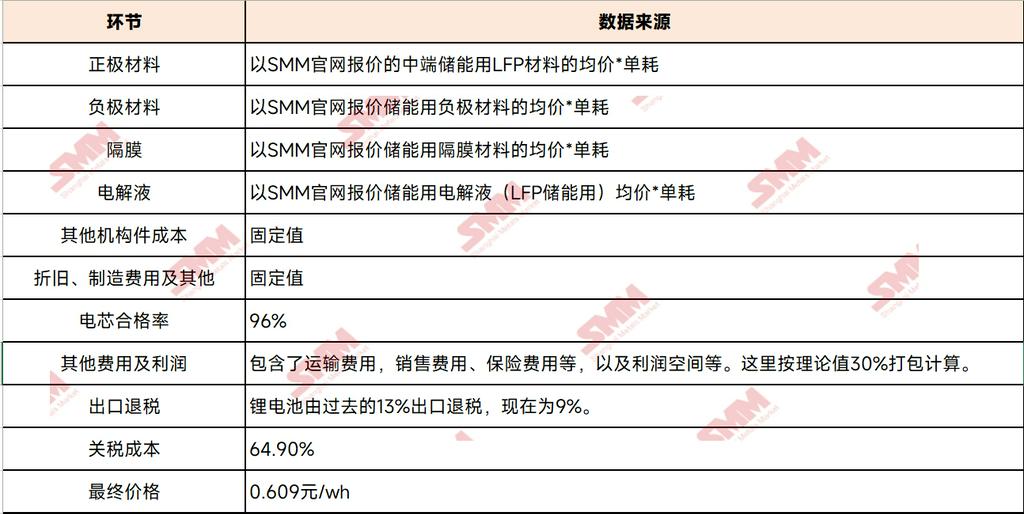
Taking domestically produced 280Ah LFP ESS battery cells as an example:

The data sources and changes for each segment are shown in the table below: Direct export from China to the US:
The data sources and changes for each segment are shown in the table below: Re-export from China via Malaysia to the US:
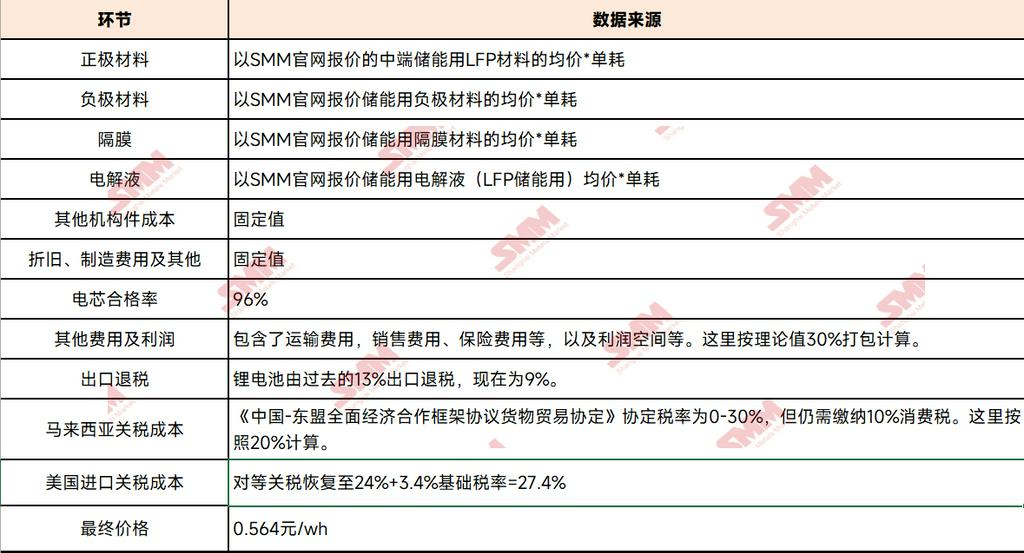
The data sources and changes for each segment are shown in the table below: Domestic production of LFP battery cells in the US:
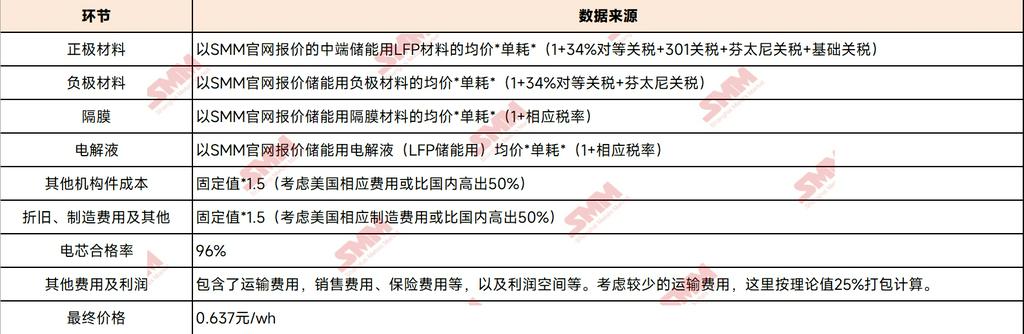
Based on the above calculations, considering the price of 0.609 yuan/Wh for battery cells exported directly from China from August 13, 2025, to January 1, 2026, re-exporting via Malaysia offers a 7.5% price advantage, while the cost of directly producing ESS battery cells in the US remains 4.6% higher than in China.

The above summary is as follows:
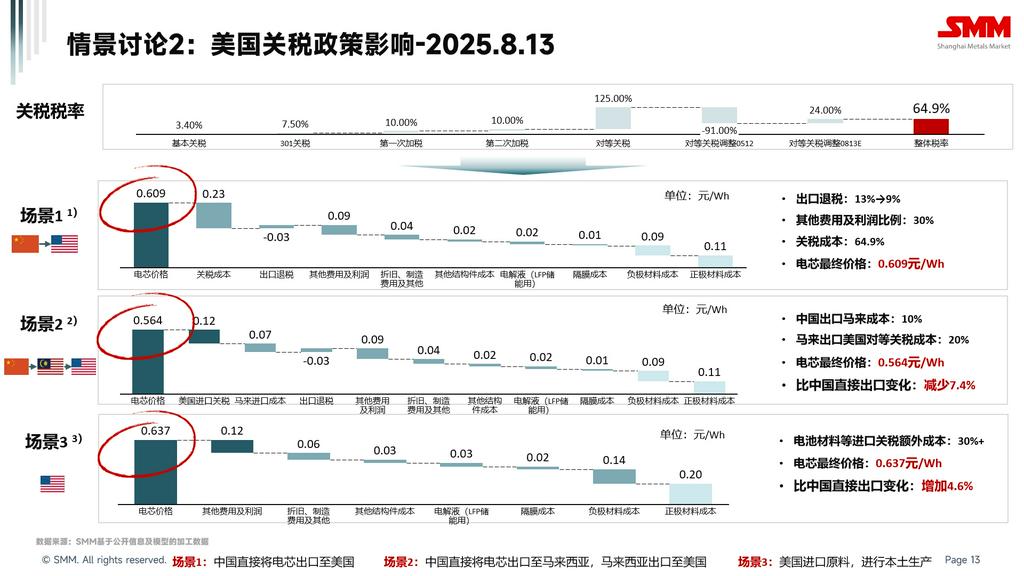
 

Note: Some calculated data were obtained through discussions and processing in the market, while more data were sourced from the average prices at various price points on the SMM official website. Additionally, in current practical operations, the cost increases resulting from US tariffs on China are mainly borne by overseas customers. Therefore, the results calculated in this article may be higher than the actual transaction prices.


SMM New Energy Industry Research Department

Wang Cong 021-51666838

Ma Rui 021-51595780

Feng Disheng 021-51666714

Lv Yanlin 021-20707875

Zhou Zhicheng 021-51666711

Zhang Haohan 021-51666752

Wang Zihan 021-51666914

Wang Jie 021-51595902

Xu Yang 021-51666760

Chen Bolin 021-51666836

Data Source Statement: Except for publicly available information, all other data are processed by SMM based on publicly available information, market communication, and relying on SMM's internal database model. They are for reference only and do not constitute decision-making recommendations.

For any inquiries or for more information, please contact: lemonzhao@smm.cn
For more information on how to access our research reports, please contact:service.en@smm.cn
Related News
Samsung SDI Targets AI Data Center BBU Market With Cylindrical Batteries
30 mins ago
Samsung SDI Targets AI Data Center BBU Market With Cylindrical Batteries
Read More
Samsung SDI Targets AI Data Center BBU Market With Cylindrical Batteries
Samsung SDI announced on August 4 that it will strengthen its push into the AI data center battery backup unit (BBU) market with cylindrical batteries that offer space efficiency, high output and safety. The company plans to expand the application of its cylindrical batteries from power tools and home appliances to BBUs for artificial intelligence (AI) data centers.
30 mins ago
Fayette County to Take Over Permitting and Inspection Work for LG Energy Solution-Honda U.S. Battery Plant
32 mins ago
Fayette County to Take Over Permitting and Inspection Work for LG Energy Solution-Honda U.S. Battery Plant
Read More
Fayette County to Take Over Permitting and Inspection Work for LG Energy Solution-Honda U.S. Battery Plant
According to local U.S. media reports, the Fayette County Board of Commissioners in Ohio unanimously approved on June 29 a proposal for the county building department to resume reviewing building permits and conducting site inspections for the L-H Battery Company plant. The work had previously been handled by the state government. Following the decision, construction-related permitting and inspection authority for the battery plant near Jeffersonville will be transferred to Fayette County.
32 mins ago
Electric Vehicles Excluded From “Korean IRA” Tax Credit Scheme
34 mins ago
Electric Vehicles Excluded From “Korean IRA” Tax Credit Scheme
Read More
Electric Vehicles Excluded From “Korean IRA” Tax Credit Scheme
In the tax reform plan announced on August 3, the South Korean government limited domestic production tax credit support to six sectors: semiconductors, secondary batteries, artificial intelligence (AI) robot components, critical materials, solar power and wind power. As a result, electric vehicles were excluded from the domestic production tax credit scheme, often referred to as the “Korean IRA.”
34 mins ago