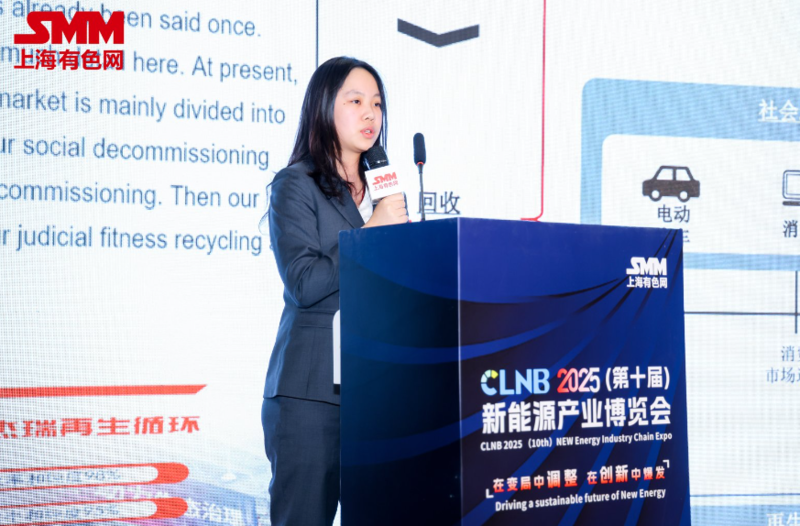
At the CLNB 2025 (10th) New Energy Industry Chain Expo - Lithium Battery Recycling Forum hosted by SMM Information & Technology Co., Ltd., Lin Ziya, lithium battery recycling industry analyst of Shanghai Metals Market, discussed the theme of "Breakthrough in 2025: Analysis of Profitability in China's Lithium Battery Recycling, and Opportunities and Challenges Under Policy Reforms."
She noted that, driven by the global carbon neutrality process, the NEV and ESS markets are experiencing explosive growth, and the demand for lithium batteries remains optimistic, although marginal growth rates are slowing. Considering cost and safety issues, the penetration rate of the LFP battery will continue to rise steadily worldwide. Currently, China's recycling industry is still in a stage of overcapacity, gradually achieving capacity clearance.
Overview of the Recycling Market and Global Scrap Battery Market Size
The new energy market maintains a growth trend, but marginal growth rates in both the NEV and ESS sectors are gradually slowing.
SMM expects the global NEV sales CAGR to reach around 9% from 2025 to 2028.
Analyzing the factors influencing NEV market growth in China, North America, and Europe, China is primarily supported by the trade-in policy; in North America, the NEV market is hindered by the US tariff hike, which has increased the prices of new energy-related products and raw materials, raising costs and impeding long-term new energy development; in Europe, NEV market growth is mainly driven by carbon emission assessments.
In the ESS market, SMM expects the CAGR to reach around 16% from 2024 to 2028.
Analyzing the factors influencing ESS market growth in China, North America, and Europe, China is driven by power market reforms and new-type energy storage demand; in North America, the US tariff hike has increased the prices of new energy-related products and raw materials, raising costs and impeding long-term new energy development; in Europe, the Renewable Energy Directive RED III aims to increase the share of renewable energy in EU end-use energy consumption to 42.5% by 2030.
Global Theoretical Recyclable Metal Volume from Lithium-Ion Battery
According to SMM, currently, end-of-life batteries mainly come from production waste; after 2028, the theoretical recyclable metal volume from scrapped batteries will gradually exceed that from production waste.
SMM expects the global CAGR for theoretical end-of-life lithium-ion battery recycling volume from social channel to reach around 48% from 2024 to 2030, while the CAGR for theoretical lithium-ion battery recycling volume from production waste is expected to reach around 14%, and the CAGR for recycling volume of end-of-life lithium-ion battery inventory may be around 8%.
In terms of global theoretical recyclable metal volume, by 2030, the recyclable metal volume of end-of-life battery from social channel is expected to reach around 1.06 million mt in metal content, while the theoretical recyclable metal volume from production waste is expected to be around 670,000 mt in metal content, and the theoretical recyclable metal volume from end-of-life battery inventory may be around 66,000 mt.
Current Status of China's Lithium Battery Recycling Market: Profit and Production
Overview of China's Recycling Industry - Market Status
According to SMM data, the volume of black mass from scrap lithium battery recycling in China rose YoY for three consecutive months in February, March, and April compared to the same period in 2024.
Value Breakdown of Different Types of Uncrushed Scrap Products
Currently, the main product after processing scrap batteries and pole pieces is black mass, accounting for about 57% of the value of different types of batteries.
According to SMM analysis, scrap battery cells and pole pieces are priced by weight, with buyers and sellers negotiating fixed prices (yuan/mt). The main components of scrap battery cell costs are black mass, copper powder, and aluminum powder, so the price changes of black mass, copper and aluminum have a significant impact on scrap battery cell costs.
China's Secondary Nickel Sulphate, Secondary Cobalt Sulphate, and Secondary Lithium Chemical Capacity and Production (2022-2025E)
The share of secondary metal supply remains low, but as more batteries reach the end of their life and ESG regulations tighten, their share will steadily increase.
SMM expects that by 2026, China's secondary nickel sulphate capacity will exceed 200,000 mt in metal content annually, with production expected to be around 100,000 mt in metal content; from 2025 to 2026, the supply share of secondary nickel sulphate is expected to remain between 15% and 20%.
In terms of secondary cobalt sulphate, it is expected that by 2026, China's secondary cobalt sulphate capacity will exceed 80,000 mt in metal content annually, with production expected to reach around 20,000 mt in metal content annually; by 2026, the supply share of secondary cobalt sulphate is expected to approach 25%.
In terms of secondary lithium carbonate, it is expected that by 2026, the capacity of secondary lithium carbonate will approach 600,000 mt in metal content, with production expected to reach around 100,000 mt in metal content; from 2024 to 2026, the supply share of secondary lithium carbonate will continue to increase, approaching around 25% by 2026.
According to SMM analysis, from November 2024 to March 2025: Due to the earlier destocking of lithium carbonate, lithium carbonate prices rose slightly, temporarily restoring the profit of scrap LFP battery hydrometallurgy recycling plants. However, as the resumption of production at CATL’s mine after the holiday led to a surplus in lithium carbonate supply, lithium chemical prices continued to decline, incurring losses on scrap LFP battery hydrometallurgy recycling plants.
From November 2024 to March 2025: Due to the earlier decline in nickel sulphate and cobalt sulphate prices, scrap ternary and LCO battery hydrometallurgy recycling plants still suffered losses. However, as the DRC restricted the export of cobalt intermediate products, cobalt salt prices surged, easing the losses of scrap ternary and LCO battery hydrometallurgy recycling plants, with the latter even starting to make profits.
Analysis of China's Lithium Battery Recycling Industry Policies
Recycling Industry: EU and North America Are in the Initial Stage, While China's Recycling Market Is Entering a Critical Period
China's Vehicle Trade-In Policy
The state "trade-in" policy for the automotive industry, followed by local policies, aims to stimulate sales through vehicle upgrades and increase the recycling volume of scrapped vehicles.
China's Black Mass Policy - Policies on the Import of Recycled Black Mass for Lithium-Ion Batteries
In 2025, China released a draft for public comment on the "black mass import and export" policy, with the comment period ending on March 20. The draft specifies various index requirements for black mass.
According to SMM analysis, qualified recycled black mass for lithium-ion batteries is not classified as solid waste and can be freely imported. Mixed packaging of black mass is not allowed. The index requirements in the black mass import and export regulations align with the Class II black mass requirements in "GBT 45203-2024 Recycled Black Mass for Lithium-Ion Batteries."
In October 2024, the EU released a draft to revise the European List of Waste, adding waste residues and intermediate products from the recycling of waste lithium batteries and nickel batteries as hazardous substances. Once the revision is passed, the export of hazardous waste to non-OECD countries, including Southeast Asia and China, will be prohibited.
Summary
End-Use Demand:
Driven by the global carbon neutrality process, the NEV and energy storage markets are experiencing explosive growth, and the demand for lithium batteries remains optimistic, although marginal growth rates are slowing.
Considering cost and safety issues, the penetration rate of LFP battery will continue to rise steadily worldwide.
China's Recycling Market:
The degree of integration is gradually deepening. As end-of-life batteries from social channel and battery cell production schedules increase, the total procurement volume and output of scrap battery are gradually increasing.
Profit: Hydrometallurgy recycling plants have long been plagued by losses, so are crushing plants, although losses of the latter are slightly smaller than the former.
Recycling Policies:
Newly introduced policies such as trade-in, black mass import and export, and black mass regulations have become key focuses.
Recycling capacity allocation in regions such as the EU and North America remains uneven, mainly concentrated in crushing and pretreatment plants.
Opportunities and Challenges:
With the large-scale recycling of end-of-life batteries from social channel and the liberalization of black mass import and export policy, black mass supply will gradually increase.
Currently, China's recycling industry is still in a stage of overcapacity, with some capacity being gradually cleared.
LinkedIn: https://www.linkedin.com/company/98924065/admin/dashboard/
Facebook: https://www.facebook.com/profile.php?id=61572704694550