SMM May 20,
According to customs data released on May 20, 2026, China’s phosphate ore imports stood at 207,000 mt in April 2026, rising 13.5% month-on-month from 182,000 mt in March. April total import value hit US$19.741 million, a MoM increase of 35.7% versus US$14.552 million in March. The average import unit price was US$95.5 per mt, up 19.6% from US$79.9 per mt in March.
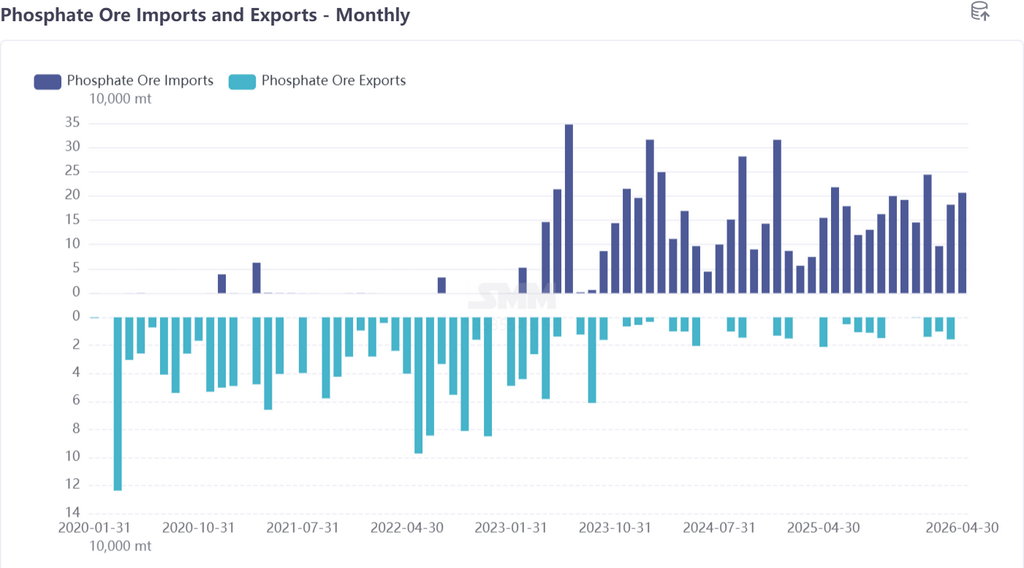
Phosphate ore imports: Jordan resumed exports to China, Hubei's imports surged, and Peru became the second-largest source country.
Note: China's traditional major phosphate ore import sources are Egypt, Peru, and Jordan. The main importing provinces are Guangxi and Zhejiang, and the main importing enterprises are coastal phosphorus chemical companies such as Chuanjinnuo.
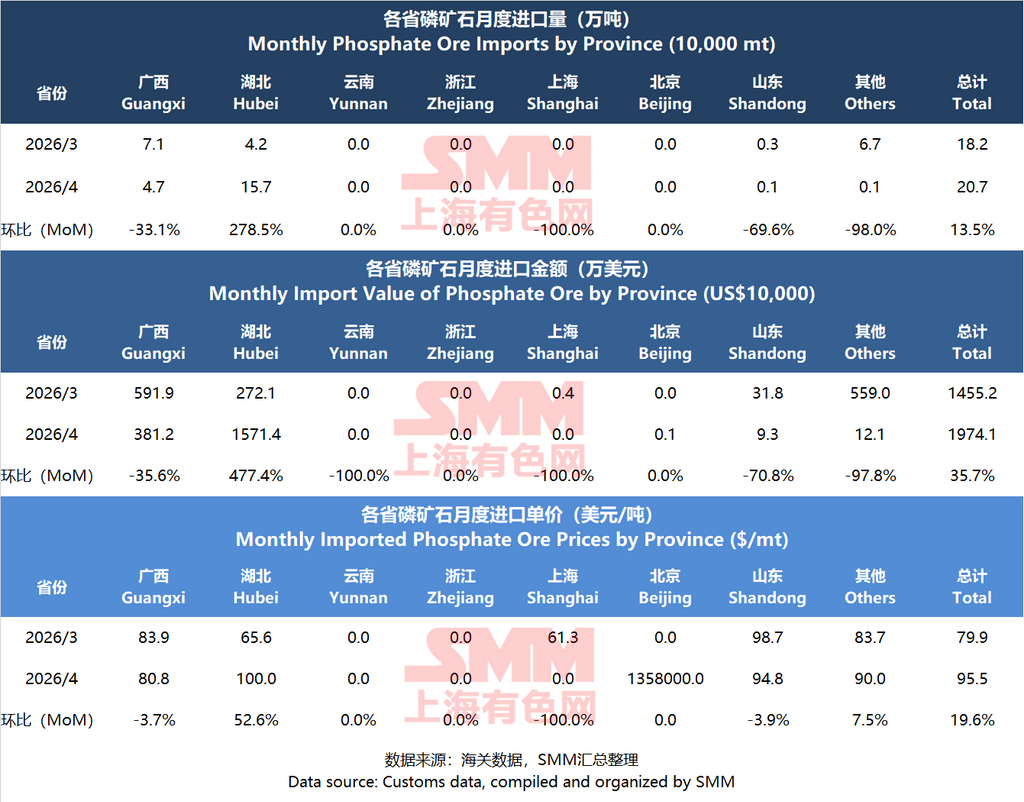
In April, China's phosphate ore import landscape underwent significant changes. Jordan, whose exports were disrupted by logistics issues in the Strait of Hormuz, resumed supply with 48,000 mt. Egypt remained the largest source country, yet its April imports of 97,000 mt pulled back sharply month-on-month from 170,000 mt in March. Notably, Peru ranked as the second-largest supplier with 60,000 mt arrivals, versus zero shipments recorded in March. Besides, imports from Pakistan dropped to merely 1,000 mt.
Looking at importing provinces, Hubei took the top spot with 157,000 mt, a surge of 278.5% month-on-month, replacing Guangxi’s traditional leading position. Guangxi’s imports stood at 47,000 mt, down 33.1% month-on-month. Imports by Shandong and other provinces were minimal.
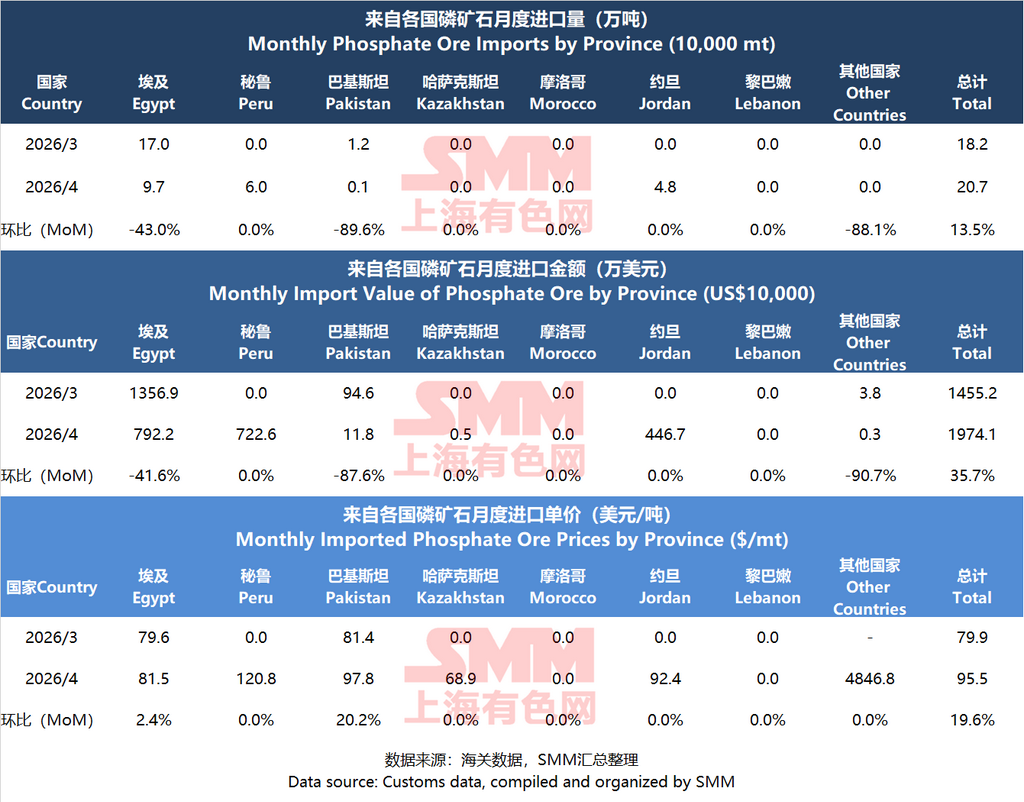
In terms of prices, the average import price rebounded to US$95.5/mt in April. Among major source countries, prices from Peru (US$120.8/mt) and Pakistan (US$97.8/mt) were higher, while Egypt (US$81.5/mt) and Jordan (US$92.4/mt) were relatively lower. The increase in higher-priced sources, together with the return of high-priced Jordanian ore, pushed up the overall import cost in April.
Import comment: In May, Egypt’s phosphate ore exports showed a trend of “tighter policy and weaker demand”. On May 13, Egypt’s Ministry of Petroleum and Mineral Resources announced that it would not sign any new phosphate ore export contracts. Earlier, at a meeting on May 10, Egyptian Prime Minister Mostafa Madbouly made clear that the government is promoting a shift from exporting raw materials to producing high-value-added products such as phosphate fertilizers. Existing long-term contracts are not affected. This is expected to push up import prices in the future and may also affect import volumes.
2.Phosphate Ore Exports: Export volume fell month-on-month, Fujian became the main exporting province.
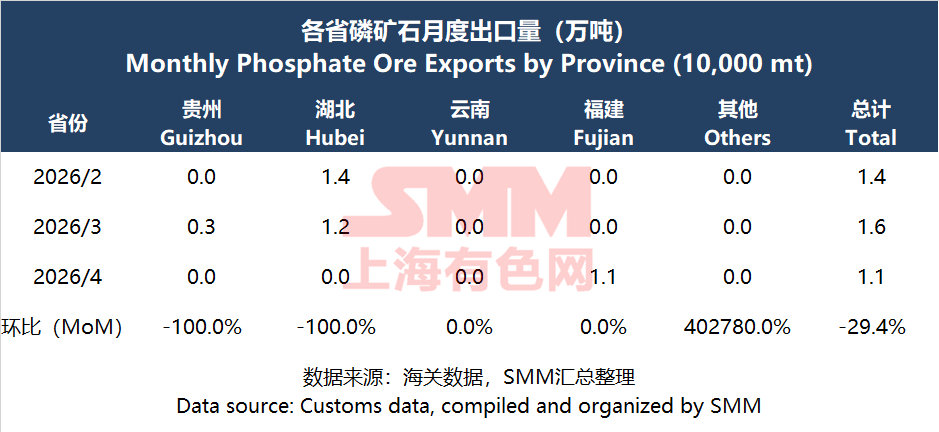
In April 2026, China’s phosphate ore exports were 11,000 mt, down 29.4% from 16,000 mt in March. Looking at exporting provinces, all shipments in April came from Fujian (11,000 mt), while Guizhou, Hubei and other provinces that had recorded exports earlier had no volumes in April.
Note: If you have any further details to add regarding the points mentioned in this article, or if you have any questions on the phosphorus chemical industry (phosphate rock, phosphoric acid, iron phosphate, lithium iron phosphate, etc.) and solid-state batteries, please feel free to contact:
Tel: 021-20707860 (or add WeChat: 13585549799) – Yang Chaoxing. Thank you!
![[Li Xiang: Humanoid robots still at least 3 years behind EVs]](https://imgqn.smm.cn/usercenter/cTxNb20251217171727.jpg)
![[JAC Group on Maserati tie‑up: "Zunjie brand has plenty of room to grow]](https://imgqn.smm.cn/usercenter/AYpRQ20251217171727.jpg)
![[Toyota Motor plans to open new factory in Brazil in November]](https://imgqn.smm.cn/usercenter/KnMyT20251217171727.jpg)