SMM, July 10:
I. PV-Grade EVA Resin: A Complete “Rollercoaster” Cycle
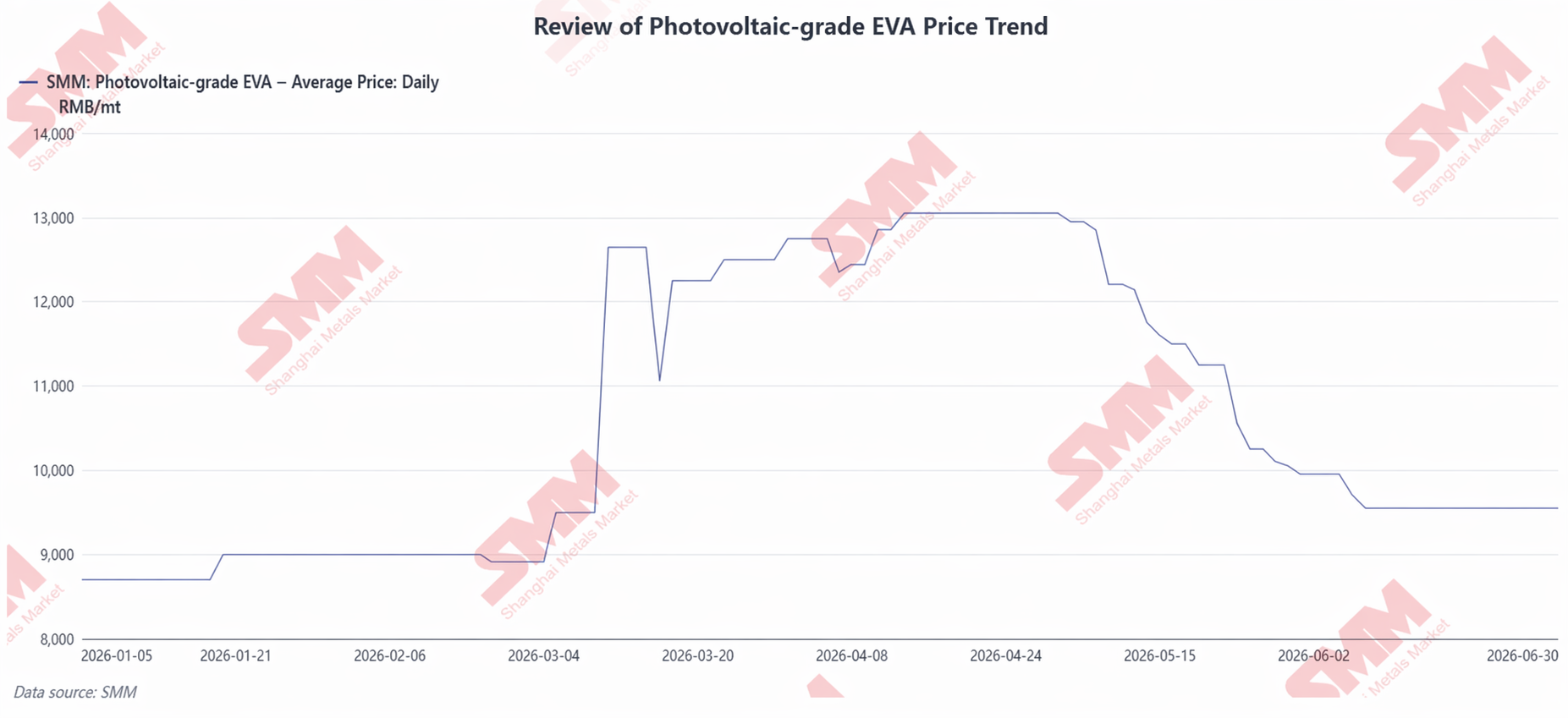
In H1 2026, PV-grade EVA resin prices went through a complete cycle of “low-level sideways movement—pulse surge—consolidating at highs—accelerated decline—hitting bottom and stabilizing,” with the fluctuation range exceeding 50%.
1. Price Trends
At the start of the year, PV-grade EVA resin prices operated at low levels in the range of 8,700-9,000 yuan/mt. Inventory pressure at petrochemical plants was relatively high, and the industry was in a loss-making or marginally profitable state. Downstream film factories primarily drew down earlier raw material stockpiles, leading to a cautious procurement pace. In March, ahead of the implementation of the export tax rebate cancellation policy, an export rush window opened. Domestic module scheduled production surged from 27.19 GW in February to 36.46 GW, driving up film production schedules, and resin prices were rapidly pulled up from 9,000 yuan/mt to 12,650 yuan/mt, an extremely rapid rise. In April, resin consolidated at highs of 12,250-13,050 yuan/mt, with prices hitting the H1 peak mid-month. Entering May, the module export rush window officially closed, end-use scheduled production pulled back sharply, film raw material demand weakened rapidly, and industry resin inventory continued to accumulate. Coupled with the easing of US-Iran tensions, international crude oil prices clearly declined, weakening the cost support for EVA raw materials, and resin prices entered a sustained downward trajectory. In June, as petrochemical plants proactively controlled output to support prices, and downstream film rigid demand restocking continued to emerge, industry inventory steadily destocked, earlier high inventory pressure was notably alleviated, and PV-grade EVA prices stopped falling and stabilized near 9,550 yuan/mt.
2. Supply-Demand Pattern
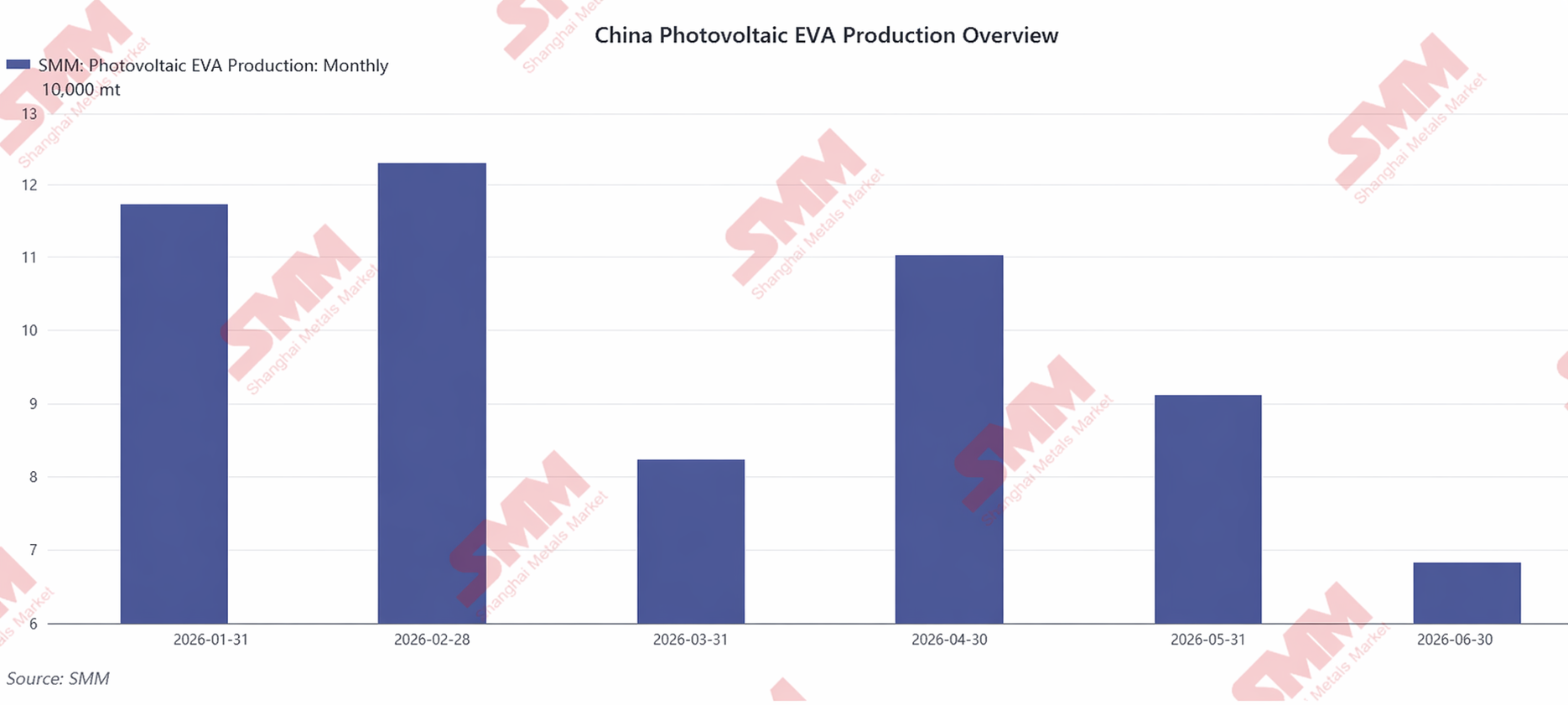
In H1 2026, China’s total domestic PV-grade EVA production was approximately 592,700 mt, down 18.16% YoY. In March, the module export rush drove scheduled production to surge, simultaneously boosting film operating rates. However, due to the concentrated maintenance of multiple production lines and proactive output control by petrochemical enterprises, monthly PV-grade EVA production fell sharply by 33.2% MoM. Supply failed to expand in line with demand, further magnifying the short-term supply-demand mismatch. In April, module scheduled production pulled back to 28.8 GW, and the resin supply released intensively earlier gradually became a surplus. In the mid-to-late Q2 period, although downstream module scheduled production mildly recovered, film factories adopted a conservative procurement strategy, only purchasing on a rigid, as-needed basis. At the same time, petrochemical enterprises continued to actively control volumes by switching between PV-grade and non-PV-grade material production schedules, consistently alleviating overall industry supply pressure.
3. Costs and Profitability
The two core raw materials, ethylene and vinyl acetate, together account for roughly 80% of PV-grade EVA production costs. In H1, resin costs completed a three-phase cycle of “geopolitical conflict escalation—consolidating at highs—demand weakening and pulling back,” which was one of the core factors driving the wild swings in EVA resin prices. From January to April, the intensification of the US-Iran geopolitical conflict pushed up international crude oil, driving ethylene and vinyl acetate up synchronously. Moreover, the increase in spot resin prices notably outpaced the rise in raw material costs, leading to a sustained recovery in petrochemical plant profits. From May to June, as the module installation rush window ended, weakening end-use demand drove a sharp decline in EVA resin prices. Combined with the sustained consumption of enterprises’ earlier high-priced raw material inventory, industry profitability also rapidly contracted.
II. PV-Grade POE Resin: High-Elasticity Market Under Import Dependence
Due to a different supply-demand fundamental and localisation progress, POE resin showed significant divergence from EVA in terms of fluctuation magnitude and recovery pace.
1. Price Trends
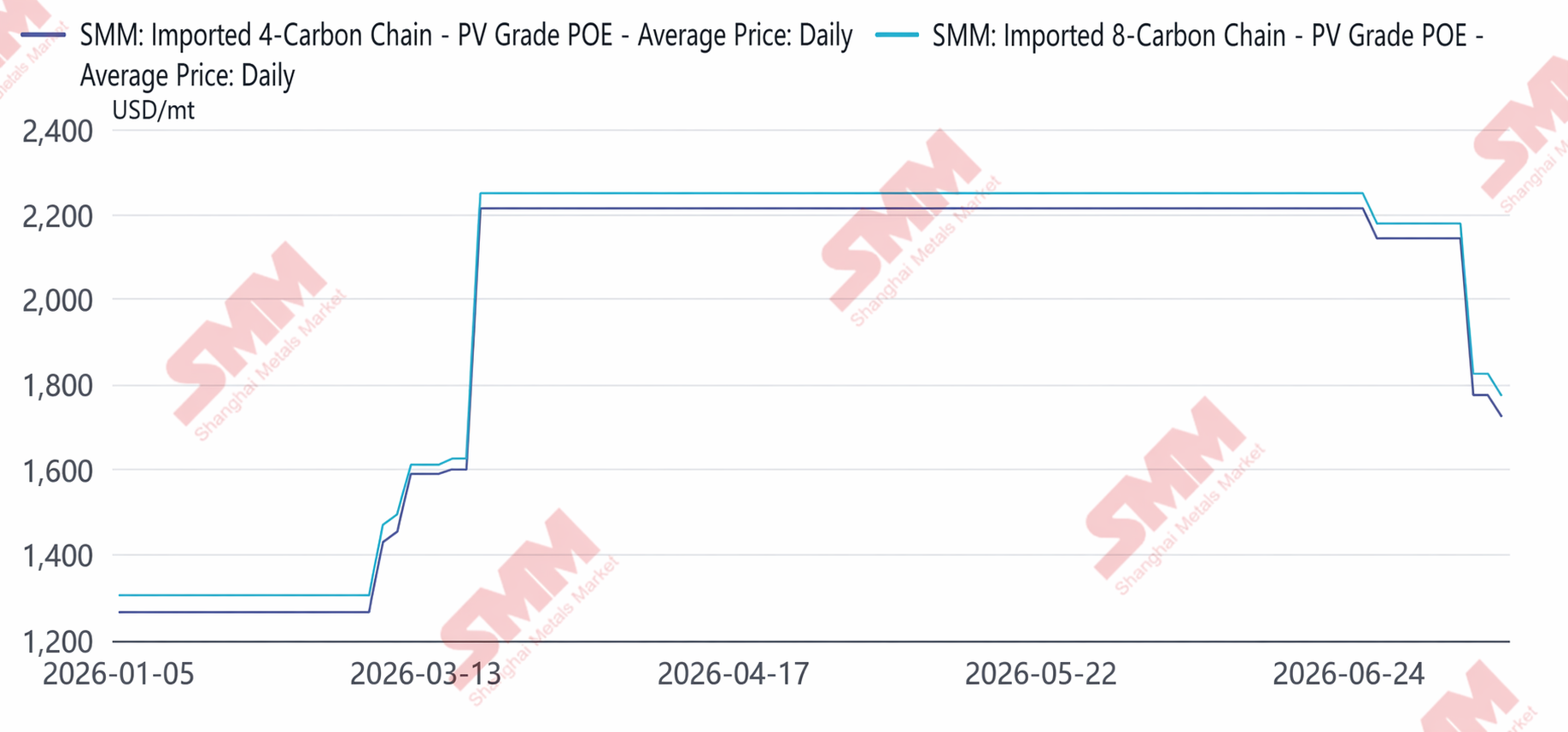
Imported 4-carbon chain POE climbed all the way from $1,265/mt at the start of the year, was pushed up to $2,215/mt in March due to the Middle East conflict, continued to consolidate at the $2,215/mt high from April to May, and loosened to $2,144/mt in June. Domestic 4-carbon chain PV-grade POE prices fluctuated narrowly at low levels of 11,281-11,400 yuan/mt from January to February at the start of the year. In March, the cost side rose significantly, pushing POE prices up rapidly. 4-carbon chain POE prices further surged to 16,000 yuan/mt in April, a cumulative increase of over 40% within two months. Entering May, as geopolitical conflicts eased and downstream demand weakened, coupled with the sustained release of new domestic POE capacity, the supply-demand imbalance gradually intensified, and prices retreated from highs. In June, the market supply-demand imbalance further worsened, and POE prices accelerated their downward trajectory. By end-June, 4-carbon chain POE prices had pulled back to around 13,000 yuan/mt.
2. Unique Characteristics of POE
POE localisation has achieved a staged breakthrough, but complete import substitution in the short term still faces notable resistance. In H1, domestic POE capacity steadily ramped up, synchronously causing a contraction in overseas imported supply sources. However, constrained by technical barriers such as product stability and catalytic processes, the domestic market still requires imported grades to supplement supply. At the same time, hampered by relatively high raw material costs and high technical thresholds for pure POE film production, the actual absorption space for downstream film factories is limited. End-use demand struggles to see large-scale growth in the short term, and the pace of supply expansion is significantly faster than demand growth.
V. H2 Outlook
In H2, both types of resin will face the interplay of “expectations of demand recovery” and “pressure from supply release,” but EVA will be under heavier overall pressure. For EVA, nearly 600,000 mt of new capacity is expected to be released concentratedly from late Q3 to Q4, suppressing upside room for prices. Although there are staged recovery opportunities during peak season, the increase will be limited under the wave of capacity. For POE, it will also face pressure from new capacity release later, but with industry profitability under pressure, the commissioning of some plants may be delayed, and the actual growth may fall below plans. From a long-term perspective, with the mandatory national energy consumption standards about to be implemented in 2027, coupled with the progress of related surveys on industry capacity governance, if this can effectively force the accelerated exit of high-energy-consumption, old and outdated capacity, the medium and long-term supply-demand patterns for both PV-grade EVA and POE resin are expected to continuously improve.
![[SMM PV News] TCL Solar Debuts at Vietnam International PV and Energy Storage Exhibition 2026](https://imgqn.smm.cn/usercenter/HfeeS20251217171739.jpg)
![[SMM PV News] Central State-Owned Enterprises Ramp Up High-Efficiency Technology, AIKO Wins Bid for Datang's 4 GW BC Section PV Module Centralised Procurement](https://imgqn.smm.cn/usercenter/RGBgE20251217171739.jpg)
![PV Aluminum Extrusion Operating Rate Remains Stable; Middle East Conflict and Aluminum Ingot Destocking Jointly Support Aluminum Prices [SMM Analysis]](https://imgqn.smm.cn/usercenter/FtiwK20251217171741.jpg)