

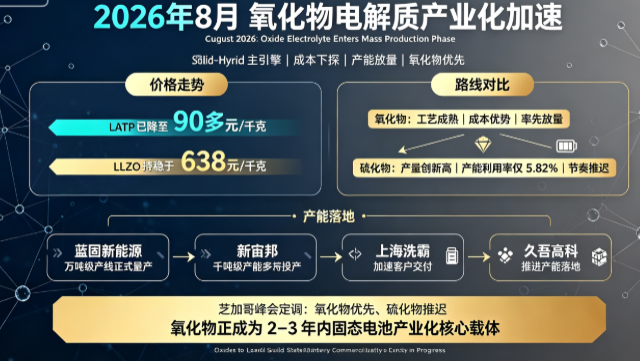
Key Points: In August 2026, oxide electrolytes continued their role as the "main engine for solid-liquid hybrid batteries." LATP prices dropped to just over RMB 90/kg, while LLZO held steady at RMB 638/kg. Unlike sulfide electrolytes, which saw record-high production but a meager capacity utilization rate of just 5.82%, the oxide route—leveraging process maturity and cost advantages—has taken the lead in large-scale production. LanGu New Energy's 10,000-tonne production line is now fully operational, Xinnuobang's thousand-tonne capacity is set to come online soon, and companies such as Shanghai Xiba and Jiugu Hi-Tech are accelerating capacity build-out and customer deliveries. The Chicago Summit set the tone for "oxides first, sulfides later," positioning oxides as the core enabler of solid-state battery industrialization over the next 2–3 years.
I. Price Divergence: LATP's Cost Advantage Stands Out, LLZO Remains High
In August, oxide electrolyte prices showed a "steady vs. declining" divergence. LLZO (lanthanum-zirconium-titanium oxide) held firm at RMB 638/kg throughout the month, while LATP (lithium titanium aluminum phosphate) fell to just over RMB 90/kg thanks to process maturity—less than 15% of LLZO's price. According to SMM data, oxide LATP costs approximately RMB 150,000–200,000/tonne, while LLZO costs RMB 250,000–300,000/tonne.
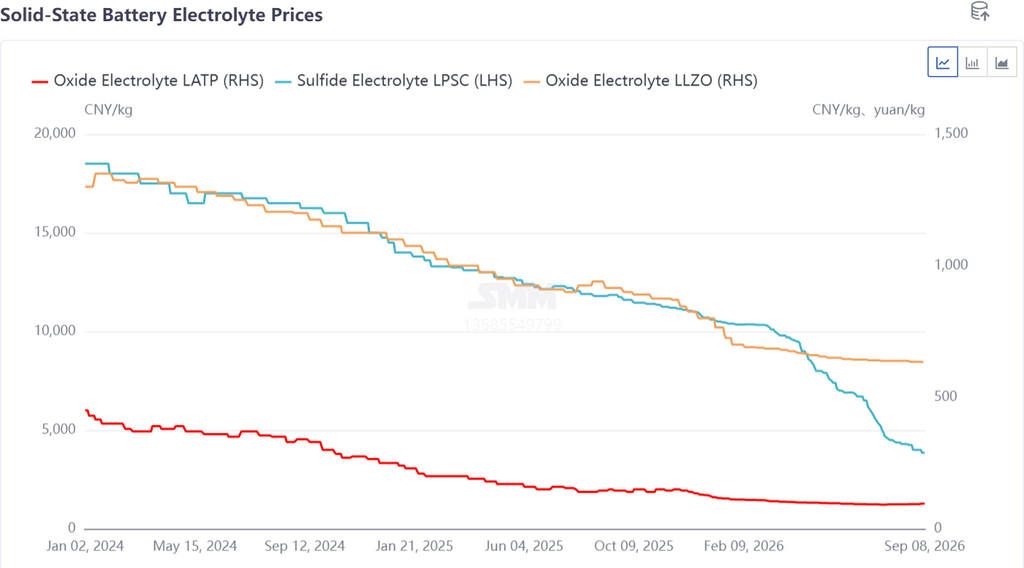
Behind this price gap lie two distinct strategic positions: LLZO, with its high ionic conductivity and stability toward lithium metal, is the long-term target material for all-solid-state batteries, while LATP, with its cost advantages and mature production processes, has become the preferred choice for commercializing solid-liquid hybrid batteries. The widening price spread in August reflected the market's tiered pricing logic for "near-term scalable" versus "long-term high-performance" solutions.
II. Capacity Build-Out: 10,000-tonne Lines Come Online, Industry Leaps from "Hundred-tonne" to "Ten-thousand-tonne" Scale
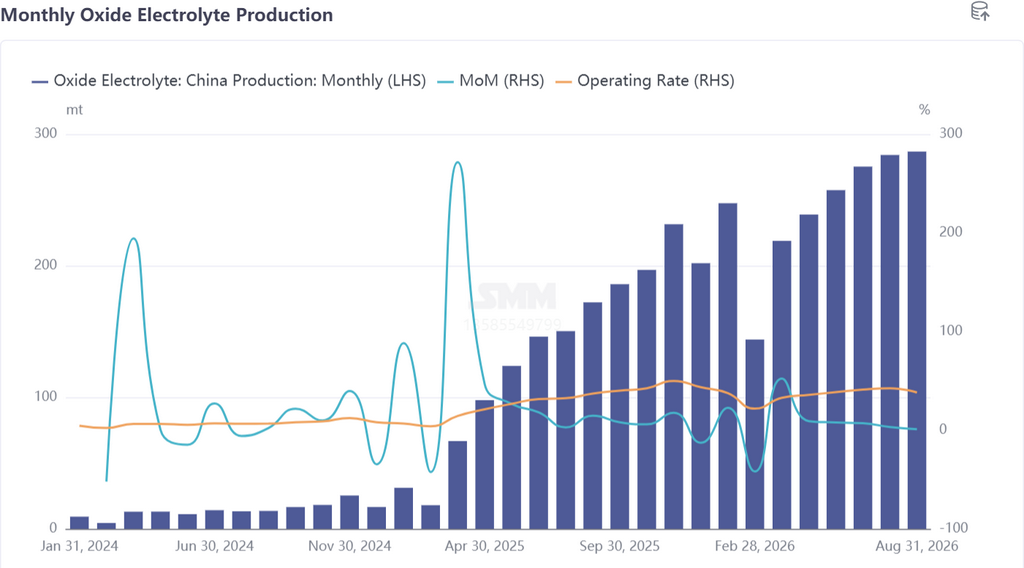
The most critical industry event in August was the continued ramp-up of LanGu New Energy's 10,000-tonne production line. On May 31 this year, LanGu New Energy officially launched its annual 10,000-tonne oxide solid-state electrolyte production line in Liyang—the first time domestic oxide solid-state electrolyte capacity has been scaled up from the hundred-tonne to the ten-thousand-tonne level. LanGu has now established a thousand-tonne oxide solid-state electrolyte production line and achieved stable operation of a hundred-tonne all-solid-state battery electrolyte line.
At the same time, Xinnuobang disclosed that its oxide electrolytes have achieved mass production and sales, with thousand-tonne capacity to come online in 2026, to be gradually expanded to ten-thousand-tonne scale. Shanghai Xiba's Songjiang Phase I project has entered trial production, with planned annual capacity of fifty-tonne-scale oxide electrolyte powder, and products have been delivered in batches to multiple leading battery manufacturers. Wuhan Ruishida's thousand-tonne oxide solid-state electrolyte line has also been formally completed. Jiugu Hi-Tech's oxide products achieved pilot-scale production and small-batch supply in 2025, and the company has recently completed scaled capacity build-out with stable batch deliveries now in place.
Unlike the awkward position of sulfide electrolytes—"lines built but operating rates below 6%"—oxide electrolyte capacity build-out and customer deliveries are advancing in tandem, demonstrating a much higher level of industrialization maturity. According to research institutions, China's solid-state electrolyte shipments are expected to reach 6,000 tonnes in 2026, with the oxide route being the undisputed mainstay.
III. International Consensus: "Oxides First" Emerges as Industry Consensus
The most significant industry signal in August came from across the Pacific. The Chicago Solid-State Battery Summit set the tone for "oxides first, sulfides later": oxide electrolytes are to be prioritized for deployment over the next 2–3 years, while all-solid-state sulfide batteries are pushed back to 2028–2030.
This assessment aligns closely with industry realities. Oxide electrolytes are primarily used in solid-liquid hybrid batteries, which have already achieved mass production and vehicle installation—Dongfeng Motor's self-developed oxide-polymer composite solid-state battery delivers 350 Wh/kg and is scheduled for mass vehicle installation in the second half of 2026; Qingtao Energy's Chengdu Phase II 15 GWh project is progressing steadily, with the oxide route as its main focus. Dangsheng Technology's plans also include 2,000 tonnes/year of oxide electrolyte capacity.
IV. Outlook: Oxides Are the "Now" for Solid-Liquid Hybrid and the "Bridge" to All-Solid-State
August's industry landscape clearly delineates the dual role of oxides: In the short term, they are the core material for the commercial-scale deployment of solid-liquid hybrid batteries. LATP's cost advantages and scalable production make it the electrolyte of choice for hybrid solid-liquid batteries (liquid electrolyte mass fraction of 5%–20%). In the long term, they serve as the critical bridge taking all-solid-state batteries from the lab to production lines. LLZO's technological iteration and cost-reduction trajectory are already clear—in 2025, oxide systems achieved a breakthrough in thin-film process cost reduction, with interfacial impedance reduced by 46.8% compared to 2023.
Compared to the early-stage ramp-up of sulfide electrolytes—"70 tonnes of output, 5.82% capacity utilization, and plummeting prices"—oxide electrolytes have already crossed the "from 0 to 1" lab threshold and are steadily advancing on the "from 1 to 100" large-scale journey. 2026 marks the Year Zero for all-solid-state validation, and oxides are the very track on which the first rays of dawn are now visible.


**Note:** For further details or inquiries regarding solid-state battery development, please contact:
Phone: 021-20707860 (or WeChat: 13585549799)
Contact: Chaoxing Yang. Thank you!
![[Pin thể rắn: ProLogium Technology sản xuất hàng loạt pin thể rắn hoàn toàn thế hệ 3.5 mật độ năng lượng cao đạt 381 Wh/kg và 903 Wh/L]](https://imgqn.smm.cn/usercenter/nVnLo20251217171728.jpg)
![Cách vượt qua thách thức áp suất cao của pin thể rắn sulfide—Phân tích chuyên sâu về các lộ trình kỹ thuật toàn cầu [Phân tích SMM]](https://imgqn.smm.cn/usercenter/akEdZ20251217171728.jpg)
![[Bác bỏ tin đồn về pin thể rắn: Vương Phương từ CATARC cho biết chưa có quyết định tuân thủ nào được đưa ra đối với các doanh nghiệp pin thể rắn]](https://imgqn.smm.cn/usercenter/JSjkr20251217171728.jpg)