May 31, 2026
Over the past two weeks, the price of gold has failed to recover further. Instead, its failure to break through the falling 50-day moving average increased downward pressure, causing gold to be pushed back down to $4,366 this morning—and thus to the 200-day moving average—amid the resurgent Iran crisis.
Silver presents a similar picture; here, even lower price targets are in play. Overall, precious metals have been in a healthy but treacherous and confusing correction since the end of January, one that is likely not yet over.
The ongoing conflict in the Middle East remains the dominant and highly unpredictable risk factor for commodity and financial markets. A sustainable solution does not appear to be in sight. Rather, physical oil and gas shipments through the Strait of Hormuz remain well below pre-crisis levels. Europe’s reserves have so far cushioned the supply bottlenecks but are now nearing depletion. As long as the logistical bottlenecks remain unresolved, volatility will stay high.
In addition, the vulnerability of financial markets is increasing. Short-term signs of peace can abruptly push oil prices down, while setbacks or military escalations drive them back up just as quickly—an environment in which precious metals are also suffering.
On the macro side, however, the dilemma for risk assets is intensifying, particularly for the heavily overbought stock markets. The recent price increases caused by rising energy prices heighten the risk of accelerating inflation, meaning central banks could be forced to raise interest rates and tighten monetary policy.
Whether the central banks can actually implement this at all, given the complex and fragile starting point, remains questionable, however.
However, the mere expectation of higher real interest rates could put further pressure on the gold price, even if this interest rate trend ultimately fails to materialize. At the same time, rising energy prices are supporting the inflation outlook and, in the long term, the demand for inflation-protected assets.
China continues to shift into gold
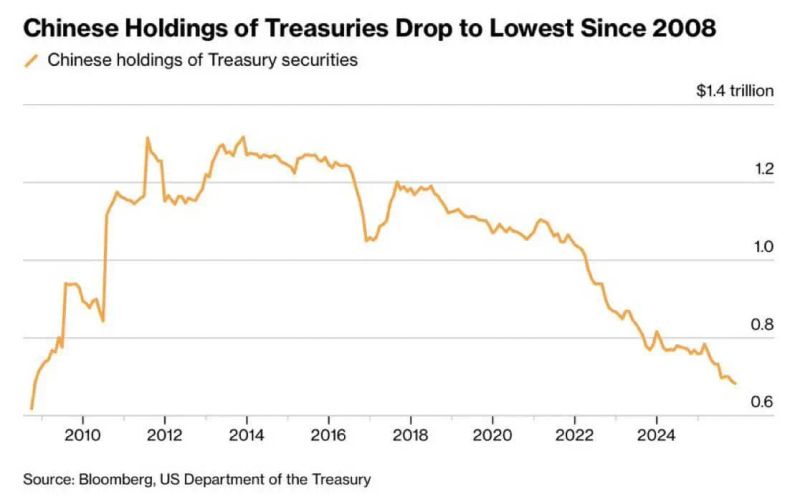
Chinese holdings of U.S. Treasury bonds, as of May 25, 2026. © Bloomberg
At the same time, China’s holdings of U.S. Treasuries have fallen to their lowest level since 2008, while official gold reserves continue to rise. China is thus consistently shifting assets from dollars to gold. However, the decline in Treasury holdings is also, to some extent, a matter of accounting.
A significant portion of China’s reserves was apparently held through custodians such as Belgium or transferred to the balance sheets of state-owned banks. Economically, the exposure to U.S. Treasury bonds thus remains, even if it no longer appears directly under China’s name in official statistics. The composition has therefore changed more significantly than the actual risk.
What is changing, however, is the nature of sovereign risk management. Like other strategically minded nations, China is gradually reducing its vulnerability to assets carrying political counterparty risk. While U.S. Treasuries are liquid and deeply traded, they ultimately remain claims within a Western-dominated financial system. Under extreme conditions, they can be frozen or subject to sanctions.
Gold, on the other hand, has no issuer, no counterparty risk, no digital barriers to access, and has been money for millennia. The Chinese are not seeking an abrupt exit from the Western financial system, but rather a reduction in dependence and greater freedom of action.
Nevertheless, the price of gold has been in a correction since the end of January, which, in our view, is more than justified and, above all, healthy following the spectacular gains of the past three and a half years.
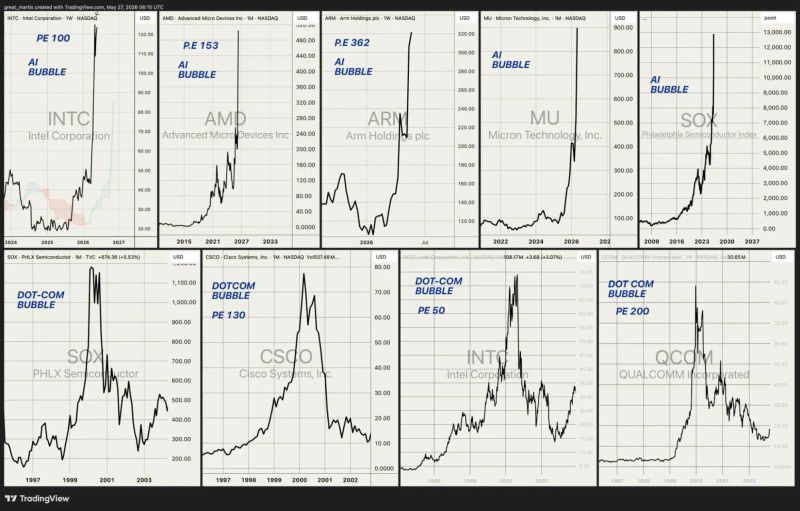
Semiconductor Boom vs. Dot-Com Bubble, May 27, 2026. © The Great Martis
The only real cause for concern is that stock markets have recently surged into parabolic price movements amid a very fragile, geopolitically strained environment. The AI rally has driven semiconductor stocks in particular into completely overvalued territory: The semiconductor sector is currently more overbought than it has been in twenty years. NVIDIA is trading at a trailing P/E ratio of around 33 and has posted a 44% gain in the last two months alone. Micron Technology has seen its share price rise by 1,450% over the past 14 months!
Margin levels (i.e., speculative trading on credit) stand at approximately $1.3 trillion (5.2% of GDP), exceeding the peak levels of 2008 and the dot-com era. Should a reversal and correction occur here, precious metals are likely to be dragged down with them in a temporary liquidity crunch. That is why we would like to mention our worst-case scenario of $3,500 for the gold price once again at this point.
Gold – Our price target “200-day line” was reached today
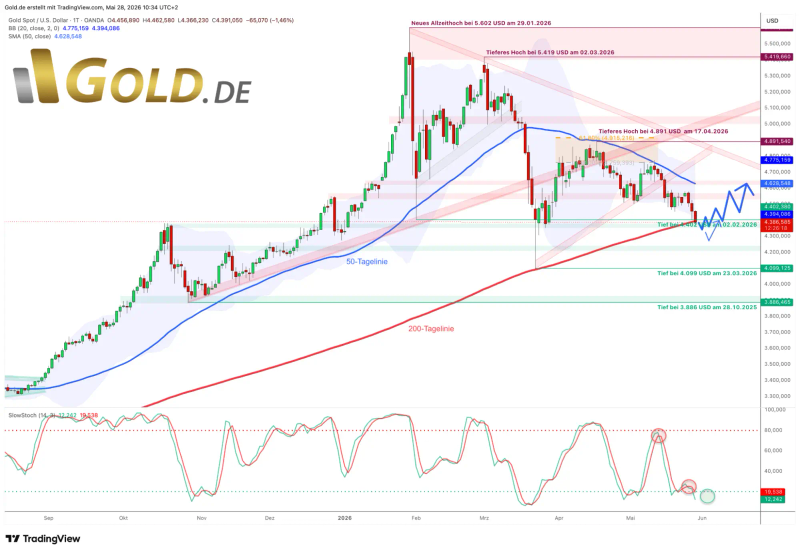
Gold in US dollars, daily chart as of May 28, 2026. © GOLD.DE
As suspected, the falling 50-day line ($4,628) has stopped the gold price twice on its way up over the past six weeks. In light of this difficult-to-overcome and psychologically burdensome barrier, a new, sharp downward wave began on May 12, which today reached our repeatedly mentioned price target in the form of the 200-day line ($4,392).
This means that, in our view, the bulk of the correction potential for the gold price has been exhausted for now. We had consistently emphasized that the first support level at the 200-day moving average of $4,100 from March 23 did not constitute a sufficiently solid foundation.
However, the problem is that the silver price has not yet reached its 200-day moving average (US$66.56) during the correction that has been underway since late January, and no real panic has yet been observed in the precious metals sector.
Despite the already oversold conditions in the gold market, we would therefore not be surprised to see the correction continue down to the lower Bollinger Band on the weekly chart ($4,289).
Overall, the price action reflects a typical spring correction. We already see buying opportunities again between $4,250 and $4,400. We initially expect a bottom to form in this range, which should then lay the foundation for a foreseeable recovery and the summer rally.
Conclusion: Gold – Correction Continues, Buying Opportunities Ahead
Gold and silver have been undergoing a healthy but not yet complete correction since late January: Gold failed twice at the falling 50-day moving average and has now fallen back to its 200-day moving average.
Silver, on the other hand, still faces significantly more downside risk, as the 200-day moving average has not yet been tested at all. Although a test of the lower weekly Bollinger Bands around $4,280 on the gold market would therefore not be surprising, we already see attractive entry prices between $4,250 and $4,400.
However, macroeconomic and geopolitical risks remain high and are increasing volatility in the short term: The Iran crisis and the ongoing bottlenecks through the Strait of Hormuz continue to weigh on commodity and energy markets and weaken Europe’s security of supply.
In the long term, however, China’s shift from U.S. Treasuries to gold supports demand for precious metals.
Only a broad-based sell-off in the heavily overbought stock markets—driven by high margin leverage and an overheated semiconductor/AI rally—could also put gold under significant short-term pressure in the event of a liquidity crunch; our worst-case scenario therefore remains $3,500.
Source:https://goldinvest.de/en/gold-correction-continues-buying-opportunities-are-emerging