April 30 (SMM) — According to the General Office of the State Council Notice on the 2026 Partial Holiday Arrangements, the Labor Day holiday will run from Friday, May 1 to Tuesday, May 5, a total of 5 days.
As the Labor Day holiday approaches at the end of April, SMM conducted a survey on holiday arrangements among lead-acid battery enterprises across 10 provinces in China. For the 2026 Labor Day holiday, the shutdown period ranged from 0 to 7 days, with an average of 3.6 days, an increase of 0.7 days compared with the same period last year.
Compared with 2025, the number of lead-acid battery enterprises taking ultra-long holidays has decreased this year, and there are no enterprises taking holidays of more than one week or even half a month. At the same time, the number of enterprises taking no holidays or only short holidays has also declined.
Additionally, during the 2025 Labor Day holiday, enterprises in multiple provinces took advantage of the break to relocate factories or carry out new equipment installation and upgrades. In contrast, this year, enterprises are using the Labor Day holiday mainly to reduce production and ease finished goods inventory pressure.
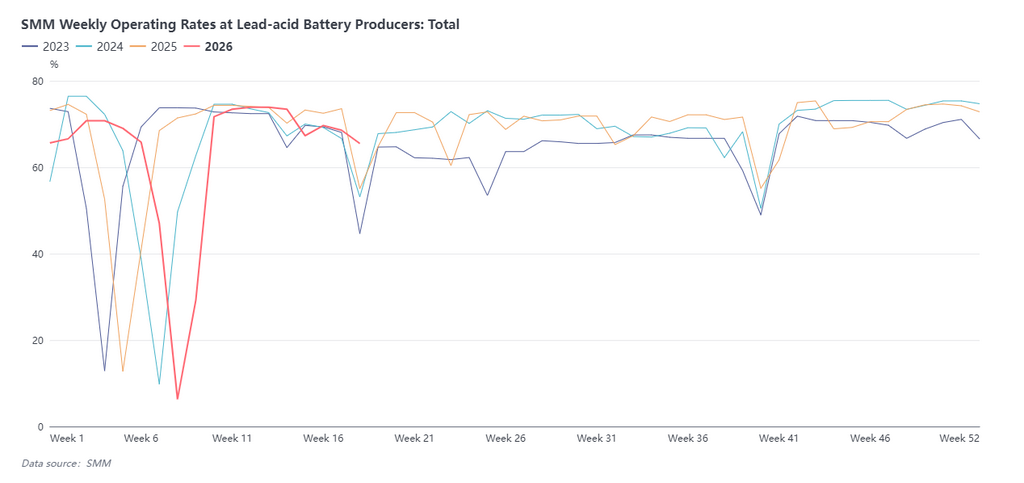
According to sources, lead-acid battery enterprises have planned longer holidays for this year's Labor Day. The main reasons are as follows:
On one hand, April to May coincides with the traditional off-season for lead-acid battery consumption, and manufacturers have generally implemented seasonal production cuts.
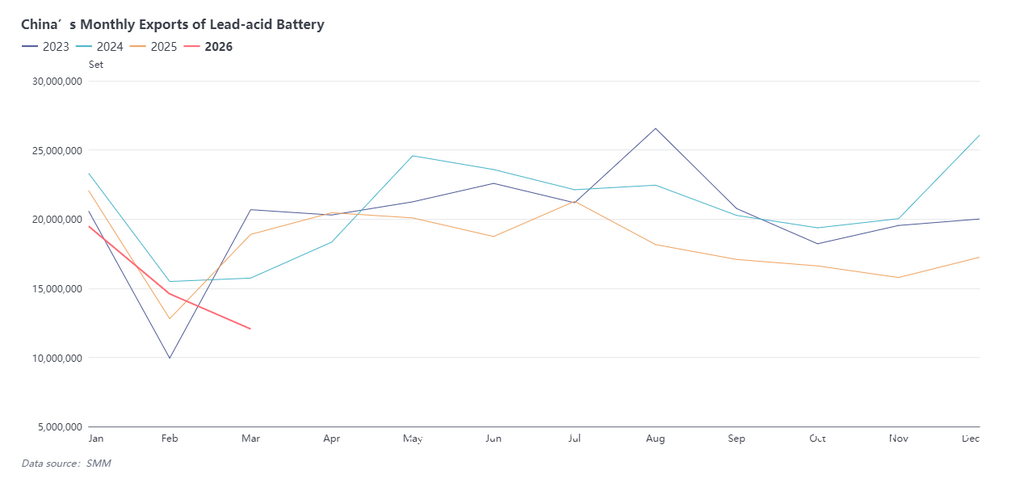
On the other hand, lead-acid battery exports have continued to weaken since the first quarter of 2026, dampening enterprises' production enthusiasm. According to customs data, China's lead-acid battery exports in Q1 2026 totaled 46.1243 million units, down 14.18% year-on-year. Notably, exports in March saw a rare 17.37% month-on-month decline from February. (By convention, January and February generally fall around the Chinese Lunar New Year, during which battery enterprises shut down and logistics are suspended, making exports in this period typically at an annual low. March usually sees a rebound as Spring Festival disruptions fade and overseas enterprises restock, so March export volumes are normally higher than those of January and February.)
Data Source Disclaimer: The above information is based on market data collection and a comprehensive assessment by the SMM research team. The information provided in this article is for reference only. This article does not constitute a direct recommendation for investment research decisions. Clients should make decisions with caution and not rely on this as a substitute for their own independent judgment. Any decisions made by clients are not the responsibility of Shanghai Metals Market (SMM).
![SMM Primary Lead Smelter Weekly Operating Rate (April 24-30, 2026) [SMM Primary Lead Operating Rate Weekly Review]](https://imgqn.smm.cn/usercenter/bAjSC20251217171721.jpg)
![Weekly Review of Lead Futures Prices, 2026.4.27-2026.4.30 [SMM Lead Weekly Review]](https://imgqn.smm.cn/usercenter/hrxHx20251217171721.jpeg)