The European Union’s Carbon Border Adjustment Mechanism (CBAM): Implications on the Global Aluminium Industry
What Is CBAM — And Why It’s Shaking Up Global Trade
The European Union’s Carbon Border Adjustment Mechanism (CBAM) is a policy introduced to prevent carbon leakage and ensure fair competition by regulating the import of carbon-intensive goods into the EU. Launched in October 2023, CBAM targets six high-emission sectors: cement, iron and steel, aluminium, fertilisers, electricity, and hydrogen.
Under this mechanism, imports from outside the European Economic Area (EEA) and Switzerland will face a carbon cost if their production emits more carbon than a defined benchmark. This approach encourages both EU and non-EU producers to transition towards low-carbon and cleaner production methods to maintain market access to the EU.
The CBAM Timeline
Currently, the CBAM is in its transitional period, which started from October 2023 and lasts until December 2025. In this period, businesses in the 6 carbon intensive sectors are obligated to report import emissions, but without any financial obligations tied to the reported imported carbon values. This allows for importers within the EU and exporters from outside the EU to adapt to the upcoming CBAM implementation, which will officially start on the 1st of January 2026.
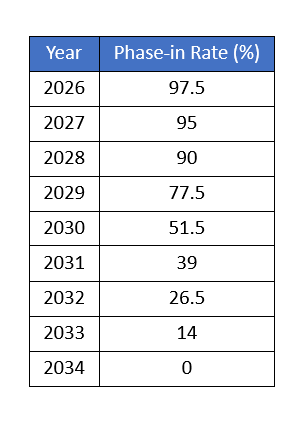
From 2025 to 2034, the CBAM will go through its initial implementation phase, where businesses are required to pay based upon carbon emission values of their imports. From 2026 to 2034, there will be adjustments to the carbon pricing, which act functionally as reductions of payments which are highest in 2026 (meaning you pay the least in 2026). Annually, this payment adjustment gets lowered, up until 2034 where there will be no adjustments to the carbon pricing, and businesses have to bear the full burden of any carbon imports that they make.
 Inside the Mechanism: How CBAM Calculates Carbon Costs
The EU has not yet released the final carbon pricing details, which are expected in early 2026, according to a letter from Gerassimos Thomas, Director-General for the Taxation and Customs Union of the European Commission to McCloskey. However, the structure of the CBAM pricing mechanism has already been outlined.
Importers of products from the six targeted industries will need to purchase CBAM certificates for goods falling under specified HS codes. For aluminium, these codes include 7601, 7603–7608, 7609.00.00, 7610, 7611.00.00, 7612, 7613.00.00, 7614, and 7616.
Certain codes, such as 7602 (aluminium waste and scrap) and 7615 (household aluminium articles such as tables, kitchenware, or sanitary ware), are excluded because they are considered either already carbon-friendly or are “too processed or complex”. Similarly, components like car doors and bodies, though commonly listed under HS 7610, are exempt as they are complex assemblies involving multiple parts and fall under products that are “too processed or complex”.
For goods within the CBAM scope, EU importers must purchase certificates corresponding to their carbon intensity relative to the CBAM benchmark for each HS code. The CBAM cost is calculated as follows:

Key terms:
tCO2e/t : Tonnes of CO2 emissions per tonne of product
Embedded Emissions : Verified carbon intensity (in tCO2e/t) of the imported product, accredited by EU-approved verification bodies
CBAM Benchmark : A benchmark of acceptable tCO2e/t for each different product; official CBAM benchmarks not yet released
CBAM Phase-in Rate/Factor : An annual adjustment (discount) rate of the benchmark, that decreases annually up until 2034 where it reaches 0
EUA Cost : EU Emissions Trading System Allowances, the price of a CBAM certificate per tCO2e/t; official EUA costs not yet released
Example calculation:
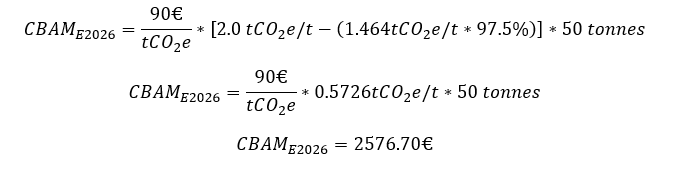
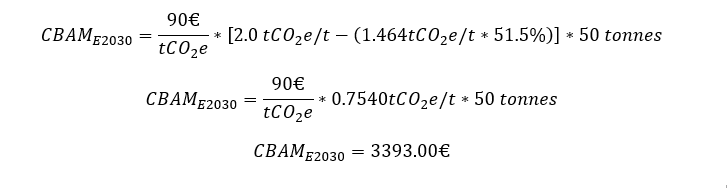
An import of 50 tonnes of unwrought aluminium HS7601, with 2.0 tCO2e/t, and an estimated EUA cost of 90€ per tCO2e/t would be calculated as follows:
2026
2030
Winners and Losers: Who Gains and Who Pays Under CBAM
Since CBAM applies only to imports from outside the EU, intra-EU trade (for example, aluminium traded between Germany and France) remains unaffected. Countries such as Norway, Liechtenstein, Switzerland, and Iceland are also exempt, owing to their close trade relationships with the EU or the existence of equivalent carbon regulations recognised by the EU and CBAM.
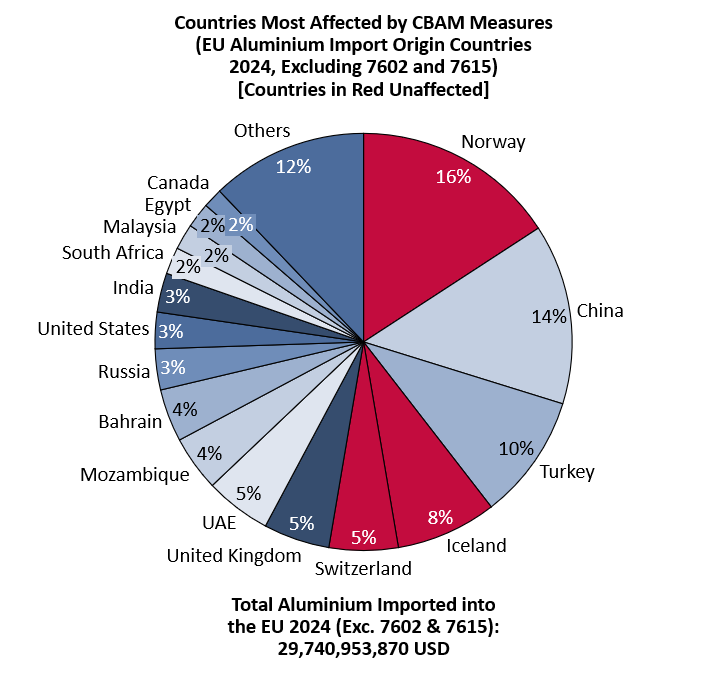
However, exporters of aluminium to the EU, excluding scrap aluminium and highly processed products, will face the greatest challenges once CBAM payments begin in 2026. Based on 2024 aluminium export data (excluding HS 7602 and 7615), Norway, Iceland, and Switzerland account for 29% of the EU’s total aluminium import value in USD in 2024, but they are unaffected by CBAM pricing.
In contrast, exporters from China, Turkey, the UAE, Mozambique and Bahrain will be most exposed, with combined exports to the EU valued at USD 11.065 billion or 37% of the total import value of the EU in 2024. Overall, Asian exporters are expected to be the most impacted, followed closely by those in Africa and North America.
Non-EU European countries such as the United Kingdom, Serbia, and Bosnia and Herzegovina are also affected. However, this may change as their political and regulatory landscapes evolve. For instance, Serbia and Bosnia and Herzegovina are pursuing accession into the EU framework, which would eventually exempt their exports from CBAM obligations. Meanwhile, the United Kingdom is developing a parallel carbon pricing system and is in discussions with the EU for a temporary exemption in 2026, lasting until 2027, when the two schemes are expected to align.
Looking Ahead: A New Era of Carbon Accountability
In summary, the European Union’s Carbon Border Adjustment Mechanism marks a step toward integrating carbon accountability into international trade. For the global aluminium industry, and other carbon-intensive sectors, CBAM represents both a challenge and an opportunity, pushing exporters worldwide toward decarbonisation and transparency in face of decarbonisation efforts worldwide, and not only limiting combating climate change to developed nations.
As the EU has yet to release definitive EUA costs and CBAM emission benchmarks, SMM will closely monitor forthcoming updates from the European Commission and related authorities and report on any updates.