1.1 Sales Review
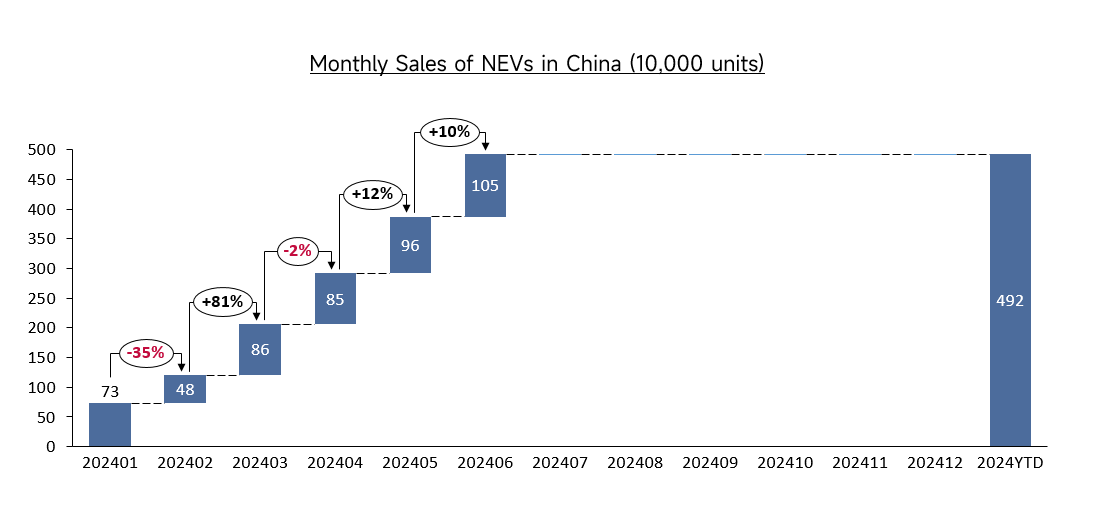
In 2024H1, China's NEV sales reached 4.923 million units (including exports), up 31.53% YoY, with a penetration rate of 35.2%.
Reviewing the sales pace in 2024H1:
In January, the Chinese NEV market experienced a decline following the year-end sales surge in 2023.
February, a traditional off-season for the car market, saw NEV sales drop by 35% MoM and 9% YoY. Amidst the poor performance, leading NEV producers initiated a price war, with BYD's new model "Qin" priced at 79,800 yuan, followed by other domestic NEV brands joining the price reduction trend.
In March, the NEV market saw a strong recovery, with sales up 81% MoM and 32% YoY. The price cuts from car manufacturers boosted market recovery and increased consumer willingness to purchase. The policy support from the State Council's "Action Plan for Large-Scale Equipment Renewal and Consumer Goods Trade-In" facilitated smoother circulation and promoted tiered and updated consumption.
In April, NEV sales saw a slight decline mainly as the sales surge at the end of Q1 consumed some of April demand.
In May, the NEV market defied the traditional off-season, achieving significant sales growth. This was due to the ongoing price war among car manufacturers, the release of new models by mainstream NEV producers, and the mid-May launch of the 2024 NEV Rural Promotion policy.
In June, the NEV market continued its growth trend, driven by the ongoing trade-in policy, continued promotional activities by car manufacturers, and mid-year sales pushes by some producers, resulting in impressive sales figures.
1.2 NEVs vs. Fuel Vehicles? PHEVs vs. BEVs?
(1) NEVs vs. Fuel Vehicles
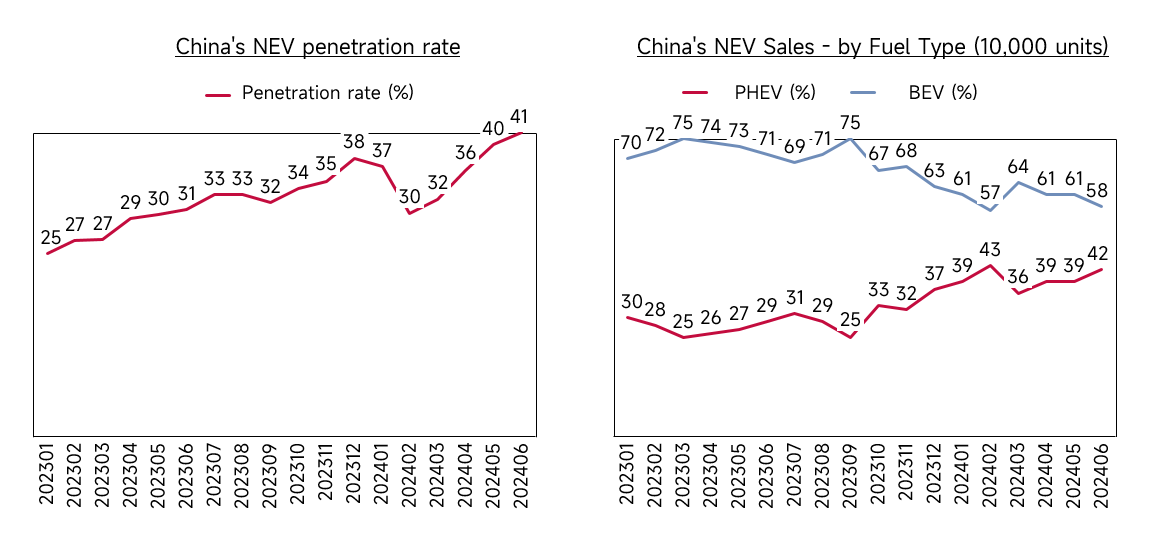
NEV penetration rate indicates the proportion of NEV sales to total car sales over a certain period and reflects the market influence of NEVs versus fuel vehicles. Since the beginning of 2024, China's NEV penetration rate increased from 36.5% to 41% by June. Driven by the continuous decline in NEV prices and improvements in NEV performance, consumer willingness to purchase enhanced (usual reasons that have been discussed before). The strong performance of NEVs in H1 was also related to aggressive sales strategies. NEV producers led price cuts, forcing fuel vehicle producers to follow suit, thus fuel vehicle producers losing tactical advantage. Additionally, NEVs gained significant online attention, with NEV CEOs frequently making headlines, while fuel vehicles received minimal attention at events like Auto China. NEV sales have been "riding the wave," with weekly penetration rates reaching 50%, and further increases in H2 are anticipated.
(2) PHEVs vs. BEVs
Within the NEV sector, PHEVs continued to gain popularity, with their share rising from 2023 and reaching 42% by June 2024. The reasons for this increase include: 1) PHEVs reduce mileage anxiety by using electricity for short trips and fuel for long trips; 2) High battery costs make PHEVs more affordable due to their lower battery capacity; 3) China's charging infrastructure still needs improvement, and it will take time for BEVs to fully address mileage anxiety.
1.3 Exports
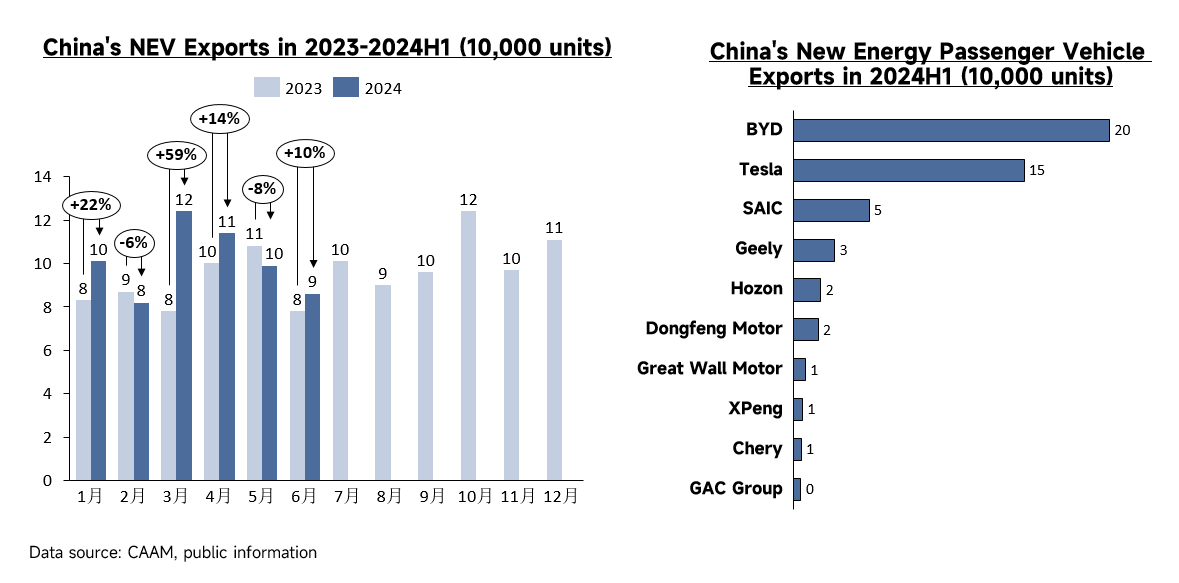
According to CAAM data, NEV exports in 2024H1 reached 605,000 units, up 13.2% YoY. Total vehicle exports were 2.793 million units, up 30.5% YoY, with NEVs accounting for about 12% of the total.
The top five export destinations for NEVs in 2024H1 were Brazil, Belgium, the UK, Thailand, and the Philippines. The top five NEV exporters were BYD, Tesla, SAIC, Geely, and Hozon.
In terms of exports, global trade protectionism cannot be ignored. On May 14, 2024, US President Biden announced higher tariffs on imports of electric vehicles, electric vehicle batteries, solar cells, computer chips, and medical products from China, including over 100% tariffs on electric vehicles. Similarly, on July 4, 2024, the European Commission announced temporary anti-subsidy duties on Chinese BEVs following a nine-month investigation. The temporary tariffs are: BYD 17.4%, Geely 19.9%, SAIC 37.6%, other cooperating but unsampled producers 20.8%, and non-cooperating manufacturers 37.6%. SMM expects these tariffs to have some negative impact on NEV exports, but given the small share of exports to the US and EU, the overall impact will be limited.
1.4 Summary
In 2024H1, China's NEV sales continued to grow, with a penetration rate of 35.2%.
Policy support: Trade-in policies and NEV Rural Promotion provided favorable support.
Car manufacturers: NEV producers boosted market activity through price cuts, new competitive models, and product upgrades.
Within the NEV sector, the share of PHEVs increased, and exports also showed a growth trend.