This article will introduce the lithium extraction process from salt lake brine.
About 60% of global lithium resources are found in salt lake brine. Besides lithium ions, salt lake brine is also rich in magnesium ions, potassium ions, and others. Lithium is generally mixed with alkaline earth metals or alkali metals, making the extraction and separation of lithium quite difficult. This is especially true for brine with a high magnesium-to-lithium ratio, which makes the extraction and separation of lithium even more complex. Therefore, researching the lithium extraction process from salt lake brine is of great significance. Moreover, the magnesium-to-lithium ratio varies among different salt lakes, and the lithium extraction processes adopted also differ, usually following a "one lake, one process" approach. In China, the technology for extracting lithium from salt lakes with a low magnesium-to-lithium ratio is relatively scarce, with most focusing on salt lakes with a high magnesium-to-lithium ratio. And the latter faces more complex issues. Currently, no single industrialized lithium extraction technology can be applied to all types of salt lake brine, and the applicability of lithium extraction technology is limited. Exploring a widely applicable method for extracting lithium from salt lakes is a key focus for future research.
The following is a brief introduction to four relatively mature methods for extracting lithium from salt lake brine.
1. Adsorption Method
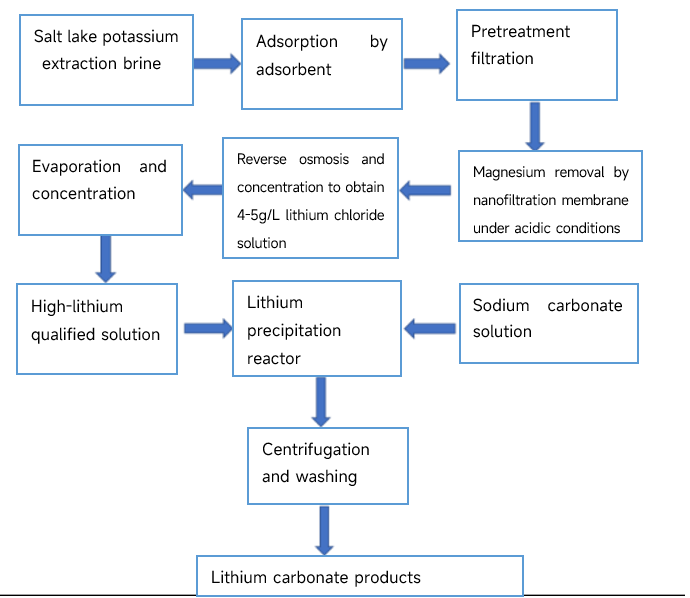
The adsorption method uses an adsorbent that is selective for lithium ions to bind lithium ions, and then adopts a nanofiltration membrane to remove magnesium under acidic conditions after eluting and extracting the lithium ions by an eluent. After reverse osmosis and concentration as well as natural evaporation, a high-lithium qualified solution is obtained. Finally, lithium carbonate products are achieved by precipitating and filtering.
The performance of the adsorbent determines the efficiency of the ion exchange adsorption process. Currently, there are various types of adsorbents in use. The adsorbent must be able to exclude a large number of coexisting alkali metals in the brine, selectively adsorb lithium ions from the brine, and have high adsorption capacity and strength. Common lithium adsorbents can be divided into two main categories: organic resin adsorbents and inorganic adsorbents. Inorganic adsorbents can be further divided into ionic sieve adsorbents, aluminum salt adsorbents, natural mineral adsorbents, and other types.
Source: CNKI, Hua'an Securities
2. Extraction Method
The extraction method is suitable for extracting lithium from salt lakes with a high magnesium-to-lithium ratio. Its principle is based on the concept of "like dissolves like." An organic solvent that is immiscible with brine and has a density not less than that of water is mixed and contacted with the brine. Through physical dissolution, separation, or chemical reaction, the desired components in the brine are extracted and transferred to the organic phase. The desired components are extracted from the organic solvent into the aqueous phase through back-extraction. However, the drawback of this method is that the toxic and harmful nature of organic solvents increases costs in the environmental protection sector. Therefore, the application scale of the extraction method is not very large, and the capacity is relatively small.
3. Membrane Method
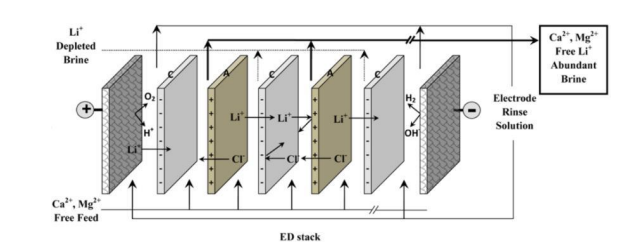
The membrane method includes two techniques: electrodialysis membranes and nanofiltration membranes. The principle of the electrodialysis membrane method is to use alternately placed cation and anion exchange membranes. Under the influence of an electric field, cations pass through the cation exchange membrane, and anions pass through the anion exchange membrane to migrate to the electrodes. Monovalent cations such as lithium ions, sodium ions, and potassium ions migrate to the concentration chamber through the monovalent selective cation exchange membrane, while divalent cations such as calcium ions and magnesium ions are blocked and remain in the desalination chamber, thus achieving the separation of magnesium and lithium. However, in actual production, magnesium hydroxide precipitates and adheres to the ion exchange membrane under the influence of the electric field, affecting the efficiency of electrodialysis. Therefore, the membranes need to be frequently disassembled and cleaned, resulting in high maintenance costs.
Source: CNKI, Hua'an Securities
The principle of the nanofiltration membrane method is to use nanofiltration membranes to retain divalent and higher metal cations, while monovalent lithium ions and sodium ions can pass through, allowing the separation of magnesium ions from lithium ions. The nanofiltration membrane method is suitable for salt lake brine with a magnesium-to-lithium ratio lower than 30. In salt lakes with a magnesium-to-lithium ratio greater than or equal to 30, it is necessary to combine the two membrane techniques.
4. Calcination Method
The calcination method for extracting lithium from salt lakes is the earliest industrialised process. The principle of this method is that lithium-containing magnesium oxide and magnesium carbonate are insoluble in water. By leaching magnesium oxide with water, the separation of lithium and magnesium can be achieved. The specific process involves acidifying and concentrating the salt lake brine to obtain magnesium chloride tetrahydrate, which is then dried and dehydrated to obtain magnesium chloride dihydrate. This is then fed into a rotary kiln and calcined at a high temperature of around 800℃ to obtain anhydrous lithium-containing magnesium oxide and other mixtures. At this point, high-purity water is added to leach the lithium, and then calcium hydroxide and sodium carbonate are added to remove impurity ions such as calcium and magnesium. However, due to the high energy consumption of the calcination method and the production of toxic and harmful gases, it causes severe environmental pollution. Therefore, this method may gradually be phased out of the market.
In addition to the four methods mentioned above, there are also solar pond methods, electrochemical methods, etc., which are not elaborated here due to their limited application.
Given costs and resource advantages, lithium salt plants should choose the most suitable technical route according to local conditions, reduce production costs, and stabilise production while protecting the environment and ensuring product quality.