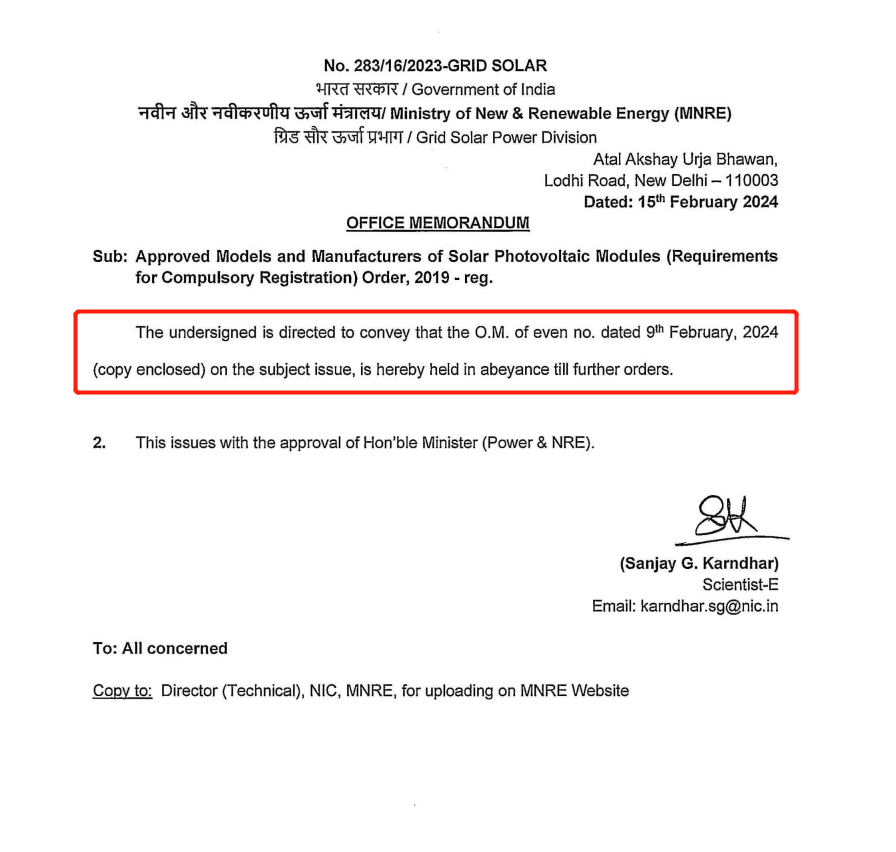
On February 9th, the Ministry of New and Renewable Energy (MNRE) of India released a office memorandum stating that from April 1st, 2024, the Approved List of Models and Manufacturers (ALMM) for solar PV modules will be implemented once again.
This effectively signifies that the Indian government has officially announced that starting from April 1st, it will cease the import of PV modules manufactured in China.
However, on February 15th, the MNRE issued another notice indicating that the announcement made on February 9th is temporarily suspended, pending further instructions.
The original text is as follows:
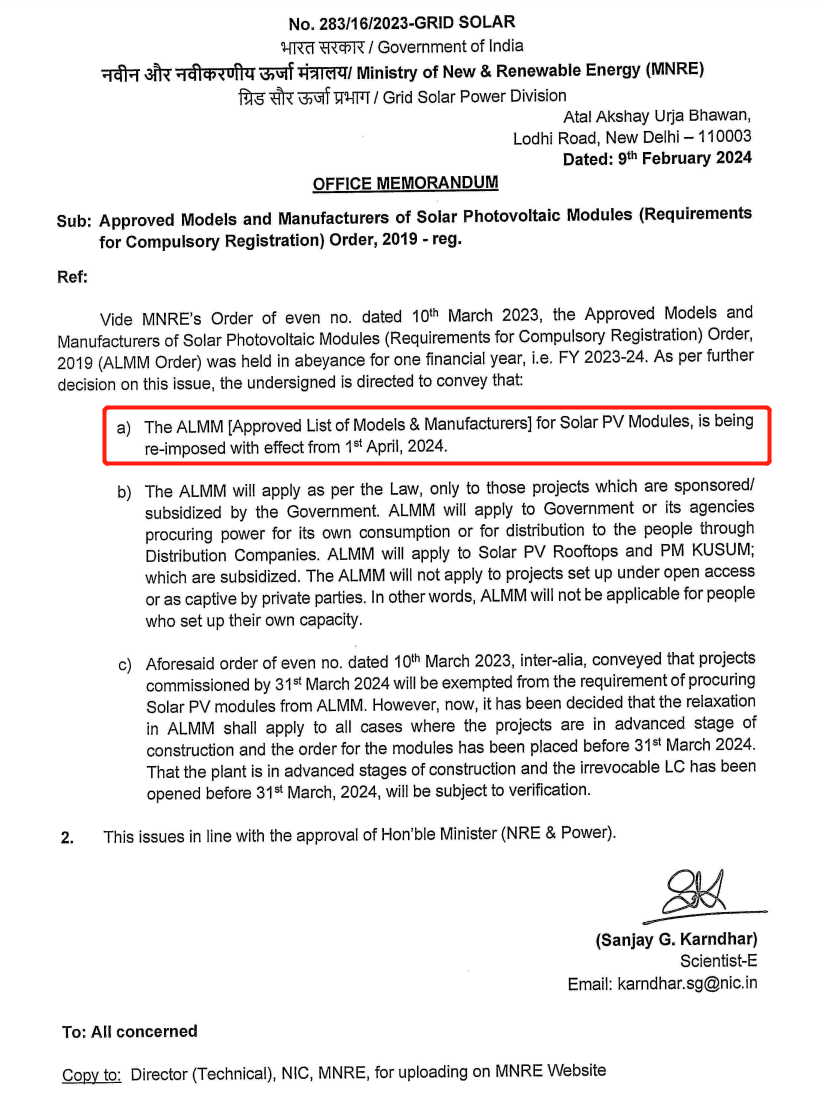
The ALMM order has been announced to be suspended for one fiscal year, effective from March 10th, 2023, covering the financial year of 2023-24.
As a result, projects that are commissioned before March 31st, 2024, will be exempt from the requirement to procure solar PV modules from the ALMM.
The notice issued on February 9th stipulates that the relaxation of the ALMM will apply to all projects that are in the late stages of construction and have placed orders for PV modules before March 31st, 2024.
Further official verification is required to ascertain whether a photovoltaic project has entered the later stages of construction and whether an irrevocable letter of credit has been issued before March 31st, 2024.
The definition of the "later stages of construction" for projects has not been explicitly defined in the notice.
Subsequently, on February 15th, the MNRE retracted the notice and announced that whether the ALMM list will be reinstated on April 1st is subject to further orders.
Considering the current situation of domestic module production capacity in India, there is a possibility that the implementation of the ALMM list may be deferred.
On January 2, 2019, the MNRE issued the "Order for Approved Models and Manufacturers of Solar PV Modules (Compulsory Registration) 2019."
The ALMM directive mandates the composition of the ALMM to include LIST-I, which specifies the models and manufacturers of solar PV modules, and LIST-II, which identifies the models and manufacturers of solar PV cells.
Only the models and manufacturers included in the ALMM List-I (solar PV modules) are eligible for use in government-installed projects, government-assisted projects, and government-schemed projects in India, including those selling electricity to the government, established under the guidelines issued by the Central Government in accordance with Section 63 of the Electricity Act 2003 and its amendments.
In August 2023, the MNRE released an updated list of approved PV module models and manufacturers.
This list comprises 82 photovoltaic module manufacturers with a total annual capacity of approximately 19.559 GW and specifies the approved models, product efficiency, and other related information for each enterprise. Notably, the list does not include any Chinese PV module manufacturing enterprises.
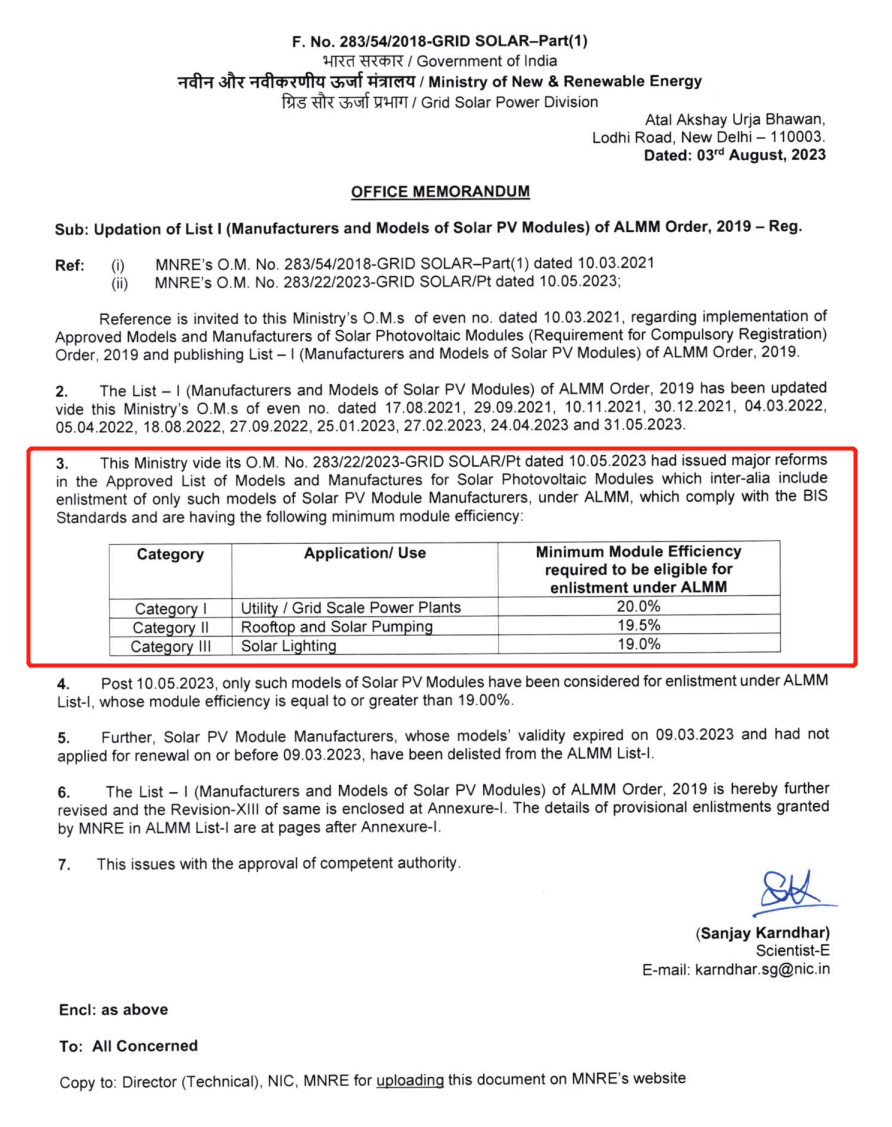
Furthermore, the latest list emphasizes that only models from manufacturers that comply with BIS standards and have the following minimum module efficiencies will be included under ALMM.
For modules utilized in the scenarios of utility/grid-scale power plants, rooftop and solar pumping, and solar lighting, the minimum efficiency requirements are respectively set at 20%, 19.5%, and 19%.
India's imports of Chinese modules surged since Q3 2023, remaining high through year-end.
Should the ALMM list be reopened in April, it will undoubtedly stimulate the demand for Chinese module imports into India for Q1 2024. It is anticipated that January and February 2024 will see a sharp increase in the import of Chinese modules to India due to policy incentives, with exports from China expected to decline starting in April.
In the current state of uncertainty regarding the opening of the ALMM list, Indian project developers are also expected to have plans to stockpile inventories.
If the implementation of the ALMM list is delayed, there remains a favorable period for the export of Chinese modules and for modules from Southeast Asian bases to India.
From the perspective of India's end photovoltaic demand, according to data released by the MNRE, as of the end of January 2024, India's cumulative photovoltaic grid-connection volume is approximately 74.3GW, with about 10.016GW of new photovoltaic installations added in the year 2023.
Due to a reduction in utility / grid scale power plants, the new photovoltaic installations in India in 2023 down about 30% YoY, and were even less than the additions in 2021.
With the rooftop photovoltaic incentive policies released this year in India and the recent surge in utility / grid scale power plants tender activities, it is expected that the new photovoltaic installations in 2024 will see a slight YoY increase, with the demand for modules estimated to be at least 15GW.
For more information, please contact: viola@smm.cn
![[SMM Photovoltaic] Aiko Solar 72MW Ground-Mounted Project in Germany Successfully Grid-Connected](https://imgqn.smm.cn/usercenter/WUJtg20251217171743.jpg)
![[Solar: Mexico’s CFE awards around 6.71GW of PV capacity]](https://imgqn.smm.cn/usercenter/xBtJB20251217171738.jpg)
![[Solar: Bangladesh announces tax incentives to accelerate solar development]](https://imgqn.smm.cn/usercenter/HdPjk20251217171741.jpg)