The Red Sea crisis is dividing the energy market: Global energy trade has been split into "two worlds"?

Đã xuất bản: Feb 4, 2024 13:46
Some signs indicate that as the Red Sea crisis continues to escalate and oil tanker freight rates continue to soar, the global energy market is becoming increasingly localized and regionalized, and the once-global energy trade seems to be "dividing in two," with the Suez Canal becoming the dividing line...

Some signs indicate that as the Red Sea crisis continues to escalate and oil tanker freight rates continue to soar, the global energy market is becoming increasingly localized and regionalized, and the once-global energy trade seems to be "dividing in two," with the Suez Canal becoming the dividing line...


Among them, one trading zone is centered on the Atlantic basin, including the U.S. East Coast and the Gulf of Mexico coastal areas, the Caribbean, and Europe (including the North Sea and the Mediterranean); while the other trading zone includes the Persian Gulf, the Indian Ocean, and East Asia.


Although some crude oil is still flowing between these two trading zones - through longer and more expensive routes around the southern tip of Africa - recent buying patterns suggest that the connection between the two seems to be on the verge of being cut off.


In Europe, according to traders, some refiners abandoned plans to purchase Basra crude oil from Iraq last month, while buyers from the European continent were rushing to buy goods from the North Sea and Guyana.


In Asia, demand for Abu Dhabi's Murban crude oil has surged, leading to a sharp increase in spot prices in mid-January, while crude oil flowing from Kazakhstani ports to Asia has greatly decreased. At the same time, ship tracking data from trade data provider Kpler shows that oil loading from the U.S. to Asia last month dropped by more than a third compared to December.


While it is foreseeable that this divergence in global energy trade will not be permanent, the current situation is indeed making it more difficult for countries heavily dependent on energy imports such as India and South Korea to diversify their sources of oil supply.


For refiners around the world, this also limits their flexibility to respond to rapidly changing market dynamics and could ultimately erode profits.


Viktor Katona, chief oil analyst at Kpler, said, "Turning to more conveniently located goods makes commercial sense now, as long as disruptions in the Red Sea keep freight rates high. It's not easy to choose between supply security and maximizing profit."


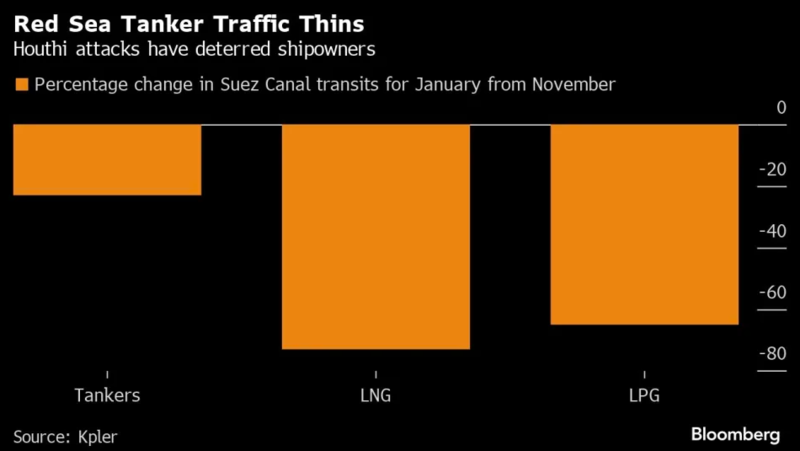
According to a report released by Kpler on January 30, the volume of oil tankers transiting the Suez Canal last month decreased by 23% compared to November. The decline in liquefied petroleum gas and liquefied natural gas was even more significant, dropping by 65% and 73% respectively.
In terms of specific product segments, the impact is greatest on diesel and aviation fuel from India and the Middle East flowing to Europe, as well as on European fuel oil and naphtha flowing to Asia. The price of naphtha in Asia reached its highest level in nearly two years last week, as the market is concerned that purchasing naphtha from Europe will become more difficult. Naphtha is a light oil used as a feedstock for chemical production, processed from crude oil or other raw materials. The impact of the Red Sea attacks is also leading to increased transportation costs, thereby prompting refiners to procure locally as much as possible. Shipping costs for Suezmax tankers from the Middle East to Northwest Europe have risen by about half since mid-December, while global benchmark Brent crude has risen by about 8% during the same period. Meanwhile, according to traders in the market, the delivery cost of oil from the increasing production in the United States to Asia has risen by over $2 per barrel in the three weeks of January. Giovanni Staunovo, commodity analyst at UBS Group, stated that while it is still possible to diversify import channels, the cost is becoming increasingly prohibitive. Refiners' profits will be impacted unless they can pass on the cost to end consumers. Adi Imsirovic, director of Surrey Clean Energy, pointed out that the geopolitical situation is not favorable for energy trade and advised caution for buyers. He also stated that it is a difficult time for refiners, especially for Asian refiners who need to be more flexible.


For more information contact Gina Wen: ginawen@smm.cn

Tuyên bố về Nguồn Dữ liệu: Ngoại trừ thông tin công khai, tất cả dữ liệu khác được SMM xử lý dựa trên thông tin công khai, giao tiếp thị trường và dựa trên mô hình cơ sở dữ liệu nội bộ của SMM. Chúng chỉ mang tính chất tham khảo và không cấu thành khuyến nghị ra quyết định.

Để biết thêm thông tin hoặc có thắc mắc gì, vui lòng liên hệ: lemonzhao@smm.cn
Để biết thêm thông tin về cách truy cập báo cáo nghiên cứu, vui lòng liên hệ:service.en@smm.cn
Tin Liên Quan
Bộ Thương mại: Thặng dư thương mại của Trung Quốc do nhu cầu toàn cầu thúc đẩy, không phải do chính sách; Tài khoản vãng lai ở mức hợp lý
19 phút trước
Bộ Thương mại: Thặng dư thương mại của Trung Quốc do nhu cầu toàn cầu thúc đẩy, không phải do chính sách; Tài khoản vãng lai ở mức hợp lý
Đọc thêm
Bộ Thương mại: Thặng dư thương mại của Trung Quốc do nhu cầu toàn cầu thúc đẩy, không phải do chính sách; Tài khoản vãng lai ở mức hợp lý
[Bộ Thương mại: Trung Quốc chưa bao giờ cố ý theo đuổi thặng dư thương mại; nhìn chung, tỷ trọng thặng dư tài khoản vãng lai trong GDP nằm trong phạm vi hợp lý được quốc tế công nhận] Ngày 28 tháng 7, Bộ Thương mại công bố văn bản tựa đề “Lập trường của Trung Quốc về vấn đề được gọi là ‘dư thừa năng lực’”, trong đó chỉ ra rằng Trung Quốc chưa bao giờ cố ý theo đuổi thặng dư thương mại. Tăng trưởng xuất khẩu của Trung Quốc bắt nguồn từ quy mô kinh tế và năng lực đổi mới sáng tạo được tăng cường, cũng như nhu cầu từ quá trình chuyển đổi xanh và công nghiệp hóa của các quốc gia khác. Ví dụ, tăng trưởng xuất khẩu của Trung Quốc sang châu Âu chủ yếu tập trung vào điện mặt trời (PV), xe năng lượng mới (NEV), pin lithium và các sản phẩm hóa chất, phần lớn phản ánh nhu cầu về sản phẩm năng lượng do quá trình chuyển đổi xanh thúc đẩy; và cuộc khủng hoảng năng lượng đã làm tăng chi phí sản xuất trong các ngành công nghiệp châu Âu như hóa chất. Trung Quốc cũng chưa bao giờ cố ý theo đuổi thị phần xuất khẩu các sản phẩm sử dụng nhiều lao động; tỷ trọng xuất khẩu các sản phẩm này đã giảm từ 20,7% năm 2012 xuống còn 15,1% năm 2025. Về phân phối lợi ích thương mại, 'thặng dư ở Trung Quốc, nhưng lợi ích được chia sẻ cho tất cả.' Năm 2025, các doanh nghiệp có vốn đầu tư nước ngoài chiếm 27% tổng xuất khẩu của Trung Quốc và 16% thặng dư, với mức tăng trưởng thặng dư và lợi nhuận nhanh hơn so với các doanh nghiệp trong nước. Từ góc độ cán cân thanh toán tổng thể, mặc dù Trung Quốc có thặng dư lớn trong thương mại hàng hóa, nhưng lại thâm hụt trong thương mại dịch vụ và thu nhập từ đầu tư. Nhìn chung, thặng dư tài khoản vãng lai chiếm khoảng 3,7% GDP, nằm trong phạm vi hợp lý được quốc tế công nhận.
19 phút trước
【SMM New Energy News】Trung Quốc và Anh tăng cường hợp tác về chuyển đổi xanh và năng lượng tái tạo
28 phút trước
【SMM New Energy News】Trung Quốc và Anh tăng cường hợp tác về chuyển đổi xanh và năng lượng tái tạo
Đọc thêm
【SMM New Energy News】Trung Quốc và Anh tăng cường hợp tác về chuyển đổi xanh và năng lượng tái tạo
Bộ trưởng Thương mại Trung Quốc Vương Văn Đào đã có cuộc điện đàm video với tân Bộ trưởng Thương mại Anh Reynolds để trao đổi ý kiến về quan hệ kinh tế và thương mại song phương. Trung Quốc bày tỏ sẵn sàng tăng cường hợp tác với Anh về thương mại dịch vụ, chuyển đổi xanh và năng lượng tái tạo, thúc đẩy tăng trưởng cân bằng trong thương mại song phương.
28 phút trước
Gotion khởi động dự án vật liệu pin thể rắn 10.000 tấn; dây chuyền sản xuất lithium sulfide đầu tiên bắt đầu.
30 phút trước
Gotion khởi động dự án vật liệu pin thể rắn 10.000 tấn; dây chuyền sản xuất lithium sulfide đầu tiên bắt đầu.
Đọc thêm
Gotion khởi động dự án vật liệu pin thể rắn 10.000 tấn; dây chuyền sản xuất lithium sulfide đầu tiên bắt đầu.
Ngày 29 tháng 7, khái niệm pin thể rắn tăng điểm trong phiên, Jinlongyu chạm mức giá trần và Lingpai Technology tăng hơn 10%. Theo tin tức, ngày 21 tháng 7 năm 2026, dự án vật liệu then chốt cho pin thể rắn với công suất 20.000 tấn/năm của Tập đoàn Gotion chính thức khởi động tại An Khánh, An Huy. Đây là dây chuyền sản xuất hàng loạt lithi sunfua độ tinh khiết cao quy mô vạn tấn đầu tiên trong ngành, với kế hoạch xây dựng thí điểm hoàn thành cuối năm 2026 và sản xuất hàng loạt chính thức vào năm 2027.
30 phút trước
The Red Sea crisis is dividing the energy market: Global energy trade has been split into "two worlds"? - Shanghai Metals Market (SMM)