[SMM Annual Report] Global Nickel Likely to be Oversupplied in 2023-2026E

Đã xuất bản: Jan 10, 2023 17:33 (GMT+8)
In 2023, in addition to the impact of the aforementioned delays in the commissioning of some capacity, the demand from the new energy industry will stimulate the production and ramp-up of the upstream producers.

SHANGHAI, Jan 10 (SMM) - 2022 is another year that has witnesses the nickel price turmoil. In March 2022, nickel prices soared to a record high. In the second quarter, the prices were on a downward trend and returned to the fundamentals due to COVID-19 outbreak and the macro factors. In the middle and late third quarter, steel mills were expected to resume their production owing to the sharp drop in stainless steel supply earlier, pushing up the short-term stainless steel output and the nickel demand. In addition, the new energy industry mushroomed in the third quarter. The operating rates of battery companies grew amid the improvement of orders, the low inventory of precursor companies, the rapid expansion of the leading battery producers, etc. Nickel demand gained strong support from the new energy industry. As a result, the prices rallied from lows.

In terms of the fundamentals in 2022, the US Fed continued to raise the interest rates to temper inflation. The global economy showed signs of recession from time to time, and overseas consumption, especially in European countries, slumped, while nickel consumption performed relatively well. The two major downstream markets, the stainless steel and new energy industries both maintained positive growth, and the nickel demand in the latter burgeoned by more than 30% year-on-year. Nickel demand from the military alloy sector grew apace, while that from the electroplating sector performed poorly during the year.

In 2023, the market may witness a significant supply surplus of primary nickel, especially the NPI.  Besides, the refined nickel supply will also be in surplus. Nonetheless, the same scenario is unlikely happen to nickel sulphate in 2023 because of its capacity mismatch. The Indonesian government’s potential export tax hike on nickel products may, on the other hand, affect the rhythm of NPI production and cause oversupply. The global economy will not be optimistic in 2023. Under the influence of factors on the fundamentals and macro front, nickel prices will fluctuate wildly with a high probability and will trend lower amid the expected supply surplus.
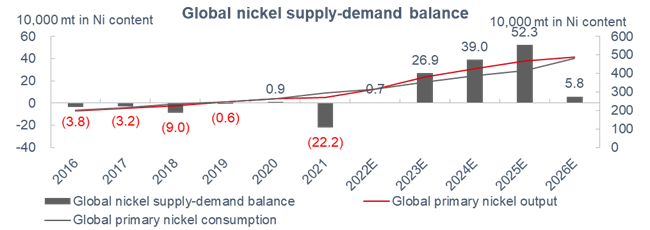
In 2022, the global primary nickel consumption is expected to be 3.14 million mt in Ni content, up 6.9% YoY. The supply will add 15.9% YoY to 3.148 million mt in Ni content. The global primary nickel surplus will reach 8,000 mt in Ni content. The market should see no supply surplus if the downstream restocking demand had been taken into account. In 2022, nickel supply has been relatively tight, which is mainly caused by the lower-than-expected growth of supply.  The commissioning of Indonesia NPI slowed down, and some production lines were switched to produce high-grade nickel matte, reducing the expectations of NPI oversupply to some extent. Meanwhile, the nickel salt output, restricted by the mismatch between converted battery-grade nickel sulphate capacity and the raw material types, failed to surge, thus the market supply was in deficit for most of the year.

In 2023, the surplus is expected to expand further. In addition to the impact of the aforementioned delays in the commissioning of some capacity, the demand from the new energy industry will stimulate the production and ramp-up of the upstream producers. In 2023, the total supply will reach 3.808 million mt in Ni content while the demand will be 3.54 million mt in Ni content, resulting in a supply surplus of 269,000 mt in Ni content, which is mainly contributed by NPI supply since there will be multiple new NPI production lines put into production. SMM predicts that SMM #1 refined nickel prices will move between 143,000-178,000 yuan/mt, with an average of 160,500 yuan/mt.
Tuyên bố về Nguồn Dữ liệu: Ngoại trừ thông tin công khai, tất cả dữ liệu khác được SMM xử lý dựa trên thông tin công khai, giao tiếp thị trường và dựa trên mô hình cơ sở dữ liệu nội bộ của SMM. Chúng chỉ mang tính chất tham khảo và không cấu thành khuyến nghị ra quyết định.

Để biết thêm thông tin hoặc có thắc mắc gì, vui lòng liên hệ: lemonzhao@smm.cn
Để biết thêm thông tin về cách truy cập báo cáo nghiên cứu, vui lòng liên hệ:service.en@smm.cn
Tin Liên Quan
【Flash | Phụ phí ống chứa molypden tháng 10 của Tubacex biến động trái chiều】
02 Oct 2026 10:52 (GMT+8)
【Flash | Phụ phí ống chứa molypden tháng 10 của Tubacex biến động trái chiều】
Đọc thêm
【Flash | Phụ phí ống chứa molypden tháng 10 của Tubacex biến động trái chiều】
Tubacex đã công bố phụ phí hợp kim ống tháng 10. Tính theo euro, thép 316/316L cán nóng/nguội giảm từ €5,07/€5,59 mỗi kg (€5.070/€5.590 mỗi tấn) xuống €5,05/€5,56 mỗi kg (€5.050/€5.560 mỗi tấn). Các loại vật liệu có hàm lượng Mo cao, với Mo trên 2,5%, giảm từ €5,26/€5,79 xuống €5,23/€5,76 mỗi kg. Phụ phí cho 2205 và 2507 không đổi, trong khi 254 SMO tăng từ €9,64/€10,62 lên €9,67/€10,65 mỗi kg. Phân tích của SMM: hầu hết các loại ống chứa Mo đều đi ngang hoặc giảm nhẹ, trong khi 254 SMO tăng, cho thấy sự truyền tải chi phí có sự khác biệt giữa các loại thép.
02 Oct 2026 10:52 (GMT+8)
[SMM Tin nhanh Thép không gỉ] Giá phế liệu thép không gỉ Ấn Độ phân hóa khi 304 giảm theo niken và 316 khan hiếm giữ vững
02 Oct 2026 10:50 (GMT+8)
[SMM Tin nhanh Thép không gỉ] Giá phế liệu thép không gỉ Ấn Độ phân hóa khi 304 giảm theo niken và 316 khan hiếm giữ vững
Đọc thêm
[SMM Tin nhanh Thép không gỉ] Giá phế liệu thép không gỉ Ấn Độ phân hóa khi 304 giảm theo niken và 316 khan hiếm giữ vững
[SMM Tin nhanh Thép không gỉ] Giá phế liệu thép không gỉ Ấn Độ phân hóa khi 304 giảm theo niken và 316 khan hiếm giữ vững
Thị trường thép phế liệu không gỉ của Ấn Độ diễn biến trái chiều trong tuần kết thúc vào ngày 1 tháng 10. Giá phế liệu 304 nội địa giảm nhẹ và giá chào nhập khẩu cũng theo xu hướng giảm, trong khi giá 316 giữ ổn định ở cả thị trường nội địa và nhập khẩu. Giá niken trên LME suy yếu gây áp lực lên tâm lý đối với 304, và người mua chỉ mua theo nhu cầu trước mắt khi giao dịch chậm lại trong kỳ lễ hội. Nguồn cung khan hiếm đã hạn chế đà giảm của 316. Về thu mua, thời gian xử lý ngắn sau khi chính phủ nới lỏng yêu cầu về Giấy chứng nhận kiểm định trước khi giao hàng (PSIC), cùng với chi phí nhập khẩu tăng thêm, tiếp tục hạn chế sự linh hoạt của các nhà máy. Một số nhà máy đang cân nhắc phôi, tấm slab và gang niken (NPI) như các lựa chọn thay thế phế liệu để quản lý chi phí đầu vào. Nhìn xa hơn, đề xuất của EU về việc hạn chế xuất khẩu phế liệu kim loại sang Ấn Độ theo Quy định vận chuyển chất thải (WSR) mới, nếu được thông qua, sẽ tiếp tục thu hẹp các lựa chọn nhập khẩu phế liệu của Ấn Độ. Trong ngắn hạn, phế liệu 304 chịu áp lực giảm nhẹ nếu niken vẫn yếu, trong khi 316 dự kiến sẽ duy trì ổn định chừng nào nguồn cung còn thắt chặt. Các diễn biến về PSIC và tính kinh tế tương đối của phôi và NPI sẽ là những yếu tố chính cần theo dõi.
02 Oct 2026 10:50 (GMT+8)
【Tin nhanh | Metallus tăng phụ phí molypden tháng 10 cho thép 300M】
02 Oct 2026 10:47 (GMT+8)
【Tin nhanh | Metallus tăng phụ phí molypden tháng 10 cho thép 300M】
Đọc thêm
【Tin nhanh | Metallus tăng phụ phí molypden tháng 10 cho thép 300M】
Metallus công bố phụ phí nguyên liệu thô tháng 10 áp dụng từ ngày 1–30/10. Thành phần Mo cho thép 300M tăng 0,52% lên 15,176 USD/cwt, tương đương khoảng 334,57 USD/tấn thép, từ mức 15,098 USD/cwt, tức 332,85 USD/tấn. Tổng phụ phí niêm yết tăng 1,03% lên 45,054 USD/cwt. Phế liệu tăng lên 17,750 USD/cwt, trong khi phụ phí năng lượng riêng cho thép thanh và thép ống giảm từ 1,296 USD/cwt, khoảng 28,57 USD/tấn, xuống còn 0,050 USD/cwt, tức 1,10 USD/tấn.
02 Oct 2026 10:47 (GMT+8)