China Weekly Inventory Summary and Data Wrap (Dec 3)

Đã xuất bản: Dec 3, 2021 20:00
This is a roundup of China's metals weekly inventory as of December 3.

SHANGHAI, Dec 3 (SMM) - This is a roundup of China's metals weekly inventory as of December 3.

Aluminium Social Inventories Dropped 15,000 mt on Week

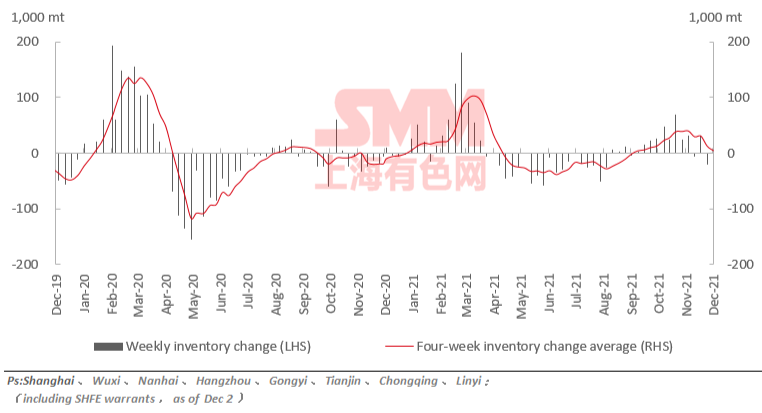
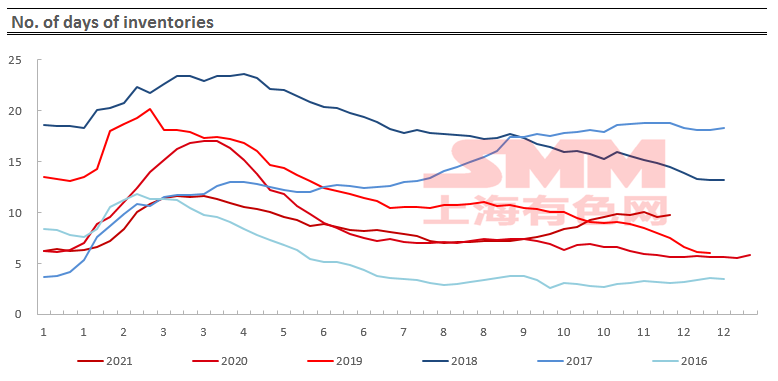
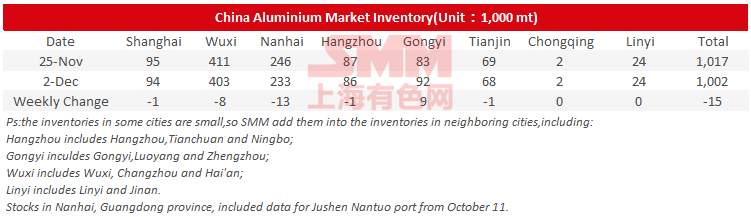
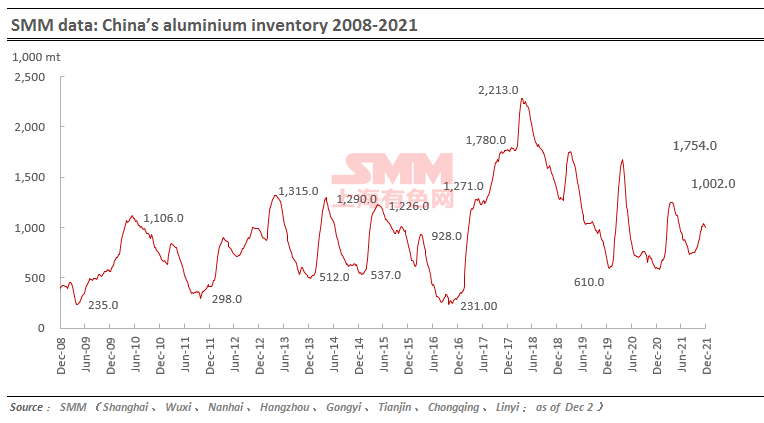
SMM data showed that China's social inventories of aluminium across eight consumption areas dropped 15,000 mt on the week to 1 million mt as of December 2, mainly contributed by Nanhai, Shanghai and Wuxi. The inventory in Gongyi rose on the week.
Aluminium Billet Inventories Down 7,200 mt on Week

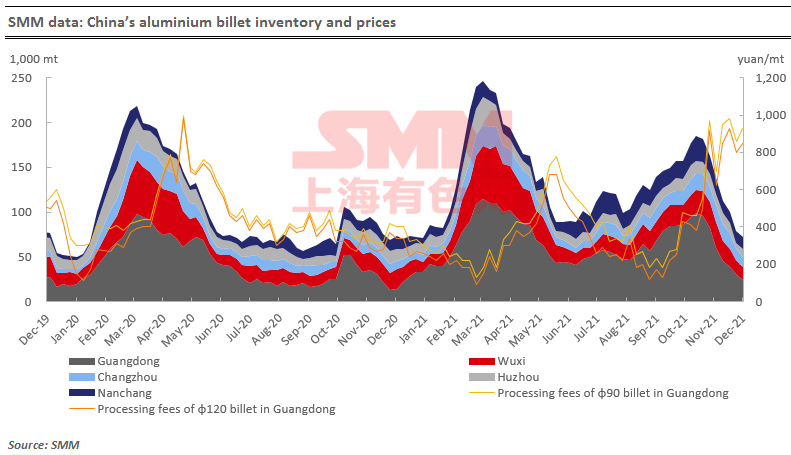
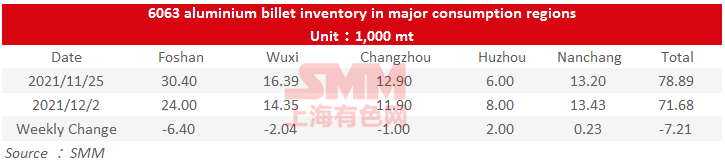
The stocks of aluminium billet in five major consumption areas dropped 7,200 mt to 71,700 mt on December 2 from a week ago, a decrease of 9.14%. And the inventory has been falling for seven straight weeks.

Foshan was still the largest contributor to the falling social inventory, and the local inventory dropped 6,400 mt or 21.05% on the week. The inventories in Wuxi and Changzhou also declined, while Huzhou and Nanchang both saw slightly rising inventories. The declines of weekly social inventory was still caused by the falling arrivals for aluminium billet.

Looking forward, the downstream sectors of aluminium billet became less interest in purchasing, and some of them turned to aluminium ingot as the conversion margin of aluminium billet was high compared with the re-smelting costs. Meanwhile, the warehouses reported that the transportation in north-west China is still disrupted. Hence the social inventory will keep falling but at a much slower pace, and there is also possibility that the inventory would rise on the week.
Copper Inventory in Major Chinese Markets Dipped 6,700 mt on Week

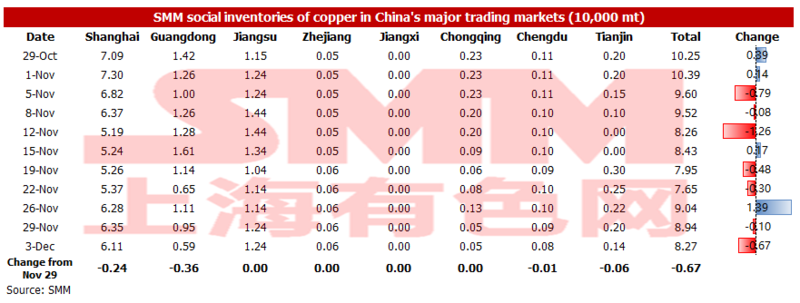
As of Friday December 3, the copper inventory across major Chinese markets fell 6,700 mt from Monday to 82,700 mt. The declines were mainly seen in Shanghai, Guangdong and Tianjin.

Specifically, the inventory in Shanghai decreased by 2,400 mt to 61,100 mt, and the inventory in Guangdong decreased 3,600 mt to 5,900 mt. The inventory in Tianjin declined 600 mt to 1,400 mt. The copper price continued to fall this week. And downstream companies stockpiled actively on adequate cash flows at the start of the month, which were the main reasons for the decline in inventories.

In addition, the invoice issuance issue for imported copper remains as a trouble in December, making it difficult to clear a large volume of imported copper into the domestic market. The smelters that undertook maintenance resume production. The volume of imported copper is unlikely to grow. The total supply is likely to grow slightly. The consumption is expected to remain stable as long as the copper prices do not rise sharply. Therefore, the inventory may increase slightly. And there is room for the spot premiums to drop, but the decline will not be significant.
Copper Inventory in China Bonded Area Dipped 5,700 mt

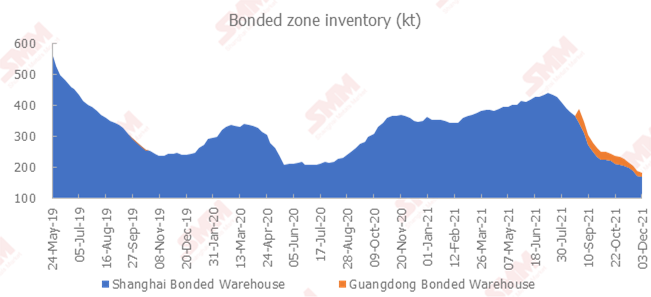
The copper inventories in the domestic bonded zones dipped 5,700 mt from November 26 to 183,500 mt as of Friday December 3, the eighth consecutive week of decline, according to the most recent SMM survey.

The inventory in the Shanghai bonded zone decreased 4,700 mt to 169,600 mt, and the inventory in the Guangdong bonded zone fell 1,000 mt to 13,900 mt. There were inflows of cargoes under warrants which were imported when the SHFE/LME copper price ratio was profitable. The arriving shipments decreased. Meanwhile, it has been difficult for some ships to call at ports due to the strengthening of the customs' quarantine work on inbound ships. And the port work efficiency was low. As such, the bonded zone inventories continued to decline.
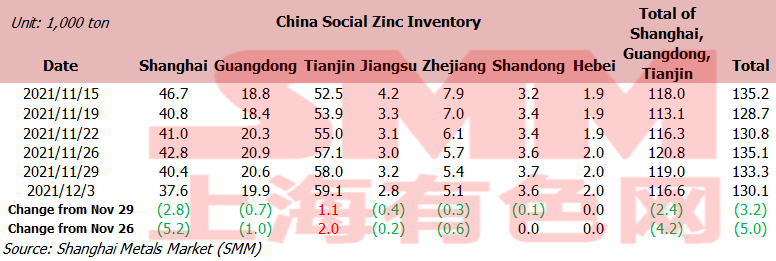
Zinc Inventories Down 5,000 mt on the Week

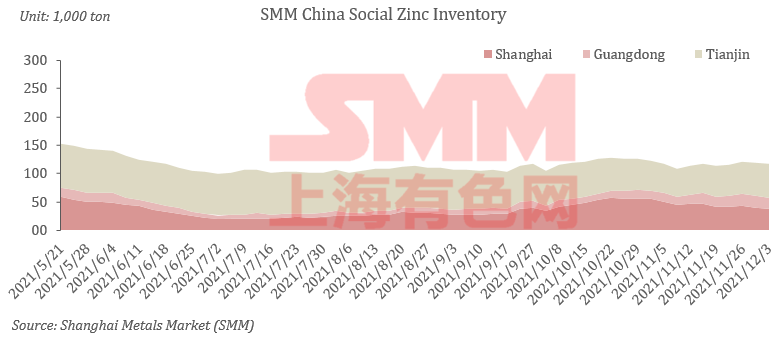
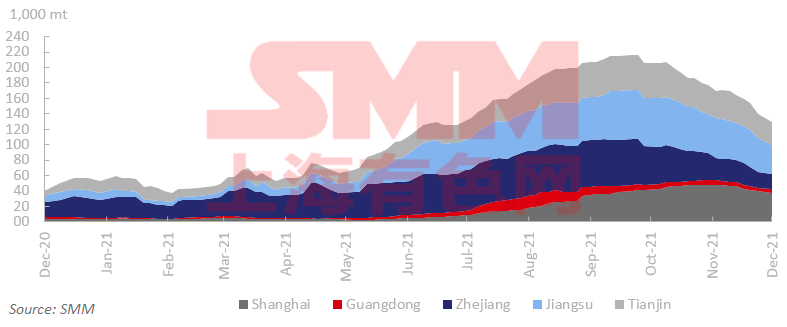
SHANGHAI, Dec 3 (SMM)—Total zinc inventories across seven Chinese markets stood at 130,100 mt as of December 3, down 3,200 mt from November 29 and 5,000 mt from November 26.

The inventory in Shanghai declined as only a small amount of imported zinc arrived and downstream producers began to restock goods after digesting government stockpiles. The stocks in Guangdong declined slightly as the arrivals of goods declined on the week and shipments stabilised. Tianjin saw an increase in the stocks as downstream producers mainly restocked on rigid demand. Inventories in Shanghai, Guangdong and Tianjin fell 4,200 mt, and inventories across seven Chinese markets decreased 5,000 mt.
Lead Ingot Social Inventory Down 6,300 mt on Week

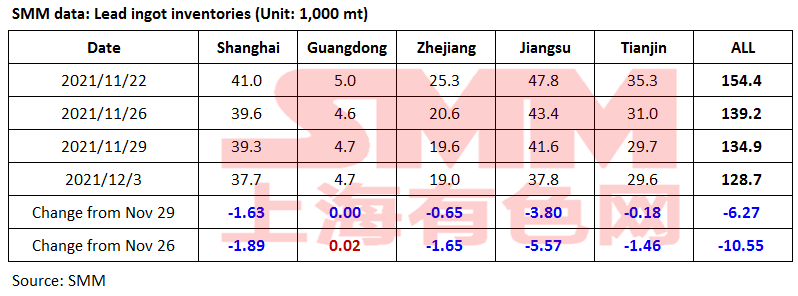
The social inventory of lead ingots across Shanghai, Guangdong, Zhejiang, Jiangsu and Tianjin decreased 10,600 mt from November 26 and 6,300 mt from November 29 to 128,700 mt as of December 3.

The secondary lead smelters in Jiangsu and Anhui continued the maintenance, and some smelters in Jianxi reduced the production under the inspections of Solid Waste Management Centre.

The Ministry of Ecology issued a notice on December 1 that the second round of the fifth batch of central environmental protection inspections was fully launched, and four inspection teams will be stations in Heilongjiang, Guizhou, Shaanxi, and Ningxia for one month. Some secondary lead smelters in Guizhou have reduced the production, and the downstream users consumed the social stocks in surrounding areas.

Some primary lead smelters will end maintenance next week, and the output is expected to increase. The lead ingot exports may drop as the export causes losses amid rising SHFE/LME price ratio. The lead ingot social inventory may drop more slowly.
Silicon Metal Social Inventory Increased 3,000 mt on Week

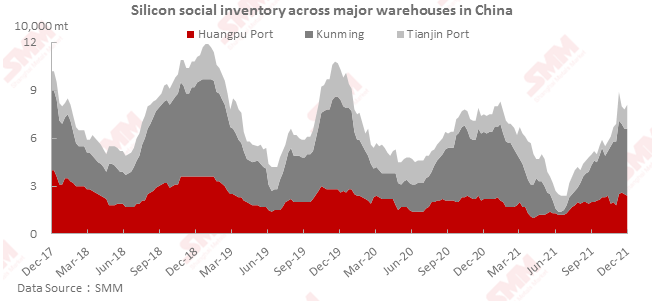
The social inventory of silicon metal across Huangpu port, Kunming city and Tianjin port increased 3,000 mt from the previous week to 81,000 mt as of Friday December 3.

The operating rates across the plants in south and north China remained hight. The silicon metal inventories were transferred from factories to social warehouses. The social inventory increased amid sluggish transactions.

Nickel Ore Inventories at Chinese Ports Fell 169,000 wmt

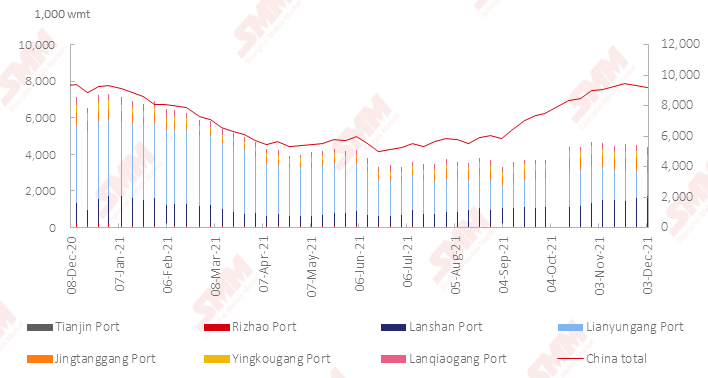
The nickel ore inventory at Chinese ports fell 169,000 wmt to 9.18 million wmt as of December 3. Total Ni content stood at 72,100 mt. The total inventory at seven major ports stood at around 4.39 million wmt, a decline of 129,000 wmt from a week earlier.

Lanshan port saw a severe backlog of cargoes and face great pressure of slow shipments from ports. Jingtang port also met difficulties in shipping cargoes.

The arriving shipments of nickel ore have decreased recently. The nickel ore inventory is expected to slide further in the short term.
SHFE/LME Nickel Price Ratio Rallied

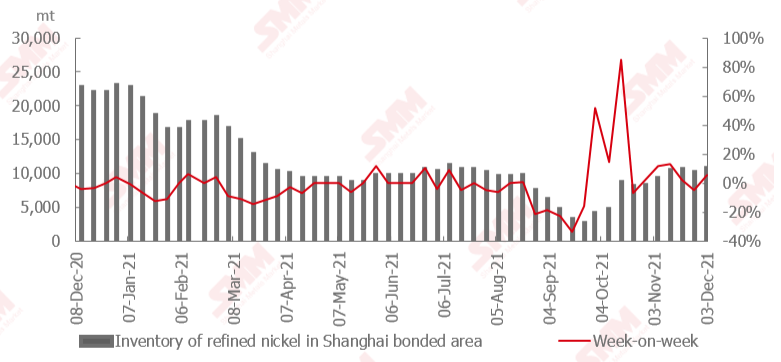
The SHFE/LME nickel price ratio rallied this week after remaining sluggish for several consecutive weeks. SMM believes that the resurgence of the COVID-19 pandemic has triggered overseas concerns over the collapse in the demand.

The domestic demand was stable. Meanwhile, the arriving shipments in China continued to decrease. However, the output of nickel sulphate and stainless steel remained high. The domestic nickel inventory declined this week.

Large volumes of planned shipments arrivals of nickel briquette and nickel plate may impact the domestic supply. This combined with the weak downstream buying interest will increase domestic inventory. As such, the upside room for the SHFE/LME nickel price ratio will be limited.

Tuyên bố về Nguồn Dữ liệu: Ngoại trừ thông tin công khai, tất cả dữ liệu khác được SMM xử lý dựa trên thông tin công khai, giao tiếp thị trường và dựa trên mô hình cơ sở dữ liệu nội bộ của SMM. Chúng chỉ mang tính chất tham khảo và không cấu thành khuyến nghị ra quyết định.

Để biết thêm thông tin hoặc có thắc mắc gì, vui lòng liên hệ: lemonzhao@smm.cn
Để biết thêm thông tin về cách truy cập báo cáo nghiên cứu, vui lòng liên hệ:service.en@smm.cn
Tin Liên Quan
[SMM Tin tức Crom] Transnet lần đầu có lãi sau bốn năm khi sản lượng đường sắt tăng 4,9% lên 167,9 triệu tấn
5 giờ trước
[SMM Tin tức Crom] Transnet lần đầu có lãi sau bốn năm khi sản lượng đường sắt tăng 4,9% lên 167,9 triệu tấn
Đọc thêm
[SMM Tin tức Crom] Transnet lần đầu có lãi sau bốn năm khi sản lượng đường sắt tăng 4,9% lên 167,9 triệu tấn
[SMM Tin tức Crom] Transnet lần đầu có lãi sau bốn năm khi sản lượng đường sắt tăng 4,9% lên 167,9 triệu tấn
Tập đoàn logistics vận tải hàng hóa quốc doanh Nam Phi Transnet báo cáo lợi nhuận 4,6 tỷ rand cho năm tài chính kết thúc ngày 31/3/2026, đánh dấu lợi nhuận năm đầu tiên sau bốn năm, đảo ngược khoản lỗ 1,9 tỷ rand của năm trước. Doanh thu tăng 7,1% lên 88,6 tỷ rand, nhờ sản lượng đường sắt và đường ống tăng cùng với mức tăng giá cước bình quân gia quyền. Sản lượng đường sắt, do bộ phận vận hành lớn nhất của Transnet quản lý, tăng 4,9% lên 167,9 triệu tấn từ 160,1 triệu tấn một năm trước đó, trong khi sản lượng đường ống tăng 6,9% lên 14,3 tỷ lít. EBITDA tăng 0,7% lên 30,9 tỷ rand, với biên EBITDA thu hẹp 2,2 điểm phần trăm xuống 34,8%, và chi phí hoạt động ròng tăng 10,8% lên 57,7 tỷ rand. Một phần đáng kể lợi nhuận đến từ một giao dịch một lần thay vì từ hoạt động kinh doanh. Transnet đã chuyển nhượng 49,999% lợi ích tại Cảng Gateway Durban cho International Container Terminal Services Inc. với giá 10,5 tỷ rand, có hiệu lực từ ngày 1/1/2026, tạo ra khoản lãi 12,5 tỷ rand từ việc chuyển nhượng bao gồm cả điều chỉnh giá trị hợp lý liên quan. Tổng giám đốc điều hành tập đoàn Michelle Phillips cho biết công ty vẫn còn chặng đường dài trong quá trình phục hồi, lưu ý rằng sản lượng đường sắt vẫn thấp hơn mục tiêu 180 triệu tấn đã công bố trước đó, mà bà mô tả là điều kiện tiên quyết để hoạt động kinh doanh cốt lõi hòa vốn. Nợ vay tăng lên 150,7 tỷ rand, và tổng vốn đầu tư đạt 23,3 tỷ rand trong năm, với kế hoạch đầu tư thêm 129,1 tỷ rand trong năm năm tới. Kết quả này có ý nghĩa liên quan đến ngành crôm của Nam Phi, vốn phụ thuộc vào mạng lưới đường sắt và cảng của Transnet để vận chuyển khối lượng xuất khẩu quặng crôm kỷ lục, và nơi mà các hạn chế về hậu cần đường sắt và cảng đã nhiều lần bị các tổ chức ngành nghề chỉ ra là lực cản cơ cấu đối với khả năng cạnh tranh của hợp kim sắt, buộc phải phụ thuộc nhiều hơn vào vận tải đường bộ đắt đỏ hơn. Transnet cũng báo cáo tiến triển trong việc mở mạng lưới đường sắt cho các nhà khai thác bên thứ ba, đã ký kết Thỏa thuận tiếp cận đường sắt với 11 công ty vận hành tàu, với các dịch vụ đầu tiên dự kiến bắt đầu trong năm tài chính 2026/27. Kết quả của Transnet không công bố sản lượng cụ thể của quặng crôm hoặc hợp kim sắt trong số liệu đường sắt hoặc cảng, khiến mức độ cải thiện trong hiệu suất hậu cần cụ thể cho crôm vẫn chưa được định lượng.
5 giờ trước
[SMM Tin nhanh Crom] Outokumpu Ký Thỏa thuận Hỗ trợ Mặt đất Dài hạn cho Kemi, Mỏ Crom Đang Hoạt động Duy nhất của Châu Âu
6 giờ trước
[SMM Tin nhanh Crom] Outokumpu Ký Thỏa thuận Hỗ trợ Mặt đất Dài hạn cho Kemi, Mỏ Crom Đang Hoạt động Duy nhất của Châu Âu
Đọc thêm
[SMM Tin nhanh Crom] Outokumpu Ký Thỏa thuận Hỗ trợ Mặt đất Dài hạn cho Kemi, Mỏ Crom Đang Hoạt động Duy nhất của Châu Âu
[SMM Tin nhanh Crom] Outokumpu Ký Thỏa thuận Hỗ trợ Mặt đất Dài hạn cho Kemi, Mỏ Crom Đang Hoạt động Duy nhất của Châu Âu
Nhà cung cấp sản phẩm hạ tầng khai thác mỏ toàn cầu Jennmar đã ký kết quan hệ đối tác dài hạn với nhà sản xuất thép không gỉ Outokumpu Corporation để cung cấp các sản phẩm kiểm soát nền đất cho mỏ Kemi ở Phần Lan, mỏ hầm lò lớn nhất nước này và là mỏ crôm duy nhất đang hoạt động tại châu Âu. Jennmar đã thành lập một pháp nhân chuyên trách Jennmar Finland nhằm tinh gọn các giao dịch thương mại cho Outokumpu và các đội quản lý mỏ. Theo thỏa thuận kéo dài nhiều năm, Jennmar sẽ cung cấp đầy đủ các thiết bị gia cố nền đất phù hợp với điều kiện hầm lò của Kemi, bao gồm bu lông mái, bu lông cáp, lưới thép, phụ kiện thép và nhựa bơm. Công ty cho biết sẽ tận dụng chuỗi cung ứng toàn cầu và chuyên môn kỹ thuật của mình để hỗ trợ an toàn, ổn định và hiệu quả sản xuất tại mỏ, đồng thời sẽ phối hợp với đội quản lý mỏ Kemi và các đội kỹ thuật hầm lò thực hiện quy trình quản lý thay đổi có cấu trúc nhằm tối ưu hóa hoạt động khai thác. Chủ tịch Jennmar Europe Mike Petkovich mô tả Kemi là một trong những hoạt động khai thác lớn nhất và ấn tượng nhất châu Âu. Mỏ Kemi có công suất chế biến quặng 2,7 triệu tấn/năm và cung cấp crôm cho hoạt động sản xuất ferôcrôm và thép không gỉ của Outokumpu tại Tornio, miền bắc Phần Lan, khiến nơi đây trở thành ví dụ hiếm hoi về chuỗi giá trị crôm tích hợp hoàn toàn từ mỏ đến thép không gỉ hoạt động trong phạm vi châu Âu. Outokumpu vận hành các cơ sở sản xuất trên khắp Phần Lan, Đức, Thụy Điển, Hà Lan, Hoa Kỳ và Mexico. Thỏa thuận này nhấn mạnh việc tiếp tục đầu tư vào độ tin cậy vận hành của nguồn quặng crôm nội địa duy nhất của châu Âu trong bối cảnh các nhà sản xuất ferôcrôm trong khu vực phải đối mặt với sự cạnh tranh liên tục từ nguyên liệu nhập khẩu giá rẻ hơn.
6 giờ trước
[SMM Tin tức nhanh về Crom] Quặng crom là một trong hai ngành khai khoáng duy nhất của Nam Phi tăng trưởng trong tháng 7 khi sản lượng giảm 7,5%
6 giờ trước
[SMM Tin tức nhanh về Crom] Quặng crom là một trong hai ngành khai khoáng duy nhất của Nam Phi tăng trưởng trong tháng 7 khi sản lượng giảm 7,5%
Đọc thêm
[SMM Tin tức nhanh về Crom] Quặng crom là một trong hai ngành khai khoáng duy nhất của Nam Phi tăng trưởng trong tháng 7 khi sản lượng giảm 7,5%
[SMM Tin tức nhanh về Crom] Quặng crom là một trong hai ngành khai khoáng duy nhất của Nam Phi tăng trưởng trong tháng 7 khi sản lượng giảm 7,5%
Sản lượng khai khoáng của Nam Phi giảm 7,5% so với cùng kỳ năm trước vào tháng 7/2026, với 10 trong số 12 ngành khai khoáng của nước này ghi nhận sụt giảm, theo công bố mới nhất về Khai khoáng: Sản lượng và Doanh số của Cơ quan Thống kê Nam Phi. Quặng crôm là một trong hai ngành duy nhất tăng trưởng, tăng 13,7% so với cùng kỳ, cùng với quặng mangan tăng 4,9%. Kim loại nhóm bạch kim là tác nhân tiêu cực lớn nhất, với sản lượng giảm 13,5% và kéo giảm 3,2 điểm phần trăm khỏi con số tổng thể. Sản lượng than giảm 7,5%, đóng góp -2 điểm phần trăm, trong khi quặng sắt giảm 8,1%, tương ứng -1,3 điểm phần trăm. Kim cương ghi nhận mức giảm mạnh nhất ở mức 48,2%, niken giảm 18,8%, cùng với sản lượng vàng và đồng yếu hơn. Theo điều chỉnh theo mùa, sản lượng khai khoáng giảm 1,9% so với tháng trước trong tháng 7, sau mức tăng nhẹ 0,1% trong tháng 6 và mức giảm 5,6% trong tháng 5. Quặng crôm cũng nổi bật về mặt doanh số. Doanh số khoáng sản theo giá hiện hành giảm 5,6% so với cùng kỳ năm trước trong tháng 7, với vàng là tác nhân tiêu cực lớn nhất khi doanh số giảm 33,4%, kéo giảm 8,5 điểm phần trăm. Doanh số các khoáng sản phi kim loại khác giảm 26% và doanh số niken giảm 51,7%. Ngược lại, doanh số quặng crôm tăng 20%, đóng góp 1,6 điểm phần trăm và là tác nhân tích cực lớn nhất, cùng với doanh số than tăng 5%, thêm 1 điểm phần trăm. Doanh số khoáng sản theo giá hiện hành đã điều chỉnh theo mùa giảm 15,1% so với tháng trước trong tháng 7, sau mức tăng 2% trong tháng 6. Nhà thống kê khảo sát chính của Stats SA, Jean-Pierre Terblanche, nhận định tháng này là một sự sụt giảm đáng kể so với cùng kỳ năm trước đối với toàn ngành, với quặng crôm và mangan là các ngoại lệ trong bối cảnh suy giảm trên diện rộng.
6 giờ trước