SHANGHAI, Jun 4 (SMM) — Due to the sharp fluctuation around the Labour Day holiday, end-users were forced to postpone procurement and a part of the demand piled up, which was released during the recent rebound and gave positive feedback to the market. Apparent demand of rebar increased by 8.44% month on month this week, and the year-on-year decline narrowed to 1.31%.
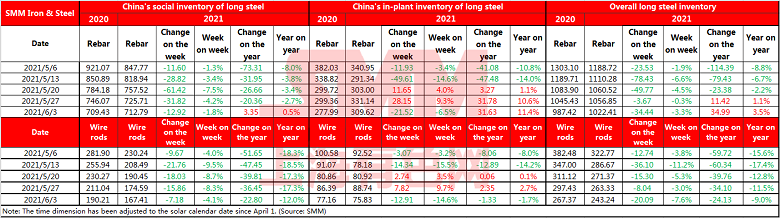
Inventories of rebar across Chinese steelmakers and social warehouses stood at 10.22 million mt as of June 3, down 3.3% from a week ago. Stocks are down 3.5% from a year earlier.
After prices stopped falling and stabilised, not only did downstream transactions pick up slightly, but merchants also created a demand for bargain hunting. Market arrivals increased at the end of last week, and in-plant stocks transferred smoothly.
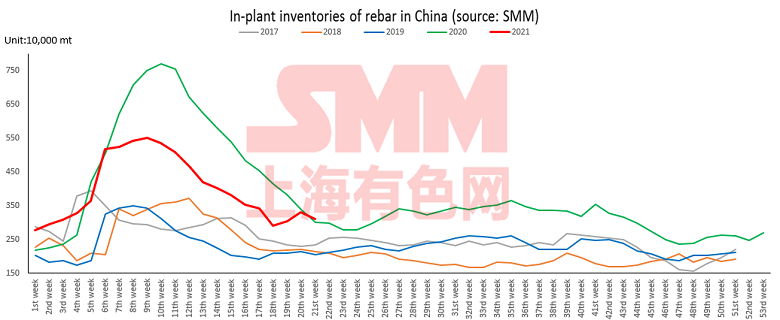
Inventories at Chinese steelmakers fell 215,200 mt on the week and stood at 3.1 million mt. Stocks are down 6.5% from a week ago and up 11.4% from a year earlier.
Although there was a short-term rebound in market transactions this week, the actual transactions were average, the trend rebound was insufficient, and the signs of seasonal weakening of real demand were obvious. It is expected that the high volume of transactions will not continue.
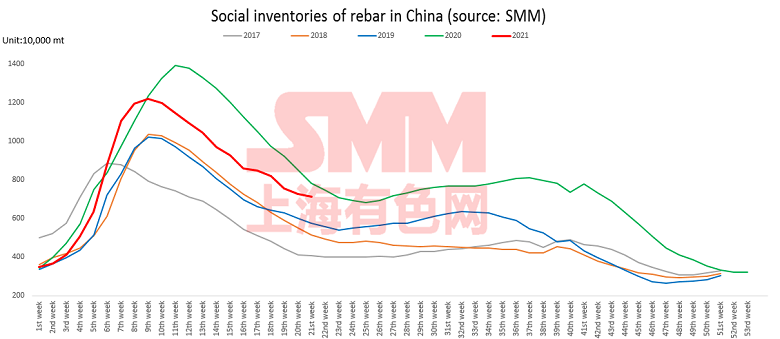
Inventories at social warehouses fell 129,200 mt on the week and stood at 7.13 million mt, down 1.8% from a week ago and 0.5% higher from a year ago. The year-on-year increase expanded 3.2 percentage points from the previous week.
In the case of a stable overseas market, the current policy administrative intervention has weakened. The market logic returns to industry fundamentals. Judging from the inventory situation, the overall inventory reduction trend remains unchanged, while the decline gradually narrowed.
On the supply side, as steel prices have stabilized in stages, smelters with and without blast furnaces will still maintain a certain profit. June is the traditional peak season for steel companies. Therefore, the overall output in June is more likely to remain high and increase slightly month on month.
On the demand side, due to the early arrival of rain and high temperature weather in the south, demand in some regions has begun to slow down. This can be reflected from the decline in the cement prices and the shipment rate. At the same time, the downstream real estate policy restrictions are gradually improving. The "three red lines" target real estate financing, "purchase restrictions, price limits" and "property tax" target real estate speculation, and "two centralizations of land supply" target land prices. According to the SMM survey, most of the real estate companies are still facing a serious shortage of funds, their ability to pay back is weak, and their acceptance of current steel prices is not high. The short-term price rebounded from a low level, and the rebound in transactions indeed partially improved the current supply and demand situation, while the real situation of rapid weakening of demand should also be monitored.
The fundamentals of both supply and demand will be weak in June, and prices are more likely to fluctuate. The policy disturbance in June will still be the key factor guiding the market trend, and market fluctuations will continue to lead the market trend. The market is expected to fluctuate in June.