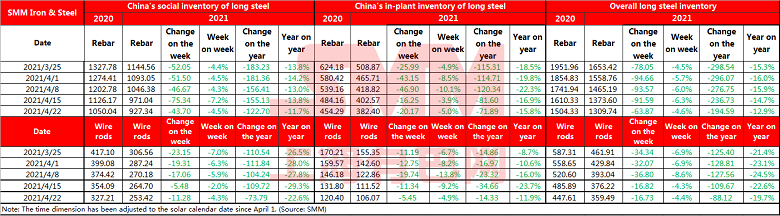
SHANGHAI, Apr 23 (SMM) – The contract and spot market resonated upward. The current national average price of rebar stood at 5046.6 yuan/mt, up 26.5 yuan/mt from last week. At the beginning of the week, the raw material end rose, driving the strong operation of ferrous metals. The frequent news of production restriction in the middle of the week boosted market confidence and kept prices high. Inventories of rebar across Chinese steelmakers and social warehouses stood at 13.1 million mt as of April 22, down 4.6% from a week ago. Stocks are down 12.9% from a year earlier.
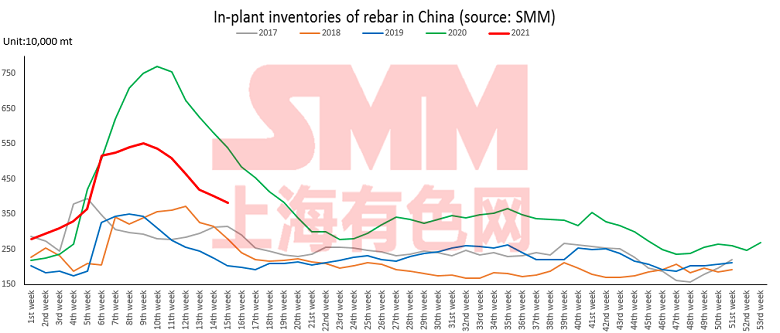
Inventories at Chinese steelmakers fell 201,700 mt on the week and stood at 3.82 million mt. Stocks are down 5% from a week ago and down 15.8% from a year earlier. The year-on-year decrease narrowed 1.1 percentage points from last week.
In-plant stocks posted faster decrease, while the decrease was slightly lower than the same period last year. The main reason was that on the one hand, steel mills had strong production enthusiasm due to high profits. According to SMM research, the actual production of rebar this week increased by 0.73% month on month and 0.95% year on year. Although there is still an increasing trend of production restrictions for environmental protection, the desire to increase production on the supply side has been underestimated at present. On the other hand, near the end of the month, most manufacturers began to shift inventory pressure to the social warehouse, which increased their shipments to the market.
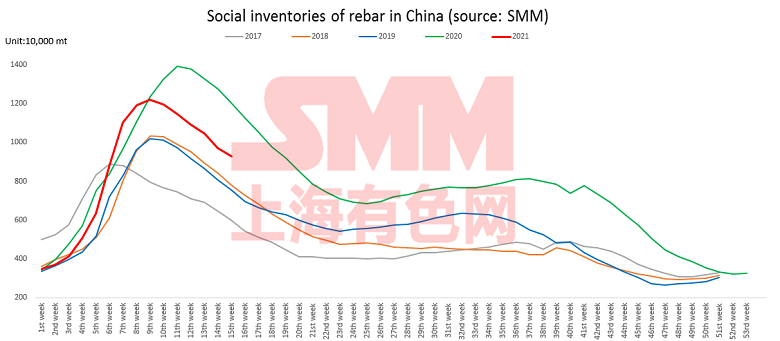
Inventories at social warehouses fell 437,000 mt on the week and stood at 9.27 million mt, down 4.5% from a week ago and 11.7% lower from a year ago. The week-on-week decrease narrowed 2.7 percentage points from the previous week. The year-on-year decrease fell 2.1 percentage points from the previous week.
Social stocks began to post slower decrease as the apparent demand for rebar was in a downward cycle for two consecutive weeks. The apparent demand fell by 4.5% year on year last week, and the decline further expanded to 10.19%. From the perspective of transaction data, the regional differentiation was obvious. North China and East China performed relatively well, while transactions in Central China, South China, and Southwest China were still tepid. Although daily transactions remained high, further breakthroughs were insufficient. Therefore, under high prices, end-user downstream purchased on demand with weak speculative demand, and rigid demand may peak.
The apparent demand posted faster increase for two consecutive weeks. Although rigid demand operated at a high level, it reached the peak in the first half of the year, and it was difficult to support the further acceleration of the decrease in stocks. Despite the continuous news of production restrictions for environmental protection, steel production still has not seen a clear downward trend. The inbound quantity of Tangshan steel billet began to rebound, and prices entered a callback cycle, forming a certain degree of suppression on the contract and spot. As a result, the fundamentals of the rebar have already weakened, and the price increase momentum is insufficient.