Nickel ore export restrictions: Indonesia unlikely to change policy amid development of domestic nickel smelting industry

Đã xuất bản: Jan 18, 2021 17:30 (GMT+8)
The European Union (EU) required the World Trade Organisation (WTO) on January 12 to establish a group to rule on Indonesian nickel ore export restrictions.

SHANGHAI, Jan 18 (SMM) – The European Union (EU) required the World Trade Organisation (WTO) on January 12 to establish a group to rule on Indonesian nickel ore export restrictions. As early as November 2019, the EU filed a complaint to the WTO about Indonesia's restrictions on nickel ore exports. The ruling usually takes at least one year. The European Commission said on January 12 that it will request the WTO to establish a panel to make a ruling.

The European Commission stated on November 25, 2019 that the EU filed a complaint with the WTO over Indonesia's restrictions on the export of nickel and other raw materials. The committee responsible for coordinating EU trade policy, which is composed of 28 countries, said that these restrictions unfairly restricted the entry of EU producers, particularly nickel, scrap metal, coal and coke, iron ore and chromium. The committee also questioned subsidies that encouraged Indonesian producers to use local materials rather than imported materials, which violates WTO rules.

European Trade Commissioner Cecilia Malmstrom stated that the measures taken by Indonesia endangered further operations of the EU steel industry. The European Commission’s statement stated that “despite our joint efforts, Indonesia has taken measures and even announced a new export ban on January 2020.”

Indonesia is the world's largest exporter of nickel ore. At the beginning of 2020, it announced restrictions on exports to stimulate the development of processing enterprises in the country. The WTO complaint started with a 60-day period, and the two parties negotiated to resolve the dispute. The complainant can then request a three-person panel to make a ruling, which usually takes at least one year.

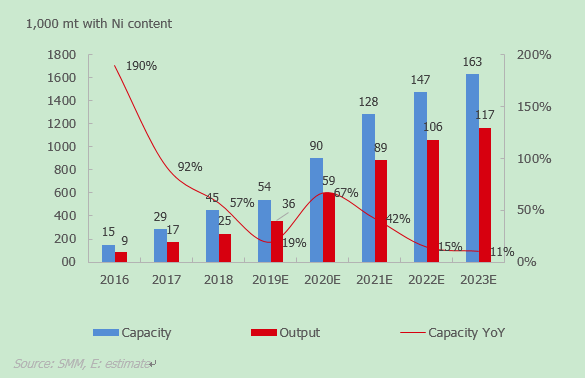
The commissioning of NPI projects in 2020 entered a stage of rapid development. In 2020, Indonesia added 360,000 mt of NPI capacity with Ni content, an increase of 67%. The construction of hydrometallurgical projects related to new energy was also in full swing. Indonesia has banned the export of nickel ore, but did not ban exports of processed products like NPI, stainless steel, and hydrometallurgical products MHP/nickel sulphate. The market believes that Indonesia is unlikely to free up nickel ore exports.

SMM believes that even if the ban on nickel ore exports is lifted, the expansion of its market share in the nickel industry would only slow down. The dominant position of the Indonesian NPI market will continue to stabilise. But for China, tight supply of nickel ore will ease and the impact on Chinese NPI producers from rapid expansion of Indonesian NPI projects will decrease.

Indonesia's NPI capacity and output 2011-2021E
For more information and updates on the China nickel sector, please subscribe to China Nickel Weekly.
Tuyên bố về Nguồn Dữ liệu: Ngoại trừ thông tin công khai, tất cả dữ liệu khác được SMM xử lý dựa trên thông tin công khai, giao tiếp thị trường và dựa trên mô hình cơ sở dữ liệu nội bộ của SMM. Chúng chỉ mang tính chất tham khảo và không cấu thành khuyến nghị ra quyết định.

Để biết thêm thông tin hoặc có thắc mắc gì, vui lòng liên hệ: lemonzhao@smm.cn
Để biết thêm thông tin về cách truy cập báo cáo nghiên cứu, vui lòng liên hệ:service.en@smm.cn
Tin Liên Quan
【Flash | Phụ phí ống chứa molypden tháng 10 của Tubacex biến động trái chiều】
13 giờ trước
【Flash | Phụ phí ống chứa molypden tháng 10 của Tubacex biến động trái chiều】
Đọc thêm
【Flash | Phụ phí ống chứa molypden tháng 10 của Tubacex biến động trái chiều】
Tubacex đã công bố phụ phí hợp kim ống tháng 10. Tính theo euro, thép 316/316L cán nóng/nguội giảm từ €5,07/€5,59 mỗi kg (€5.070/€5.590 mỗi tấn) xuống €5,05/€5,56 mỗi kg (€5.050/€5.560 mỗi tấn). Các loại vật liệu có hàm lượng Mo cao, với Mo trên 2,5%, giảm từ €5,26/€5,79 xuống €5,23/€5,76 mỗi kg. Phụ phí cho 2205 và 2507 không đổi, trong khi 254 SMO tăng từ €9,64/€10,62 lên €9,67/€10,65 mỗi kg. Phân tích của SMM: hầu hết các loại ống chứa Mo đều đi ngang hoặc giảm nhẹ, trong khi 254 SMO tăng, cho thấy sự truyền tải chi phí có sự khác biệt giữa các loại thép.
13 giờ trước
[SMM Tin nhanh Thép không gỉ] Giá phế liệu thép không gỉ Ấn Độ phân hóa khi 304 giảm theo niken và 316 khan hiếm giữ vững
13 giờ trước
[SMM Tin nhanh Thép không gỉ] Giá phế liệu thép không gỉ Ấn Độ phân hóa khi 304 giảm theo niken và 316 khan hiếm giữ vững
Đọc thêm
[SMM Tin nhanh Thép không gỉ] Giá phế liệu thép không gỉ Ấn Độ phân hóa khi 304 giảm theo niken và 316 khan hiếm giữ vững
[SMM Tin nhanh Thép không gỉ] Giá phế liệu thép không gỉ Ấn Độ phân hóa khi 304 giảm theo niken và 316 khan hiếm giữ vững
Thị trường thép phế liệu không gỉ của Ấn Độ diễn biến trái chiều trong tuần kết thúc vào ngày 1 tháng 10. Giá phế liệu 304 nội địa giảm nhẹ và giá chào nhập khẩu cũng theo xu hướng giảm, trong khi giá 316 giữ ổn định ở cả thị trường nội địa và nhập khẩu. Giá niken trên LME suy yếu gây áp lực lên tâm lý đối với 304, và người mua chỉ mua theo nhu cầu trước mắt khi giao dịch chậm lại trong kỳ lễ hội. Nguồn cung khan hiếm đã hạn chế đà giảm của 316. Về thu mua, thời gian xử lý ngắn sau khi chính phủ nới lỏng yêu cầu về Giấy chứng nhận kiểm định trước khi giao hàng (PSIC), cùng với chi phí nhập khẩu tăng thêm, tiếp tục hạn chế sự linh hoạt của các nhà máy. Một số nhà máy đang cân nhắc phôi, tấm slab và gang niken (NPI) như các lựa chọn thay thế phế liệu để quản lý chi phí đầu vào. Nhìn xa hơn, đề xuất của EU về việc hạn chế xuất khẩu phế liệu kim loại sang Ấn Độ theo Quy định vận chuyển chất thải (WSR) mới, nếu được thông qua, sẽ tiếp tục thu hẹp các lựa chọn nhập khẩu phế liệu của Ấn Độ. Trong ngắn hạn, phế liệu 304 chịu áp lực giảm nhẹ nếu niken vẫn yếu, trong khi 316 dự kiến sẽ duy trì ổn định chừng nào nguồn cung còn thắt chặt. Các diễn biến về PSIC và tính kinh tế tương đối của phôi và NPI sẽ là những yếu tố chính cần theo dõi.
13 giờ trước
【Tin nhanh | Metallus tăng phụ phí molypden tháng 10 cho thép 300M】
13 giờ trước
【Tin nhanh | Metallus tăng phụ phí molypden tháng 10 cho thép 300M】
Đọc thêm
【Tin nhanh | Metallus tăng phụ phí molypden tháng 10 cho thép 300M】
Metallus công bố phụ phí nguyên liệu thô tháng 10 áp dụng từ ngày 1–30/10. Thành phần Mo cho thép 300M tăng 0,52% lên 15,176 USD/cwt, tương đương khoảng 334,57 USD/tấn thép, từ mức 15,098 USD/cwt, tức 332,85 USD/tấn. Tổng phụ phí niêm yết tăng 1,03% lên 45,054 USD/cwt. Phế liệu tăng lên 17,750 USD/cwt, trong khi phụ phí năng lượng riêng cho thép thanh và thép ống giảm từ 1,296 USD/cwt, khoảng 28,57 USD/tấn, xuống còn 0,050 USD/cwt, tức 1,10 USD/tấn.
13 giờ trước